七年级上册Unit1教案如何设计更高效?
校园之窗 2025年12月12日 09:38:23 99ANYc3cd6
七年级上册 Unit 1 教案设计
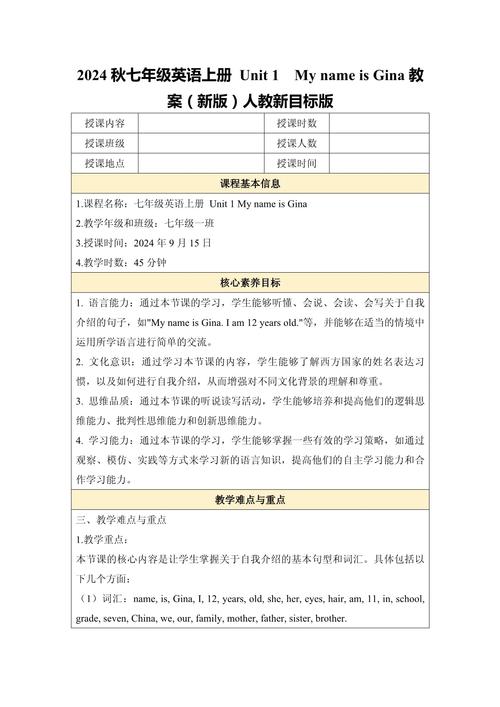
Unit 1: My name's Gina. (我的名字是吉娜。)
教学基本信息
- 课题: Unit 1 My name's Gina.
- 授课年级: 七年级上册
- 课时: 第1课时 (Section A 1a-2c)
- 课型: 新授课
- 授课教师: [教师姓名]
- 授课日期: [授课日期]
教学目标
根据课程标准和学生实际情况,设定以下三维目标:

-
知识与技能目标:
- 词汇: 能听、说、读、写核心词汇:
name,is,am,are,hello,hi,good,morning,afternoon,evening,nice,to,meet,you,what,your,I'm,he,she,it,his,her,yes,no,not。 - 句型:
- 能熟练运用问候语及其回答:
Hello! / Hi!Good morning! / Good afternoon! / Good evening!— How are you? — I'm fine, thanks. And you? — I'm OK.
- 能熟练运用自我介绍和询问姓名的核心句型:
— What's your name? — My name's... / I'm...— I'm... / My name's... — Nice to meet you. — Nice to meet you, too.
- 能熟练运用问候语及其回答:
- 语法: 初步掌握be动词
am,is,are在第一、第二、第三人称单数和复数中的基本用法。 - 听: 能听懂简单的自我介绍和问候对话。
- 说: 能在真实或模拟的情境中,运用所学句型进行自我介绍和问候他人。
- 读: 能认读所学单词和核心句型。
- 写: 能正确拼写核心单词,并写出简单的自我介绍句子。
- 词汇: 能听、说、读、写核心词汇:
-
过程与方法目标:
- 通过情景创设、小组合作、角色扮演等活动,引导学生在“做中学”,体验语言的实际运用。
- 培养学生通过观察、模仿和实践来学习语言的能力。
- 鼓励学生积极参与课堂互动,大胆开口说英语。
-
情感态度与价值观目标:
- 培养学生乐于与人交流、友好相处的良好品质。
- 帮助学生建立学习英语的自信心和兴趣,体验用英语进行简单交际的成就感。
- 了解中西方在初次见面时的基本礼仪差异。
教学重难点
-
教学重点:
 (图片来源网络,侵删)
- 核心句型
— What's your name? — My name's... / I'm...的掌握和运用。 - 问候语
Hello! / Hi!和Nice to meet you.的正确使用。
- 核心句型
-
教学难点:
am,is,are的区别与正确使用(I与am搭配,he/she/it与is搭配,you/they/we与are搭配)。What's是What is的缩写形式,发音和拼写。- 在实际交际中,自然、流畅地运用所学句型进行对话。
教学准备
- 教师准备: 多媒体课件、单词卡片、录音机或音频播放设备、白板或黑板。
- 学生准备: 课本、练习本、笔。
教学过程
(一) Warming-up & Lead-in (热身与导入) (约5分钟)
-
Greeting (问候):
- Teacher (T): (Smiling and waving) Hello, everyone!
- Students (Ss): (Responding) Hello, teacher!
- T: Good morning / afternoon, class!
- Ss: Good morning / afternoon, teacher!
- 设计意图:用最简单的问候语开始课堂,营造轻松的英语氛围,自然地引出本课主题。
-
Song & Video (歌曲导入):
 (图片来源网络,侵删)
- 播放一首简单的英文问候歌曲,如 "Hello, Hello"。
- T: Let's listen to a song. Please try to sing after it.
- 播放完毕后,T: Do you know what "Hello" means? Yes, it's 你好! Today, we are going to learn how to greet people and ask for names. (板书课题: Unit 1 My name's Gina.)
- 设计意图:通过活泼的歌曲激发学生兴趣,直观地呈现核心词汇 "hello",并点明本课学习目标。
(二) Presentation (新知呈现) (约15分钟)
-
Learn New Words (学习新单词):
- 利用PPT或单词卡片,逐一呈现
name,I'm,your,his,her,what,is等单词。 - 采用“音、形、义”结合的方式教学:
- 发音: 教师领读,学生跟读,注意纠正发音。
- 词义: 结合图片、动作或简笔画解释词义,指着学生说 "You",然后指着男生说 "he",指着女生说 "she"。
- 拼写: 在黑板上板书重点单词,让学生观察并记忆。
- 利用PPT或单词卡片,逐一呈现
-
Present Key Sentences (呈现核心句型):
-
句型1: Self-introduction (自我介绍)
- T: (Pointing to myself) My name is [Teacher's Name]. You can call me Miss/Mr. [Last Name]. I'm [Teacher's Name]. (板书:
My name's.../I'm...) - T: Now, look at me. I'm smiling. I'm happy to meet you. (做出微笑和友好的手势)
Nice to meet you.(板书) - T: And you should say...? (引导学生回答)
Nice to meet you, too.(板书) - 设计意图:教师亲身示范,让学生在真实的语境中理解句子的含义和用法。
- T: (Pointing to myself) My name is [Teacher's Name]. You can call me Miss/Mr. [Last Name]. I'm [Teacher's Name]. (板书:
-
句型2: Asking for a name (询问姓名)
- T: (走到一个学生面前,微笑着) I know my name. But what's your name? (板书:
— What's your name?) - T: (引导学生回答)
— My name's... / I'm... - 进行2-3组师生问答示范。
- 突破难点: 强调
What's是What is的缩写,在黑板上写出What is和What's,并解释缩写规则,通过I am->I'm的例子,帮助学生理解缩写形式。 - 设计意图:通过师生互动,自然引出询问姓名的句型,并重点讲解缩写形式这一难点。
- T: (走到一个学生面前,微笑着) I know my name. But what's your name? (板书:
-
(三) Practice (练习) (约15分钟)
-
Listening Practice 1 (听力练习 1):
- Activity 1a (课本):
- T: Open your books to page 1. Look at the picture in 1a. Listen to the recording and number the pictures. (播放录音)
- Ss listen and number.
- Check the answers together. (Ask: "What are they doing in Picture 1? They are saying hello.")
- Activity 1b (课本):
- T: Now, listen again. Circle the names you hear in the conversation. (播放录音)
- Ss listen and circle.
- Check the answers. (Ask: "What's the boy's name? What's the girl's name?")
- 设计意图:从输入开始,让学生通过听力活动巩固新单词和句型,培养抓取关键信息的能力。
- Activity 1a (课本):
-
Pair Work (结对练习):
- Activity 1c (课本):
- T: Now, work in pairs. Practice the conversation in 1b. You can use your own name.
- 教师先与一名学生做示范:
- T: Hi, I'm [Teacher's Name]. What's your name?
- S1: My name's [Student's Name]. Nice to meet you.
- T: Nice to meet you, too.
- Ss work in pairs, practicing the dialogue. T walks around the classroom, offering help and correcting pronunciation.
- Ask a few pairs to perform in front of the class.
- 设计意图:通过结对活动,让学生在半控制的情境中操练核心句型,实现从“听懂”到“会说”的过渡。
- Activity 1c (课本):
-
Game: "Find Your Partner" (游戏:寻找伙伴):
- T: Let's play a game. I will give each of you a name card (e.g., Alan, Jenny, Cindy, Bob, Mary). Walk around the classroom and find your partner. When you find someone, you must ask "What's your name?" and greet them.
- Ss walk around and practice. The goal is to find the person whose name card matches their partner's (e.g., "Nice to meet you, Alan." "Nice to meet you, too, Cindy.").
- 设计意图:通过游戏化的方式,让学生在轻松愉快的氛围中反复练习,增加趣味性和参与度。
(四) Production (产出与应用) (约7分钟)
-
Activity 2a & 2b (课本):
- T: Turn to page 2. Look at the picture in 2a. These are new students. Listen to the recording and write down their names. (播放录音)
- Ss listen and write the names (Gina, Peter, Mary, Bob).
- T: Now, listen again. Fill in the blanks in 2b. (播放录音)
- Ss fill in the blanks with
isorare. - Check the answers. Use this chance to explain the basic usage of
am,is,are:I->amHe/She/It(a single person/thing) ->isYou/We/They(more than one person) ->are
- 设计意图:在应用中巩固be动词的用法,将语法知识融入具体的语境中,帮助学生理解。
-
Make a New Dialogue (创编新对话):
- T: Imagine you are a new student. Make a short dialogue with your partner. You can use these sentences: (在PPT上展示句型框架)
- A: Hello! / Good morning!
- B: Hello! / Good morning!
- A: My name is... / I'm...
- B: Nice to meet you.
- A: Nice to meet you, too.
- B: What's your name?
- A: My name is... / I'm...
- Ss work in pairs to create their own dialogues.
- Invite 2-3 pairs to show their dialogues.
- 设计意图:从控制性练习过渡到半开放性练习,鼓励学生创造性地运用语言,培养综合语言运用能力。
- T: Imagine you are a new student. Make a short dialogue with your partner. You can use these sentences: (在PPT上展示句型框架)
(五) Summary & Homework (总结与作业) (约3分钟)
-
Summary (课堂总结):
- T: Today we have learned how to greet people and ask for names. Let's review what we've learned. (指着黑板上的重点句型)
- T: What have we learned today? (引导学生一起回顾核心词汇和句型)
- T: Great job! Remember, practice makes perfect. Speak English every day!
-
Homework (布置作业):
- 基础作业:
- Listen and repeat the new words and conversations after the tape for 15 minutes.
- Copy the new words and key sentences three times.
- 拓展作业 (选做):
- Introduce yourself to at least three people (family members, friends) in English today.
- Write a short paragraph to introduce yourself. ( Hello, my name is... I'm a student. I'm 12 years old. Nice to meet you.)
- 设计意图:分层作业设计,既巩固了基础知识,又为学有余力的学生提供了拓展空间,并将课堂学习延伸到课外生活。
- 基础作业:
板书设计
一个清晰、有条理的板书有助于学生构建知识框架。
| Unit 1 My name's Gina. |
|---|
| Greetings (问候语) |
| Hello! / Hi! |
| Good morning! / Good afternoon! / Good evening! |
| Key Sentences (核心句型) |
| Self-introduction (自我介绍) |
| My name's... / I'm... |
| Asking for a name (询问姓名) |
| — What's your name? |
| — My name's... / I'm... |
| Response (回应) |
| Nice to meet you. |
| Nice to meet you, too. |
| Grammar (语法) |
| I am = I'm |
| he is = he's |
| she is = she's |
| it is = it's |
| Be Verbs (be动词) |
| I → am |
| He/She/It → is |
| You/We/They → are |
教学反思
本节课的设计力求以学生为中心,通过多样化的活动激发学生的学习兴趣,在实际教学中,需要注意以下几点:
- 关注个体差异: 在结对活动和角色扮演时,要特别关注那些性格内向或基础稍弱的学生,多给予鼓励和指导,帮助他们开口说英语。
- 控制课堂节奏: 七年级学生活泼好动,容易兴奋,教师需要把握好课堂节奏,确保每个环节都能有效完成,避免因过度活跃而影响教学目标的达成。
- 及时反馈与评价: 对学生的每一个回答和表演都应给予及时、积极的反馈,多用 "Good job!", "Excellent!", "Well done!" 等鼓励性语言,保护学生的学习热情。
- 灵活调整: 根据学生的实际反应,可以灵活调整教学内容和时间,如果学生对某个游戏特别感兴趣,可以适当延长游戏时间;如果某个知识点掌握有困难,可以增加练习和讲解的时间。