七下英语单元知识点有哪些重点难点?
校园之窗 2025年12月14日 11:33:00 99ANYc3cd6
总体特点
七年级下册英语的核心内容围绕 “一般过去时” 和 “情态动词 can” 展开,同时引入了更多的方位介词和日常活动表达,旨在帮助学生描述过去发生的事情和谈论能力与许可。
Unit 1: Can you play the guitar? (你会弹吉他吗?)
核心词汇
- 乐器类:
- guitar /ɡɪˈtɑːr/ n. 吉他
- piano /piˈænoʊ/ n. 钢琴
- violin /ˌvaɪəˈlɪn/ n. 小提琴
- drums /drʌmz/ n. 鼓 (复数)
- trumpet /ˈtrʌmpɪt/ n. 喇叭,小号
- erhu /ˈɜːrhuː/ n. 二胡
- 能力类:
- sing /sɪŋ/ v. 唱歌
- dance /dæns/ v. 跳舞
- draw /drɔː/ v. 画
- speak /spiːk/ v. 说,讲
- join /dʒɔɪn/ v. 加入,参加
- 其他:
- tell /tel/ v. 讲述,告诉
- story /ˈstɔːri/ n. 故事
- write /raɪt/ v. 写,写作
- show /ʃoʊ/ v. 展示,给...看
- or /ɔːr/ conj. 或者
- talk /tɔːk/ v. 谈话,谈论
- kung fu /ˌkʌŋ ˈfuː/ n. (中国)功夫
核心句型
- 询问能力:
- — Can you swim? (你会游泳吗?)
- — Yes, I can. / No, I can't. (是的,我会。/ 不,我不会。)
- — Can he play chess? (他会下棋吗?)
- — Yes, he can. / No, he can't. (是的,他会。/ 不,他不会。)
- 谈论加入社团:
- — Can you join our music club? (你能加入我们的音乐俱乐部吗?)
- — I can sing and dance. (我会唱歌和跳舞。)
- — What club do you want to join? (你想加入什么俱乐部?)
- — I want to join the art club. (我想加入美术俱乐部。)
- 自我介绍/介绍他人:
- I can play the piano. (我会弹钢琴。)
- She tells stories well. (她很会讲故事。)
- Let's join the basketball club! (让我们加入篮球俱乐部吧!)
主要语法点
- 情态动词 Can 的用法:
- 构成:
can + 动词原形 - 用法1: 表示能力,意为“会,能”。
I can speak a little English. (我会说一点英语。)
- 用法2: 表示请求或许可,意为“可以,能”。
Can I use your pen? (我能用一下你的笔吗?)
 (图片来源网络,侵删)
 - 用法3: 在疑问句和否定句中,
can没有人称和数的变化。- He can swim. (他会游泳。)
- Can he swim? (他会游泳吗?)
- He can't swim. (他不会游泳。)
- 构成:
- play + 乐器:
- 当乐器前有定冠词
the时,表示“演奏该乐器”。play the guitar (弹吉他), play the piano (弹钢琴)
- 当乐器前有定冠词
- play + 球类/棋类:
- 当球类或棋类名词前没有冠词时,表示“打/踢/下...”。
play basketball (打篮球), play chess (下棋), soccer (踢足球)
- 当球类或棋类名词前没有冠词时,表示“打/踢/下...”。
Unit 2: What time do you go to school? (你几点去上学?)
核心词汇
- 时间类:
- time /taɪm/ n. 时间
- morning /ˈmɔːrnɪŋ/ n. 早晨,上午
- afternoon /ˌæftərˈnuːn/ n. 下午
- evening /ˈiːvnɪŋ/ n. 晚上,傍晚
- night /naɪt/ n. 夜,夜晚
- hour /ˈaʊər/ n. 小时
- minute /ˈmɪnɪt/ n. 分钟
- 日常活动:
- go to school (去上学)
- get up (起床)
- run (跑步)
- eat breakfast (吃早饭)
- take a walk (散步)
- go home (回家)
- do homework (做作业)
- clean (打扫)
- work (工作)
- job /dʒɒb/ n. 工作
- exercise /ˈeksərsaɪz/ v. 锻炼;n. 锻炼
- best /best/ adj. & adv. 最好的(地)
- 其他:
o'clock /əˈklɒk/ adv. ...点钟
 (图片来源网络,侵删)
核心句型
- 询问时间:
- — What time is it? / What's the time? (现在几点了?)
- — It's seven o'clock. (七点了。)
- 询问日常活动时间:
- — What time do you usually get up? (你通常几点起床?)
- — I usually get up at six thirty. (我通常六点半起床。)
- — What time does he go to work? (他几点去上班?)
- — He goes to work at eight. (他八点去上班。)
- 描述日常作息:
- I brush my teeth in the morning. (我早上刷牙。)
- She eats dinner at 7:00 PM. (她晚上7点吃晚饭。)
主要语法点
- what time 与 when 的区别:
- what time: 询问具体的时间点(几点几分),回答通常是
at + 时间点。- — What time do you go to bed? (你几点睡觉?)
- — I go to bed at 10:00. (我10点睡。)
- when: 询问“什么时候”,可以指具体时间,也可以指一天中的某个时段(上午/下午/晚上)或年份/月份/季节。
- — When do you go to school? (你什么时候去上学?)
- — I go to school in the morning. (我早上上学。)
- — When is your birthday? (你生日是什么时候?)
- what time: 询问具体的时间点(几点几分),回答通常是
- 一般现在时 (Simple Present Tense) - 第三人称单数:
- 构成: 主语 (第三人称单数) + 动词-s/-es
- 用法: 描述习惯性、经常性的动作或客观事实。
- 规则:
- 一般情况加
-s(e.g.,go→goes,run→runs) - 以 s, x, ch, sh, o 加
-es(e.g.,watch→watches,do→does) - 以“辅音字母+y”变 y 为 i,再加
-es(e.g.,study→studies)
- 一般情况加
- 否定句和疑问句: 借助助动词
does(does not = doesn't)。- He doesn't like milk. (他不喜欢牛奶。)
- Does he like milk? (他喜欢牛奶吗?)
Unit 3: How do you get to school? (你怎么去上学?)
核心词汇
- 交通方式:
- how /haʊ/ adv. 怎样,如何
- get to (到达)
- subway /ˈsʌbweɪ/ n. 地铁
- train /treɪn/ n. 火车
- bus /bʌs/ n. 公共汽车
- bike /baɪk/ n. 自行车
- car /kɑːr/ n. 小汽车
- walk /wɔːk/ v. & n. 走路,步行
- ride /raɪd/ v. 骑 (马、自行车等)
- minute /ˈmɪnɪt/ n. 分钟
- kilometer /ˈkɪləmiːtər/ n. 千米,公里
- far /fɑːr/ adj. 远的
- transportation /ˌtrænspɔːrˈteɪʃn/ n. 运输,交通
- 距离:
- distance /ˈdɪstəns/ n. 距离
- stop /stɒp/ n. 车站
- 其他:
- village /ˈvɪlɪdʒ/ n. 村庄
- student /ˈstuːdnt/ n. 学生
- dream /driːm/ n. 梦想
- true /truː/ adj. 真实的
核心句型
- 询问交通方式:
- — How do you get to school? (你怎么去上学?)
- — I ride my bike. / I take the bus. (我骑自行车。/ 我坐公交车。)
- — How does he get to work? (他怎么去上班?)
- — He takes the subway. (他坐地铁。)
- 询问距离和花费时间:
- — How far is it from your home to school? (从你家到学校有多远?)
- — It's about three kilometers. (大约三公里。)
- — How long does it take? (要花多长时间?)
- — It takes about 20 minutes. (大约20分钟。)
主要语法点
- how 引导的特殊疑问句:
- How do/does + 主语 + get to + 地点? (询问去某地的交通方式)
- How far + be + it from... to...? (询问两地间的距离)
- How long + does it take + (for sb) + to do sth? (询问做某事花费多长时间)
- 动词短语:
take + a/the + 交通工具表示“乘坐某种交通工具”。take the bus (乘公交车), take the train (坐火车), take a taxi (打出租车)
ride + a/the + 交通工具表示“骑某种交通工具”。ride a bike (骑自行车), ride a horse (骑马)
walk to + 地点=go to + 地点 + on foot(步行去某地)
- It takes (sb) some time to do sth.
- 这是一个固定句型,意为“(某人)花费多长时间做某事”。
It takes me 10 minutes to get to school. (我花10分钟到学校。)
- 这是一个固定句型,意为“(某人)花费多长时间做某事”。
Unit 4: Don't eat in class. (不要在课堂上吃东西。)
核心词汇
- 规则类:
- rule /ruːl/ n. 规则
- hallway /ˈhɔːlweɪ/ n. 走廊
- dining hall /ˈdaɪnɪŋ hɔːl/ n. 食堂
- gym /dʒɪm/ n. 体育馆
- outside /ˌaʊtˈsaɪd/ adv. & prep. 在外面
- inside /ˌɪnˈsaɪd/ adv. & prep. 在里面
- fight /faɪt/ v. & n. 打架,争吵
- 动词短语:
- arrive at/in (到达)
- listen to (听)
- fight with (与...打架)
- wear /wer/ v. 穿,戴
- be quiet (保持安静)
- go out (外出)
- practice /ˈpræktɪs/ v. 练习
- 形容词:
- strict /strɪkt/ adj. 严格的
- follow /ˈfoʊloʊ/ v. 遵守
- follow the rules (遵守规则)
- remember /rɪˈmembər/ v. 记住
- lucky /ˈlʌki/ adj. 幸运的
- sorry /ˈsɔːri/ adj. 抱歉的,难过的
- be sorry for (为...感到抱歉)
核心句型
- 祈使句:
- 肯定祈使句:
动词原形 + 其他.- Be quiet! (安静!)
- Listen to the teacher. (听老师讲课。)
- 否定祈使句:
Don't + 动词原形 + 其他.- Don't eat in class. (不要在课堂上吃东西。)
- Don't run in the hallways. (不要在走廊里跑。)
- 肯定祈使句:
- 谈论规则:
- — What are the rules? (有哪些规则?)
- — We must be on time for class. (我们必须准时上课。)
- — Can we eat in the classroom? (我们能在教室里吃东西吗?)
- — No, we can't. / No, we mustn't. (不,我们不能。/ 不,我们绝对不能。)
- 描述规则和要求:
- You have to wear the school uniform. (你必须穿校服。)
- Students can't listen to music in the hallways. (学生们不能在走廊里听音乐。)
主要语法点
- 祈使句:
- 用于表达命令、请求、建议、警告等。
- 否定形式是在句首加
Don't。
- 情态动词 must / have to 的用法:
- must: 表示“必须,一定要”,强调主观看法,否定形式是
mustn't(禁止,千万别)。- You must finish your homework. (你必须完成作业。)
- You mustn't be late. (你千万别迟到。)
- have to: 表示“不得不”,强调客观需要,有人称和数的变化,否定形式是
don't/doesn't have to(不必)。- I have to get up early. (我不得不早起。)
- He doesn't have to wear a uniform. (他不必穿校服。)
- must: 表示“必须,一定要”,强调主观看法,否定形式是
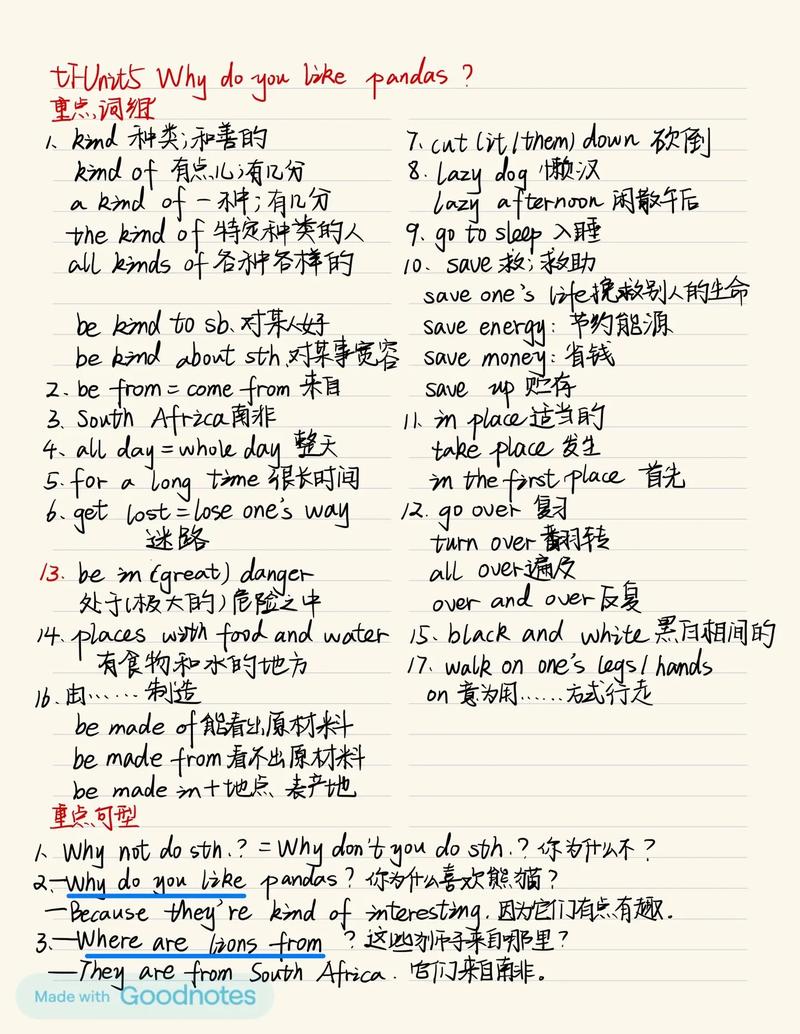
Unit 5: Why do you like pandas? (你为什么喜欢熊猫?)
核心词汇
- 动物类:
- panda /ˈpændə/ n. 熊猫
- tiger /ˈtaɪɡər/ n. 老虎
- elephant /ˈelɪfənt/ n. 大象
- koala /koʊˈɑːlə/ n. 考拉,树袋熊
- lion /ˈlaɪən/ n. 狮子
- giraffe /dʒəˈræf/ n. 长颈鹿
- animal /ˈænɪml/ n. 动物
- zoo /zuː/ n. 动物园
- kind /kaɪnd/ n. 种类
- all kinds of (各种各样的)
- pet /pet/ n. 宠物
- 描述性形容词:
- cute /kjuːt/ adj. 可爱的
- smart /smɑːrt/ adj. 聪明的
- beautiful /ˈbjuːtɪfl/ adj. 美丽的
- friendly /ˈfrendli/ adj. 友好的
- shy /ʃaɪ/ adj. 害羞的
- scary /ˈskeri/ adj. 吓人的
- lazy /ˈleɪzi/ adj. 懒惰的
- difficult /ˈdɪfɪkəlt/ adj. 困难的
- interesting /ˈɪntrəstɪŋ/ adj. 有趣的
- 其他:
- save /seɪv/ v. 拯救,挽救
- flag /flæɡ/ n. 旗帜 *. get lost (迷路)
- symbol /ˈsɪmbl/ n. 象征,符号 *. forget /fərˈɡet/ v. 忘记
核心句型
- 询问喜好及原因:
- — Why do you like pandas? (你为什么喜欢熊猫?)
- — Because they're cute. (因为它们很可爱。)
- — Why does John like koalas? (约翰为什么喜欢考拉?)
- — Because they're interesting. (因为它们很有趣。)
- 描述动物特征:
- Pandas are from China. (熊猫来自中国。)
- Lions are kind of scary. (狮子有点吓人。)
- Elephants are very friendly. (大象非常友好。)
- 表达观点:
- I like dogs because they are loyal. (我喜欢狗,因为它们很忠诚。)
- Let's see the pandas first. (我们先去看熊猫吧。)
主要语法点
- Why 引导的特殊疑问句:
- Why + do/does + 主语 + 动词原形 + ...? (询问做某事的原因)
- 回答:
Because + 句子.(因为...)
- 形容词的用法:
- 形容词在句中常作表语或定语。
- 作表语: The panda is cute. (熊猫是可爱的。)
- 作定语: I like cute animals. (我喜欢可爱的动物。)
- 形容词在句中常作表语或定语。
- kind of:
- 意为“有点儿,稍微”,用来修饰形容词或副词。
The tiger is kind of scary. (那只老虎有点吓人。)
- 意为“有点儿,稍微”,用来修饰形容词或副词。
- let's...:
Let's = Let us,意为“让我们...”,是提出建议的常用句型。Let's go to the zoo. (我们去动物园吧。)
Unit 6: I'm watching TV. (我正在看电视。)
核心词汇
- 日常活动:
- watch /wɒtʃ/ v. 观看
- TV /ˌtiː ˈviː/ n. 电视
- newspaper /ˈnuːzpeɪpər/ n. 报纸 . read /riːd/ v. 阅读 . soup /suːp/ n. 汤 . wash /wɒʃ/ v. 洗 . movie /ˈmuːvi/ n. 电影 *. just /dʒʌst/ adv. 正在,恰好
- 地点: . pool /puːl/ n. 游泳池 . supermarket /ˈsuːpərmɑːrkɪt/ n. 超市 . man /mæn/ n. 男人 (复数 men) . woman /ˈwʊmən/ n. 女人 (复数 women) *. host /hoʊst/ n. 主人
- 现在进行时标志词: . now /naʊ/ adv. . look /lʊk/ adv. 看 (用作提示) *. listen /ˈlɪsn/ adv. 听 (用作提示)
核心句型
- 描述正在发生的动作:
- — What are you doing? (你正在做什么?)
- — I'm watching TV. (我正在看电视。)
- — Is he reading a newspaper? (他正在读报纸吗?)
- — Yes, he is. / No, he isn't. (是的,他是。/ 不,他不是。)
- 打电话用语:
- — Hello! This is... (喂!我是...)
- — Hello! This is... Can I speak to...? (喂!我是...我能找...吗?)
- — Hold on, please. (请稍等。)
- — Sorry, he's not here right now. (抱歉,他现在不在这里。)
主要语法点
- 现在进行时:
- 构成:
am/is/are + 动词的-ing形式 - 用法: 表示说话时正在进行的动作或现阶段正在发生的动作。
- 现在分词的构成规则:
- 一般情况直接加
-ing(e.g.,do→doing,watch→watching) - 以不发音的
e去e加-ing(e.g.,write→writing,make→making) - 以重读闭音节结尾,且末尾只有一个辅音字母,双写该辅音字母再加
-ing(e.g.,sit→sitting,run→running) - 以
ie变ie为y再加-ing(e.g.,lie→lying,die→dying)
- 一般情况直接加
- 构成:
- 现在进行时的句型结构:
- 肯定句:
主语 + am/is/are + V-ing + ...I am doing my homework. (我正在做作业。)
- 否定句:
主语 + am/is/are + not + V-ing + ...She isn't sleeping. (她没在睡觉。)
- 一般疑问句:
Am/Is/Are + 主语 + V-ing + ...?Are they playing basketball? (他们正在打篮球吗?)
- 特殊疑问句:
特殊疑问词 + am/is/are + 主语 + V-ing + ...?What is he doing? (他正在做什么?)
- 肯定句:
Unit 7: It's raining! (天在下雨!)
核心词汇
- 天气类:
- weather /ˈweðər/ n. 天气 . sunny /ˈsʌni/ adj. 晴朗的 . cloudy /ˈklaʊdi/ adj. 多云的 . rainy /ˈreɪni/ adj. 下雨的 . snowy /ˈsnoʊi/ adj. 下雪的 . windy /ˈwɪndi/ adj. 有风的 . hot /hɒt/ adj. 炎热的 . cool /kuːl/ adj. 凉爽的 . warm /wɔːrm/ adj. 温暖的 *. cold /koʊld/ adj. 寒冷的
- 活动类: . cook /kʊk/ v. 烹饪 . study /ˈstʌdi/ v. 学习 . relax /rɪˈlæks/ v. 放松,休息 . watch TV (看电视) . read a book (看书) . talk on the phone (打电话) . take a message (捎个口信) . have a great time (玩得开心)
- 其他: . park /pɑːrk/ n. 公园 . beach /biːtʃ/ n. 海滩 . Canada /ˈkænədə/ n. 加拿大 . Russian /ˈrʌʃn/ adj. 俄罗斯的;n. 俄语 . Spain /speɪn/ n. 西班牙 . situation /ˌsɪtʃuˈeɪʃn/ n. 情况,形势
核心句型
- 描述天气:
- — How's the weather? / What's the weather like? (天气怎么样?)
- — It's sunny/rainy/windy. (天晴/下雨/刮风。)
- — It's raining. / It's snowing. (天在下雨/下雪。)
- 描述某地正在发生的事情:
- — What are they doing? (他们正在做什么?)
- — They're playing basketball. (他们正在打篮球。)
- — How's it going? (情况怎么样?)
- — Great! / Not bad. / Terrible! (很好!/ 还不错。/ 糟透了!)
主要语法点
- How's the weather? / What's the weather like?
- 两者都用来询问天气,
How's the weather?更口语化。
- 两者都用来询问天气,
- It's + 天气形容词.
It在这里是无人称主语,指代天气。It's hot today. (今天很热。)
- It's + V-ing.
- 描述天气状况正在发生。
It's raining heavily. (雨下得很大。)
- 描述天气状况正在发生。
- 现在进行时的扩展应用:
- 不仅可以描述人正在做的事,也可以描述某个地方正在发生的情景。
Look! The children are playing happily in the park. (看!孩子们正在公园里开心地玩耍。)
- 不仅可以描述人正在做的事,也可以描述某个地方正在发生的情景。
Unit 8: Is there a post office near here? (这附近有邮局吗?)
核心词汇
- 地点名词: . post office /ˈpoʊst ɒfɪs/ n. 邮局 . police station /pəˈliːs ˈsteɪʃn/ n. 警察局 . hospital /ˈhɒspɪtl/ n. 医院 . hotel /hoʊˈtel/ n. 饭店,酒店 . restaurant /ˈrestrɒnt/ n. 饭馆,餐厅 . bank /bæŋk/ n. 银行 . library /ˈlaɪbreri/ n. 图书馆 . bookstore /ˈbʊkstɔːr/ n. 书店 . supermarket /ˈsuːpərmɑːrkɪt/ n. 超市 . street /striːt/ n. 大街 . pay phone /peɪ foʊn/ n. 投币式公用电话 . park /pɑːrk/ n. 公园 . bridge /brɪdʒ/ n. 桥 . avenue /ˈævənuː/ n. 大街,林荫道
- 方位介词: . near /nɪr/ prep. 在...附近 . next to /nekst tuː/ 紧挨着,在...旁边 . across from /əˈkrɒs frəm/ 在...对面 . behind /bɪˈhaɪnd/ 在...后面 . in front of /ɪn frʌnt əv/ 在...前面 (注意:指外部的前面) . between...and... (在...和...之间)
- 其他: . enjoy /ɪnˈdʒɔɪ/ v. 欣赏,享受 . trip /trɪp/ n. 旅行,旅程 . quick /kwɪk/ adj. 快的,迅速的 . right /raɪt/ adv. & n. 右边;正确的 . left /left/ adv. & n. 左边 . turn /tɜːrn/ v. 转弯 *. down /daʊn/ adv. 向下
核心句型
- 询问地点:
- — Is there a hospital near here? (这附近有医院吗?)
- — Yes, there is. / No, there isn't. (是的,有。/ 不,没有。)
- — Where is the post office? (邮局在哪里?)
- — It's behind the library. (它在图书馆后面。)
- 指路:
- — Excuse me, is there a bank around here? (打扰一下,这附近有银行吗?)
- — Yes, there is one on Bridge Street. (是的,在桥大街有一家。)
- — How can I get to the supermarket? (我怎么去超市?)
- — Go straight and turn left. (直走然后左转。)
主要语法点
- There be 句型:
- 含义: “存在”,表示“某个地方有某人或某物”。
- 构成:
There be + (名词) + (地点状语) - be动词的选择:
There is + 单数名词/不可数名词 + ...(There is a book on the desk.)There are + 复数名词 + ...(There are some students in the classroom.)
- 句型转换:
- 否定句:
There be + not + (名词) + ...(There isn't a pen.) - 一般疑问句:
Be there + (名词) + ...?(Is there a pen?) - 回答:
Yes, there is. / No, there isn't.或Yes, there are. / No, there aren't.
- 否定句:
- 方位介词短语:
- 这是本单元的重点和难点,需要结合地图或图片来理解和记忆它们之间的位置关系。
in front of(外部前面) vsin the front of(内部前面)behind(在...后面)next to/beside(紧挨着)across from(在...对面)between...and...(在两者之间)among(在三者或以上之间)
- 这是本单元的重点和难点,需要结合地图或图片来理解和记忆它们之间的位置关系。
Unit 9: What does he look like? (他长什么样?)
核心词汇
- 外貌描述: . look like (看起来像) . height /haɪt/ n. 高度 . of medium height (中等身高) . build /bɪld/ n. 体格,体型 . of medium build (中等体型) . thin /θɪn/ adj. 瘦的 . heavy /ˈhevi/ adj. 重的 (指人时意为“胖的”) . always /ˈɔːlweɪz/ adv. 总是,一直 . captain /ˈkæptɪn/ n. (运动队)队长 . team /tiːm/ n. 队,团队
- 发型和面部特征: . hair /her/ n. 头发 (不可数名词) . curly /ˈkɜːrli/ adj. 卷曲的 . straight /streɪt/ adj. 直的 . long /lɔŋ/ adj. 长的 . short /ʃɔːrt/ adj. 短的;矮的 . glasses /ˈɡlæsɪz/ n. 眼镜 (复数) . sunglasses /ˈsʌnɡlɑːsɪz/ n. 太阳镜 (复数) . mustache /məˈstæʃ/ n. (嘴唇上方的)胡子 *. beard /bɪərd/ n. (下巴和两颊的)胡须
- 其他: . describe /dɪˈskraɪb/ v. 描述 . popular /ˈpɒpjələr/ adj. 受欢迎的 . singer /ˈsɪŋər/ n. 歌手 . artist /ˈɑːrtɪst/ n. 艺术家 *. put on (穿上)
核心句型
- 询问外貌:
- — What does he look like? (他长什么样?)
- — He is of medium height and of medium build. (他中等身高,中等体型。)
- — What does she look like? (她长什么样?)
- — She has long straight hair. (她留着长直发。)
- 描述外貌:
- He is tall and thin. (他又高又瘦。)
- She has short curly hair. (她留着短卷发。)
- The man with glasses is our teacher. (那个戴眼镜的男人是我们的老师。)
主要语法点
- 询问外貌:
What + do/does + 主语 + look like?(询问整体长相、身高、体型等)What + do/does + 主语 + look like?的回答通常用be + 描述外貌的形容词或have/has + 描述头发的名词短语。
- 描述外貌:
- 描述身高、体型:
主语 + be + 形容词.He
- 描述身高、体型: