七年级上册英语知识点归纳有哪些核心考点?
校园之窗 2025年12月14日 04:31:33 99ANYc3cd6
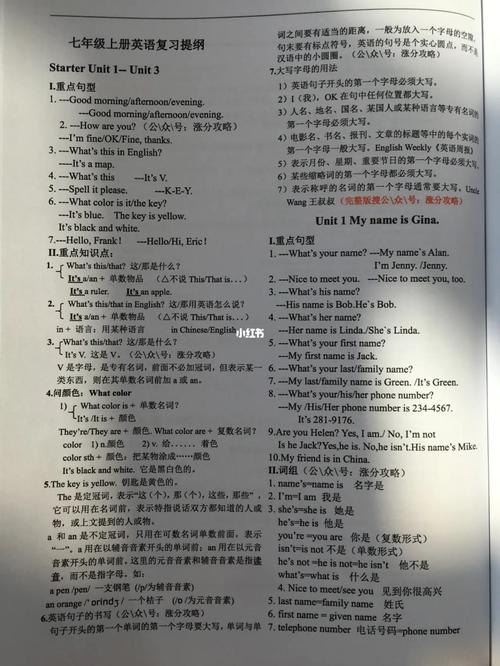
七年级上册英语核心知识点归纳
第一部分:基础知识
这部分是英语学习的基石,必须牢固掌握。
字母、音标与问候
-
字母
 (图片来源网络,侵删)
- 26个英文字母:要会认、会读、会写、会默写。
- 分类:
- 元音字母:A, E, I, O, U (有时 Y 也算)。
- 辅音字母:剩下的21个。
- 字母的书写:注意笔顺和占格大小写(大写占上两格,小写a, c, e, m, n, o, r, s, u, v, w, x, z占中间两格;b, d, h, k, l, t占上两格和中两格;g, p, q, y占下两格和中两格;f, j, p占三格)。
-
国际音标
- 48个音标:是单词发音的“拼音”,必须掌握。
- 元音:20个 (长元音5个,短元音7个,双元音8个)。
- 短元音:/e/ (bed), /æ/ (apple), /ɪ/ (sit), /ɒ/ (hot), /ʌ/ (cup), /ʊ/ (book), /ə/ (teacher)
- 长元音:/i:/ (see), /ɑ:/ (father), /ɔ:/ (saw), /u:/ (blue), /ɜ:/ (bird)
- 双元音:/eɪ/ (day), /aɪ/ (my), /ɔɪ/ (boy), /aʊ/ (now), /əʊ/ (go), /ɪə/ (here), /eə/ (there), /ʊə/ (tour)
- 辅音:28个。
- 重点辅音:/θ/ (think), /ð/ (this), /ʃ/ (she), /ʒ/ (vision), /tʃ/ (ch), /dʒ/ (j), /tr/ (train), /dr/ (drink), /ts/ (ts), /dz/ (ds)
-
问候与介绍
- 核心句型:
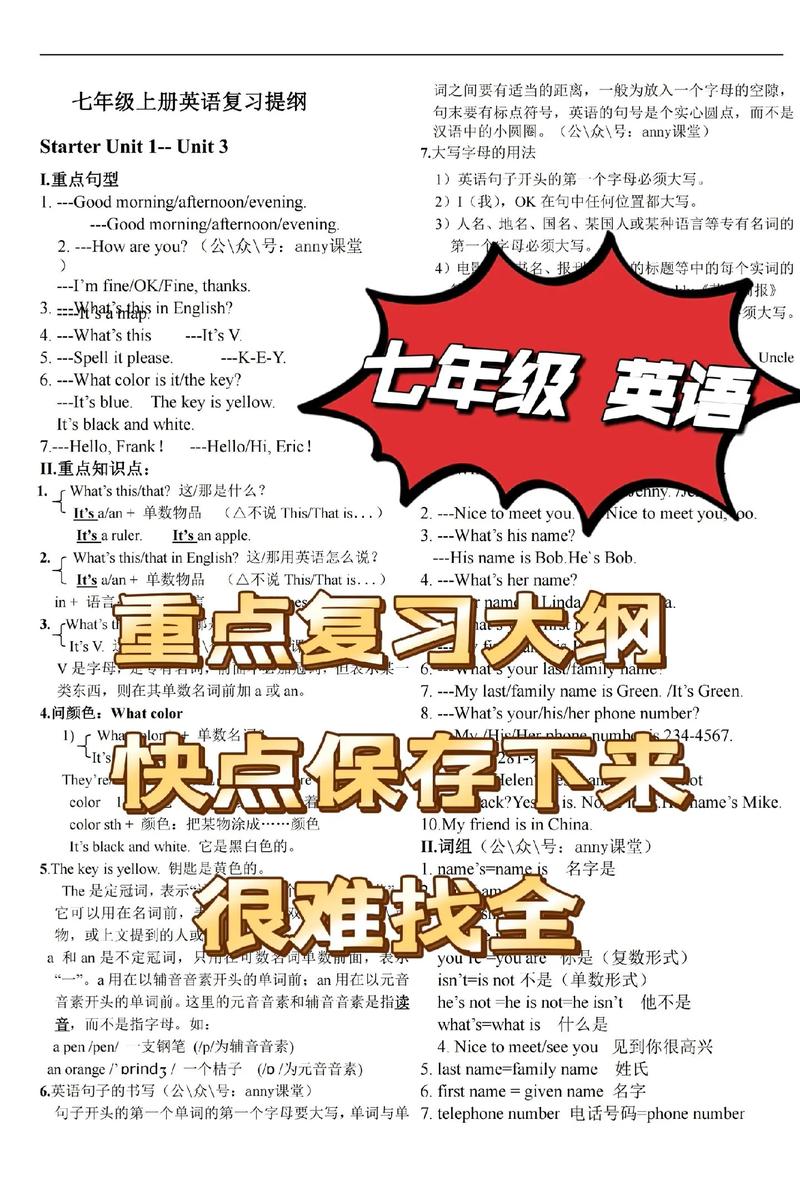
Hello! / Hi!(你好!)Good morning/afternoon/evening.(早上/下午/晚上好。)How are you?(你好吗?) ->I'm fine, thank you. And you?(我很好,谢谢,你呢?) ->I'm fine, too.(我也很好。)What's your name?(你叫什么名字?) ->My name is... / I'm...(我的名字是.../我是...)Nice to meet you.(很高兴认识你。) ->Nice to meet you, too.(我也很高兴认识你。)
- 核心句型:
数字、颜色与物品
-
数字
- 0-100:必须会听、说、读、写。
- 重点:13-19 (以-teen结尾), 20-90 (以-ty结尾), 21-99 (几十几,中间用连字符“-”,如 21 = twenty-one)。
-
颜色
 (图片来源网络,侵删)
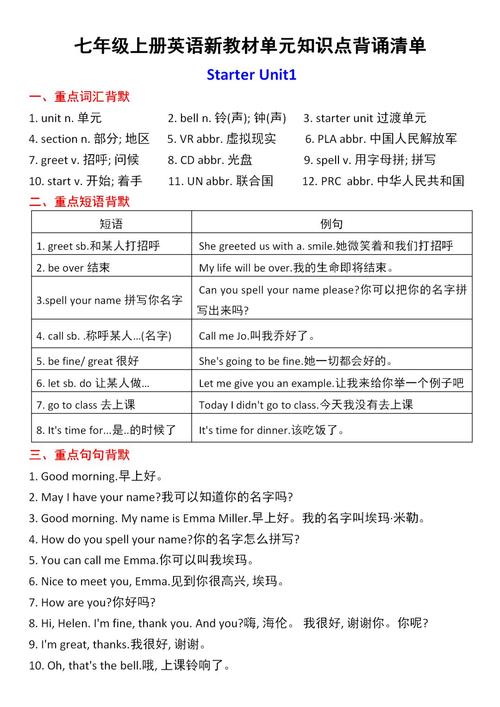
- 核心词汇:red, yellow, blue, green, black, white, orange, purple, pink, brown, gray/grey。
- 句型:
What color is it?(它是什么颜色的?) ->It's red.(它是红色的。)What color are they?(它们是什么颜色的?) ->They are blue.(它们是蓝色的。)
-
物品
- 核心词汇:
- 学习用品:pen, pencil, ruler, eraser, book, notebook, schoolbag, dictionary...
- 其他物品:key, cup, quilt, jacket, hat, bag...
- 句型:
What's this in English?(这个用英语怎么说?) ->It's a/an...(它是一个...)Spell it, please.(请拼写它。) ->P-E-N.(P-E-N。)Is this/that your...?(这是/那是你的...吗?) ->Yes, it is. / No, it isn't.(是的,它是。/不,它不是。)
- 核心词汇:
人称、名词与所有格
-
人称代词
- 主格:I (我), you (你/你们), he (他), she (她), it (它), we (我们), they (他们/她们/它们)。
- 宾格:me (我), you (你/你们), him (他), her (她), it (它), us (我们), them (他们/她们/它们)。
- 用法:主格作主语,宾格作宾语。
- e.g.,
______ (I/Me) am a student.->I am a student. - e.g.,
He loves ______ (I/me).->He loves me.
- e.g.,
-
名词
- 可数名词:有单复数之分。
- 规则变化:一般在词尾加-s (book -> books)。
- 特殊变化:
- 以-s, x, ch, sh结尾,加-es (box -> boxes, watch -> watches)。
- 以“辅音+y”变y为i再加-es (family -> families)。
- 以f/fe结尾,变f/fe为v再加-es (leaf -> leaves)。
- 不规则变化 (必须记):man -> men, woman -> women, child -> children, foot -> feet, tooth -> teeth, mouse -> mice, sheep -> sheep (单复数同形)。
- 不可数名词:没有复数形式,不能直接用a/an修饰。
- 常见词:water, milk, juice, tea, coffee, rice, bread, meat, fish, chicken, food, homework, information, news...
- 修饰词:much (很多), a little (一点), some (一些), a lot of (许多)。
- 名词所有格:表示“...的”。
- 有生命:通常在词尾加's (Tom's book, my mother's car)。
- 无生命:通常用 "of" 结构 (the door of the room)。
- 共同所有:只在最后一个名词后加's (Lucy and Lily's room - 露西和莉莉共有的房间)。
- 各自所有:每个名词后都加's (Lucy's and Lily's rooms - 露西的和莉莉各自的房间)。
- 可数名词:有单复数之分。
指示代词、方位介词与There be句型
-
指示代词
 (图片来源网络,侵删)
this(这个,指近处的单数),that(那个,指远处的单数)。these(这些,指近处的复数),those(那些,指远处的复数)。- 用法:
This is... / That is... / These are... / Those are...
-
方位介词
in(在...里面),on(在...上面),under(在...下面),near(在...附近),behind(在...后面),next to(紧挨着),between...and...(在...和...之间)。- 句型:
The ball is in the box.
-
There be 句型
- 含义:“某地有某物”。
- 结构:
There be + (名词) + (地点状语)。 - 用法:
- 就近原则:be动词的形式由它后面的第一个名词决定。
- e.g.,
There ______ (is/are) a book and two pens on the desk.->There is a book and two pens... - e.g.,
There ______ (is/are) two pens and a book on the desk.->There are two pens and a book...
- e.g.,
- 疑问句:把
be动词提到句首。- e.g.,
Is there a bird in the tree?->Yes, there is. / No, there isn't. - e.g.,
Are there any students in the classroom?->Yes, there are. / No, there aren't.
- e.g.,
- 否定句:在
be动词后加not。- e.g.,
There isn't a cat./There aren't any cats.(注意:some在否定句和疑问句中通常变为any)
- e.g.,
- 就近原则:be动词的形式由它后面的第一个名词决定。
一般现在时
这是七年级上册最重要的时态。
-
含义:表示经常性、习惯性的动作或存在的状态。
- e.g.,
I get up at 6:00 every day.(我每天6点起床。) - e.g.,
He likes apples.(他喜欢苹果。)
- e.g.,
-
结构:
- 主语 + be动词 + ...
- be动词:am, is, are。
- e.g.,
I am a student.He is my friend.They are happy.
- 主语 + 实义动词 + ...
- 当主语是第三人称单数 (he, she, it, 单个的人名/事物名) 时,动词要加-s或-es。
- e.g.,
He goes to school by bus. - e.g.,
She has a new dress.(have -> has) - e.g.,
It gets dark early in winter.
- e.g.,
- 当主语是其他人称 (I, you, we, they) 或复数时,动词用原形。
- e.g.,
I like English. - e.g.,
They play football on weekends.
- e.g.,
- 当主语是第三人称单数 (he, she, it, 单个的人名/事物名) 时,动词要加-s或-es。
- 主语 + be动词 + ...
-
时间状语:
always(总是),usually(,often(经常),sometimes(有时),every day/week...(每天/每周...),on Sundays(在周日)。
现在进行时
-
含义:表示说话时正在进行的动作。
- e.g.,
Look! The birds are flying.(看!鸟儿正在飞。) - e.g.,
I am doing my homework now.(我正在做作业。)
- e.g.,
-
结构:
am/is/are + 动词ing形式 -
动词ing形式的变化规则:
- 直接加-ing:
do -> doing,look -> looking - 以不发音的e结尾,去e加-ing:
write -> writing,make -> making - 以“辅音+y”变y为i再加-ing:
study -> studying,carry -> carrying - 重读闭音节结尾,双写末尾辅音字母再加-ing:
run -> running,swim -> swimming,sit -> sitting
- 直接加-ing:
情态动词 can
-
含义:表示能力“能,会”,或请求许可“可以”。
- e.g.,
I can swim.(我会游泳。) - e.g.,
Can you help me?(你能帮我吗?)
- e.g.,
-
结构:
主语 + can + 动词原形 + ... -
否定句:
主语 + can't + 动词原形 + ... -
疑问句:
Can + 主语 + 动词原形 + ...? -
回答:
Yes, ... can./No, ... can't.
一般疑问句与特殊疑问句
-
一般疑问句
- 特点:以助动词 (be, can, do, does) 或情态动词开头,回答用 "Yes" 或 "No"。
- 类型:
- Be动词开头:
Are you a student? - 情态动词开头:
Can you swim? - 实义动词开头:需要借助助动词
do或does。- 主语是
I/you/we/they/复数时,用do。- e.g.,
Do you like apples?->Yes, I do. / No, I don't.
- e.g.,
- 主语是
he/she/it/单数时,用does,且后面的动词用原形。- e.g.,
Does he like apples?->Yes, he does. / No, he doesn't.
- e.g.,
- 主语是
- Be动词开头:
-
特殊疑问句
- 特点:以疑问词开头,用来询问具体信息,不能用 "Yes" 或 "No" 回答。
- 常见疑问词:
What(什么):What's this?,What's your name?,What color is it?Who(谁):Who is he?Where(哪里):Where is my book?When(什么时候):When is your birthday?Why(为什么):Why are you late?How(怎么样):How are you?,How old are you?How many(多少,修饰可数名词复数):How many books are there?How much(多少,修饰不可数名词;多少钱):How much water is there?,How much is the T-shirt?
学习建议
- 词汇为王:每天坚持背单词,利用单词卡片或App(如百词斩、扇贝)。
- 语法框架:不要死记硬背语法规则,要通过例句理解并学会运用,上面的归纳就是很好的框架。
- 听说领先:多听课本录音、英文歌,模仿语音语调,敢于开口说,哪怕自言自语。
- 读写跟上:每天坚持读一篇短文,每周写几句话的日记或小作文。
- 错题整理:准备一个错题本,把做错的题和知识点记录下来,定期复习。
希望这份详细的归纳能对你的学习有所帮助!加油!