八年级上册英语复习重点有哪些?
校园之窗 2025年12月10日 19:07:34 99ANYc3cd6
- 核心知识梳理 (按单元和模块)
- 重点难点突破 (语法、词汇、句型)
- 高效复习方法与建议
- 模拟自测题
第一部分:核心知识梳理 (按单元)
八年级上册共10个单元,我们可以将其归为几个大的主题模块。
日常活动与频率 (Unit 1)
- 核心话题: 讨论日常活动及其频率。
- 核心句型:
What do you usually do on weekends?-I often go shopping.How often do you exercise?-I exercise every day.What's your favorite program?-My favorite program is ...
- 核心词汇:
- 活动类:
go shopping, go to the movies, watch TV, exercise, use the Internet, read books - 频率副词:
always (100%), usually (often), sometimes, hardly ever, never (0%) - 其他:
junk food, coffee, health, habit, interviewer
- 活动类:
- 核心语法: 频率副词 在句中的位置 (
be动词、情态动词、助动词之后,实义动词之前)。
健康状况与建议 (Unit 2)
- 核心话题: 描述自己或他人的健康状况,并给出建议。
- 核心句型:
What's the matter? / What's wrong with you?-I have a sore back.You should lie down and rest. / You shouldn't eat so much.It's important to eat a balanced diet.
- 核心词汇:
- 病症:
have a fever/cold/headache/stomachache/sore throat/back - 建议:
should, shouldn't, drink hot tea with honey, see a doctor, get some rest - 健康相关:
balance, diet, habit, stressed out, tired, yucky, healthy
- 病症:
- 核心语法:
should(应该) 的用法 (后接动词原形,用于提出建议)。
过去时态入门 (Unit 3 & 4)
- 核心话题: 讲述过去发生的事情和经历。
- 核心句型:
Where did you go on vacation?-I went to New York City.Did you do anything special?-Yes, I did. / No, I didn't.How was the food?-It was delicious.How was your weekend?-It was great.
- 核心词汇:
- 地点:
New York City, Central Park, the beach, museum, camp, countryside - 活动:
go to the mountains, visit museums, go fishing, study for a test, stay at home - 评价:
great, interesting, boring, beautiful, fantastic, terrible
- 地点:
- 核心语法: 一般过去时。
- 构成:
主语 + 动词过去式 + 其他 - 标志词:
yesterday, last night/week/month/year, ... ago, in + 过去的年份 - 规则动词过去式 (加 -ed, 以 e 结尾加 d, 辅音+y 结尾变 i 加 ed, 重读闭音节双写末尾辅音加 ed)。
- 不规则动词过去式 (
go-went, see-saw, eat-ate, have-had, do-did, get-got, buy-bought, take-took等,必须重点记忆)。
- 构成:
交通工具与距离 (Unit 5)
- 核心话题: 询问和描述去某地的交通方式、距离和花费时间。
- 核心句型:
How do you get to school?-I take the bus / ride my bike / walk.How far is it from your home to school?-It's about 10 kilometers.How long does it take?-It takes about 25 minutes.
- 核心词汇:
- 交通方式:
take the bus/subway/train/boat, ride a bike, walk, by bus/bike/train - 其他:
kilometer, minute, far, transportation, North America, depend on
- 交通方式:
- 核心语法:
How引导的特殊疑问句:How(方式) +do/does + 主语 + 动词原形...How far(距离) +is/are + ...How long(时间) +does/it take...
It takes (sb) some time to do sth.句型。
未来计划与邀请 (Unit 6 & 7)
- 核心话题: 讨论未来的计划、意图和发出邀请。
- 核心句型:
What are you doing for vacation?-I'm babysitting my sister.When are you going?-I'm going on Friday.Can you come to my party?-Sure, I'd love to. / Sorry, I can't. I have to study.How about going shopping?/What about the movies?
- 核心词汇:
- 活动:
go hiking, go fishing, rent videos, take walks, get back, babysit, plan, final exam - 邀请:
invitation, party, concert, event, calendar, the day after tomorrow, look after
- 活动:
- 核心语法:
- 现在进行时表将来:表示已经安排好的、近期要发生的计划。
结构:主语 + am/is/are + 动词ing + 其他
Can表请求许可和邀请。would love to / like to的用法。
- 现在进行时表将来:表示已经安排好的、近期要发生的计划。
规则与义务 (Unit 8)
- 核心话题: 描述规章制度,谈论义务和责任。
- 核心句型:
What are the rules?-We can't eat in the classrooms.Don't run in the hallways.You have to wear the school uniform.Do you have to wear a uniform?-Yes, we do. / No, we don't.
- 核心词汇:
- 规则:
rule, hallway, dining hall, fight, listen to, arrive late, wear, uniform, quiet - 情态动词:
can, can't, have to, don't have to
- 规则:
- 核心语法: 情态动词
can和have to的区别。can/can't(表示能力或许可)have to / has to / don't have to / doesn't have to(表示客观上的义务或必要性,有人称和数的变化)。
兴趣与爱好 (Unit 9)
- 核心话题: 谈论自己和他人的兴趣爱好,以及如何制作/做某事。
- 核心句型:
What does he look like?-He's of medium height, and he has short hair.What's she like?-She's very funny and kind.(问性格)I like playing the piano./I enjoy reading.Let's make fruit salad./How do you make it?
- 核心词汇:
- 外貌:
tall, short, of medium height, thin, heavy, curly, straight, long, short hair - 性格:
funny, serious, outgoing, quiet, hard-working, smart, athletic - 爱好:
go skateboarding, play the guitar/soccer, watch TV, read, sing, dance - 制作:
peel, cut up, pour, mix, add, finally, ingredient, recipe, popcorn, sandwich
- 外貌:
- 核心语法:
like的用法:like to do sth./like doing sth.。How引导的特殊疑问句:How do you make...?(询问步骤)。- 祈使句:
Let's .../Please ...。
节日与庆典 (Unit 10)
- 核心话题: 谈论国内外节日和庆典。
- 核心句型:
When is Halloween?-It's in October.What do people do on this day?-They dress up and go to parties.What's your favorite festival?-My favorite festival is ...
- 核心词汇:
- 节日:
Christmas, Halloween, Thanksgiving, Spring Festival, Mid-Autumn Festival - 活动:
get together, have dinner, give gifts, put up Christmas trees, celebrate, relative, decorate
- 节日:
- 核心语法:
when和what引导的特殊疑问句。
第二部分:重点难点突破
语法核心
-
一般过去时 vs. 现在进行时表将来
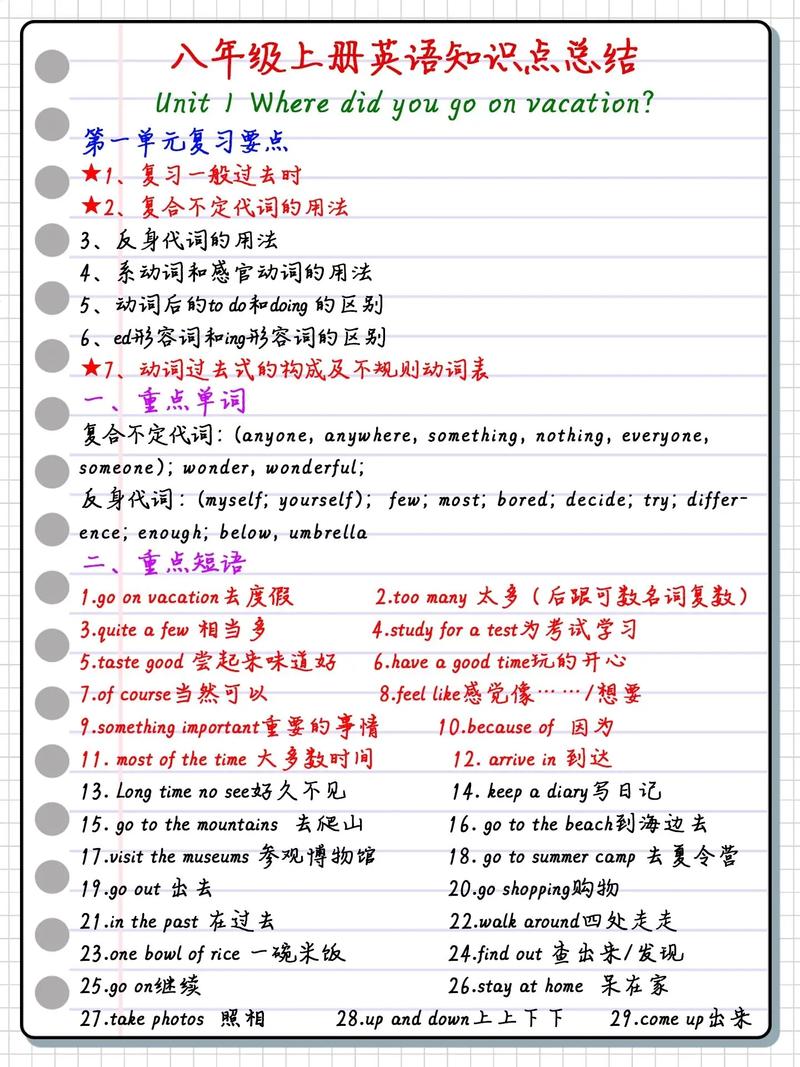 (图片来源网络,侵删)
- 一般过去时: 动词用过去式,标志词是过去的时间 (
yesterday, last week)。 - 现在进行时表将来: 动词用现在分词 (-ing),标志词是将来的计划 (
tomorrow, next week, for vacation)。 - 对比:
I **went** to the park yesterday.(昨天的事)I **am going** to the park tomorrow.(明天的计划)
- 一般过去时: 动词用过去式,标志词是过去的时间 (
-
shouldvs.have toshould: 表示主观建议 (应该),没有人称和数的变化。have to: 表示客观义务 (必须,不得不),有人称和数的变化 (has to, don't have to, doesn't have to)。- 对比:
You **should** eat more vegetables.(我建议你多吃菜)You **have to** finish your homework now.(老师要求你必须现在完成)
-
What's he like?vs.What does he look like?What's he like?: 询问性格、品质。 (He is funny and kind.)What does he look like?: 询问外貌、长相。 (He is tall and has short hair.)
-
like的两种用法like to do sth.: 偏好某一次或具体的动作。like doing sth.: 习惯性、长期的爱好。- 注意: 在多数情况下,两者可以互换。
词汇核心
- 同义词/近义词辨析:
look, see, watch, readsay, speak, talk, telllisten, hear
- 动词短语:
go to the movies, go shopping, go fishing, go hikingget up, get back, get to, get on, get offlook at, look for, look after, look likegive up, give away, give out
- 不规则动词: 这是八上的重中之重!务必单独整理一个列表,每天抽时间背诵和听写。
be-was/were, go-went, have-had, do-did, see-saw, eat-ate, take-took, get-got, buy-bought, come-came, run-ran, swim-swam, sing-sang, dance-danced, write-wrote, read-read (过去式同原形)
句型核心
It takes...句型:It takes (sb) some time to do sth.(做某事花费某人多长时间)How引导的特殊疑问句: 熟练掌握How(方式),How far(距离),How long(时间),How old(年龄),How many(可数),How much(不可数) 的用法。There be句型: 描述某地存在某物,注意be动词的单复数。
第三部分:高效复习方法与建议
-
回归课本,梳理框架:
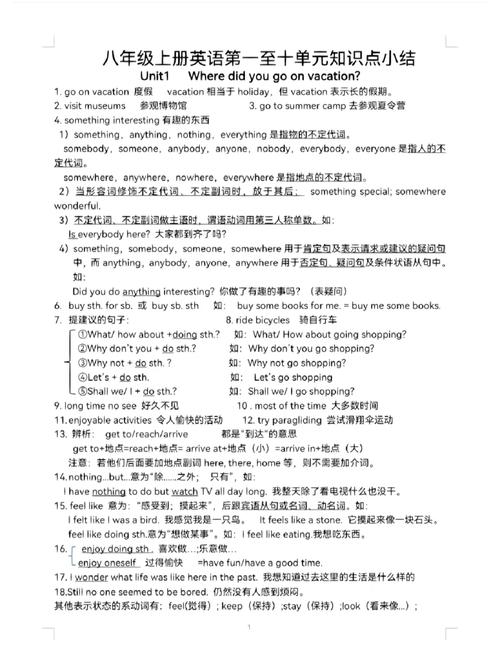 (图片来源网络,侵删)
- 快速浏览每个单元的
Section A和Section B,回顾核心词汇、句型和语法点。 - 看单元的
Grammar Focus,明确本单元的语法重点。
- 快速浏览每个单元的
-
建立“错题本”:
- 把平时作业、测验和考试中的错题抄录下来。
- 写下正确答案和错误原因 (是单词不认识?语法规则用错?还是粗心?)。
- 定期回顾错题本,效果远比做新题好。
-
专题突破,专项练习:
- 针对自己薄弱的环节,如“一般过去时”、“不规则动词”、“
should和have to”等,找相关的语法题和完形填空进行集中练习。
- 针对自己薄弱的环节,如“一般过去时”、“不规则动词”、“
-
听说读写,全面发展:
- 听: 听课本录音、英文歌曲、简单的英文动画,培养语感。
- 说: 大声朗读课文,尝试用所学句型描述自己的日常或复述课文故事。
- 读: 坚持每天阅读一篇简短的英语小短文或对话。
- 写: 每周写一篇小短文,主题可以是“我的周末”、“我的朋友”、“我的学校规则”等,尽量运用所学词汇和句型。
-
利用思维导图:
 (图片来源网络,侵删)
以单元或语法点为单位,画出思维导图,以“一般过去时”为中心,分支可以包括:定义、标志词、动词变化规则、句型结构等,这有助于构建知识网络。
-
合作学习,互相提问:
和同学组成学习小组,互相提问单词、背诵课文、进行角色扮演对话,教别人是最好的学习方式。
第四部分:模拟自测题 (Unit 1-2 综合)
词汇运用 (A. 根据汉语提示写单词; B. 用所给单词的适当形式填空)
A.
- My father __ (锻炼) every morning to keep healthy.
- You should eat less __ (垃圾食品).
- She __ (几乎不) goes to the movies on weekdays.
- It's important to have a __ (平衡的) diet.
- What's __ (错误的) with your computer?
B. 6. My sister __ (go) to the library twice a week. 7. You __ (not have) to wear your uniform today. 8. He is very __ (health). He exercises every day. 9. It's a good habit __ (brush) your teeth after meals. 10. My mother tells me I __ (should) drink more water.
单项选择
-
__ do you watch TV? A. How often B. How long C. How many D. How much
-
— What's the matter __ you? — I have a toothache. A. with B. for C. at D. on
-
My mother wants me __ milk every day. A. drink B. drinks C. to drink D. drinking
-
You look tired. You __ go to bed early tonight. A. should B. can C. would D. have to
-
Eating vegetables is good for your __. A. health B. healthy C. unhealthy D. healthily
句型转换
-
I usually go to school by bike. (对划线部分提问) __ __ you usually go to school?
-
He has a sore throat. (改为一般疑问句) __ he __ a sore throat?
-
You should lie down and rest. (改为否定句) You __ __ lie down and rest.
-
My favorite sport is basketball. (改为同义句) I __ __ basketball.
补全对话
A: Hello, Tom! You look unhappy. 1. __ ? B: Oh, I have a headache and a fever. A: 2. __ . You should see a doctor. B: I think so. 3. __ ? A: Yes, I do. You should also drink more hot water and stay in bed. B: Thank you for your advice. A: 4. __ .
参考答案
词汇运用 A. 1. exercises 2. junk food 3. hardly ever 4. balanced 5. wrong B. 6. goes 7. don't have 8. healthy 9. to brush 10. should
单项选择
- A (How often 提问频率)
- A (What's the matter with sb. 是固定搭配)
- C (want sb. to do sth.)
- A (should 提出建议)
- A (good for one's health)
句型转换
- How do
- Does, have
- shouldn't
- like playing
补全对话
- What's the matter (with you)?
- I'm sorry to hear that.
- Do you have any advice?
- You're welcome.
希望这份详细的复习攻略能帮助你系统地巩固八年级上册的英语知识!祝你学习进步,考试顺利!