八年级英语下册期末测试卷怎么高效复习?
校园之窗 2025年12月10日 07:06:09 99ANYc3cd6
八年级英语下册期末测试卷
考试时间: 90分钟 满分: 100分
第一部分 听力部分 (共20分)
I. 听句子,选择正确的图片。 (每小题1分,共5分)
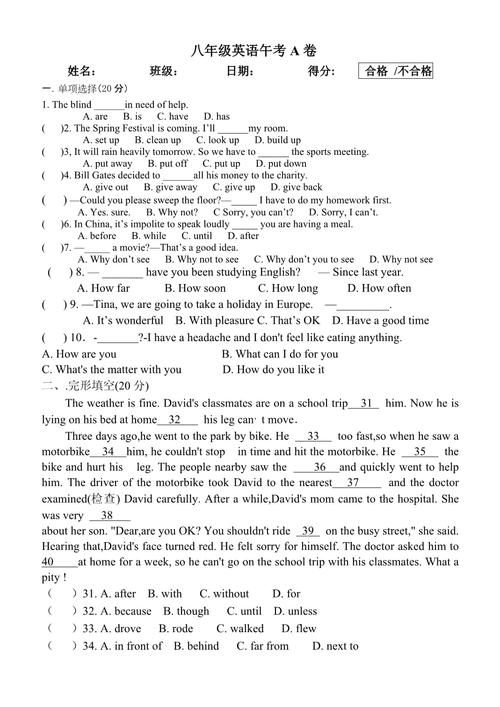
- A. B. C.
- A. B. C.
- A. B. C.
- A. B. C.
- A. B. C.
II. 听对话,选择正确的答案。 (每小题1分,共5分)
-
What's the matter with the boy? A. He has a toothache. B. He has a headache. C. He has a stomachache.
-
How long has the man had the bike? A. For about two years. B. For about three years. C. For about four years.
-
What is the girl going to be when she grows up? A. A doctor. B. An engineer. C. A teacher.
 (图片来源网络,侵删)
 -
Where are they going to have a picnic? A. On the beach. B. In the park. C. In the mountains.
-
What did the man do last night? A. He watched a movie. B. He read a book. C. He visited his friend.
III. 听短文,选择正确的答案。 (每小题2分,共10分)
-
Where did the story happen? A. In a library. B. In a restaurant. C. In a shop.
 (图片来源网络,侵删)
 -
What was the weather like that day? A. It was sunny. B. It was rainy. C. It was windy.
-
What did the young man want to buy? A. A pair of shoes. B. A pair of socks. C. A pair of glasses.
-
Why didn't the shop assistant show him the expensive ones? A. Because they were sold out. B. Because the young man looked poor. C. Because the young man didn't like them.
-
How did the young man feel at last? A. Angry. B. Happy. C. Surprised.
第二部分 笔试部分 (共80分)
IV. 单项选择。 (每小题1分,共15分)
-
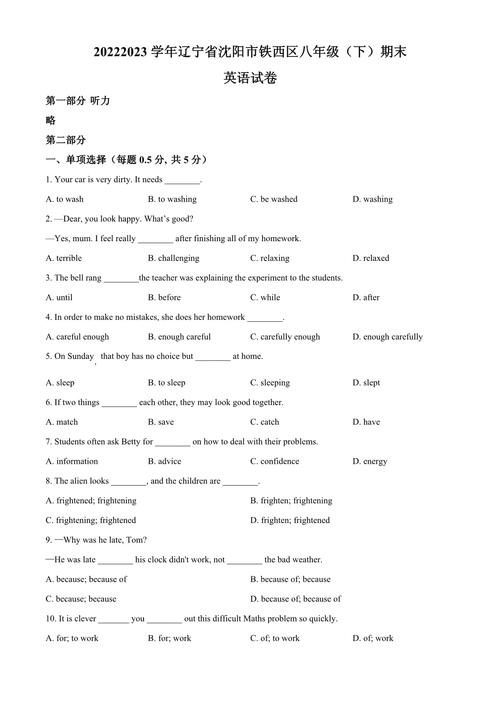
— ____ is the population of China? — It's about 1.4 billion. A. How B. What C. How many
-
My parents are strict ____ me, but they are very kind ____ me. A. with; with B. with; to C. to; with
-
— I'm going to Hawaii on vacation next month. — Wow! ____! A. Have a good time B. You're welcome C. Thank you
-
He has ____ been to Shanghai. He knows it very well. A. never B. ever C. already
-
— Could you please pass me the salt? — ____. A. No, I couldn't B. Yes, please C. Here you are
-
I ____ a novel by Mo Yan last week, and it was very interesting. A. read B. have read C. was reading
-
The little boy is ____ young to go to school. A. so B. too C. very
-
— What should I do to improve my English? — You should ____ English every day. A. practice speaking B. practice to speak C. practice speak
-
The old man lives ____, but he never feels ____. A. alone; lonely B. lonely; alone C. alone; alone
-
I'm not sure if it ____ tomorrow. If it ____, we will have to cancel the picnic. A. will rain; rains B. rains; will rain C. will rain; will rain
-
— Excuse me, where is the nearest post office? — Sorry, I'm new here. You ____ ask that policeman over there. A. should B. could C. must
-
This is the book ____ I borrowed from the library yesterday. A. who B. which C. what
-
It's important for us ____ a good habit of reading. A. to develop B. develop C. developing
-
— I'm sorry I broke your cup. — ____. A. That's right B. Not at all C. It doesn't matter
-
— Will you please help me with the box? — ____. I'm busy right now. A. I'd love to B. No problem C. Sorry, I can't
V. 完形填空。 (每小题1分,共10分)
Once there was a poor boy called Jack. He lived with his mother. They were very 31 . One day, Jack's mother asked him to sell their old cow at the market. 32 the way to the market, Jack met a man. The man had some magic beans. He told Jack that the beans were 33 . He persuaded Jack to trade the cow for the beans.
When Jack got home with only the beans, his mother was very 34 . She was so angry that she threw the beans out of the window. The next morning, Jack looked out of the window and was 35 to see a huge beanstalk. It went up and up, 36 the clouds.
Jack decided to climb the beanstalk. When he reached the top, he found a 37 . He went inside and saw a giant woman. The giant woman was not friendly at first, but she gave Jack some food. Later, her giant husband came home. He 38 , "Fee-fi-fo-fum!" and smelled a human boy. But the giant woman hid Jack.
When the giant was asleep, Jack took a bag of gold coins and 39 down the beanstalk. He and his mother were no longer poor. Jack made 40 more trips to the giant's castle and brought back even more treasures.
- A. rich B. poor C. happy
- A. On B. In C. At
- A. expensive B. useless C. special
- A. excited B. surprised C. angry
- A. sad B. surprised C. bored
- A. over B. under C. below
- A. castle B. house C. farm
- A. sang B. shouted C. laughed
- A. climbed B. jumped C. flew
- A. few B. a few C. a little
VI. 阅读理解。 (每小题2分,共20分)
A
The Spring Festival is the most important festival in China. Before the Spring Festival, people usually clean their houses and put up red lanterns and Spring Festival couplets. On New Year's Eve, families get together for a big dinner. After dinner, many people watch the Spring Festival Gala on TV. At midnight, people set off fireworks to welcome the new year. During the festival, children can get lucky money from their elders.
-
What is the most important festival in China? A. The Mid-Autumn Festival. B. The Dragon Boat Festival. C. The Spring Festival.
-
What do people usually do before the Spring Festival? A. They eat mooncakes. B. They clean their houses. C. They have a big dinner.
-
Where do people watch the Spring Festival Gala? A. In the cinema. B. On TV. C. In the park.
-
When do people set off fireworks? A. On New Year's morning. B. On New Year's Eve. C. At midnight on New Year's Eve.
-
Who can get lucky money? A. Elders. B. Children. C. Everyone.
B
Many people like to keep animals as pets. Some people like dogs, and others like cats. However, keeping pets is not always easy.
First, pets need a lot of care. Dogs need to be walked every day. Cats need to be fed regularly. If you go on a trip, you have to find someone to look after your pet. This can be a problem.
Second, pets can be expensive. You have to buy food for them. You also need to pay for their medical care when they are sick. The cost of a vet can be very high.
Third, pets can make a mess. Dogs might dirty the floor, and cats might scratch the furniture. You have to spend time cleaning up after them.
However, many people still think pets are good for them. Pets can be good friends. They can help people feel less lonely. Playing with pets can be fun. They can also teach children to be responsible.
In conclusion, before you get a pet, you should think carefully about the time, money, and effort it will take.
-
What is the main idea of the passage? A. How to choose a pet. B. The difficulties and joys of keeping pets. C. The best pets to keep.
-
What do pets need according to the passage? A. A lot of care and money. B. Only food and water. C. Only someone to play with.
-
Why is it a problem when you go on a trip? A. Because your pet will be lonely. B. Because you have to find someone to look after it. C. Because you can't buy food for it.
-
How can pets help people? A. They can help people clean the house. B. They can make people feel less lonely. C. They can help people save money.
-
What should you do before getting a pet? A. Buy the most expensive one. B. Think carefully about the responsibilities. C. Ask your friends for advice.
VII. 词汇运用。 (每小题1分,共10分)
A) 根据句意及首字母提示,完成单词。
- The Great Wall is one of the most famous a_____ in the world.
- I feel s_____ after a long walk.
- My father is a doctor and he works in a h_____.
- You should take this medicine t_____ a day.
- It's raining outside. You'd better take an u_____.
B) 用括号内所给单词的适当形式填空。
- He is much ____ (thin) than he was two years ago.
- The little girl is ____ (interest) in science.
- My brother has finished ____ (read) the book.
- The movie is very ____ (excite). I want to watch it again.
- It's important for students ____ (learn) English well.
VIII. 句型转换。 (每小题1分,共10分)
-
He has been to Shanghai twice. (对划线部分提问) ____ ____ has he been to Shanghai?
-
They started to learn English three years ago. (同义句转换) They ____ ____ English for three years.
-
The box is too heavy for me to carry. (同义句转换) The box is so heavy ____ I can't carry it.
-
"Don't be late again," the teacher said to Tom. (改为间接引语) The teacher told Tom ____ ____ late again.
-
My father is a doctor. My mother is a doctor, too. (合并为一句) My father ____ my mother ____ doctors.
-
Could you please tell me how I can get to the station? (改为简单句) Could you please tell me ____ ____ get to the station?
-
He is a clever boy. (改为感叹句) ____ ____ clever boy he is!
-
I think this is a good idea. (改为否定句) I ____ think this ____ a good idea.
-
The man in blue is our new head teacher. (对划线部分提问) ____ ____ is your new head teacher?
-
We must protect the environment. (改为被动语态) The environment ____ ____ protected by us.
IX. 补全对话。 (每小题1分,共5分)
从方框内选择适当的句子补全对话,其中有两项多余。
A: Hi, Tom! You look a little tired. 71. ____ B: Oh, I stayed up late last night to prepare for the math exam. A: 72. ____ How was the exam? B: It was not too bad, but I'm not sure if I did well. A: 73. ____ Don't worry too much. You've worked hard. B: Thank you. 74. ____ A: I'm going to the cinema to see a new action movie. It's said to be very exciting. B: That sounds great! 75. ____ A: Of course! Let's meet at the school gate at 7:00 p.m. B: OK! See you then.
A. I'm sorry to hear that. B. What are you going to do this weekend? C. What's the matter with you? D. Can I go with you? E. I hope you can get a good grade. F. When and where shall we meet? G. I feel so happy.
X. 书面表达。 (共10分)
假设你是李华,你的英国笔友 Tom 对中国的传统节日很感兴趣,请你给他写一封电子邮件,介绍一个你最喜欢的传统节日(如春节、中秋节、端午节等)。 包括:
- 你最喜欢的节日是什么?
- 这个节日通常在什么时候庆祝?
- 人们通常会做什么来庆祝这个节日?(至少写两件事)
- 你为什么喜欢这个节日?
要求:
- 词数80词左右。
- 可适当增加细节,使内容连贯。
- 邮件的开头和结尾已给出,不计入总词数。
Dear Tom,
I'm glad to hear that you are interested in Chinese traditional festivals. My favorite one is the Spring Festival.
Best wishes, Li Hua
参考答案及解析
第一部分 听力部分
I. 1-5 (根据图片描述选择) II. 6-10 (根据对话内容选择) 6. B (W: You look pale. What's the matter? M: I have a headache.) 7. B (W: How long have you had this bike? M: I bought it three years ago.) 8. C (W: What do you want to be when you grow up? M: I want to be a teacher like my father.) 9. B (M: Let's have a picnic in the park this Sunday. W: Good idea!) 10. A (W: Did you watch the football match last night? M: No. I went to see a movie with my friend.)
III. 11-15 (根据短文内容选择) 11. C (A young man went into a shop to buy a pair of shoes.) 12. B (It was a rainy day.) 13. A (He wanted to buy a pair of shoes.) 14. B (The shop assistant thought the young man looked poor and couldn't afford the expensive ones.) 15. C (The young man took out a million-pound note and surprised everyone.)
第二部分 笔试部分
IV. 单项选择 16. B (询问人口数量用 "What is the population of...?") 17. B (be strict with sb. 对某人严格;be kind to sb. 对某人友善) 18. A (对别人即将开始的假期表示祝愿,用 "Have a good time!") 19. C (already 用于肯定句,通常放在助动词后。) 20. C (请求允许,对方同意并表示帮助,用 "Here you are.") 21. A (last week 是一般过去时的标志,用一般过去时。) 22. B (too...to... 太...而不能...) 23. A (practice doing sth. 练习做某事) 24. A (alone 单独的,副词;lonely 孤独的,形容词。) 25. A (if 引导条件状语从句,如果主句用将来时,从句用一般现在时。) 26. B (could 表示委婉的建议或请求。) 27. B (先行词 book 是物,在定语从句中作宾语,用 which 或 that。) 28. A (It's + adj. + for sb. to do sth. 对某人来说做某事是...) 29. C (对道歉的回答,表示没关系,用 "It doesn't matter." 或 "That's OK.") 30. C (根据 "I'm busy right now." 可知拒绝请求。)
V. 完形填空 31. B (根据后文 "poor boy" 和 "no longer poor" 可知他们很穷。) 32. A (On the way to... 在去...的路上。) 33. C (根据故事发展,这些豆子是有魔法的,是特殊的。) 34. C (母亲只换回了一些豆子,当然会很生气。) 35. B (看到巨大的豆茎,Jack 应该感到惊讶。) 36. A (豆茎高耸入云,用 over。) 37. A (云层上面通常有城堡。) 38. B (巨人发现有人,应该大声喊叫。) 39. A (Jack 是爬下豆茎的。) 40. B (a few 修饰可数名词复数,表示“一些,几个”。)
VI. 阅读理解 A 41. C (第一段第一句。) 42. B (第一段第二句。) 43. B (第一段第四句。) 44. C (第一段第五句。) 45. B (第一段最后一句。)
B 46. B (文章主要讲述了养宠物的好处和坏处。) 47. A (第二、三段分别提到了宠物需要大量的关心和金钱。) 48. B (第二段提到如果你去旅行,必须找人照顾宠物。) 49. B (第四段提到宠物可以成为好朋友,帮助人们减少孤独感。) 50. B (最后一段建议在养宠物前要仔细考虑责任。)
VII. 词汇运用 A) 51. attractions (著名景点) 52. sleepy (困倦的) 53. hospital (医院) 54. twice (两次) 55. umbrella (雨伞)
B) 56. thinner (than 表示比较,用比较级。) 57. interested (be interested in... 对...感兴趣) 58. reading (finish doing sth. 完成做某事) 59. exciting (物本身令人兴奋,用 -ing 形容词。) 60. to learn (It's + adj. + for sb. to do sth. 结构。)
VIII. 句型转换 61. How many times (对次数提问用 how many times。) 62. have learned / have been learning (现在完成时表示从过去开始持续到现在的动作。) 63. that (so...that... ..以至于...) 64. not to be (tell sb. not to do sth. 告诉某人不要做某事。) 65. both; and (both...and... ...和...两者都...) 66. how to (特殊疑问词 + to do sth. 作宾语。) 67. What a (What a/an + adj. + +n. (+主语+谓语)!) 68. don't; is (think 后的宾语从句如果否定要转移。) 69. Which man (对特定的人提问用 which。) 70. must be (含有情态动词的被动语态:情态动词 + be + 过去分词。)
IX. 补全对话 71. C (根据 "You look a little tired." 询问原因,用 "What's the matter with you?") 72. A (根据对方熬夜备考,表示同情,用 "I'm sorry to hear that.") 73. E (根据对方不确定考得怎么样,表示安慰和祝愿,用 "I hope you can get a good grade.") 74. B (根据下文回答去电影院,是询问周末计划,用 "What are you going to do this weekend?") 75. D (根据对方说去看电影,表示想一起去,用 "Can I go with you?")
X. 书面表达 范文:
Dear Tom,
I'm glad to hear that you are interested in Chinese traditional festivals. My favorite one is the Spring Festival.
The Spring Festival is usually in January or February. It's the most important festival for Chinese people. Before the festival, families get together and have a big dinner. On New Year's Eve, children can get lucky money in red envelopes. I like it because I can have a long holiday and spend happy time with my family. It's a time for reunion and happiness.
Best wishes, Li Hua
评分标准:完整,覆盖所有要点。(3分)
- 语言准确,语法错误较少。(3分)
- 条理清晰,行文连贯。(2分)
- 词汇和句式有一定的变化。(1分)
- 书写规范,卷面整洁。(1分)