七年级上册英语知识点总结,核心考点有哪些?
校园之窗 2025年12月14日 09:49:57 99ANYc3cd6
七年级上册英语知识点总结
第一部分:核心词汇
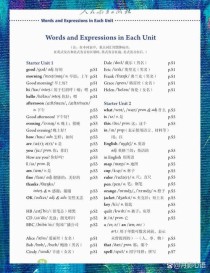
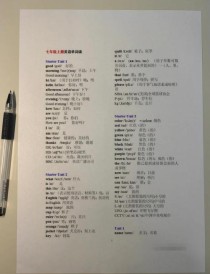
七年级上册的词汇主要围绕自我介绍、家庭、食物、学校生活等话题展开。
人物与称呼
(图片来源网络,侵删)
- 人称代词: I (我), you (你/你们), he (他), she (她), it (它), we (我们), they (他们/她们/它们)
- 形容词: tall (高的), short (矮的), long (长的), short (短的), big (大的), small (小的), young (年轻的), old (老的), heavy (重的), thin (瘦的), funny (滑稽的), cool (酷的), great (棒的), fine (好的), friendly (友好的), quiet (安静的), outgoing (外向的)
- 职业/身份: student (学生), teacher (老师), parent (父母), father (爸爸), mother (妈妈), brother (兄弟), sister (姐妹), grandfather/grandpa (爷爷/外公), grandmother/grandma (奶奶/外婆), friend (朋友)
数字与颜色
- 数字: 0-31 (日期), one to a hundred (基数词), first, second, third (序数词,用于日期)
- 颜色: red (红色), yellow (黄色), blue (蓝色), green (绿色), black (黑色), white (白色), purple (紫色), orange (橙色), brown (棕色), gray/grey (灰色)
食物与饮品
- 水果: apple (苹果), banana (香蕉), orange (橙子), pear (梨), strawberry (草莓), grape (葡萄)
- 三餐: breakfast (早餐), lunch (午餐), dinner (晚餐)
- 食物: rice (米饭), bread (面包), egg (鸡蛋), chicken (鸡肉), hamburger (汉堡包), pizza (披萨), ice cream (冰淇淋), vegetable (蔬菜), salad (沙拉), noodle (面条), fish (鱼)
- 饮品: water (水), milk (牛奶), tea (茶), juice (果汁), Coke (可乐)
学校与物品
- 学科: English (英语), math (数学), Chinese (语文), history (历史), science (科学), P.E. (体育)
- 文具: pen (钢笔), pencil (铅笔), ruler (尺子), eraser (橡皮), book (书), notebook (笔记本), schoolbag (书包), dictionary (字典)
- 地点: classroom (教室), library (图书馆), school (学校), home (家)
其他常见词汇
(图片来源网络,侵删)
- 介词: in (在...里), on (在...上), at (在...点), under (在...下), near (在...附近)
- 连词: and (和), but (, or (或者)
- 疑问词: what (什么), who (谁), where (哪里), when (什么时候), why (为什么), how (怎样)
- 动词: be (am, is, are), have (有), like (喜欢), can (能,会), play (玩,打), go (去), eat (吃), drink (喝), sing (唱), dance (跳), watch (看), listen (听), help (帮助), love (爱)
第二部分:核心语法
语法是英语的骨架,七年级上册的语法是整个初中阶段的基础。
be 动词的用法 (am, is, are)
- 口诀: 我用
am,你用are,is跟着他、她、它。 - 用法:
am用于主语I(我)。I am a student.is用于主语he(他),she(她),it(它) 或单数名词。He is my friend.,The book is new.are用于主语you(你/你们),we(我们),they(他们/她们/它们) 或复数名词。You are cool.,They are teachers.
- 否定句:
be动词 +not。I am not a teacher.,He is not tall. - 一般疑问句:
Be动词 + 主语 + ...? 肯定回答:Yes, 主语 + be.否定回答:No, 主语 + be + not.。Are you a student?->Yes, I am. / No, I'm not.
人称代词和物主代词
- 人称代词: 作主语。
I, you, he, she, it, we, they - 物主代词: 表示“我的、你的、他的...”,后面必须跟名词。
- 形容词性物主代词: my (我的), your (你的), his (他的), her (她的), its (它的), our (我们的), their (他们的)
- 名词性物主代词: mine (我的), yours (你的), his (他的), hers (她的), ours (我们的), theirs (他们的) - 后面不跟名词。
- 例句:
- This is my book. (这是我的书。)
- This book is mine. (这本书是我的。)
名词
(图片来源网络,侵删)
- 单数与复数:
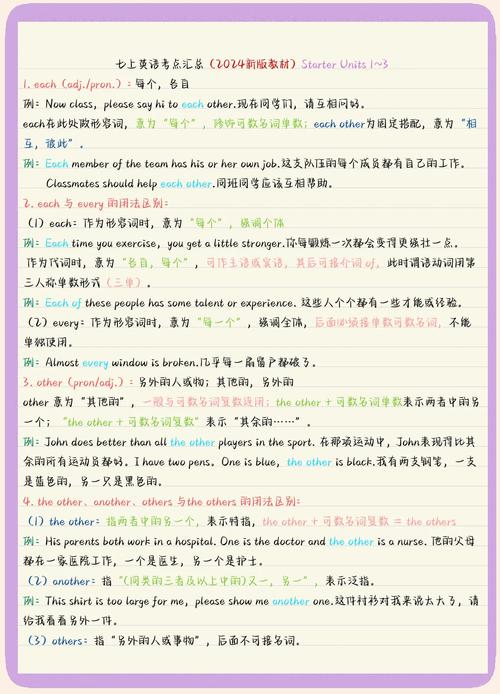
- 大多数名词在词尾加
-s。book -> books,pen -> pens - 以 s, x, sh, ch 结尾的名词加
-es。bus -> buses,watch -> watches - 以“辅音字母+y”结尾的名词,变
y为i再加-es。family -> families,strawberry -> strawberries - 以“元音字母+y”结尾的名词,直接加
-s。boy -> boys,key -> keys
- 大多数名词在词尾加
- 不可数名词: 没有复数形式,不能直接用
a/an修饰,表示数量时要用a piece of,a glass of等结构。water(水),milk(牛奶),bread(面包),rice(米饭)。
冠词 a/an/the
- a/an: 不定冠词,泛指“一个”,用于单数可数名词前。
a用于辅音音素开头的单词前。a book,a penan用于元音音素开头的单词前。an apple,an egg(注意:看的是发音,不是字母)
- the: 定冠词,特指“那个/这些”,表示双方都知道的人或物。
the book on the desk(桌上的那本书)
情态动词 can 的用法
- 含义: 能,会,可以。
- 结构:
can + 动词原形 - 否定句:
can not / can't + 动词原形 - 一般疑问句:
Can + 主语 + 动词原形...? - 例句:
- I can swim. (我会游泳。)
- He can't play the piano. (他不会弹钢琴。)
Can you help me?->Yes, I can. / No, I can't.
名词所有格 ('s)
- 含义: 表示“...的”,通常用于有生命的物体。
- 用法: 在名词后面加
's。- Tom's book (汤姆的书)
- my father's car (我爸爸的车)
- 以 s 结尾的复数名词,只在词尾加 ,the teachers' office (老师们的办公室)
- 不以 s 结尾的复数名词,在词尾加
's,the children's ball (孩子们的球)
There be 句型
- 含义: “某地有某物”,表示存在。
- 结构:
There be + (名词) + (地点状语) - be 动词的选择:
- 如果后面的名词是单数或不可数名词,用
is。There is a book on the desk. - 如果后面的名词是复数,用
are。There are some students in the classroom.
- 如果后面的名词是单数或不可数名词,用
- 就近原则:
be动词后面是并列的名词,be动词的形式由离它最近的那个名词决定。There is a pen and two books in the bag.
第三部分:核心句型
问候与介绍
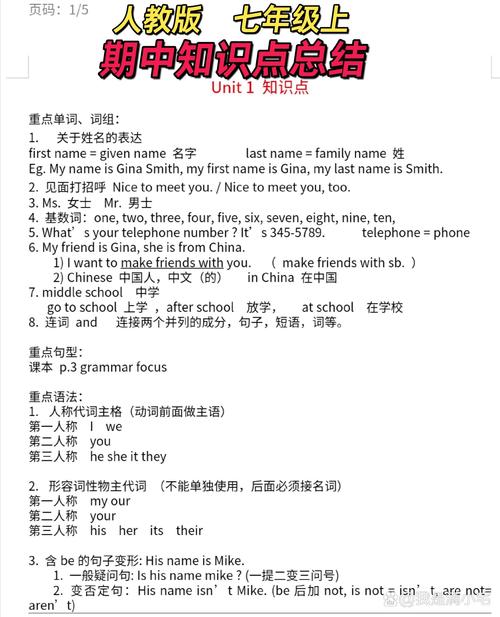
Hello! / Hi!(你好!)How are you?(你好吗?) ->I'm fine, thank you. / I'm OK.(我很好,谢谢。)What's your name?(你叫什么名字?) ->My name is... / I'm...(我的名字是... / 我是...)I'm from...(我来自...)Nice to meet you.(很高兴认识你。) ->Nice to meet you, too.(我也很高兴认识你。)
询问与描述人物
Who's he/she?(他是谁?/ 她是谁?) ->He's/She's...(他是/她是...)What's his/her name?(他/她叫什么名字?)How old are you?(你多大了?) ->I'm... years old.(我...岁了。)Is he/she...?(他/她...吗?) ->Yes, he/she is. / No, he/she isn't.(是的,他/她是。/ 不,他/她不是。)What's he/she like?(他/她是什么样的人?) ->He/She is... (funny/quiet/outgoing...)(他/她很有趣/安静/外向...)
询问与描述物品
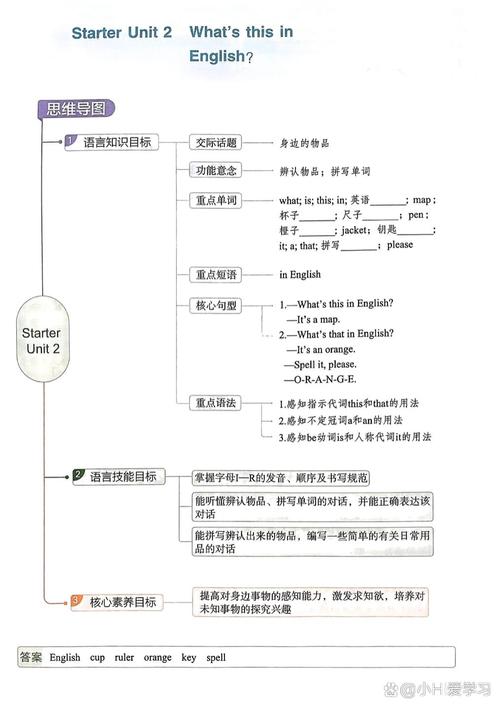
What's this/that in English?(这个/那个用英语怎么说?) ->It's a/an...(它是一个...)How do you spell it?(你怎么拼写它?) ->S-P-E-L-L.(S-P-E-L-L.)Is this/that your...?(这个/那个是你的...吗?) ->Yes, it is. / No, it isn't.(是的,它是。/ 不,它不是。)
谈论喜好
Do you like...?(你喜欢...吗?) ->Yes, I do. / No, I don't.(是的,我喜欢。/ 不,我不喜欢。)I like... (very much).(我(非常)喜欢...)He/She likes...(他/她喜欢...)Why do you like...?(你为什么喜欢...?) ->Because it's... (interesting/funny...)(因为它很有趣/滑稽...)
询问能力
Can you...?(你会...吗?) ->Yes, I can. / No, I can't.(是的,我会。/ 不,我不会。)What can you do?(你会做什么?) ->I can...(我会...)
谈论食物与三餐
What would you like?(你想要点什么?) ->I'd like...(我想要...)What do you have for breakfast/lunch/dinner?(你早餐/午餐/晚餐吃什么?)I have... for breakfast.(我早餐吃...)
第四部分:单元话题总结
- Unit 1: Making Friends (交朋友) - 自我介绍,询问姓名、年龄、来自哪里。
- Unit 2: Family and Home (家庭与家) - 介绍家庭成员,描述人物外貌和性格。
- Unit 3: School Life (学校生活) - 介绍学校设施、课程,谈论学习用品。
- Unit 4: Hobbies and Interests (爱好与兴趣) - 谈论自己的爱好和喜欢/不喜欢的食物。
- Unit 5: Daily Life (日常生活) - 询问和描述日常活动,使用现在进行时(部分教材会引入)。
- Unit 6: Food and Health (食物与健康) - 谈论一日三餐,询问他人想吃的食物,提出建议。
第五部分:易错点与注意事项
-
大小写:
- 句子的第一个单词首字母大写。
- 人称代词
I永远大写。 - 国家、语言、城市、月份、星期等专有名词首字母大写。
can,is,are,do,like等实义动词在句子中首字母不大写。
-
标点符号:
- 英文句号是 ,不是 。
- 英文问号是 ,不是 。
- 注意不要漏掉句末的标点。
-
名词单复数:
- 主语是复数,谓语动词用
are。They are boys. - 主语是单数,谓语动词用
is。He is a boy. - 不可数名词(如
water,milk)作主语时,谓语动词用is。Water is important.
- 主语是复数,谓语动词用
-
a和an的使用:- 记住看的是单词的发音,而不是首字母。
an hour(h 不发音),a university(u 发 /ju:/ 音)。
- 记住看的是单词的发音,而不是首字母。
-
this和that的回答:- 问
Is this...?回答用Yes, it is./No, it isn't.(用it代替this)。 - 问
Is that...?回答同样用it。
- 问
-
like的用法:like后面跟动词时,要使用动词 -ing形式。I like swimming.(我喜欢游泳。)like后面跟名词时,可以直接跟,也可以跟动名词。I like apples./I like eating apples.
希望这份总结对你有帮助!学习英语最重要的是多读、多听、多练、多用,加油!