八年级上英语核心知识点有哪些?
校园之窗 2025年12月11日 11:55:01 99ANYc3cd6
总体特点
八年级上册的英语学习相较于七年级,在词汇量和语法复杂度上都有显著提升,核心是一般过去时和形容词副词的比较级和最高级,这两大语法点贯穿全册。
核心语法点
形容词和副词的比较等级
这是八年级上册最重要、最核心的语法点,几乎每个单元都会涉及。
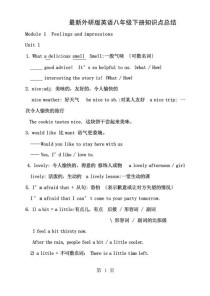
(图片来源网络,侵删)
-
原级
- 构成: 形容词/副词本身。
- 用法:
- 表示“A和B一样...”:
as + adj./adv. + as- 例句: Tom is as tall as his brother.
- 表示“A不如B...”:
not as/so + adj./adv. + as- 例句: This book is not as interesting as that one.
- 表示“A和B一样...”:
-
比较级
- 构成:
- 规则变化:
- 一般词后加
-er(tall -> taller) - 以 e 结尾的加
-r(nice -> nicer) - 以“辅音 + y”结尾的,变 y 为 i 再加
-er(happy -> happier) - 重读闭音节,末尾只有一个辅音字母,双写该辅音再加
-er(big -> bigger)
- 一般词后加
- 不规则变化 (必须熟记):
- good/well -> better
- bad/ill -> worse
- many/much -> more
- little -> less
- far -> farther/further
- 规则变化:
- 用法:
- 表示“A比B更...”:
A + 比较级 + than + B- 例句: He is taller than me.
- 表示“越来越...”:
比较级 and + 比较级- 例句: The weather is getting warmer and warmer.
- 表示“其中最...的一个”:
one of the + 最高级 + 复数名词- 例句: She is one of the most popular girls in our class.
- 表示“A比B更...”:
- 构成:
-
最高级
- 构成:
- 规则变化: 在比较级后加
-est(tall -> tallest) - 不规则变化:
- good/well -> best
- bad/ill -> worst
- many/much -> most
- little -> least
- 规则变化: 在比较级后加
- 用法:
- 表示“在...范围内最...”:
the + 最高级 + (in/of...)- 例句: This is the best movie I have ever seen. (in the world)
- 表示“在...范围内最...”:
- 构成:
一般过去时
这是另一个核心语法点,用于描述过去某个时间发生的动作或存在的状态。
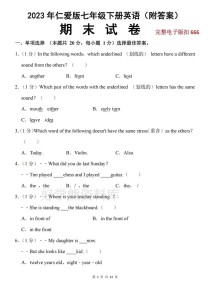
(图片来源网络,侵删)
- 构成:
主语 + 动词的过去式 + 其他 - 动词过去式的变化:
- 规则变化:
- 直接加
-ed(work -> worked) - 以 e 结尾的加
-d(live -> lived) - “辅音 + y”变 y 为 i 再加
-ed(study -> studied) - 重读闭音节,末尾一个辅音字母,双写再加
-ed(stop -> stopped)
- 直接加
- 不规则变化 (必须背熟,如:go-went, see-saw, eat-ate, have-had, do-did, take-took 等)
- 规则变化:
- 时间状语:
yesterday, the day before yesterday, last night/week/month/year, ... ago, in + 过去的年份等。- 例句: I went to the park yesterday.
情态动词 can 的过去式 could
- 用法: 表示过去的能力或许可。
- 例句: When I was five, I could swim. (能力)
- 例句: Could you help me with my homework yesterday? (许可,比 Can 更委婉)
频度副词
- 位置: 通常放在 be 动词、情态动词、助动词之后,实义动词之前。
- 频率从高到低排序:
always(总是) ->usually( ->often(经常) ->sometimes(有时) ->hardly ever(几乎不) ->never(从不)- 例句: I am always busy on weekends. / I usually get up at 6:30. / He sometimes plays basketball after school.
不定代词
- some / any:
some多用于肯定句,any多用于否定句和疑问句。- 但在表示请求或建议的疑问句中,常用
some。- 肯定句: I have some books.
- 疑问句: Do you have any questions? / Would you like some coffee?*
- few / a few / little / a little:
few / a few修饰可数名词。few(几乎没有,表否定) -> Few people like this idea.a few(有几个,表肯定) -> I have a few friends here.
little / a little修饰不可数名词。little(几乎没有,表否定) -> There is little water in the bottle.a little(有一点,表肯定) -> I can speak a little French.
动词不定式
- 用法: 常跟在
want, would like, hope, plan, decide, try等动词后面,表示“想要做某事”。- 结构:
want/like + to do sth. - 例句: I want to buy a new phone. / He decided to learn the piano.
- 结构:
各单元核心知识点与短语
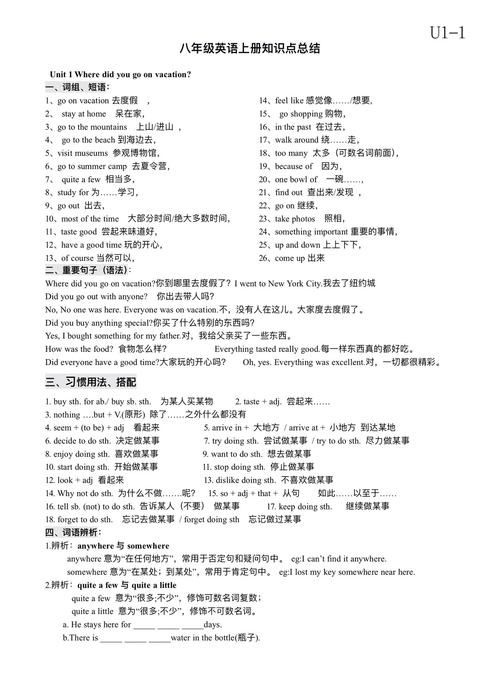
Unit 1: Where did you go on vacation? (谈论假期活动)
- 核心词汇:
anyone, anywhere, wonderful, quite, few, most, something, nothing, everyone, of course, myself, yourself - 核心句型:
Did you/he/she/it + 动词原形 + ...?(一般过去时疑问句)Yes, I/he/she/it did. / No, I/he/she/it didn't.Where did + 主语 + go...?
- 重点短语:
go on vacation去度假go to the mountains去爬山go to the beach去海滩visit museums参观博物馆quite a few相当多,不少 (修饰可数名词)because of因为,由于one of + the + 最高级 + 复数名词最...的之一feel like感觉像;想要
Unit 2: How often do you exercise? (谈论日常活动与频率)
- 核心语法: 频度副词 (见上文)
- 核心词汇:
habit, lifestyle, such, maybe, less, than, same, as, different, difference, probably, although, must, for, example, junk food, coffee, health, result, percent, online, television, mind, body, such as - 核心句型:
How often do you + 动词原形 + ...?(询问频率)What do you usually do on weekends?I try to eat it less than once a week.
- 重点短语:
how often多久一次exercise锻炼surf the internet上网watch TV看电视go shopping购物do homework做作业use the Internet使用互联网junk food垃圾食品coffee咖啡health健康a healthy lifestyle健康的生活方式the same as与...相同different from与...不同of course当然look after照顾be good for对...有益be bad for对...有害
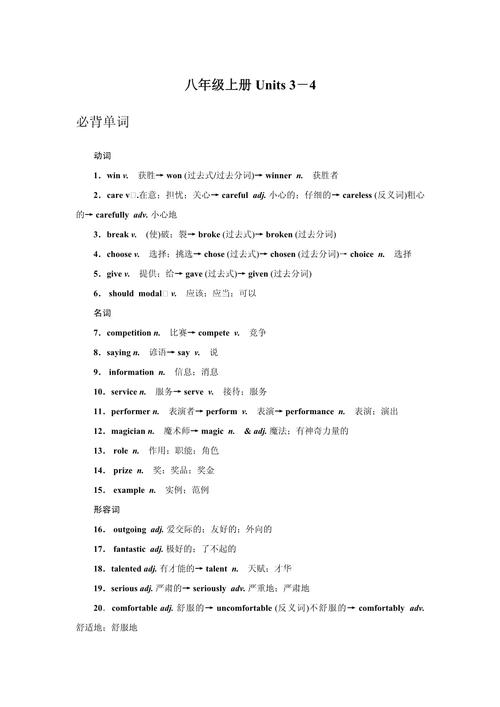
Unit 3: I'm more outgoing than my sister. (人物比较)
- 核心语法: 形容词副词的比较级和最高级 (全册重点)
- 核心词汇:
outgoing, better, loudly, quietly, hard-working, competition, fantastic, which, clearly, win, though, talent, care, about, same, as, as...as,mirror, kid, both, speak, so, primary, school, information, score, race, fantastic, which, clearly, win, though, talent, care, about, friendship, should, break, touch, trust, heart - 核心句型:
A + be + 比较级 + than + B(A比B更...)A + be as + adj. + as + B(A和B一样...)Who is + 比较级, A or B?(谁更...,A还是B?)
- 重点短语:
more outgoing更外向more hard-working更勤奋both...and......和...两者都as...as和...一样the same as与...相同make friends交朋友be good at擅长于care about关心,在乎be similar to与...相似bring out使显现;取出
Unit 4: What's the best movie theater? (谈论场所与喜好)
- 核心语法: 形容词副词的最高级
- 核心词汇:
comfortable, seat, screen, close, ticket, worst, service, creative, boring, famous, success, take, seriously, be, ready, for, example, report, hope, win, prize, so-called, deal, manager, example, talent, make, up, - 核心句型:
What's the best + 名词 + 地点?(询问...最好的地方是哪里?)Which do you prefer, A or B?(你更喜欢A还是B?)A is the best (in...)(A是最好的)
- 重点短语:
movie theater电影院comfortable seats舒适的座位big screen大屏幕best/worst最好的/最差的have the best service有最好的服务be close to离...近buy tickets买票choose the movie选择电影think of认为,考虑do a survey做调查so-called所谓的all kinds of各种各样的around the world全世界
Unit 5: Do you want to watch a game show? (谈论喜好与意愿)
- 核心语法: 动词不定式 (
want to do, hope to do, plan to do) - 核心词汇:
sitcom, news, soap, opera, stand, up, comedy, famous, appear, become, rich, might, main, reason, unlucky, lose, ready, famous, character, ready, to, do, sth., expect, joke, may, culture, famous, appear, become, rich, might, main, reason, unlucky, lose, ready, famous, character, expect, joke, may, culture, famous, appear, become, rich, might, main, reason, unlucky, lose, ready, famous, character, expect, joke, may, culture - 核心句型:
Do you want to + 动词原形 + ...?(你想...吗?)What do you think of...?/How do you like...?(你认为...怎么样?)I hope to + 动词原形 + ...(我希望...)
- 重点短语:
game show游戏节目talk show谈话节目sitcom情景喜剧soap opera肥皂剧sports show体育节目learn from...向...学习find out查出,发现expect to do sth.期望做某事plan to do sth.计划做某事want to do sth.想要做某事be ready to do sth.准备好做某事one day有一天,将来某一天
Unit 6: I'm watching TV. (现在进行时)
- 核心语法: 现在进行时
- 构成:
am/is/are + 动词ing - 用法: 表示说话时正在进行的动作。
- 时间状语:
now, at the moment, look! listen!等。
- 构成:
- 核心词汇:
use, wash, dish, movie, just, eat, somebody, anyone, kid, study, pool, shop, supermarket, man, race, host, study, test, - 核心句型:
What are you doing?(你正在做什么?)I'm + 动词ing + ...(我正在...)Is he/she/it + 动词ing + ...?(他/她/它正在...吗?)
- 重点短语:
do one's homework做作业clean the room打扫房间wash the dishes洗碗make soup做汤talk on the phone打电话use the computer使用电脑read a newspaper看报纸go to the movies去看电影read a book读书make a list列清单make dinner做晚饭
Unit 7: It's raining! (谈论天气)
- 核心词汇:
weather, rainy, windy, cloudy, sunny, snow, cook, bad, park, message, take, a, message, could, tell, he, call, back, him, problem, dry, cold, hot, go, to, a, party, study, for, a, test, have, the, flu, lie, down, rest, - 核心句型:
How's the weather?/What's the weather like?(天气怎么样?)It's + adj.(天气是...)It's + v-ing.(正在...)
- 重点短语:
How's the weather?天气怎么样?What's the weather like?天气怎么样?sunny晴朗的cloudy多云的rainy下雨的windy刮风的snowy下雪的hot热的cold冷的cook烹饪study for a test备考have the flu患流感lie down躺下take a message捎个口信call back回电话right now马上
Unit 8: How do you make a banana milk shake? (制作流程)
- 核心语法: 祈使句 和
how引导的特殊疑问句 - 核心词汇:
shake, milk, shake, blender, turn, on, peel, pour, yogurt, honey, watermelon, spoon, add, finally, salt, - 核心句型:
How do you make...?(你如何制作...?)First/Next/Then/Finally...(接下来/最后...)- 祈使句:
Open the door./Don't be late.
- 重点短语:
make a banana milk shake制作香蕉奶昔turn on打开 (电器)peel a banana剥香蕉pour...into...把...倒入...put...in...把...放进...add...to...把...加到...mix up混合在一起cut up切碎a slice of bread一片面包a cup of yogurt一杯酸奶one teaspoon of honey一茶匙蜂蜜
Unit 9: Can you come to my party? (发出邀请与回应)
- 核心语法:
can和have to的用法 - 核心词汇:
prepare, exam, flu, available, another, weekday, hang, the, weekend, the, day, after, tomorrow, look, forward, to, - 核心句型:
Can you + 动词原形 + ...?(你能...吗?)Sure, I'd love to. / Sorry, I can't. I have to + 动词原形 + ...(好的,我很乐意。/ 抱歉,我不能,我必须...)I'm sorry, I can't. I'm + v-ing.(抱歉,我不能,我正在...)
- 重点短语:
go to the party去参加聚会prepare for an exam准备考试the day after tomorrow后天the day before yesterday前天look forward to期待hang out闲逛,外出玩another time其他时间have to do sth.不得不做某事
Unit 10: If you go to the party, you'll have a great time! (条件句)
- 核心语法: if 引导的条件状语从句 (第一类条件句)
- 结构:
If + 主语 + 一般现在时, 主语 + will + 动词原形 + ... - 用法: 表示如果具备某个条件,就会发生某事。
- 结构:
- 核心词汇:
let, half, potato, chip, chocolate, upset, taxi, advice, travel, agent, get, an, idea, organize, class, tour, the, school, dance, raise, money, expert, - 核心句型:
If you + do..., you will + ...(如果你...,你将会...)If you do that, you'll be sorry.(如果你那么做,你会后悔的。)
- 重点短语:
let's do sth.让我们做某事吧take the bus乘公交车half the class班里的一半人make a video制作一个视频give advice提建议be upset沮丧的,难过的travel agent旅行代理人organize a party组织一场聚会the school dance学校舞会raise money筹钱
学习建议
- 词汇为王: 每天坚持背诵单词,并结合课文和例句来理解和记忆。
- 语法为纲: 对于比较级、最高级、一般过去时等核心语法,多做专项练习,直到完全掌握规则和用法。
- 开口说,动手写: 不要只停留在“看懂”,要尝试用学过的句型和词汇进行口头表达和书面写作,可以写日记、小短文。
- 整理错题本: 将做错的题目抄录下来,分析错误原因,定期复习,避免再犯。
- 利用好课本: 课本是最好的学习材料,反复朗读课文,培养语感,熟悉句型结构。
希望这份详细的总结能对你的八年级英语学习有所帮助!加油!
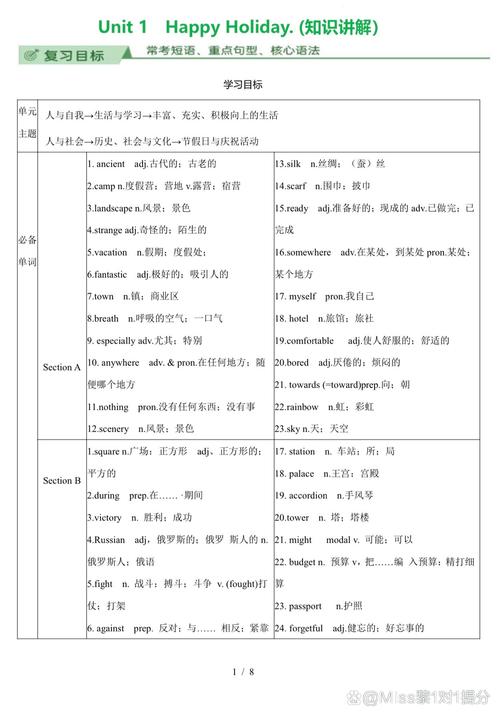
(图片来源网络,侵删)