九年级英语13单元课件重点是什么?
校园之窗 2025年12月19日 04:13:39 99ANYc3cd6
九年级英语第13单元的主题通常是 We're trying to save the earth!,核心围绕“环境保护”展开,旨在引导学生学习如何讨论环境问题,并提出解决方案。
九年级英语 Unit 13 We're trying to save the earth! 课件详解
第一部分:单元整体分析
- 单元主题: 环境保护
- 核心话题: 讨论环境问题、污染的来源、影响以及我们能采取的环保行动。
- 语言功能:
- 表达现状和问题: "The river is polluted." "There is too much trash."
- 提出原因和结果: "Because people throw litter into it." "This kills fish and affects the environment."
- 表达担忧和感受: "I'm worried about..." "It makes me sad."
- 提出解决方案和建议: "We should/shouldn't..." "We need to..." "Let's..."
- 表达努力和尝试: "We are trying to..." "He is working on..."
- 重点词汇:
- 环境问题:
pollution,litter,trash,waste,rubbish - 污染类型:
air pollution,water pollution,light pollution,noise pollution - 动词:
throw,recycle,reuse,reduce,save,protect,affect,harm,pollute - 名词:
environment,plastic,bottle,bag,fish,factory,energy,paper - 形容词/副词:
ugly,dirty,noisy,harmful,important,quickly,badly
- 环境问题:
- 重点句型/语法:
- 现在进行时表将来: "I'm meeting him tomorrow." (Unit 11复习,但在本单元讨论未来计划时复现)
- 情态动词
should的用法:We should recycle bottles. used to和now的对比: "Thereused to bemany fish in the river, but now therearenone."- 原因状语从句:
Because of .../Because ... make的用法:make + 宾语 + 形容词(e.g.,It makes me angry.)
第二部分:分课时课件内容设计 (建议4-5课时)
第一课时:Section A 1a-2d (导入与基础)
教学目标:
(图片来源网络,侵删)
- 学生能够识别并说出常见的环境问题词汇。
- 学生能够运用
What's the matter?和There is...句型描述环境问题。 - 学生能够初步了解污染的来源。
课件流程:
-
Warming-up & Lead-in (5分钟)
- 图片/视频导入: 展示两组对比强烈的图片或短视频:
- A: 干净美丽的河流、蓝天白云、绿树成荫。
- B: 漂满垃圾的河流、灰蒙蒙的天空、堆积如山的垃圾。
- 提问: "What can you see in the two pictures? How do they make you feel?" 引导学生说出
dirty,ugly,sad,worried等词。 - 揭示主题: "Yes, our environment is in danger. Today we are going to talk about how to save the earth."
- 图片/视频导入: 展示两组对比强烈的图片或短视频:
-
Presentation (15分钟)
- 词汇教学:
- 展示
pollution的图片,引出air pollution,water pollution,noise pollution,light pollution。 - 展示
litter,trash,rubbish的图片,进行辨析(litter指乱扔的杂物,trash/rubbish指垃圾)。 - 教授
throw...into...(e.g.,Don't throw litter into the river.)。
- 展示
- 句型操练:
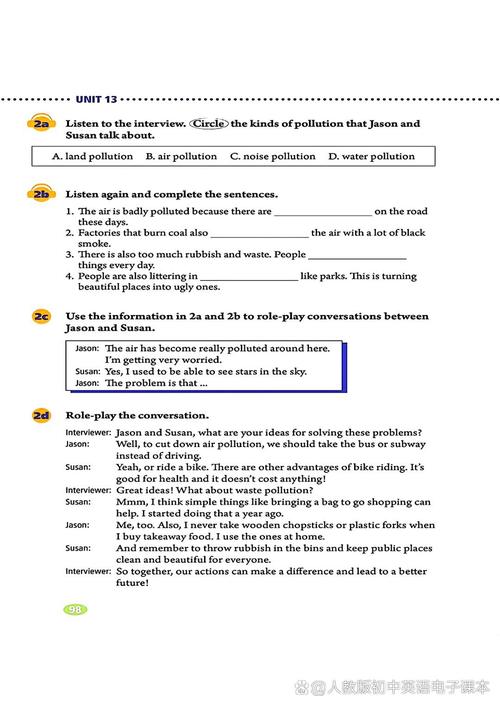
- 1a: 展示课本图片,让学生匹配问题与图片。
- 1b: 播放录音,让学生听对话,圈出听到的问题,然后跟读模仿。
- 句型展示:
What's the matter with the river?->It's polluted./There is too much trash in it.
- 词汇教学:
-
Practice (10分钟)
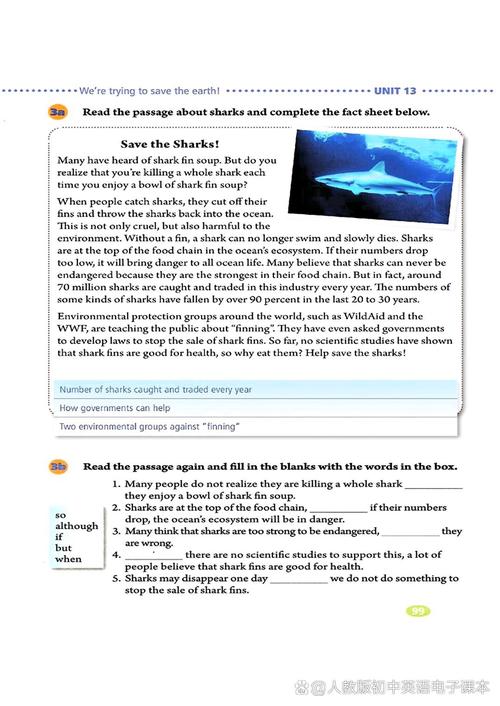 (图片来源网络,侵删)
- Pair Work: 学生两人一组,使用
What's the matter with...?和It's...句型练习对话,讨论课本中的其他图片。 - 2a & 2b: 听力练习,让学生听出人们为什么对环境问题感到担忧,重点讲解
make + 宾语 + 形容词结构 (It makes me worried.)。
- Pair Work: 学生两人一组,使用
-
Production & Summary (10分钟)
- 2c: 学生根据2a和2b的信息,进行角色扮演,采访同学对环境问题的看法。
- 课堂小结: 快速回顾本节课学习的核心词汇和句型,布置作业:预习2d,并思考自己家乡的环境问题。
第二课时:Section A 3a-4c (阅读与语法)
教学目标:
- 学生能够理解文章大意,获取关于河流污染的具体信息。
- 学生能够掌握并运用
used to...和now...进行对比。 - 学生能够用
should提出环保建议。
课件流程:
-
Revision (5分钟)
 (图片来源网络,侵删)
- 快速提问上节课内容:"What are the environmental problems we talked about?"
- 引入新话题:"Let's read a story about a river."
-
Reading (15分钟)
- Pre-reading: 展示
river的图片,提问:"Was it like this 10 years ago? How was it different?" 引出used to。 - While-reading:
- 3a: 学生快速阅读文章,回答主旨问题:"What is the passage about?"
- Careful-reading: 学生再次细读,完成课本上的表格,对比河流过去和现在的状况,这是本课的重点。
- 过去:
used to be clean,fish could live in it,people swam in it -
is polluted,is dirty,fish have gone,people can't swim
- 过去:
- Post-reading: 学生讨论污染的原因 (
factories,people,waste)。
- Pre-reading: 展示
-
Grammar Focus (10分钟)
- 语法聚焦: 在黑板上清晰呈现
used to do的结构和用法。- 含义: 过去常常做某事,但现在不做了。
- 句型:
S + used to + 动词原形... - 对比:
It used to be very quiet.->Now it is very noisy.
- 练习: 让学生用
used to和now造句,描述自己或身边事物的变化。
- 语法聚焦: 在黑板上清晰呈现
-
Practice & Production (10分钟)
- 4a: 语法填空练习,巩固
used to的用法。 - 4b: 学生小组讨论,使用
We should...和We shouldn't...提出至少3条保护河流的建议。e.g., "We shouldn't throw trash into the river." "We should tell people not to build factories near the river."
- 4c: 写作练习,让学生写一段话,描述自己家乡或学校附近环境的变化,并提出建议。
- 4a: 语法填空练习,巩固
第三课时:Section B 1a-2e (拓展与深化)
教学目标:
- 学生能够学习并使用
reduce,reuse,recycle等环保行动词汇。 - 学生能够听懂关于环保行动的对话,获取具体信息。
- 学生能够阅读文章,了解个人在环保中的作用。
课件流程:
-
Lead-in (5分钟)
- 头脑风暴: "Now we know the problems. What can we do to help?" 在黑板上写下学生的所有建议。
- 引入3R原则: 展示三个标志:循环箭头(Recycle)、两个弯曲箭头(Reuse)、一个向下的箭头(Reduce),教授这三个核心词汇。
-
Listening (10分钟)
- 1e & 2a: 播放录音,让学生听出人们在做什么环保行动 (
turn off the lights,take your own bags,use paper cups)。 - 2b: 再次听录音,完成表格,记录每个人在做什么,以及为什么这么做 (
save energy,less pollution)。
- 1e & 2a: 播放录音,让学生听出人们在做什么环保行动 (
-
Reading (15分钟)
- Pre-reading: 展示一张巨大的垃圾填埋场图片,提问:"Is this the only way to deal with trash?" 引出
recycle。 - While-reading:
- 2c: 学生快速阅读文章,找出文章的中心思想。
- Careful-reading: 学生仔细阅读,回答细节问题:"How many ways are mentioned to deal with trash?" "What are they?" (Landfill, Recycling, Reduce, Reuse)。
- Language Points: 讲解文章中的重点词组和句子,如
put...into the ground,harmful to the environment,make a difference。
- Pre-reading: 展示一张巨大的垃圾填埋场图片,提问:"Is this the only way to deal with trash?" 引出
-
Discussion & Summary (5分钟)
- 小组讨论: "Which way do you think is the best? Why?" 鼓励学生表达自己的观点。
- 强调个人行动的重要性,
Everyone can make a difference.
第四课时:Section B 3a-Self Check (写作与复习)
教学目标:
- 学生能够根据提示,写一篇关于环保问题的短文。
- 学生能够复习并巩固本单元的重点词汇和语法。
- 学生能够进行自我检测,查漏补缺。
课件流程:
-
Writing (20分钟)
- 3a: 分析写作任务和要求。
- 头脑风暴与结构搭建:
- 开头: 引出话题 (e.g., "Our town has a beautiful park, but it has some problems now.")
- 主体1 (问题): 描述问题是什么,为什么发生 (e.g., "There is too much litter... People always throw bottles and bags on the grass.")
- 主体2 (影响): 描述问题带来的影响 (e.g., "It makes the park look ugly. It's also bad for the animals.")
- 主体3 (建议): 提出解决方案 (e.g., "We should put up signs to tell people not to litter. We should also have a 'Clean-up Day'...")
- 表达希望 (e.g., "I hope everyone can help to make our park clean and beautiful again.")
- 学生写作: 给出15-20分钟时间让学生完成写作。
- 同伴互评: 交换作文,根据评分标准(内容、语法、词汇)进行评价。
-
Review (15分钟)
- Self Check: 学生独立完成Self Check的练习,然后核对答案。
- 重点讲解: 针对学生普遍出错的问题进行集中讲解,特别是
used to和should的用法。 - 词汇游戏: 快速闪现单词卡片,让学生说出中文意思或造句。
-
Homework:
- 修改自己的作文,并誊写一遍。
- 预习下一单元内容。
第三部分:教学建议与补充
- 多媒体资源: 充分利用视频(如《地球脉动》片段)、纪录片(如《塑料海洋》)、新闻图片等,使课堂更生动,更有冲击力。
- 联系实际: 鼓励学生讨论自己生活中的环保问题,如学校的垃圾分类、一次性餐具的使用等,让学习内容与生活紧密相连。
- 项目式学习: 可以布置一个长期的环保项目,如“家庭一周垃圾调查”、“制作环保海报”、“策划校园环保周”等,将课堂所学付诸实践。
- 情感态度: 在教学中始终贯穿爱护环境、从我做起的情感教育,培养学生的社会责任感。
这份课件框架希望能帮助您更好地准备和开展九年级英语第13单元的教学工作!