八年级上册英语第一次月考重点难点有哪些?
校园之窗 2025年12月13日 08:17:43 99ANYc3cd6
下面我为你梳理一下八年级上册英语第一次月考的核心考点、备考策略、模拟题和注意事项,希望能帮你高效复习,信心满满地走进考场!
核心考点分析(通常会考什么?)
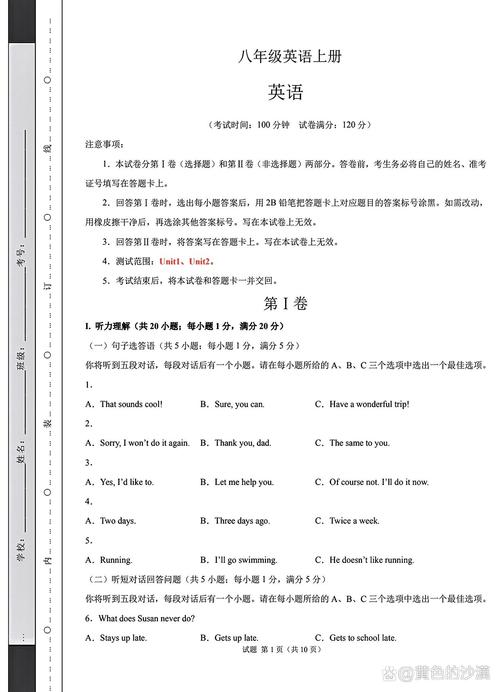
八年级上册的第一次月考,内容通常覆盖前两个单元,也就是 Unit 1 和 Unit 2。
Unit 1: Where did you go on vacation? (你去哪儿度假了?)
这个单元的核心是一般过去时,是整个八年级的重点和难点。
-
核心词汇:
- 名词: vacation, beach, pool, museum, exam, center, country, nature, student, guide, wonder, dislike, interest, night, favorite, wait, umbrella, wet, because of, below, enough, duck, decide, feel, like, paragliding, bird, bicycle, building, trader, difference, top, wait, worry, tomorrow, fire, paint, as, student, report, lucky, expensive, cheap, crowded, terrible, expensive, cheap, crowded, terrible, boring, famous, important, most, wide, enough, duck, decide, feel, like, paragliding...
- 动词: decide, try, paraglide, feel, walk, fly, take, buy, wait, worry, start, stop, get, do, go, see, eat, drink, have, is/am/are -> was/were, have -> had
- 形容词: beautiful, boring, crowded, expensive, cheap, terrible, famous, important, wonderful, lucky, hungry, tired
- 不定代词: something, anything, nothing, everybody, someone
- 短语: go on vacation, stay at home, go to the mountains, go to the beach, visit museums, go to summer camp, quite a few, most of, of course, because of, in the past, feel like, one of, all day, have a great time, take photos, buy something for sb., a lot of, something different, walk up to... at the top of, get a table, wait for, in the end, make a decision, start doing sth., stop doing sth., decide to do sth., feel like doing sth.
-
核心语法:
- 一般过去时: 这是本单元的重中之重!你需要掌握其构成和用法。
- 肯定句: 主语 + 动词过去式 + 其他.
- I went to the mountains. / They bought some gifts.
- 否定句: 主语 + didn't + 动词原形 + 其他.
- I didn't go anywhere. / She didn't have a good time.
- 一般疑问句: Did + 主语 + 动词原形 + 其他?
- Did you go to the beach? / Did he find a new job?
- 特殊疑问句: 特殊疑问词 + did + 主语 + 动词原形 + 其他?
- Where did you go? / What did she do?
- 肯定句: 主语 + 动词过去式 + 其他.
- 不定代词: something, anything, nothing, somebody, nobody 等,注意它们在句中作主语时,谓语动词用单数。
- 不定式:
decide to do sth.(决定做某事),start/stop/finish doing sth.(开始/停止/结束做某事),want/hope to do sth.(想要/希望做某事),feel like doing sth.(感觉想做某事)。
- 一般过去时: 这是本单元的重中之重!你需要掌握其构成和用法。
Unit 2: How often do you exercise? (你多久锻炼一次?)
这个单元的核心是频率副词和一般现在时。

-
核心词汇:
- 频率副词: always (总是), usually (, often (经常), sometimes (有时), hardly ever (几乎不), never (从不)。频率由高到低:always > usually > often > sometimes > hardly ever > never
- 动词短语: exercise, go skateboarding, stay up late, eat vegetables, drink milk, look after, help with (housework), use the Internet, go to the movies, get up early, be late for, do homework, take a walk, play sports
- 名词: habit, health, lifestyle, program, result, difference, percentage, junk food, coffee, cola, dentist, tooth, magazine, mind, body, such as, less than, more than, about, maybe, same, as...as, different from, though, together, die, writer, dentist
- 形容词: healthy, unhealthy, free, full, important, same, different, popular, famous
-
核心语法:
- 频率副词: 掌握它们的用法和频率排序,以及它们在句中的位置(通常放在实义动词前,be动词后)。
- I always get up at 6:00.
- He is usually late for school.
- How often...? 句型: 询问做某事的频率。
- A: How often do you exercise? (你多久锻炼一次?)
- B: I exercise every day. (我每天都锻炼。) / Twice a week. (一周两次。)
help (sb.) with sth.结构: 帮助某人做某事。- My father helps me with my math. (我爸爸帮助我学数学。)
It's + adj. + for sb. + to do sth.结构: 做某事是……的。- It's important for us to eat vegetables. (吃蔬菜很重要。)
- 比较级:
as...as...和……一样 (同级比较)- My lifestyle is the same as yours. / I am as tall as my brother.
different from...与……不同- His lifestyle is different from mine.
- 频率副词: 掌握它们的用法和频率排序,以及它们在句中的位置(通常放在实义动词前,be动词后)。
备考策略与建议(怎么复习?)
-
回归课本,夯实基础:
- 单词: 把两个单元的单词表从头到尾过一遍,做到“四会”(会读、会拼、会写、会用),可以利用单词卡片或APP(如百词斩、扇贝)来记忆。
- 短语: 重点记忆课本上的短语和固定搭配,这是完形填空和写作的得分点。
- 课文: 大声朗读课文,最好能背诵重点段落,这有助于培养语感,同时也能巩固语法和词汇。
-
梳理语法,构建体系:
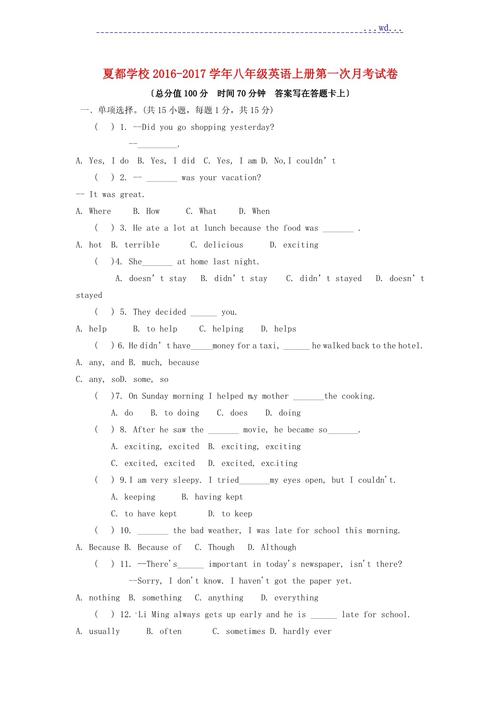 (图片来源网络,侵删)
- Unit 1: 画一个表格,对比一般现在时和一般过去时在be动词、实义动词、否定句和疑问句上的区别,这是最容易混淆的地方。
- Unit 2: 把频率副词按频率高低排序,并造句练习,重点掌握
How often...?和help sb. with sth.等核心句型。
-
专项练习,查漏补缺:
- 听力: 每天坚持听10-15分钟课本录音或简单的英语新闻/故事,熟悉语速和发音。
- 单选: 专项练习时态、介词、代词等语法点,总结错题原因。
- 完形填空: 注意上下文的逻辑关系和固定搭配。
- 阅读理解: 先看问题,再带着问题去文章中找答案,练习快速定位信息的能力。
- 词汇运用: 根据句意和首字母提示写单词,注意时态和单复数变化。
- 书面表达: 这是拉分项!务必动手写!
- 准备模板: 准备一篇关于“我的周末/假期”和“我的生活习惯”的范文,背诵其中的好词好句和万能句型。
- 注意结构: 作文要有开头、主体和结尾,时态要准确(Unit 1用过去时,Unit 2用一般现在时)。
- 书写工整: 卷面整洁会给阅卷老师留下好印象。
-
整理错题,回顾反思:
准备一个错题本,把平时练习和考试中的错题抄录下来,并写下正确答案和解析,考前重点看错题本,避免在同一个地方摔倒两次。
模拟试题(练一练)
单项选择
-
— __ did you go last weekend? — I went to the beach. A. What B. Where C. When D. How
-
My father didn't __ his car yesterday. He took the subway to work. A. drive B. drives C. drove D. driving
-
— __ do you watch TV? — I watch TV once a week. A. How long B. How often C. How many D. How much
-
It's important __ us to eat a balanced diet. A. for B. of C. to D. at
-
Eating vegetables is good __ your health. A. at B. for C. with D. to
完形填空
Last summer vacation, I went to Beijing 6 my family. We 7 there by train. The weather was very 8 , so we walked a lot. We 9 many places, such as the Great Wall, the Summer Palace and Tian'anmen Square. 10 was great! We took lots of photos 11 bought some gifts. 12 the last day, we felt a little 13 because we walked for about eight hours. But we were very 14 . It was a wonderful vacation and I hope to 15 there again.
-
A. to B. with C. for D. at
-
A. go B. went C. goes D. going
-
A. hot B. cold C. rainy D. sunny
-
A. visit B. visited C. visiting D. visits
-
A. He B. She C. It D. They
-
A. but B. and C. so D. or
-
A. At B. In C. On D. For
-
A. tired B. happy C. excited D. hungry
-
A. sad B. busy C. lucky D. tired
-
A. go B. went C. going D. goes
阅读理解
Lisa is a 14-year-old girl. She has some good habits, but she also has some bad habits.
Let's talk about her good habits first. Lisa exercises every day. She usually runs for half an hour in the morning. She hardly ever eats junk food like hamburgers or French fries. She eats vegetables and fruit every day. She also sleeps nine hours every night, so she always feels energetic in class.
However, Lisa has some bad habits, too. She uses the Internet for about three hours every evening. She sometimes stays up late to watch movies. She hardly ever helps her mother with housework. She also drinks coffee every morning, which is not good for her health.
Lisa knows she should change her bad habits. She decides to use the Internet less and help her mom more. She also wants to drink milk instead of coffee. We all hope she can have a healthier lifestyle. 判断下列句子正误,正确的写“T”,错误的写“F”。
- Lisa is thirteen years old. ( F )
- Lisa eats vegetables and fruit every day. ( T )
- Lisa uses the Internet for about two hours every evening. ( F )
- Lisa helps her mother with housework every day. ( F )
- Lisa wants to drink milk instead of coffee. ( T )
书面表达
假设你是李华,请根据下面的提示,写一篇60-80词的短文,介绍一下你上周末的活动。
提示:
- 上周末天气很好。
- 周六上午和爸爸去了博物馆,下午在家做作业。
- 周日和朋友们去公园踢足球,玩得很开心。
- 周一早上感觉有点累,但是很快乐。
要求:
语句通顺,语法正确,必须包含所有提示信息。
参考范文:
Last weekend was great. On Saturday morning, the weather was sunny. I went to the museum with my father. In the afternoon, I did my homework at home. On Sunday, I played soccer with my friends in the park. We had a lot of fun. On Monday morning, I felt a little tired, but I was very happy.
考场注意事项
- 心态平稳: 拿到试卷后,深呼吸,先通览全卷,做到心中有数。
- 认真审题: 看清题目要求,特别是选择题,注意问的是“正确”还是“不正确”。
- 书写规范: 保持卷面整洁,字母大小写、标点符号要清晰。
- 时间分配: 合理安排时间,遇到难题可以先跳过,做完会做的再回来思考,最后一定要留出时间检查。
- 检查复查: 检查是否有漏做的题目,单词拼写是否正确,时态、单复数等细节是否出错。
同学,第一次月考是检验你学习的好机会,也是一次查漏补缺的契机,只要认真复习,沉着应战,你一定能取得优异的成绩!加油!祝你考试顺利!