八年级人教版英语上册教案如何高效设计?
校园之窗 2025年12月10日 21:03:27 99ANYc3cd6
八年级人教版英语上册整体教学规划与教案
整体教学分析
-
教材分析:
- 主题:本册教材围绕学生的日常生活、兴趣爱好、健康生活、未来规划、文化交流等话题展开,内容贴近学生实际,易于激发学习兴趣。
- 结构:每个单元分为 Section A 和 Section B,Section A 侧重于基础词汇、核心句型和听、说、读的基本训练;Section B 则在 Section A 的基础上进行拓展,增加了阅读、写作和更复杂的语言运用活动。
- 语法重点:
- 一般将来时 (be going to / will)
- 情态动词 (can, could, should, might)
- 过去进行时
- 比较级和最高级
- 现在完成时初步接触
-
学情分析:
 (图片来源网络,侵删)
- 优势:经过七年级的学习,学生已具备一定的英语词汇基础和简单的句型结构知识,对英语学习有初步的兴趣和认知。
- 挑战:八年级学生出现明显的“两极分化”现象,部分学生基础扎实,求知欲强;另一部分学生则可能因难度增加而产生畏难情绪,学生的自主学习能力和合作探究能力有待进一步培养。
-
教学目标:
- 知识与技能:
- 掌握本册核心词汇和短语,能在听、说、读、写中灵活运用。
- 熟练掌握并运用本册重点语法项目。
- 能听懂接近正常语速的关于熟悉话题的语段和简短故事。
- 能就熟悉的话题进行简单的交流,提供信息并表达自己的观点。
- 能读懂不同体裁的语篇材料,理解主要意思和关键信息。
- 能根据提示或图片写出简单的段落,描述事物或表达个人看法。
- 过程与方法:
- 通过任务型教学法、情景教学法、合作学习法等多种方式,引导学生在“做中学”,主动探究和构建知识。
- 培养学生的自主学习能力、合作精神和创新思维。
- 情感态度与价值观:
- 培养学生学习英语的积极态度和自信心。
- 了解中西方文化差异,培养跨文化交际意识。
- 树立正确的价值观,如热爱生活、关爱他人、健康生活、勇于追梦等。
- 知识与技能:
-
教学重难点:
- 重点:核心词汇的运用、重点语法项目的掌握、听力和阅读技能的培养。
- 难点:
- 比较级和最高级的规则与不规则变化。
- 情态动词
should和might等表达建议和推测的用法。 - 过去进行时与一般过去时的区别。
- 在写作中综合运用所学知识,做到表达准确、连贯。
核心课文详细教案(以 Unit 6 "I'm watching TV." 为例)
Unit 6 I'm watching TV.
课题信息
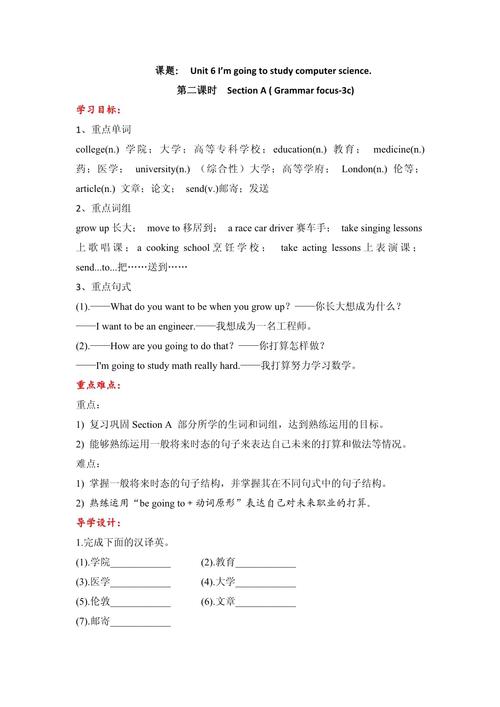
- 课题名称:Unit 6 I'm watching TV. (第一课时 Section A 1a-2c)
- 课型:新授课
- 授课年级:八年级上册
教学目标
(图片来源网络,侵删)
- 语言知识目标:
- 词汇:掌握
watching, cleaning, reading, swimming, shopping, sleeping等现在分词形式的动词短语。 - 句型:掌握并熟练运用现在进行时询问和回答正在进行的动作:
- — What are you doing?
- — I'm watching TV.
- — What is he/she doing?
- — He/She is reading.
- 词汇:掌握
- 语言技能目标:
- 听:能听懂包含现在进行时的简短对话,获取关键信息。
- 说:能运用现在进行时谈论自己和他人正在做的事情。
- 读:能看懂图片和简短的描述性文字。
- 情感态度目标:
引导学生观察生活,乐于用英语描述日常活动,培养学习英语的积极性和自信心。
教学重难点
- 教学重点:
- 现在进行时的构成:
am/is/are + V-ing。 - 核心句型
What are you doing? I'm...的运用。
- 现在进行时的构成:
- 教学难点:
- 现在分词 (
-ing) 的构成规则,特别是双写辅音字母加-ing的情况(如running,swimming)。 - 在实际情景中灵活运用现在进行时。
- 现在分词 (
教学准备
- 多媒体课件
- 单词卡片或图片卡片
- 录音机或音频播放设备
教学过程
(图片来源网络,侵删)
| 教学环节 | 教师活动 | 学生活动 | 设计意图 |
|---|---|---|---|
| Step 1: Lead-in (热身导入) | Greeting: "Good morning, class! How are you today?" Play a short video or show some pictures of people doing different activities (e.g., a boy playing basketball, a girl singing, a cat sleeping). Ask: "Look! What is he/she doing? Can you guess?" 引导学生用中文回答,引出“正在做某事”的概念。 |
Greet the teacher and answer. Watch the video/pictures and try to describe the actions in Chinese. Think and answer the teacher's question. |
通过直观的视听材料,吸引学生注意力,自然地引出本课主题“正在进行的动作”,为新知识的学习做好铺垫。 |
| Step 2: Presentation (新知呈现) | Vocabulary Presentation: Show a picture of someone watching TV. Say and write on the PPT: "He is watching TV." Teach the phrase watch TV and the -ing form watching. In the same way, present other phrases: cleaning the room, reading a book, swimming, shopping, sleeping.Focus on the spelling rules of -ing: 一般直接加-ing (reading), 以不发音e结尾去e加-ing (cleaning), 重读闭音节且末尾只有一个辅音字母,双写该辅音字母再加-ing (swimming, running)。Sentence Pattern Presentation: Point to a student and ask: "What are you doing?" Help him/her answer: "I'm reading a book." Point to a picture of a boy and ask: "What is he doing?" Guide the class to answer: "He is swimming." Write the key patterns on the blackboard: — What are you doing? — I'm + V-ing. — What is he/she doing? — He/She is + V-ing. |
Look at the pictures, listen to the teacher, and repeat the new words and phrases. Learn the spelling rules of -ing and take notes.Listen to the teacher's questions and try to answer using the target sentence patterns. Read and understand the key patterns on the blackboard. |
分步呈现词汇和句型,由浅入深,符合认知规律,通过图片和情景,使语言学习更直观、生动,板书清晰呈现核心内容,便于学生理解和记忆。 |
| Step 3: Practice (趣味操练) | 1a Look and match: Ask students to open their books to page 31, look at the pictures in 1a, and match the activities with the pictures. Check the answers as a class. 1b Listen and number: Play the recording for 1b. Ask students to listen and number the pictures 1-4. Play the recording again for students to check their answers. Ask some pairs: "What is Jenny doing? What is John doing?" Pair Work (1c): Ask students to work in pairs. One student acts out an action (or points to a picture), the other asks and answers using the target language. Example: S1 (points to pic 3): "What am I doing?" S2: "You're reading." Walk around the classroom to offer help. |
Complete the matching task in 1a individually. Listen to the recording carefully and number the pictures. Work with a partner and practice the conversation in 1c, then create their own dialogues based on the pictures. Act out their dialogues in front of the class. |
从听、读的输入性练习,过渡到说的输出性练习,遵循“先输入,后输出”的语言学习规律,结对活动为学生提供了大量开口说英语的机会,增强了互动性和趣味性。 |
| Step 4: Production (拓展应用) | Survey (2c): Divide the class into small groups of 4-5 students. Give each group a survey table with the names of group members. Task: Ask your group members "What are you doing now?" and fill in the table. Example: Name |
Activity |
|
| Step 5: Summary & Homework (总结与作业) | Summary: Ask: "What did we learn today?" Guide students to summarize the key words ( -ing forms) and sentence patterns (What are you doing? I'm...). Review the spelling rules of -ing.Homework: Level 1 (基础): Copy the new words and key sentences three times. Level 2 (提高): Write 5 sentences about what your family members are doing now. * Level 3 (拓展): Draw a picture of your family at home this evening and write a short paragraph to describe it (at least 5 sentences). |
Participate in the summary and recall what they have learned. Write down the homework. |
总结环节帮助学生梳理本课知识,形成知识体系,分层作业设计尊重学生的个体差异,让不同水平的学生都能在原有基础上有所提高,实现个性化学习。 |
板书设计
Unit 6 I'm watching TV.
-------------------------------
Key Vocabulary:              Key Patterns:
watching TV                  — What are you doing?
cleaning the room            — I'm + V-ing.
reading a book               — What is he/she doing?
swimming                     — He/She is + V-ing.
shopping
sleeping
Spelling Rules of -ing:
1. 一般直接加: e.g., read -> reading
2. e结尾去e加: e.g., clean -> cleaning
3. 双写辅音加: e.g., run -> running, swim -> swimming
教学反思 (此部分供教师课后填写)
- 本节课的教学目标是否达成?
- 哪些教学环节学生参与度高,效果好?哪些环节有待改进?
- 学生在掌握
-ing形式的拼写规则时遇到了哪些困难?下次如何更好地突破? - 时间分配是否合理?小组活动是否有效?
- 对于学困生,采取了哪些帮助措施?效果如何?
其他单元教学建议
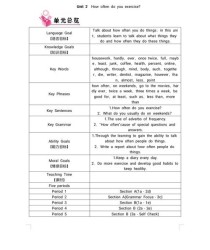
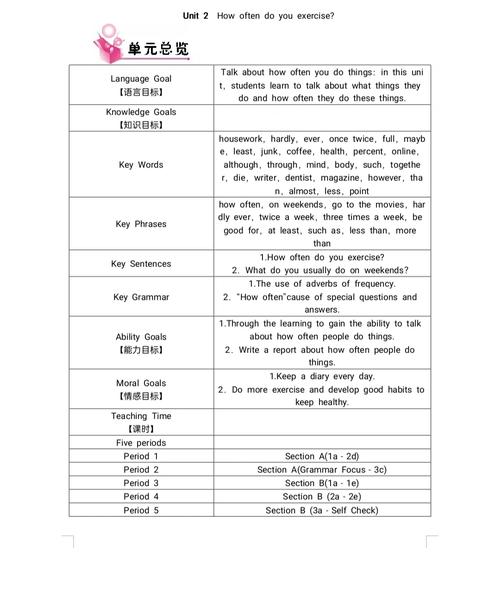
- Unit 1: How often do you exercise?
- 重点:频率副词 (
always, usually, sometimes, never) 的一般现在时用法。 - 活动建议:设计一个 "My Healthy Lifestyle" 的调查问卷,让学生采访同学并汇报结果,将语言学习与健康教育结合。
- 重点:频率副词 (
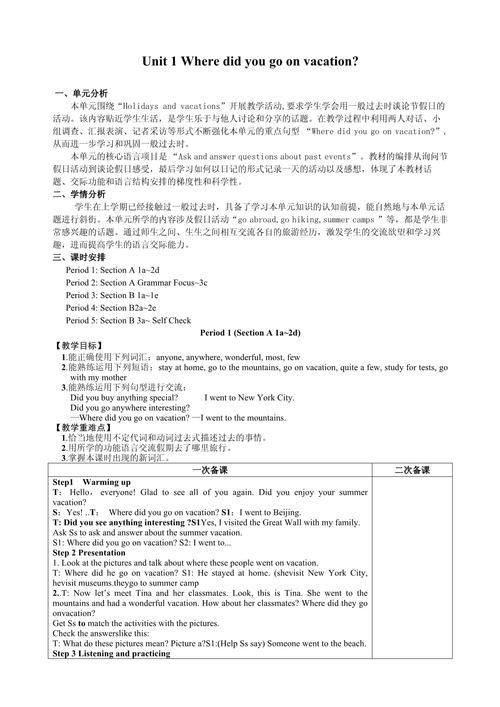
- Unit 3: What are you doing for vacation?
- 重点:用
be going to和will谈论未来的计划和打算。 - 活动建议:举办一个 "Dream Vacation" 分享会,让学生制作PPT或海报,用英语介绍自己的假期梦想。
- 重点:用
- Unit 7: How do you make a banana milk shake?
- 重点:祈使句和
how引导的特殊疑问句,描述过程。 - 活动建议:组织一次 "Cooking Show" 或 "Recipe Sharing" 活动,让学生分组制作简单的食物(如三明治、水果沙拉)并用英语描述步骤,寓教于乐。
- 重点:祈使句和
- Unit 10: I'm going to be a basketball player.
- 重点:
be going to结构表达未来的计划和决心。 - 活动建议:开展 "My Future Dream" 主题班会,让学生畅谈自己的职业理想,并讨论如何为之努力,进行理想和励志教育。
- 重点:
希望这份详细的教案和规划能对您的教学工作有所帮助!