人教版八年级上册英语提纲重点难点有哪些?
校园之窗 2025年12月10日 05:58:52 99ANYc3cd6
人教版八年级上册英语总提纲
八年级上册英语是人教版《Go for it!》系列教材的关键一环,它承接了七年级的基础,并为九年级的总复习打下重要基础,核心在于深化语法体系、扩充核心词汇、提升综合运用能力。
整体结构与核心主题
全册共包含10个单元和2个复习单元,主题贴近学生生活,易于理解和应用。
(图片来源网络,侵删)
| 单元 | 核心话题 | 重点语法项目 | 核心词汇/短语 |
|---|---|---|---|
| Unit 1 | 如何谈论日常活动与频率 | 频率副词; How often 引导的特殊疑问句 | how often, exercise, sleep, junk food, habit, coffee, health, result |
| Unit 2 | 如何描述健康状况与提建议 | 情态动词 should (应该); maybe 与 may be 的区别 |
have a cold, have a fever, stomachache, toothache, should, dentist, medicine, advice |
| Unit 3 | 如何谈论过去的事件 | 一般过去时 | go to the movies, camp, beach, yesterday, last weekend, great, visit, fish |
| Unit 4 | 如何谈论未来的计划和打算 | be going to 结构 (表将来意图) |
have a picnic, go hiking, exam, trip, plan, palace museum, Tian'anmen Square |
| Unit 5 | 如何谈论做出决定和邀请 | let's... 句型; Why don't you...? 句型 |
meet, movie, this evening, what about, get together, invited, forward |
| Unit 6 | 如何谈论兴趣与爱好 | 现在进行时 (表现阶段正在进行或暂时的状态) | collect, seashell, marble, skateboard, interesting, boring, difficult, free time |
| Unit 7 | 如何谈论天气 | How's the weather? 句型; 描述天气的形容词 |
weather, sunny, cloudy, rainy, windy, snowy, terrible, hot, cold |
| Unit 8 | 如何提建议和谈论节假日 | Why don't you...?; How about...? 节日相关词汇 |
vacation, take a vacation, Central America, Spain, Europe, tour, pack, famous |
| Unit 9 | 如何谈论电影类型和喜好 | 形容词比较级和最高级 | comedy, action movie, scary, funny, exciting, sad, learn about, character |
| Unit 10 | 如何描述人的外貌和性格 | 形容词比较级和最高级 | short hair, long hair, curly hair, straight hair, tall, heavy, thin, outgoing, hard-working |
核心语法知识详解
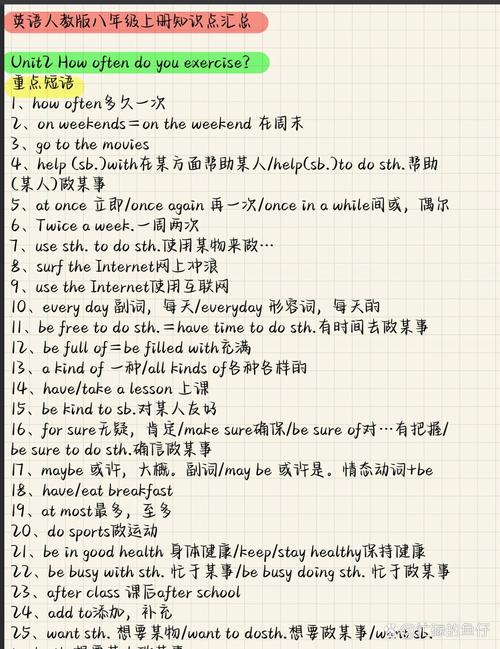
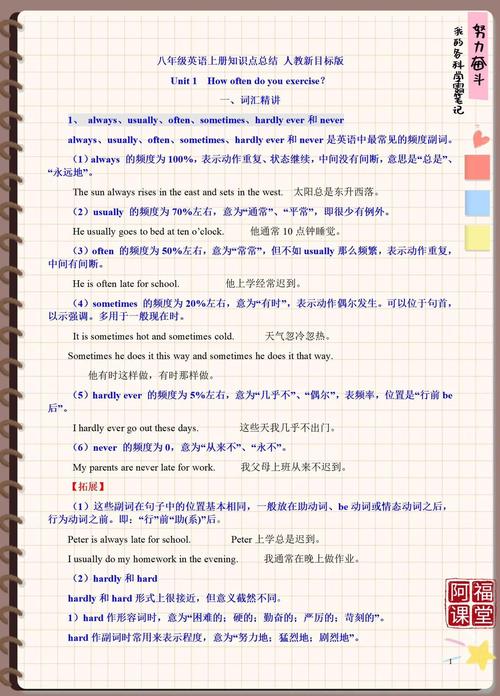
频率副词
- 含义: 表示动作发生的频率。
- 排序:
always(总是) >usually( >often(经常) >sometimes(有时) >hardly ever(几乎不) >never(从不)。 - 位置: 放在实义动词前,be动词、助动词、情态动词后。
I **usually** get up at 6:30.She **is always** late for school.
- 句型:
How often + do/does + 主语 + 动词原形...?— How often do you exercise? — I exercise every day.
情态动词 should
- 含义: “应该”,表示建议或义务。
- 结构:
should + 动词原形。 - 否定式:
shouldn't + 动词原形。You **should** drink more water.He **shouldn't** eat too much junk food.
- 提建议的常用句型:
You should see a doctor.Why don't you see a doctor?How about seeing a doctor?What about seeing a doctor?
一般过去时
- 含义: 表示过去某个时间发生的动作或存在的状态。
- 结构:
- 肯定句: 主语 + 动词过去式 + ...
- 否定句: 主语 +
didn't+ 动词原形 + ... - 一般疑问句:
Did+ 主语 + 动词原形 + ...? - 特殊疑问句: 特殊疑问词 +
did+ 主语 + 动词原形 + ...?
- 规则动词过去式: 大部分在词尾加
-ed(e.g.,play->played),以不发音的e结尾加-d(e.g.,live->lived),辅音+y结尾,变y为i再加-ed (e.g.,study->studied),重读闭音节词,双写末尾辅音字母再加-ed (e.g.,stop->stopped)。 - 不规则动词过去式: 需要单独记忆 (e.g.,
go->went,eat->ate,see->saw,do->did)。 - 时间标志词:
yesterday,last night/week/month,... ago,in 1998等。
be going to 结构
(图片来源网络,侵删)
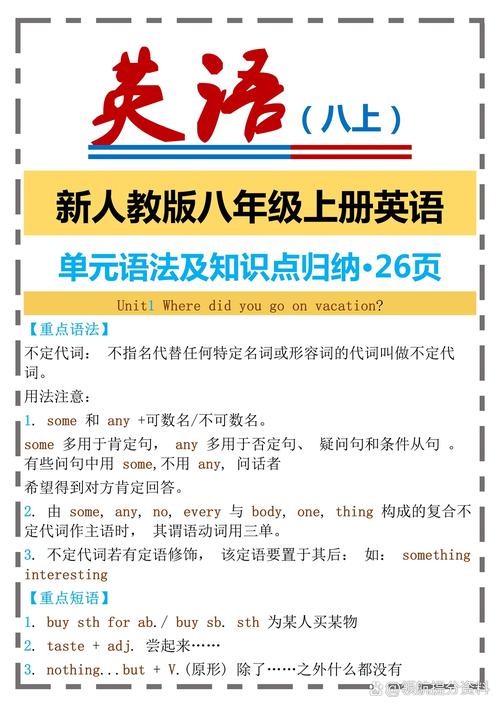
- 含义: 表示计划、打算做某事,或根据现有迹象某事很可能发生。
- 结构:
be (am/is/are) + going to + 动词原形。I **am going to** play basketball this afternoon.(打算)Look at the dark clouds. It **is going to** rain.(预测)
- 否定式:
be (am/is/are) + not + going to + 动词原形。 - 一般疑问句:
Be (Am/Is/Are) + 主语 + going to + 动词原形...?
现在进行时
- 含义: 表示说话时正在进行的动作,或现阶段正在进行的动作。
- 结构:
am/is/are + 动词ing。 - 现在分词的构成:
- 一般直接加-ing (e.g.,
do->doing)。 - 不发音的e结尾,去e加-ing (e.g.,
make->making)。 - 重读闭音节词,双写末尾辅音字母再加-ing (e.g.,
swim->swimming)。 - ie结尾,变ie为y再加-ing (e.g.,
lie->lying)。
- 一般直接加-ing (e.g.,
- 注意: 现在进行时通常与
now,look,listen等词连用。
形容词的比较级和最高级
- 规则变化:
- 一般直接加-er / -est (e.g.,
tall->taller->tallest)。 - 以e结尾,加-r / -st (e.g.,
nice->nicer->nicest)。 - “辅音+y”变y为i再加-er / -est (e.g.,
happy->happier->happiest)。 - 重读闭音节词,双写末尾辅音字母再加-er / -est (e.g.,
big->bigger->biggest)。 - 多音节词和部分双音节词,在词前加
more/most(e.g.,beautiful->more beautiful->most beautiful)。
- 一般直接加-er / -est (e.g.,
- 不规则变化:
good/well->better->bestbad/badly->worse->worstmany/much->more->mostlittle->less->leastfar->farther/further->farthest/furthest
- 句型:
- 比较级:
A + be + 比较级 + than + B(e.g.,Tom is taller than Mike.) - 最高级:
A + be + the + 最高级 + in/of + 范围(e.g.,Tom is the tallest in his class.)
- 比较级:
核心词汇与短语
- 动词:
exercise,visit,go,do,have,get,make,eat,drink,see,watch,play,study,clean,shop,fish,camp,surf,skateboard,collect,pack。 - 名词:
health,habit,result,weekend,movie,park,beach,trip,plan,vacation,exam,weather,cloud,sun,rain,wind,snow,comedy,action movie,character,hair,friend,schoolwork。 - 形容词/副词:
often,usually,sometimes,hardly,never,healthy,unhealthy,important,boring,difficult,interesting,free,terrible,hot,cold,sunny,cloudy,rainy,windy,snowy,funny,exciting,sad,scary,tall,short,heavy,thin,outgoing,hard-working,good。 - 短语:
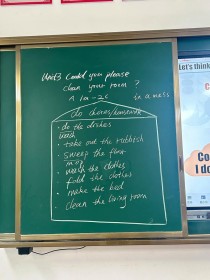
go to the movies,do homework,clean the room,exercise,junk food,go shopping,go fishing,go camping,go hiking,have a picnic,go on vacation,take a vacation,watch TV,listen to music,surf the internet,play basketball,long hair,short hair,curly hair,straight hair。
听力与口语技能
- 听力: 能听懂关于日常活动、健康问题、周末计划、电影评论、天气情况等简短对话和独白,并获取关键信息。
- 口语:
- 能用
How often...?和频率副词谈论生活习惯。 - 能用
should给别人提建议。 - 能用一般过去时讲述过去发生的事情。
- 能用
be going to谈论未来的计划。 - 能用
How's the weather?和描述天气的词语进行对话。 - 能讨论喜欢的电影类型和人物外貌性格。
- 能用
阅读与写作技能
- 阅读: 能读懂关于健康生活方式、名人传记、节日介绍、天气预报、影评等不同题材的简短文章,理解大意并找出具体信息。
- 写作:
- 能写一篇关于自己日常习惯的短文。
- 能写一封给朋友的信,描述自己上周末的活动。
- 能写一个简单的计划或邀请。
- 能写一篇关于自己喜欢的电影或人物的小短文。
- 能运用比较级和最高级来描述人或事物。
学习建议
- 词汇为王: 每天坚持背诵单词,利用词根词缀、联想记忆等方法,并结合课文和例句来理解和运用。
- 语法为本: 对于每个语法点,不仅要记住规则,更要通过造句、练习来巩固,准备一个语法错题本,反复复习。
- 听说领先: 大胆开口说,创造语言环境,可以跟着录音模仿朗读,或者用英语自言自语描述身边的事物,多听英文歌曲、看简单的英文动画。
- 读写结合: 坚持用英语写日记、周记,哪怕只有一两句话,把阅读中学到的好的句型和表达方式记录下来,并尝试在自己的写作中使用。
- 整理归纳: 定期对所学知识进行梳理,比如用思维导图整理一个单元的词汇和语法,形成自己的知识体系。
- 错题反思: 认真对待每一次练习和考试中的错题,分析错误原因,确保不再犯类似的错误。
希望这份提纲能帮助你清晰地把握八年级上册英语的学习重点,祝你学习进步,取得好成绩!
(图片来源网络,侵删)