八年级上册英语知识点有哪些重点难点?
校园之窗 2025年12月9日 14:14:48 99ANYc3cd6
总体特点
八年级是初中英语学习的关键时期,知识点难度和广度都有所提升,主要特点包括:
- 词汇量增大:出现了更多抽象和功能性词汇。
- 语法深化:重点学习几种核心的复合时态(过去进行时、现在完成时)和重要的从句(状语从句、宾语从句)。
- 句型复杂:句子结构更复杂,长句增多。
- 话题更广:话题涉及校园生活、旅行、环保、人际交往等,更贴近现实生活。
八年级上册 (8A) 核心知识点
Unit 1: Friends (朋友)
- 核心话题:描述朋友的品质和性格。
- 重点词汇:
- 形容词:
kind(善良的),generous(慷慨的),loyal(忠诚的),smart/clever(聪明的),funny(有趣的),hard-working(勤奋的),helpful(乐于助人的),polite(有礼貌的),similar(相似的),different(不同的)。 - 动词:
share(分享),argue(争吵),laugh(笑),enjoy(享受),hate(憎恨)。
- 形容词:
- 重点句型:
- 描述品质:
He/She is .../He/She has .../He/She always ... - 表达观点:
I think .../In my opinion, ... - 对比:
A is ... than B./A is as ... as B.
- 描述品质:
- 语法重点:
- 形容词的比较级和最高级:
- 规则变化:
-er/-est(e.g.,tall->taller->tallest);-y变i加er/est(e.g.,happy->happier->happiest);双写词尾加er/est(e.g.,big->bigger->biggest);-er/-or加more/most(e.g.,careful->more careful->most careful)。 - 不规则变化:
good/well->better->best,bad/badly->worse->worst,many/much->more->most。 - 句型:
A + 比较级 + than + B(A比B更...);One of the + 最高级 + 复数名词(最...之一)。
- 规则变化:
- 形容词的比较级和最高级:
Unit 2: School life (校园生活)
- 核心话题:比较中西方校园生活的异同。
- 重点词汇:
- 校园:
campus,hall,library,lab,canteen,playground。 - 学科:
Maths,Chinese,English,Science,History,Geography,Art。 - 活动:
club,activity,homework,exam,project。
- 校园:
- 重点句型:
- 比较数量:
There are more/fewer ... in ... than in ...(在...比在...有更多/更少的...)。 - 提出建议:
How/What about ...?/Let's .../Why not ...?/Shall we ...?
- 比较数量:
- 语法重点:
- 副词的比较级和最高级:规则与形容词类似,用来修饰动词、形容词或其他副词。
how many/how much的区别:how many+ 可数名词复数。how much+ 不可数名词。
Unit 3: A day out (一日游)
- 核心话题:谈论一次出游的经历和计划。
- 重点词汇:
- 地点:
zoo,park,museum,theatre,cinema,aquarium,theatre。 - 交通:
bus,train,subway,underground,bike,on foot。 - 动词:
visit,enjoy,get,leave,meet,take a boat,walk across。
- 地点:
- 重点句型:
- 谈论计划:
What are you going to do ...?/We are going to ... - 谈论经历:
We visited .../We saw .../We had a great time.
- 谈论计划:
- 语法重点:
be going to结构:表示计划、打算或即将发生的事情。- 构成:
am/is/are + going to + 动词原形。 - 否定:
am/is/are not + going to + 动词原形。 - 疑问:
Am/Is/Are + 主语 + going to + 动词原形?
- 构成:
Unit 4: Wild animals (野生动物)
- 核心话题:谈论野生动物的现状和保护。
- 重点词汇:
- 动物:
giant panda,tiger,lion,elephant,monkey,zebra,wolf。 - 动词:
live,hunt,kill,protect,save,endangered。 - 形容词:
dangerous,cute,lovely,strong,beautiful,amazing。
- 动物:
- 重点句型:
- 描述习性:
Pandas live in ... and eat .../They are in danger because ... - 提出倡议:
We should protect .../Let's ...
- 描述习性:
- 语法重点:
- 不定式作目的状语:
to + 动词原形,表示“为了...”。- e.g.,
We need to save them to protect the environment.(我们需要拯救它们,以保护环境。) - e.g.,
He came to see me.(他来看我。)
- e.g.,
- 不定式作目的状语:
Unit 5: Birdwatchers (观鸟者)
- 核心话题:介绍观鸟活动和鸟类知识。
- 重点词汇:
- 鸟类:
sparrow,eagle,swallow,kingfisher,crane。 - 动词:
watch,find,count,learn,protect,stay。 - 介词短语:
in the tree,on the branch,by the lake,fly to,fly back。
- 鸟类:
- 重点句型:
- 描述位置:
There is/are .../Some ... are ... - 描述观察:
We can see .../We are looking forward to ...
- 描述位置:
- 语法重点:
There be句型的一般过去时:表示过去某个时间或地点存在某物。- 肯定:
There was/were + ... - 否定:
There wasn't/weren't + ... - 疑问:
Was/Were there + ...?
- 肯定:
Unit 6: Natural disasters (自然灾害)
- 核心话题:描述自然灾害及其带来的影响。
- 重点词汇:
- 灾害:
earthquake,flood,typhoon,storm,lightning,thunder。 - 动词:
happen,start,destroy,kill,lose,shake,fall down。 - 情感词:
afraid,scared,sad,worried,brave。
- 灾害:
- 重点句型:
- 描述事件:
When the earthquake happened, .../There was a loud noise. - 寻求帮助:
What should we do?/We must stay calm.
- 描述事件:
- 语法重点:
- 过去进行时:
- 用法:表示过去某个特定时间点正在进行的动作。
- 构成:
was/were + 动词-ing。 - 标志词:
at 8 o'clock yesterday,this time yesterday,when引导的时间状语从句。 - e.g.,
I was doing my homework at 9 p.m. last night.(昨晚九点我正在做作业。)
- 过去进行时:
八年级下册 (8B) 核心知识点
Unit 1: Past and present (过去与现在)
- 核心话题:对比家乡或某个地方过去和现在的变化。
- 重点词汇:
- 时间/变化:
in the past,now,change,different,same,disappear,develop。 - 地点/设施:
factory,countryside,town,building,road,shop。
- 时间/变化:
- 重点句型:
- 对比:
It's different from .../Things have changed a lot./In the past, ... but now ...
- 对比:
- 语法重点:
- 现在完成时:
- 用法1:表示过去发生并持续到现在的动作或状态。标志词:
for(持续多久),since(自从何时开始)。- e.g.,
I have lived here for ten years.(我在这里住了十年了。)
- e.g.,
- 用法2:表示过去发生的、对现在有影响的动作。标志词:
already,yet,just,ever,never。- e.g.,
I have already finished my homework.(我已经完成作业了。)
- e.g.,
- 构成:
have/has + 动词过去分词。 - 注意:
since+ 时间点 (e.g.,since 2010,since last year);for+ 时间段 (e.g.,for two hours,for a long time)。
- 用法1:表示过去发生并持续到现在的动作或状态。标志词:
- 现在完成时:
Unit 2: Travelling (旅行)
- 核心话题:计划一次旅行并介绍旅行经历。
- 重点词汇:
- 旅行相关:
book,order,flight,hotel,ticket,pack,suitcase,take photos,souvenir。 - 地点:
Beijing,Shanghai,Paris,Sydney,Great Wall,Eiffel Tower。
- 旅行相关:
- 重点句型:
- 预订:
I'd like to book .../Could you tell me ...? - 询问信息:
How can I get to ...?/What can we do there?
- 预订:
- 语法重点:
- 宾语从句:
- 定义:在句子中作宾语的从句。
- 语序:无论主句是何种句型,宾语从句都必须使用陈述句语序 (主语 + 谓语)。
- 连接词:
that(无实际意义,可省略)。if / whether(表示“是否”)。- 特殊疑问词 (
what,where,when,why,how等)。
- e.g.,
He asked (me) if I knew the answer.(他问我是否知道答案。) - e.g.,
Can you tell me where the bus station is?(你能告诉我汽车站在哪里吗?)
- 宾语从句:
Unit 3: Online tours (在线游览)
- 核心话题:利用网络进行虚拟旅游。
- 重点词汇:
- 网络:
website,click,enter,search,online,virtual tour。 - 感受:
amazing,wonderful,fantastic,boring,difficult。
- 网络:
- 重点句型:
- 操作指引:
First, .../Next, .../Then, .../Finally, ... - 表达感受:
It's amazing!/I feel like I'm really there.
- 操作指引:
- 语法重点:
- 状语从句:
- 定义:在句子中作状语,修饰主句的动词、形容词或副词,表示时间、地点、原因、条件等。
- 重点:
when,while,before,after,if,because等引导的从句。 - 注意:状语从句也使用陈述句语序。
- e.g.,
I will call you when I arrive.(我到达后会给你打电话。) - e.g.,
He was late because he missed the bus.(他迟到了,因为他错过了公交车。)
- 状语从句:
Unit 4: A good read (一本好书)
- 核心话题:谈论喜欢的书籍和阅读习惯。
- 重点词汇:
- 书籍类型:
novel,science fiction,fairy tale,biography,history book,magazine。 - 动词:
enjoy,finish,recommend,borrow,lend,join,review。
- 书籍类型:
- 重点句型:
- 表达喜好:
I like ... best./I enjoy reading .../It's about ... - 借阅:
Can I borrow ...?/You can keep it for two weeks.
- 表达喜好:
- 语法重点:
- 动词不定式作主语、宾语、表语:
- 作主语:
To learn English is important.(学英语很重要。) - 作宾语:
I want to read a book.(我想读本书。) - 作表语:
My dream is to travel around the world.(我的梦想是环游世界。)
- 作主语:
- 动词不定式作主语、宾语、表语:
Unit 5: Good manners (良好礼仪)
- 核心话题:谈论在不同场合的礼仪规范。
- 重点词汇:
- 礼仪:
manners,polite,impolite,queue,litter,noise,introduce。 - 动词:
wait,say,talk,laugh,point,drop。
- 礼仪:
- 重点句型:
- 提出建议/要求:
You should/shouldn't .../It's important to .../You'd better ... - 请求许可:
Could/Can I ...?/Would you mind ...?
- 提出建议/要求:
- 语法重点:
- 情态动词的用法:
should,had better (not),must,can,could,may。should(应该):提出建议。had better(最好):提出强烈的建议,有“警告”意味。must(必须):表示义务或强烈的必要性。can/could(可以):表示许可或能力。may(可以):表示许可,语气更委婉。
- 情态动词的用法:
Unit 6: Sunshine for all (阳光普照)
- 核心话题:参与志愿者活动,帮助他人。
- 重点词汇:
- 志愿活动:
volunteer,charity,help out,raise money,visit the old,read to。 - 情感与品质:
happy,proud,kind,warm-hearted,make a difference。
- 志愿活动:
- 重点句型:
- 表达意愿:
I want to be a volunteer./I'd like to ... - 描述活动:
We are going to .../It's about helping others.
- 表达意愿:
- 语法重点:
- 被动语态:
- 定义:强调动作的承受者,而非执行者。
- 构成:
be + 动词过去分词。 - 时态:根据需要使用不同的
be动词形式 (am/is/are/was/were/will be 等)。 - e.g.,
The book was written by Lu Xun.(这本书是鲁迅写的。) - e.g.,
Money is being raised for the charity.(钱正在为这个慈善机构筹集。)
- 被动语态:
学习建议
- 词汇是基础:坚持每天背单词,结合课文和例句记忆,不要孤立地背单词表。
- 语法要理解:不要死记硬背规则,通过分析例句,理解每个语法点的用法和意义。
- 听说读写并重:多听课文录音,模仿语音语调;尝试用英语描述日常;坚持写日记或小短文;多做阅读理解练习。
- 整理错题本:把做错的题目记录下来,分析错误原因,定期复习,避免再犯。
- 及时复习:根据艾宾浩斯遗忘曲线,学过的知识要及时复习,才能记得牢固。
希望这份总结对你的学习有所帮助!祝你学习进步!
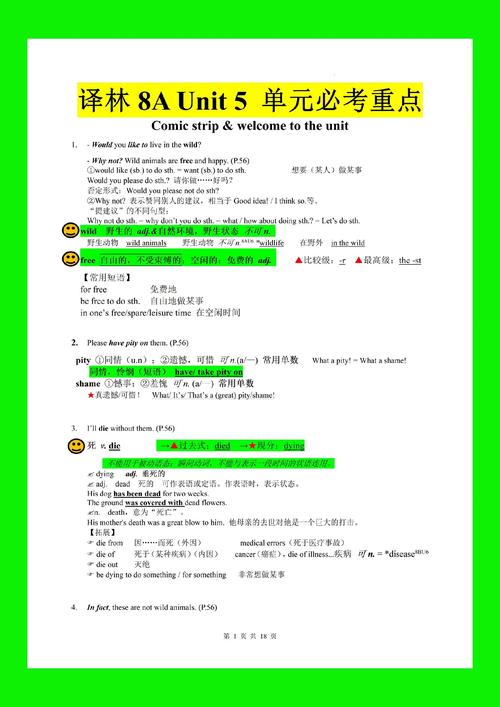
(图片来源网络,侵删)

(图片来源网络,侵删)