九年级上册英语核心知识点有哪些?
校园之窗 2025年12月9日 14:10:37 99ANYc3cd6
下面我将为你梳理九年级上册的核心知识点,分为词汇、语法、功能意念项目和备考建议四个部分,帮助你系统地掌握。
核心词汇与短语
九年级上册的词汇量要求更高,且与话题紧密结合,以下是各单元的核心词汇和短语,建议你按单元记忆并结合语境使用。
-
Unit 1 How can we become good learners?
- 核心动词/短语:
by doing sth.(通过做某事),ask for help,practice doing sth.,connect...with...,get bored,pay attention to,depend on,in common - 核心名词:
pronunciation,grammar,secret,speed,ability,mistake,partner
- 核心动词/短语:
-
Unit 2 I think that mooncakes are delicious!
- 核心名词:
mooncake,relative,tradition,lunar,goddess,stupid,lie,novel - 核心形容词/副词:
delicious,traditional,lucky,alive,put on,end up,give out,warm-hearted - 文化背景: 中秋节、圣诞节、感恩节的习俗。
- 核心名词:
-
Unit 3 Could you please tell me where the restrooms are?
- 核心短语:
go straight,on one's left/right,turn left/right,pass by,a couple of,exchange student,be interested in - 地点名词:
restroom,bookstore,bank,supermarket,post office,farm,pavement(英式),sidewalk(美式) - 功能: 问路和指路的礼貌用语。
- 核心短语:
-
Unit 4 I used to be afraid of the dark.
 (图片来源网络,侵删)
- 核心语法点:
used to do sth.(过去常常做某事) - 核心短语:
be interested in,be afraid of,make friends,take up,in the past,on the swim team,be proud of,from time to time - 核心词汇:
humorous,silent,helpful,dark,influence,absent,fail
- 核心语法点:
-
Unit 5 What are the shirts made of?
- 核心语法点:
be made of/from/in(由...制成) - 核心名词:
chopsticks,fork,blouse,silver,cotton,steel,grass,leaf,product - 核心动词:
process,produce,pack,avoid
- 核心语法点:
-
Unit 6 When was it invented?
- 核心语法点: 一般过去时的被动语态 (
was/were done) - 核心词汇:
invent,inventor,accidental,crispy,salty,by mistake,divide...into...,the number of,a number of - 常见发明:
telescope,zipper,light bulb,potato chips
- 核心语法点: 一般过去时的被动语态 (
-
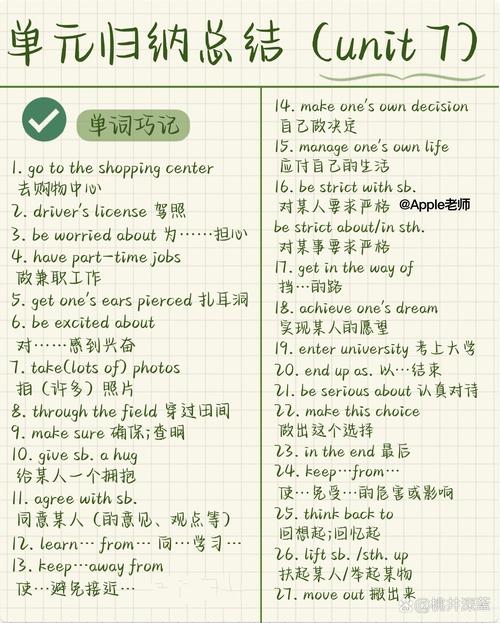
Unit 7 Teenagers should be allowed to choose their own clothes.
- 核心语法点: 情态动词的被动语态 (
should be done) - 核心短语:
be allowed to do sth.,get one's ears pierced,instead of,stay up,look after,concentrate on,at present,manage to do - 核心词汇:
license,silly,earring,concentrate,community,choose,achieve
- 核心语法点: 情态动词的被动语态 (
-
Unit 8 It must belong to Carla.
 (图片来源网络,侵删)
- 核心语法点: 情态表推测 (
must/can/could/may/might + do/be) - 核心词汇:
belong to,picnic,possibly,anybody,noise,rabbit,escape,neighbor - 功能: 对物品归属进行推测。
- 核心语法点: 情态表推测 (
-
Unit 9 I like music that I can dance to.
- 核心语法点: 定语从句 (Attributive Clause)
- 核心词汇:
prefer,lyrics,gentle,electronic,suppose,smooth,feel,warmer,remind...of... - 音乐类型:
jazz,classical music,dance music,rock
-
Unit 10 You're supposed to shake hands.
- 核心语法点:
be supposed to do sth.(应该做某事) - 核心短语:
be supposed to do,drop by,table manners,make noise,point at,stick out,get annoyed,in public - 文化背景: 不同国家的餐桌礼仪和见面礼仪。
- 核心语法点:
-
Unit 11 Sad movies make me cry.
- 核心语法点: 使役动词 (
make/let/have sb. do sth.) 和感官动词 (see/hear/feel sb. do sth.) - 核心词汇:
powerful,influence,friendship,trust,nervous,fair,unfair,kingdom,ghost - 功能: 谈论事物或人对情感的影响。
- 核心语法点: 使役动词 (
-
Unit 12 Life is full of the unexpected.
- 核心词汇:
unexpected,alarm,ring,off,give...a lift,by the time,lock,empty,discover - 核心短语:
by the time (从句),take off,give up,end up (doing)
- 核心词汇:
-
Unit 13 We're trying to save the earth!
- 核心语法点: 现在进行时表将来 (
be doing) - 核心词汇:
litter,bottom,fisherman,coal,plastic,cancer,advantage,take action,recycle - 环保议题: 水污染、空气污染、白色污染。
- 核心语法点: 现在进行时表将来 (
-
Unit 14 I remember meeting all of you in Grade 7.
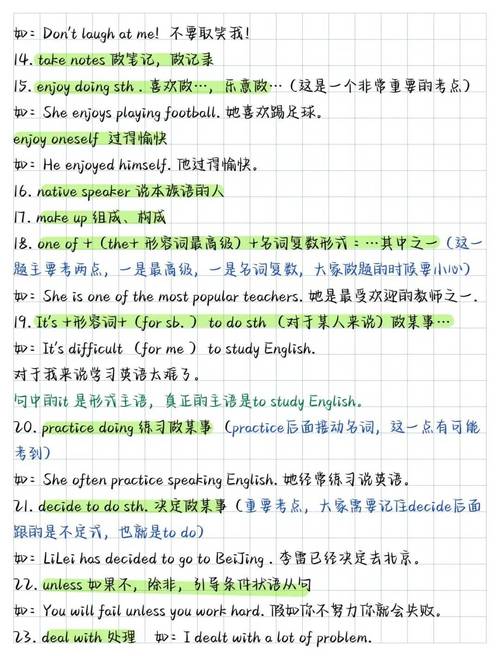
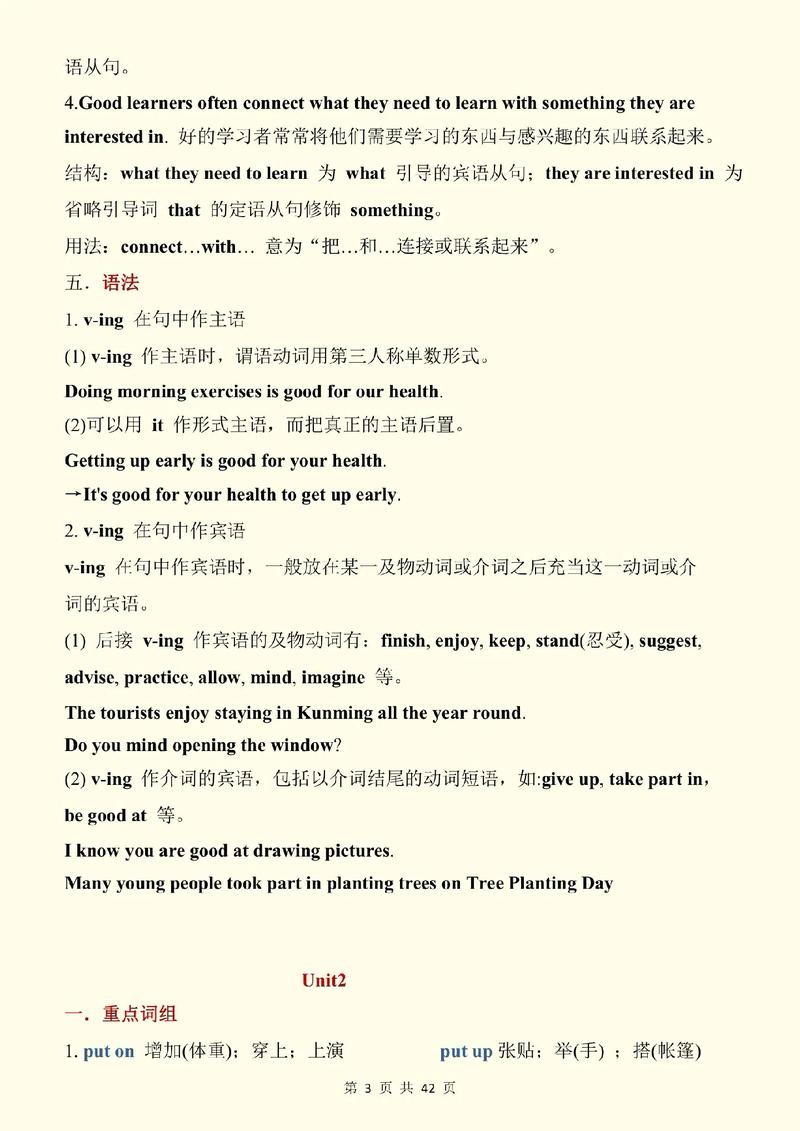
- 核心语法点: 动名词作宾语 (
enjoy/finish/mind/practice doing) - 核心词汇:
introduce,congradulate,graduate,thankful,proud,regret,reflect on,look forward to (doing) - 功能: 回顾过去,展望未来,表达感谢与不舍。
- 核心语法点: 动名词作宾语 (
核心语法点
九年级上册的语法是中考的重中之重,必须彻底理解并熟练运用。
宾语从句
- 结构:
主句 + 连接词 + 从句 - 连接词:
- that: 无实际意义,只起连接作用,可省略。 (e.g., I know (that) he is right.)
- if/whether: “是否”,不能省略。 (e.g., I wonder if/whether it will rain.)
- 特殊疑问词: what, who, which, when, where, why, how。 (e.g., Can you tell me where the bus station is?)
- 语序: 宾语从句必须使用陈述句语序 (主语 + 谓语),即使主句是疑问句。
- 错误: Do you know where is he?
- 正确: Do you know where he is?
- 时态: 主句为现在/将来时,从句可用任何时态;主句为过去时,从句要用过去的某种时态。
定语从句
- 功能: 修饰名词或代词,相当于形容词。
- 结构:
名词/代词 + 关系代词/副词 + 从句 - 关系代词:
- that: 指物或人,在从句中作主语或宾语。 (e.g., The book (that) I bought yesterday is interesting.)
- which: 指物,在从句中作主语或宾语。 (e.g., The story (which) he told us is funny.)
- who: 指人,在从句中作主语。 (e.g. The boy who is playing basketball is my brother.)
- whom: 指人,在从句中作宾语,多用于正式文体,可用
who或that代替。 (e.g. The man (whom/who/that) you met is our teacher.) - whose: 指人“的”或物“的”,在从句中作定语。 (e.g. The girl whose mother is a nurse is very kind.)
- 关系副词:
where(地点),when(时间),why(原因),相当于介词 + which。- e.g., This is the house where I lived. (= ...the house in which I lived.)
- e.g., I'll never forget the day when we met. (= ...the day on which we met.)
被动语态
- 核心结构:
be + 动词的过去分词 - 时态变化:
- 一般现在时:
am/is/are + done - 一般过去时:
was/were + done(Unit 6 重点) - 含有情态动词:
can/may/should + be + done(Unit 7 重点) - 现在完成时:
have/has + been + done - 含有不定式:
to be done
- 一般现在时:
- 用法: 强调动作的承受者,或不知道/不必说明动作的执行者。
情态动词表推测
- must: 语气最强,表示“一定,肯定”,通常用于肯定句。
e.g., It must be Tom's. The keys are in his pocket.
- can't: 语气较强,表示“不可能”,用于否定句。
e.g., He can't be at home. His car isn't in the garage.
- could/may/might: 语气最弱,表示“可能,也许”,可用于肯定、否定和疑问句。
e.g., She may know the answer. / He might not come tomorrow.
used to do 与 be used to doing
- used to do: 过去常常做某事,现在不做了,强调过去的习惯和状态。
e.g., I used to be afraid of the dark. (我现在不怕了。)
- be used to doing: 习惯于做某事。
to是介词。e.g., I am used to getting up early. (我习惯早起。)
- be used to do: 被用来做某事。
to是不定式符号。e.g., Wood is used to make tables. (木材被用来做桌子。)
其他重要语法点
make sb. do sth./let sb. do sth./have sb. do sth.: 使役动词,后面接不带to的不定式。see/hear/feel sb. do sth.: 感官动词,表示动作的全过程,也接不带to的不定式。be supposed to do sth.: 应该做某事(常表示规则、习俗或期望)。- 现在进行时表将来:
be doing表示已安排好的、近期就要发生的计划或打算。
功能意念项目
即单元话题和交际功能,是听说和写作的核心。
- 谈论学习方法: How do you study for a test? (Unit 1)
- 谈论节日和习俗: What do you like most about...? (Unit 2)
- 问路与指路: Could you tell me where...is? (Unit 3)
- 谈论过去与现在的变化: I used to... (Unit 4)
- 谈论物品的构成: What is it made of/from? (Unit 5)
- 谈论发明与历史: When was it invented? (Unit 6)
- 谈论规则与许可: Students should be allowed to... (Unit 7)
- 进行推测: It must belong to... (Unit 8)
- 谈论喜好: I like music that... (Unit 9)
- 谈论礼仪与习俗: You're supposed to... (Unit 10)
- 谈论情感影响: Sad movies make me... (Unit 11)
- 讲述过去的经历: By the time I..., I had already... (Unit 12)
- 讨论环保问题: We should reduce... (Unit 13)
- 回顾与展望: I remember... and I look forward to... (Unit 14)
备考建议
- 回归课本,夯实基础: 课本是最好的复习资料,重新朗读课文,确保所有单词、短语和重点句型都烂熟于心。
- 专题突破,攻克语法: 针对上面列出的核心语法点,特别是宾语从句、定语从句和被动语态,做专项练习,整理错题本,反复研究错误原因。
- 构建知识网络: 将零散的知识点串联起来,学到
be used to doing,就把它和used to do、be used to do放在一起对比记忆。 - 强化听说读写:
- 听: 每天坚持听15-20分钟,可以是课文录音、模拟题听力或英文歌曲。
- 说: 大声朗读课文,尝试复述故事,或者和同学用英语讨论话题。
- 读: 增加课外阅读量,如简易读物、英语新闻,这有助于巩固词汇和理解长难句。
- 写: 坚持每周写1-2篇作文,可以围绕单元话题展开,写完后自己检查或请老师批改,注意语法、拼写和句式多样性。
- 整理错题,查漏补缺: 错题是宝贵的财富,建立错题本,定期回顾,确保同样的错误不再犯第二次。
- 模拟演练,熟悉题型: 在复习后期,进行限时模拟考试,熟悉中考题型和时间分配,培养应试心态。
九年级上册是承上启下的关键时期,打好这一阶段的基础,将为九年级下册的复习冲刺和中考奠定坚实的基础,祝你学习进步,取得优异的成绩!