八年级下册英语核心知识点有哪些?
校园之窗 2025年12月9日 04:21:53 99ANYc3cd6
整体概览
八年级下册的核心围绕“过去进行时”、“情态动词的过去式”、“被动语态”、“定语从句”等核心语法展开,同时话题也更加贴近生活,如旅行、健康、环保、文学艺术等。
Unit 1 What's the matter?
话题: 健康、问题与建议
核心语法: 情态动词 should 的用法
核心词汇
- 身体部位: head, eye, ear, nose, mouth, tooth, neck, throat, arm, hand, finger, leg, foot, back, stomach
- 疾病与问题: have a fever/cold/cough/headache/toothache/sore throat/stomachache, have a sore back, hurt, tired, stressed out, have a problem, trouble
- 建议与措施: should, shouldn't, rest, drink hot tea with honey, see a dentist, lie down and rest, listen to soft music, take breaks, take one's temperature
重点句型
- 询问身体状况:
- — What's the matter (with you)? — I have a cold.
- — What's the trouble (with him)? — He hurt himself.
- — What's wrong (with her)? — She has a stomachache.
- — What should I do? — You should drink some hot tea with honey.
- 提出建议:
- You should/shouldn't eat so much candy.
- He shouldn't work so hard.
- Maybe you should lie down and rest.
- It's a good idea to see a doctor.
语法精讲:情态动词 should
- 用法: 用于提出建议或劝告,意为“应该”。
- 肯定句:
主语 + should + 动词原形 + ...You should drink more water.
- 否定句:
主语 + shouldn't + 动词原形 + ...He shouldn't stay up late.
- 疑问句:
Should + 主语 + 动词原形 + ...?Should I take this medicine?
- 特殊疑问句:
特殊疑问词 + should + 主语 + 动词原形 + ...?What should I do about my toothache?
 (图片来源网络,侵删)
Unit 2 I'll help to clean up the city parks.
话题: 志愿活动与帮助他人
核心语法: want/would like/hope to do sth.;动词不定式作宾语、宾语补足语、目的状语
核心词汇
- 动词短语: clean up, cheer up, give out, come up with, put off, write down, call up, hand out, volunteer, fix up, set up
- 相关名词: volunteer, sign, notice, feeling, satisfaction, joy
- 形容词: lonely, happy, excited, grateful, interested
重点句型
- 表达意愿:
- I want to volunteer at an animal hospital.
- We'd like to set up a food bank to help hungry people.
- I hope to travel around the world one day.
- 提出帮助:
- You could help clean up the city parks.
- Let's make some notices to ask for donations.
- I'd like to help homeless people.
- 动词不定式用法:
- 作宾语:I want to help others. (help作want的宾语)
- 作宾语补足语:The teacher asked us to clean the classroom. (clean作us的宾语补足语)
- 作目的状语:He studies hard to get good grades. (to get表目的)
语法精讲:动词不定式
动词不定式 to do sth. 是非谓语动词的一种,功能强大。
- 作宾语: 常跟在
want, would like, hope, plan, decide, try等词后。- She decided to learn the piano.
- 作宾语补足语: 常跟在
tell, ask, want, teach, help等词后。- My father told me not to play computer games.
- 作目的状语: 放在句首或句末,表示做某事的目的。
- To keep healthy, we should exercise every day.
- He gets up early to catch the early bus.
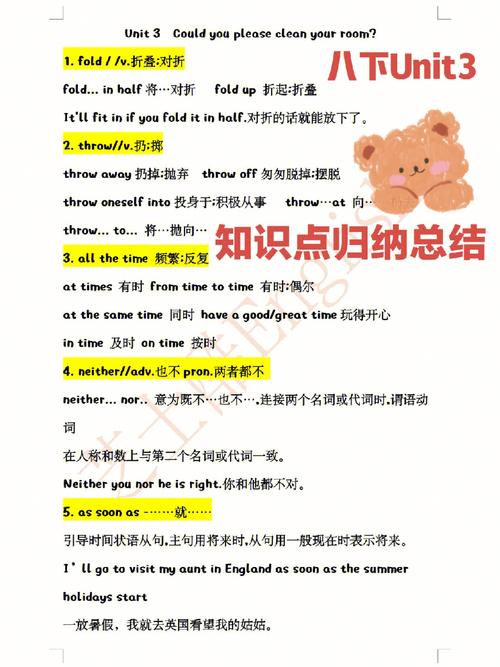
Unit 3 Could you please clean your room?
话题: 家庭责任与请求许可
核心语法: 情态动词 could 和 might 表示礼貌的请求与许可;make/do 的用法区别
核心词汇
- 家务劳动: do the dishes, sweep the floor, take out the trash, make the bed, fold the clothes, clean the living room
- 动词: borrow, lend, invite, hate, stress, waste, depend on
- 词组: do the laundry, take care of, get a ride, work on, at least, throw a party, hang out
重点句型
- 礼貌地提出请求:
- — Could you please clean your room? — Yes, sure. / Sorry, I can't. I have to study for a test.
- Could you please take out the trash?
- 礼貌地请求许可:
- Could/May I borrow your car? — Sure, no problem.
- Do you mind if I use your computer?
- 表达不满与抱怨:
- Could you at least take out the trash?
- I hate to do chores.
- Why don't you do the dishes?
语法精讲
- 情态动词
could的用法:- 表示礼貌的请求: 比
can更委婉、客气。Could you please + 动词原形?Could I + 动词原形?
- 表示可能性(比
can弱): It could rain this afternoon.
- 表示礼貌的请求: 比
make与do的区别:- do: 通常指做某项具体的“工作”或“任务”。
do the dishes, do the laundry, do homework, do a favor
 (图片来源网络,侵删)
 - make: 通常指“创造”、“制作”或“导致”。
make a cake, make a plan, make a mistake, make friends, make money
- do: 通常指做某项具体的“工作”或“任务”。
Unit 4 Why don't you talk to your parents?
话题: 人际关系与情感问题
核心语法: Why don't you...? 提建议;until, so that 引导的目的状语从句
核心词汇
- 情绪与问题: instead, instead of, argue, communicate, get on (well) with, circle, pressure, compete, opinion, skill, typical, quick, usual
- 建议与解决方案: explain, clear up, work out, focus on, in order to, so that, until, communication, offer, proper
重点句型
- 提建议(多种方式):
- Why don't you/they/we + 动词原形? (Why don't you talk to your parents?)
- You should... (You should communicate with them.)
- How about/What about + doing sth.? (How about asking them for advice?)
- Let's... (Let's have a discussion.)
语法精讲
Why don't you...?句型:- 这是一个非常实用的提建议的句型,相当于
You should...。 - Why don't you join an English club? (Why don't you join an English club?)
- 这是一个非常实用的提建议的句型,相当于
until引导的时间状语从句:- 含义: 直到...才...
- 肯定句: 主句用延续性动词,表示动作一直持续到某个时间点。
- I waited until he came back. (我等到他回来。)
- 否定句: 主句用非延续性动词,表示动作直到某个时间点才发生。
- He didn't leave until I arrived. (直到我来了他才走。)
so that引导的目的状语从句:- 含义: 以便,为了...
- 特点:
so that后面跟can/could/will/would/might等情态动词。- He got up early so that he could catch the first bus. (他早起是为了能赶上第一班公交车。)
Unit 5 What were you doing when the rainstorm came?
话题: 过去进行时与过去进行时与一般过去时的对比 核心语法: 过去进行时
核心词汇
- 天气与事件: rainstorm, storm, suddenly, alarm, report, begin, heavy, suddenly, strange, kid, date, alive, trap, miss, event, news, witness, student, jump
- 时间词: at 8:00 last night, at that time, when, while
重点句型
- 过去进行时:
- — What were you doing at 8:00 last night? — I was doing my homework.
- — What was he doing when the rainstorm came? — He was reading in the library.
- 过去进行时与一般过去时连用:
- I was cooking dinner when the phone rang. (过去进行时表背景,一般过去时表突发事件)
- While my mother was watching TV, I was doing my homework. (两个过去的动作同时进行)
语法精讲:过去进行时
- 结构:
was/were + 动词的现在分词 - 用法:
- 表示过去某个时间点正在进行的动作。
- I was having breakfast at 7:00 this morning.
- 表示过去某个时间段内持续进行的动作。
- They were playing basketball from 4 to 5 yesterday afternoon.
- 表示一个过去的动作作为另一个过去动作的背景。
- He was sleeping when I got home.
- 表示过去某个时间点正在进行的动作。
Unit 6 An old man tried to move the mountains.
话题: 传说与故事
核心语法: 除非引导的状语从句;unless, so...that..., such...that...
核心词汇
- 神话与传说: god, remind, bit, fit, shoot, stone, weak, remind sb. of sth., continue, unless, finally, hide, tail, turn...into...
- 故事人物: Yu Gong, a very old man, the two gods
重点句型
- 讲故事:
- Once upon a time, there was an old man...
- He tried to move the mountains.
- A man told Yu Gong that he could never do it.
unless引导的条件状语从句:- 含义: 除非...,如果不... (相当于
if...not...) - 结构:
主句 + unless + 从句 - You will fail unless you work hard. = You will fail if you don't work hard.
- 含义: 除非...,如果不... (相当于
语法精讲
so...that...和such...that...so + 形容词/副词 + that + 从句- He was so tired that he fell asleep quickly. (他太累了,很快就睡着了。)
such + (a/an) + 形容词 + 名词 + that + 从句- It was such a fine day that we decided to go for a picnic. (天气如此好,以至于我们决定去野餐。)
- He told such a funny story that we all laughed. (他讲了一个如此有趣的故事,我们都笑了。)
Unit 7 What's the highest mountain in the world?
话题: 地理与自然 核心语法: 形容词和副词的最高级
核心词汇
- 地理名词: square, meter, deep, desert, population, tour, tourist, wall, fact, wall, place, country, ocean, Asia, tourist, country, fact
- 形容词: high, deep, large, big, popular, famous, difficult, dangerous, amazing
重点句型
- 询问最高级:
- — What's the highest mountain in the world? — It's Qomolangma.
- — Which is the deepest ocean? — The Pacific Ocean is the deepest.
- 比较级和最高级转换:
- Qomolangma is higher than any other mountain in the world. (比较级)
- Qomolangma is the highest mountain in the world. (最高级)
语法精讲:形容词和副词的最高级
- 规则变化:
- 单音节和部分双音节词:
-est(tall -> tallest, big -> biggest) - 以 -e
-st(nice -> nicest) - 以“辅音+y”
变y为i, -est(happy -> happiest) - 以重读闭音节结尾,且末尾只有一个辅音:
双写辅音, -est(big -> biggest, hot -> hottest) - 多音节词:
most + 原级(beautiful -> most beautiful)
- 单音节和部分双音节词:
- 不规则变化:
- good/well -> best
- bad/ill -> worst
- many/much -> most
- little -> least
- far -> farthest/furthest
- 常用句型:
- 主语 + 谓语 + the + 最高级 + (in/of...) (在...范围内最高)
- Tom is the tallest (student) in his class.
- 主语 + 谓语 + one of the + 最高级 + 复数名词 + (in/of...) (最...之一)
- Beijing is one of the most beautiful cities in China.
- 主语 + 谓语 + the + 最高级 + (in/of...) (在...范围内最高)
Unit 8 Have you read Treasure Island yet?
话题: 文学作品与经历 核心语法: 现在完成时
核心词汇
- 文学与阅读: treasure, island, classic, page, already, yet, just, finish, novel, writer, fiction, hurry, due, full, hurry up, due to, science fiction, full of, character, ship, cannibal
- 副词: already, yet, just, ever, never, ever since, so far
重点句型
- 现在完成时:
- — Have you read Treasure Island? — Yes, I have. / No, I haven't.
- — Has he seen the movie yet? — Yes, he has. He saw it last week.
- I have just finished my homework.
语法精讲:现在完成时
- 结构:
have/has + 动词的过去分词 - 核心用法:
- 表示过去发生并持续到现在的动作或状态。
- I have lived here for ten years. (我在这里住了十年了,现在还住在这里。)
- 表示过去发生,但对现在有影响或结果的动作。
- He has broken his leg. (他的腿断了,现在还伤着。)
- 表示“已经”、“刚刚”、“曾经”等含义。
- I have already seen the film. (我已经看过这部电影了。)
- He has just arrived. (他刚刚到达。)
- 表示过去发生并持续到现在的动作或状态。
- 与一般过去时的区别:
- 现在完成时 强调对现在的影响或与现在的联系,常与
for,since,already,yet,just,ever,never等词连用。 - 一般过去时 强调动作在过去某个时间点发生并结束,与现在无关,常与
yesterday,last week,in 1999等具体时间连用。- I have lost my key. (钥匙丢了,现在还没找到。) -> 结果:我现在没有钥匙。
- I lost my key yesterday. (我昨天丢了钥匙。) -> 事实:昨天发生了丢钥匙这件事。
- 现在完成时 强调对现在的影响或与现在的联系,常与
Unit 9 Have you ever been to a museum?
话题: 旅行经历
核心语法: 现在完成时 (have/has been to vs. have/has gone to)
核心词汇
- 地点与场所: museum, aquarium, amusement park, water park, zoo, space museum, cinema, mall, game center, restaurant, birdwatching, take a vacation, somewhere, different, camp, theme, report, especially
- 副词: ever, never, once, twice, many times
重点句型
- 询问旅行经历:
- — Have you ever been to a museum? — Yes, I have. / No, I haven't.
- — Has he ever been to an aquarium? — Yes, he has. He went there last year.
- I have never been to a water park.
语法精讲:have/has been to vs. have/has gone to
have/has been to + 地点- 含义: “去过某地”,人已经回来了。
- 回答: Yes, I have. / No, I haven't.
- 例句: I have been to Beijing twice. (我去过北京两次了。)
have/has gone to + 地点- 含义: “去了某地”,人已经去了,还没回来,或在去的路上。
- 回答: 只能用肯定回答
Yes, he/she has.,不能说No, he hasn't.,因为说这话的人不知道对方在哪。 - 例句: He has gone to Shanghai. (他去上海了。)
have/has been in + 地点- 含义: “在某地待了(多久)”,表示持续的状态。
- 常与
for或since连用。 - 例句: He has been in Shanghai for three days. (他在上海待了三天了。)
Unit 10 I'm watching TV.
话题: 正在进行的活动与电话用语 核心语法: 现在进行时表将来
核心词汇
- 活动与爱好: join, show, competition, soup, wash, movie, just, kitchen, newspaper, soup, movie, cake, tomorrow, tonight, tomorrow, invite, party, picnic, test
- 电话用语: Hello, this is... speaking. Is that...? Hold on, please. Can I take a message? I'll call back later.
重点句型
- 现在进行时:
- — What are you doing? — I am watching TV.
- 现在进行时表将来:
- I am leaving for Beijing tomorrow. (我明天动身去北京。)
- We are having a party tonight. (我们今晚要开个派对。)
语法精讲:现在进行时表将来
- 用法: 表示已经安排好或计划好,并且确定会发生的将来动作。
- 标志: 常与
tomorrow,tonight,this afternoon,next week等表示将来的时间状语连用。 - 对比:
- I am buying a new car. (我已经决定要买了,可能在去车行的路上,或者正在和销售谈。)
- I will buy a new car. (我打算买,但计划还不确定。)
学习建议
- 词汇为王: 每天坚持背诵和复习单词,不仅要记住拼写和中文意思,更要学会在句子中运用。
- 语法为纲: 语法是语言的骨架,对于每个单元的核心语法,一定要理解其概念、结构和用法,并通过造句来巩固。
- 听说并重: 大胆开口说英语,可以跟着录音模仿,或者和同学进行对话练习,听力是输入的关键,每天坚持听一些简单的英语材料。
- 读写结合: 多读课文,培养语感,尝试用学过的单词和句型写一些小短文、日记或邮件,将知识内化为自己的能力。
- 整理错题: 准备一个错题本,记录自己做错的题目,并分析错误原因,定期回顾,避免再犯。
希望这份详细的知识点梳理能帮助你更好地学习八年级下册英语!祝你学习进步!