人教版九年级英语unit7
校园之窗 2025年12月5日 22:28:26 99ANYc3cd6
核心主题与单元目标
- 主题: Rules and Permissions (规则与许可)
- 核心语法: 含有情态动词的被动语态 (Modal Verbs + Passive Voice)
- 单元目标:
- 能够使用情态动词
should,could,must等谈论规则和许可。 - 能够熟练运用含有情态动词的被动语态来表达“某事应该/可以/必须被做”。
- 能够就学校、家庭中的规则发表自己的观点,并说明理由。
- 能够使用情态动词
核心词汇
重点单词
| 单词 | 词性 | 中文意思 | 搭配/例句 |
|---|---|---|---|
| license | n. | 执照,许可证 | a driver's license (驾照) |
| safety | n. | 安全 | traffic safety (交通安全) |
| smoke | v. / n. | 吸烟;烟 | Don't smoke here. (别在这里吸烟。) |
| punish | v. | 惩罚 | punish sb. for sth. (因某事惩罚某人) |
| reflect | v. | 反映;思考 | reflect on sth. (思考某事) |
| instead of | 短语 | 代替,而不是 | I'll have tea instead of coffee. (我要喝茶,而不是咖啡。) |
| opportunity | n. | 机会 | a good opportunity (一个好机会) |
| choose | v. | 选择 | choose to do sth. (选择做某事) |
| communicate | v. | 沟通,交流 | communicate with sb. (与某人交流) |
| get in the way of | 短语 | 妨碍,阻碍 | Don't let anger get in the way of friendship. (别让 anger 妨碍了友谊。) |
| society | n. | 社会 | modern society (现代社会) |
| manage | v. | 管理;设法完成 | manage to do sth. (设法做成某事) |
| fight | v. / n. | 打架;斗争 | have a fight with sb. (与某人打架) |
| pressure | n. | 压力 | peer pressure (同伴压力) |
| compare...to... | 短语 | 把...比作... | compare life to a journey. (把人生比作一场旅行。) |
| usual | adj. | 通常的,惯例的 | as usual (像往常一样) |
| cut out | 短语 | 删去;戒掉 | You should cut out junk food. (你应该戒掉垃圾食品。) |
重点短语
- be allowed to do sth. 被允许做某事
- by the time 到...的时候
- stay up late 熬夜
- clean up 打扫干净
- fail (in) a test 考试不及格
- take the test 参加考试
- pass the test 通过考试
- concentrate on 专注于
- worry about 担心
- a part-time job 一份兼职工作 | get to class late 上课迟到 | be strict with sb. 对某人严格 | have enough sleep 睡够觉 | look after 照顾
核心语法:含有情态动词的被动语态
这是整个单元的重中之重,必须牢固掌握。
构成
情态动词 (can/may/must/should/could/would...) + be + 动词的过去分词 (v-ed)

(图片来源网络,侵删)
用法
用来表达“某事应该/可以/必须被做”,即对主语(动作的承受者)的义务、许可、可能性等进行描述。
例句对比(主动 vs. 被动)
| 主动语态 | 被动语态 | 中文意思 |
|---|---|---|
| We should clean the classroom. | The classroom should be cleaned (by us). | 教室应该被(我们)打扫干净。 |
| Teachers can allow us to choose our clothes. | We can be allowed to choose our clothes (by teachers). | 我们可以被(老师)允许选择自己的衣服。 |
| Parents must look after their children. | Children must be looked after (by their parents). | 孩子们必须被(他们的父母)照顾。 |
| Teenagers shouldn't be given too much pressure. | 青少年不应该被给予太多压力。 | |
| Mistakes must be corrected. | 错误必须被纠正。 |
常见情态动词的被动语态含义
- should be done: 应该被做 (建议、义务)
- must be done: 必须被做 (强制要求)
- can be done: 可以被做 (能力、许可)
- may be done: 可以被做 (可能性、许可)
- could be done: 可以被做 (过去的能力/许可,或委婉的现在可能性)
功能句型
谈论规则和许可
- A: Do you think teenagers should be allowed to work part-time?
(你认为青少年应该被允许做兼职吗?)
- B: Yes, I agree. / No, I disagree.
(是的,我同意。/ 不,我不同意。)
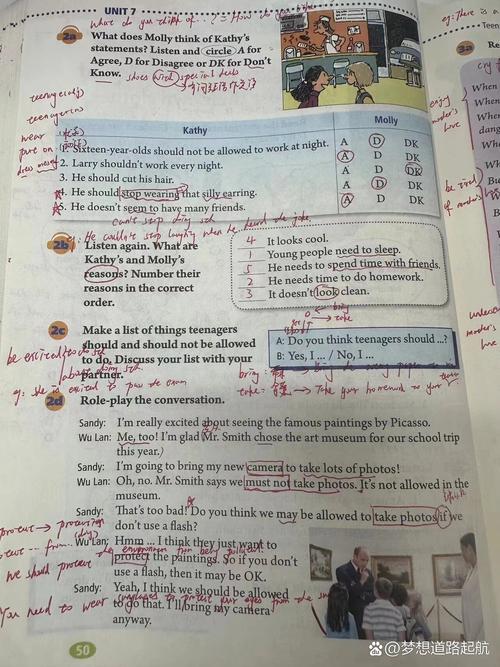
- A: Sixteen-year-olds should be allowed to drive.
(十六岁的人应该被允许开车。)
 (图片来源网络,侵删)
 - B: I don't agree. They are not serious enough.
(我不同意,他们不够成熟。)
表达观点和理由
- I think... / I believe... / In my opinion...
(我认为... / 我相信... / 在我看来...)
- The reason is that...
(理由是...)
- For example, ...
(...)
- It is important for sb. to do sth.
(做某事很重要。)
- It's a good/bad idea to do sth.
(做某事是个好/坏主意。)
课文/对话核心内容解析
Section A: School Rules (校规)
- 对话/文章核心: 讨论学校的着装规定和其他规则。
- 主要观点:
- 观点一 (支持): 校规有助于创造平等的学习环境,让学生专注于学习,而不是穿着。 (
...they can stop students from focusing on their studies.) - 观点二 (反对): 学生应该有选择自己衣服的自由,以表达个性。 (
...we should be allowed to choose our own clothes.)
- 观点一 (支持): 校规有助于创造平等的学习环境,让学生专注于学习,而不是穿着。 (
- 重点句型:
- Students should be allowed to wear their own clothes.
- What do you think about the school rules?
- I agree that they should be allowed to design their own uniforms.
Section B: Family Rules & Pressures (家规与压力)
- 文章核心: 探讨青少年面临的来自家庭和同伴的压力,以及如何与父母沟通。
- 家规: 父母严格,担心孩子安全,不允许熬夜、做兼职等。
- 同伴压力: 同伴可能会影响你的选择,比如让你做不想做的事。
- 沟通的重要性: 文章建议青少年应该学会与父母沟通,解释自己的想法,而不是争吵。 (
...it's a good idea to talk about these feelings with your parents.)
- 重点句型:
- I don't think sixteen-year-olds should be allowed to get their ears pierced.
- Parents are sometimes strict, but they make rules to help us.
- It's important for parents to trust their children.
- We should learn to communicate with our parents.
学习建议
- 语法是核心: 反复练习含有情态动词的被动语态的转换,可以找一些主动句,自己改成被动句,加深理解。
- 词汇要活用: 不要只背单词的中文意思,要结合短语和例句来记,并尝试造句。
- 开口说: 找一个伙伴,用本单元的功能句型讨论你们学校的规则、家规等,把学到的知识用起来。
- 联系实际: 思考一下你生活中的各种规则(校规、班规、家规),尝试用英语去评价它们,说明你支持或反对的理由,这能帮助你更好地理解单元主题。
- 整理笔记: 将重点语法、短语和句型整理到笔记本上,方便随时复习。
希望这份详细的梳理对你有帮助!祝你学习进步!