八年级下册英语重点短语有哪些?
校园之窗 2025年12月17日 07:50:37 99ANYc3cd6
下面我将按照人教版(Go for it!)八年级下册各单元的顺序,为你整理出重点短语、核心句型和用法解析,并附上记忆技巧,希望能帮助你高效掌握!
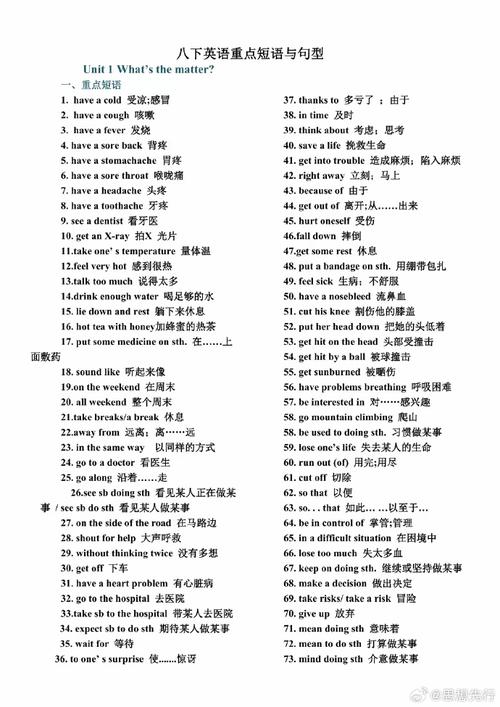
Unit 1: What's the matter?
主题: 健康、问题与建议
核心语法: should / shouldn't + 动词原形;Why don't you...? / Why not...?
| 重点短语 | 中文释义 | 用法解析与例句 |
|---|---|---|
| What's the matter? | 怎么了? | 询问对方或他人身体或状况。What's the matter with you? 你怎么了? |
| What's the trouble (with you)? | 你有什么麻烦? | 同上,更侧重于“麻烦”。What's the trouble with your bike? 你的自行车出什么问题了? |
| have a fever / a cold / a cough / a sore throat | 发烧 / 感冒 / 咳嗽 / 喉咙痛 | have + 疾病名词,表示“得了某种病”。He has a sore throat, so he can't speak. |
| have a stomachache / a headache / a toothache | 胃痛 / 头痛 / 牙痛 | 同上。I have a bad headache. 我头痛得厉害。 |
| lie down and rest | 躺下休息 | lie 是不规则动词,过去式 lay。You should lie down and rest for a while. |
| drink lots of water | 多喝水 | lots of = a lot of,修饰可数或不可数名词。You should drink lots of water when you have a fever. |
| see a doctor | 看医生 | see 在这里是“看(病)”的意思。You should see a doctor if you feel sick. |
| get an X-ray | 拍X光片 | get 在这里表示“做(某项检查)”。The doctor asked me to get an X-ray. |
| stress out | 紧张,有压力 | 形容词 stressed (感到紧张的)。I'm so stressed out about the exam. |
| listen to light music | 听轻音乐 | listen to + 宾语。Listening to light music can help you relax. |
| exercise such as walking and running | 比如散步和跑步这样的锻炼 | such as 用来举例。You can do some exercise, such as walking and running. |
| at the moment | 目前 | 相当于 right now。I'm busy at the moment. |
| be stressed out | 感到紧张 | 描述人的状态。He is always stressed out because of his work. |
| a few / a little | 一些,几个 | a few + 可数名词复数;a little + 不可数名词。I have a few friends here. / I have a little money. |
| not...at all | 一点也不 | 加强否定语气。I don't like coffee at all. |
Unit 2: I'll help to clean up the city parks.
主题: 志愿活动、提供帮助
核心语法: want/would like/hope to do sth.;offer to do sth.;try to do sth.
| 重点短语 | 中文释义 | 用法解析与例句 |
|---|---|---|
| clean up | 打扫干净 | up 表示“彻底地”。Let's clean up the classroom after school. |
| cheer up | 使振奋,使高兴起来 | up 表示“向上”,引申为“情绪变好”。Your words cheered me up. |
| give out | 分发,发放 | out 表示“向外”。The teacher gave out the exam papers. |
| come up with | 想出(主意、办法等) | up with 表示“跟上(想法)”。We need to come up with a plan. |
| put off | 推迟 | off 表示“离开、远离”,引申为“延迟”。Don't put off your homework until tomorrow. |
| write down | 写下,记下 | down 表示“向下”,引申为“记录下来”。Please write down your name. |
| make a plan | 制定计划 | make + 名词,表示“制作、制定”。Let's make a plan for the trip. |
| sign up | 报名,登记 | sign (签名) + up (向上),表示“报名参加”。You can sign up for the basketball team. |
| be able to do sth. | 能够做某事 | can 的同义短语,但可用于更多时态。He was able to swim when he was five. |
| care for | 照顾,非常喜欢 | care for sb./sth. 表示“照顾”;care for doing sth. 表示“喜欢做某事”。She cares for her sick mother. / I don't care for coffee. |
| try one's best (to do sth.) | 尽某人最大努力(做某事) | try one's best 是固定搭配。I will try my best to help you. |
| fix up | 修理,修补 | up 表示“彻底地”。He fixed up my old bike. |
| give away | 赠送,分发 | away 表示“离开”。He gave away all his old books to the children. |
Unit 3: Could you please clean your room?
主题: 家庭责任、礼貌地提出请求与许可
核心语法: Could you please...? (委婉请求);Could I...? (委婉许可);have to / must
| 重点短语 | 中文释义 | 用法解析与例句 |
|---|---|---|
| do the dishes | 洗碗碟 | do + 家务活。It's your turn to do the dishes. |
| sweep the floor | 扫地 | sweep 是不规则动词,过去式 swept。Could you please sweep the floor? |
| take out the trash | 倒垃圾 | take out 拿出。Mom asked me to take out the trash. |
| fold the clothes | 叠衣服 | fold 折叠。I'm folding my clothes. |
| make the bed | 整理床铺 | make 在这里是“整理”的意思。You should make your bed every morning. |
| work on | 从事,忙于 | work on sth. 表示“致力于某事”。He is working on a new project. |
| at least | 至少 | at + least (最小的)。You should sleep for at least 8 hours a day. |
| throw down | 扔下 | down 表示向下。Don't throw your things down on the floor. |
| as soon as | 一...就... | 引导时间状语从句。As soon as he gets home, he starts to do his homework. |
| pass me the salt | 把盐递给我 | pass sb. sth. 或 pass sth. to sb.。Pass me the salt, please. |
| borrow...from... | 从...借入 | borrow 是“借入”,指向外拿。I borrowed a book from the library. |
| lend...to... | 把...借给... | lend 是“借出”,指向外给。Can you lend your pen to me? |
| invite sb. to do sth. | 邀请某人做某事 | invite sb. to + 地点 邀请某人去某地。He invited me to have dinner. |
| go to the movies | 去看电影 | go to + the + 活动场所。Let's go to the movies this weekend. |
Unit 4: Why don't you talk to your parents?
主题: 与人相处、提建议、解决问题
核心语法: Why don't you...? / Why not...? (提建议);until / so that 引导的状语从句
| 重点短语 | 中文释义 | 用法解析与例句 |
|---|---|---|
| argue with sb. | 与某人争吵 | argue with 表示“和...争吵”。He often argues with his sister. |
| instead of | 代替,而不是 | 后面跟名词、代词或动名词。Let's play soccer instead of basketball. |
| communicate with sb. | 与某人交流 | communicate with 是固定搭配。You should communicate with your parents more. |
| get on well with sb. | 与某人相处融洽 | get on well with 是固定搭配。I get on well with my classmates. |
| compete with sb. | 与某人竞争 | compete with / against。They are competing with each other for the first prize. |
| take pride in | 为...感到自豪 | be proud of 是其同义短语。He takes pride in his work. |
| free time | 空闲时间 | free (空闲的) + time。I have a lot of free time on weekends. |
| in order to | 为了 | 后面跟动词原形,表目的。He gets up early in order to catch the bus. |
| so that | 以便,为了 | 引导目的状语从句,从句中常有 can, could, may, might 等情态动词。Speak loudly so that everyone can hear you. |
| cut out | 删去,剪下 | out 表示“出来”。You should cut out junk food. |
| compare...to/with... | 把...比作/与...比较 | compare A to B 把A比作B;compare A with B 比较A和B的异同。Poets often compare life to a journey. |
| perhaps | 也许,可能 | 相当于 maybe,放在句首。Perhaps he is at home. |
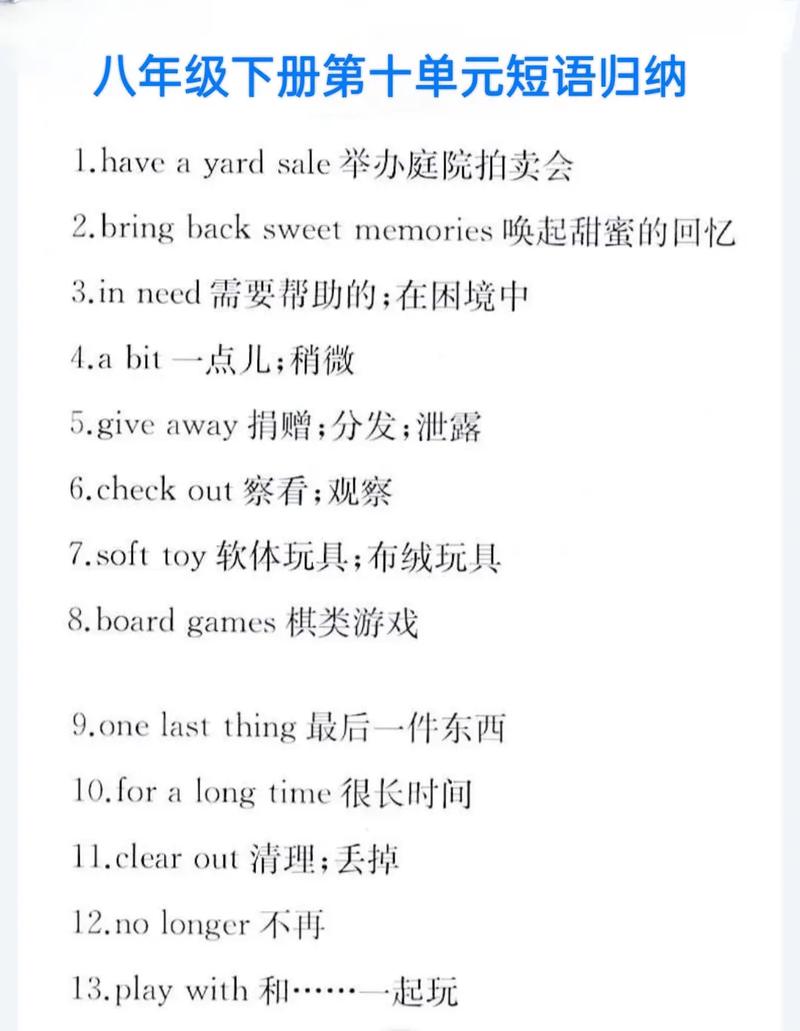
Unit 5: What were you doing when the rainstorm came?
主题: 过去进行时
核心语法: 过去进行时 (was/were doing)
| 重点短语 | 中文释义 | 用法解析与例句 |
|---|---|---|
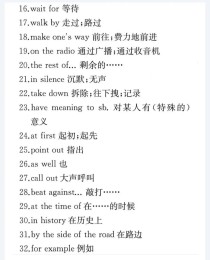
| at the time of... | 在...的时候 | at the time of + 名词/动名词。What were you doing at the time of the rainstorm? |
| wait for | 等待 | wait for sb./sth.。I was waiting for the bus when it started to rain. |
| go off | (闹钟)发出响声 | off 表示“离开(睡眠状态)”。My alarm clock didn't go off this morning. |
| take a hot shower | 洗个热水澡 | take/have a + 名词 表示“做一次(某事)”。I was taking a hot shower when the phone rang. |
| miss the bus / miss the event | 错过公交车 / 错过活动 | miss 错过。I missed the bus because I got up late. |
| pick up | 接(人),捡起 | pick up sb. 接某人;pick up sth. 捡起东西。My dad picked me up from school. |
| by the time | 到...时候为止 | by the time + 从句,主句用过去完成时或一般过去时。By the time I got home, he had already left. |
| break down | (机器)出故障 | break (打破) + down (向下)。My car broke down on the way. |
| in silence | 沉默地,无声地 | in silence 是固定搭配。The students sat in silence. |
| fall asleep | 入睡 | fall 是系动词,后接形容词。He was so tired that he fell asleep quickly. |
| die down (风/火) 变弱,逐渐平息 | die (消失) + down (向下)。The wind began to die down. |
|
| wake up | 醒来 | wake 是不规则动词,过去式 woke。I woke up at 6 AM. |
Unit 6: An old man tried to move the mountains.
主题: 故事与传说、神话
核心语法: unless, as soon as, so...that... 等引导的状语从句;remind sb. to do sth.
| 重点短语 | 中文释义 | 用法解析与例句 |
|---|---|---|
| work on | 从事,忙于 | work on a story 忙于一个故事。He is working on a new novel. |
| turn...into... | 把...变成... | turn A into B。The witch turned the prince into a frog. |
| instead of | 代替,而不是 | 同Unit 4。He walked home instead of taking a bus. |
| get married | 结婚 | get + 过去分词,表示状态变化。They got last year. |
| keep doing sth. | 不断地做某事 | keep on doing sth. 也是此意。He kept trying and never gave up. |
| give up | 放弃 | up 表示“结束”。Don't give up easily. |
| at the same time | 同时 | at the same time。We can't watch TV and do homework at the same time. |
| once upon a time | 从前 | 用于讲故事开头。Once upon a time, there was a beautiful princess. |
| become interested in | 对...变得感兴趣 | become interested in + 名词/动名词。He became interested in science. |
| remind sb. of sth. | 使某人想起某事 | remind sb. of sth.。This song reminds me of my childhood. |
| remind sb. to do sth. | 提醒某人做某事 | remind sb. to do sth.。Please remind me to lock the door. |
| as soon as | 一...就... | As soon as he saw me, he ran away. |
| so...that... | ..以至于... | so + 形容词/副词 + that + 从句。He was so tired that he fell asleep. |
| unless | 除非,如果不 | unless = if...not。You will fail unless you study hard. |
Unit 7: What's the highest mountain in the world?
主题: 地理、自然、世界之最 核心语法: 形容词/副词的最高级
| 重点短语 | 中文释义 | 用法解析与例句 |
|---|---|---|
| in the world | 在世界上 | 用于最高级前。Qomolangma is the highest mountain in the world. |
| square kilometers | 平方公里 | square (平方的) + kilometers。The city covers an area of 200 square kilometers. |
| as far as I know | 据我所知 | as far as I know 是插入语。As far as I know, he is not at home. |
| feel free to do sth. | 随意做某事 | feel free 感到自由。Feel free to ask me if you have any questions. |
| even though / even if | 即使,尽管 | 引导让步状语从句。Even though it was raining, we went out. |
| take in | 吸入,吞入(空气等) | in 表示“进入”。Plants take in carbon dioxide. |
| in the face of danger | 面对危险 | in the face of 是固定搭配。He remained calm in the face of danger. |
| give up | 放弃 | 同Unit 6。Never give up your dream. |
| achieve one's dream | 实现某人的梦想 | achieve (实现) + one's dream。You can achieve your dream if you work hard. |
| the forces of nature | 大自然的力量 | the forces of nature。We are amazed by the forces of nature. |
| be in danger | 处于危险中 | in danger。The pandas are in danger. |
| protect...from... | 保护...免受... | protect sb./sth. from harm/danger。We should protect the environment from pollution. |
Unit 8: Have you read Treasure Island yet?
主题: 经历、阅读、现在完成时
核心语法: 现在完成时 (have/has done)
| 重点短语 | 中文释义 | 用法解析与例句 |
|---|---|---|
| listen to | 听 | listen to + 宾语。I have listened to this song three times. |
| make a list | 列一个清单 | make a list of...。Let's make a list of books we want to read. |
| so far | 到目前为止 | so far = up to now,常与现在完成时连用。So far, I have finished half of the book. |
| according to | 根据,按照 | According to the news, it will rain tomorrow. |
| over time | 随着时间的推移 | Over time, things will get better. |
| more than | 超过 | more than + 数字。He has been to Beijing more than five times. |
| in fact | 事实上 | In fact, he is my brother. |
| put...down | 放下 | put down the book 把书放下。Put down your pen and listen to me. |
| page after page | 一页又一页地 | page after page 是副词短语。He read the book page after page. |
| grow up | 长大 | grow 是不规则动词,过去式 grew。I want to be a doctor when I grow up. |
| ever since | 从那时起 | ever since + 过去的时间点。I have lived here ever since 2010. |
| hurry to do sth. | 赶紧做某事 | hurry to do sth.。He hurried to catch the train. |
| divide...into... | 把...分成... | divide A into B。Please divide the class into four groups. |
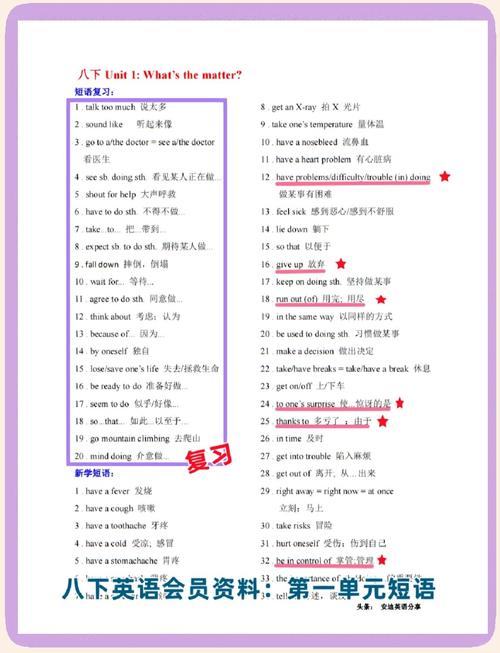
Unit 9: Have you ever been to a museum?
主题: 旅行经历、现在完成时
核心语法: have/has been to vs. have/has gone to;how long 引导的现在完成时疑问句
| 重点短语 | 中文释义 | 用法解析与例句 |
|---|---|---|
| have/has been to + 地点 | (某人)去过某地(现在已不在那里) | I have been to Beijing twice. (我去过两次北京,我现在不在北京) |
| have/has gone to + 地点 | (某人)去了某地(现在可能在去某地的路上,或已在那里) | He has gone to Shanghai. (他去上海了,他现在不在说话的地方) |
| have/has been in + 地点 | (某人)在某地待了多久 | How long have you been in Shanghai? (你在上海待了多久了?) |
| on a school trip | 在学校组织的旅行中 | on a trip 在旅行中。We went to the museum on a school trip. |
| take a ride | 乘坐一段旅程(尤指乘车或船) | take a ride in a car 坐车兜风。Let's take a ride on the subway. |
| end up | 最终成为,结果是 | end up doing sth.。We ended up watching a movie. |
| not...at all | 一点也不 | 同Unit 1。I don't like the movie at all. |
| in total | 总共 | in total。There are 50 students in our class in total. |
| all year round | 一年到头 | all year round。The weather here is warm all year round. |
| be famous for | 因...而著名 | be famous for sth.。Paris is famous for the Eiffel Tower. |
| be famous as | 作为...而著名 | He is famous as a writer. |
| be interested in | 对...感兴趣 | be interested in + 名词/动名词。I am interested in science. |
| would love to do sth. | 很乐意做某事 | would love to = would like to。I would love to visit the Great Wall. |
Unit 10: I've had this bike for three years.
主题: 持续性动作、现在完成时 (for / since 引导的时间状语)
核心语法: 现在完成时 (have/has done + for / since)
| 重点短语 | 中文释义 | 用法解析与例句 |
|---|---|---|
| have/has had/has owned | 拥有 | 强调“拥有”这个状态持续了多久。I have had this bike for three years. (我拥有这辆自行车三年了) |
| for + 一段时间 | 持续了多长时间 | for two hours, for a week。I have lived here for ten years. |
| since + 过去的时间点 | 从过去某个时间点开始 | since 2010, since last month, since I was a child。I have known him since we were kids. |
| the same...as... | 和...一样的 | the same age as me。He is the same age as me. |
| be different from | 与...不同 | be different from sth.。My opinion is different from yours. |
| to be honest | 老实说 | To be honest, I don't like this idea. |
| pay for | 支付...的费用 | pay for sth.。How much did you pay for this T-shirt? |
| throw away | 扔掉,丢弃 | throw away。Don't throw away these old newspapers. |
| as for | 至于,就...而言 | As for me, I agree with you. |
| regret doing sth. | 后悔做了某事 | regret + 动名词,表示对已发生事情的后悔。I regret telling him the secret. |
| run out of | 用完,耗尽 | run out of sth.。We have run out of milk. |
| move to... | 搬到... | move to a new city。My family is going to move to Shanghai. |
高效记忆小贴士
- 情景记忆法: 不要孤立地背单词,想象一个场景,比如你生病了 (
have a fever),妈妈让你 (ask you to) 躺下休息 (lie down and rest),多喝水 (drink lots of water),如果还不去看医生 (see a doctor),你就会一直紧张 (be stressed out),这样一整串短语就记住了。 - 造句法: 每学一个短语,立刻用它造一个与你自己生活相关的句子,比如学到
put off,就造句I always put off doing my homework.(我总是拖延做作业),这样的句子印象最深。 - 分类归纳法: 将意思相近的短语放在一起比较和记忆。
borrow和lend,be famous for和be famous as,have been to和have gone to,弄清楚它们的区别,就不容易混淆了。 - 卡片法: 制作单词卡片,正面写英文短语,反面写中文释义和例句,利用碎片时间(如等车、排队)拿出来看,反复记忆。
希望这份详细的总结能对你有所帮助!祝你学习进步,英语越来越棒!