九年级上册英语知识点有哪些重点?
校园之窗 2025年12月14日 02:55:34 99ANYc3cd6
九年级上册英语核心知识点总结
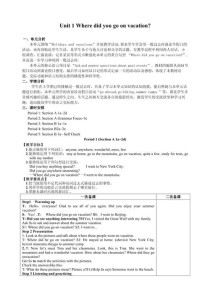
九年级上册的英语学习是整个初中阶段的冲刺和拔高期,知识点更加综合,对语法、词汇和运用能力的要求也更高,本总结将帮助你构建清晰的知识框架。
第一部分:词法
动词时态与语态
这是九年级的重中之重,需要重点掌握。

| 时态/语态 | 结构 | 用法 | 例句 |
|---|---|---|---|
| 现在完成时 | have/has + 过去分词 |
核心用法:表示过去发生并持续到现在的动作或状态,或对现在造成的影响。 表示持续:与 for (时间段) 或 since (时间点) 连用。表示经历: have/has been to (去过某地,已回来) vs. have/has gone to (去了某地,未回来)。 |
I have lived here for ten years. (我住这儿十年了,现在仍住在这里。) He has been to Beijing twice. (他去过北京两次。) — Where is Tom? — He has gone to the library. (他去图书馆了,人不在。) |
| 被动语态 | be + 过去分词 |
核心用法:强调动作的承受者,而非执行者。 一般现在时被动: am/is/are + 过去分词一般过去时被动: was/were + 过去分词现在完成时被动: have/has been + 过去分词 |
This book is written by Mo Yan. (这本书是莫言写的。) The bridge was built in 2010. (这座桥建于2010年。) The homework has been finished already. (作业已经完成了。) |
| 过去进行时 | was/were + 现在分词 |
表示过去某个特定时间点或时间段正在进行的动作。 | I was doing my homework at 8 o'clock last night. (昨晚8点我正在做作业。) They were having an English class this time yesterday. (昨天这个时候他们正在上英语课。) |
| 一般将来时 | will/shall + 动词原形 或 be going to + 动词原形 |
will:表示临时的、主观的决定或将来会发生的客观情况。be going to:表示事先计划好的意图或根据现有迹象做出的预测。 |
It's late. I will call a taxi. (天晚了,我打算叫辆出租车。—临时决定) Look at the dark clouds. It is going to rain. (看乌云,要下雨了。—预测) |
情态动词
除了复习 can, may, must 等基础用法,重点掌握以下两点:
| 情态动词 | 结构 | 用法 | 例句 |
|---|---|---|---|
should / ought to |
should/ought to + 动词原形 |
表示“应该”,带有建议、劝告或义务的意味。 | You should eat more vegetables to keep healthy. (你应该多吃蔬菜来保持健康。) |
must vs. have to |
must + 动词原形have to + 动词原形 |
must: 1. 表示“必须”,主观意志强。 2. 表示肯定的推测,意为“一定是”。have to: 表示“不得不”,客观需要,有人称和时态变化。 |
You must finish your work now. (你现在必须完成工作。—主观要求) He must be at home. The lights are on. (他一定在家,灯亮着呢。—推测) I had to stay at home yesterday because of the rain. (昨天我不得不待在家里,因为下雨了。—客观原因) |
非谓语动词
| 类型 | 用法 | 例句 |
|---|---|---|
| 动词不定式 | 作目的状语 (常用 in order to / so as to 加强语气) 作宾语 (常跟 want, hope, decide, plan, agree 等词) 作后置定语,修饰名词 |
He came to see me. (他来看我。) She studies hard in order to pass the exam. (为了通过考试,她努力学习。) I want to buy a new phone. (我想买部新手机。) I have a lot of work to do. (我有许多工作要做。) |
| 动名词 | 作主语 作宾语 (常跟 enjoy, finish, practice, mind, suggest 等词) |
Swimming is my favorite sport. (游泳是我最喜欢的运动。) She enjoys listening to music. (她喜欢听音乐。) |
连词
重点掌握表示对比、因果、条件的连词。
| 类型 | 常见连词 | 例句 |
|---|---|---|
| 转折/对比 | while, but, however |
Some people like coffee, while others prefer tea. (一些人喜欢咖啡,而另一些人则喜欢茶。) |
| 因果 | because, because of, since, as, so, therefore |
He was late because he missed the bus. (因为他错过了公交车,所以他迟到了。) He was late because of the heavy rain. (因为大雨,他迟到了。) |
| 条件 | if, unless |
If it rains tomorrow, we will cancel the picnic. (如果明天下雨,我们将取消野餐。) You will fail unless you work hard. = If you don't work hard, you will fail. (除非你努力学习,否则你会失败。) |
第二部分:句法
宾语从句
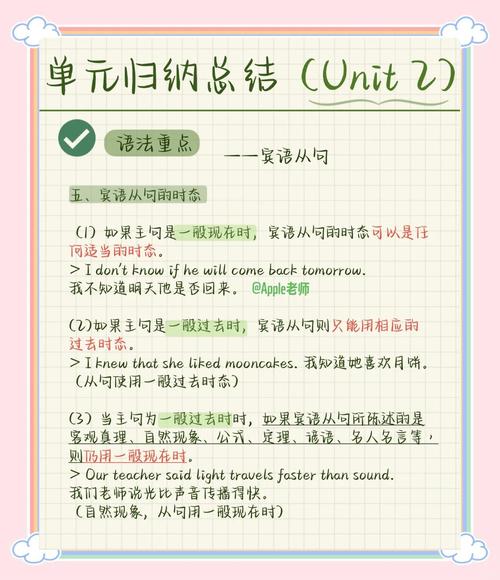
在句子中作宾语的句子,掌握“引导词 + 陈述句语序”的核心原则。
| 引导词 | 用法 | 例句 |
|---|---|---|
that |
无实际意义,只起连接作用,常可省略。 | I know (that) he is right. (我知道他是对的。) |
if / whether |
表示“是否”,whether 更正式,可接 or not。 |
Can you tell me if/whether it will rain? (你能告诉我是否会下雨吗?) |
| 特殊疑问词 | (what, where, when, why, how 等) | Please tell me what time it is. (请告诉我现在几点了。) I wonder why he was late. (我想知道他为什么迟到了。) |
注意:宾语从句必须使用陈述句语序 (主语 + 谓语),不能使用疑问句语序。
- 错误:Do you know what time is it?
- 正确:Do you know what time it is?
状语从句
在句子中作状语,修饰主句的动词、形容词或副词。
| 类型 | 常用引导词 | 例句 |
|---|---|---|
| 时间状语从句 | when, while, as, before, after, since, until, as soon as |
I will call you as soon as I arrive. (我一到就给你打电话。) |
| 条件状语从句 | if, unless |
You can't learn English well if you don't practice. (如果你不练习,就学不好英语。) |
| 原因状语从句 | because, since, as |
He didn't come to the party because he was ill. (他没来派对,因为他病了。) |
| 让步状语从句 | although, though, even though |
Although he is very rich, he is not happy. (尽管他很富有,但他并不快乐。) |
| 结果状语从句 | ... so + 形容词/副词 + that ...... such + (a/an) + 形容词 + 名词 + that ... |
The box was so heavy that I couldn't lift it. (这个箱子太重了,我搬不动。) It was such a fine day that we decided to go for a walk. (天气如此好,以至于我们决定去散步。) |
第三部分:功能意念项目
这部分是关于“说什么”,即日常交际用语。
| 话题 | 常用句型 |
|---|---|
| 同意与不同意 | I agree. / I don't agree. / That's a good idea. / I'm afraid not. |
| 建议与忠告 | You should/ought to... / Why don't you...? / What about...? / Let's... / How about...? |
| 表达感谢与应答 | Thank you very much. / Thanks a lot. / I'm grateful for... / You're welcome. / Not at all. |
| 道歉与应答 | I'm sorry. / I apologize for... / Excuse me. / That's all right. / Never mind. |
| 询问与提供信息 | Could you tell me...? / What's the population of...? / Let me help you. / Can I do anything for you? |
| 表达喜好与厌恶 | I like/enjoy... / I'm interested in... / I hate/dislike... / I can't stand... |
| 表达可能与不可能 | It may/might... / It's possible that... / It can't be... / I'm sure that... |
第四部分:核心话题与词汇
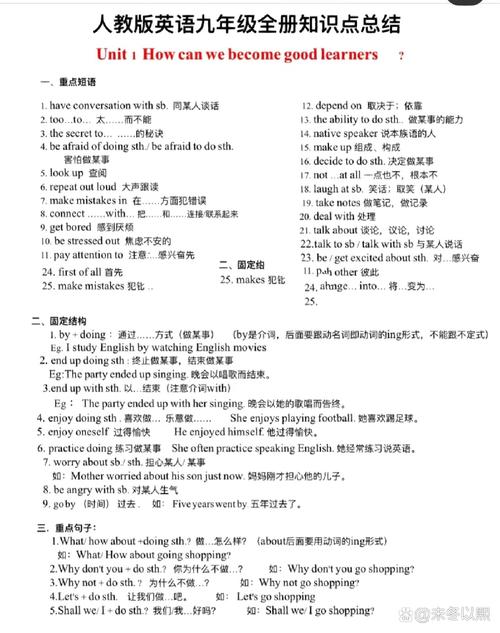
Topic 1: How do you study for a test? (学习方式)
- 核心词汇: `aloud, pronunciation, specific, memorize, grammar, differently, quickly, slowly, mistake, conversation, partner, increase, speed, born, be born with, create, knowledge, review, solution, realize, matter, afraid, be afraid to, laugh, take notes, deal with, unless, influence, be influenced by, direct, exam, textbook, soft, hard, skill, active, attention, pay attention to, connect...with... |
- 重点句型:
- — How do you study for a test? — I study by working with a group. (你是如何备考的?我通过小组学习。)
- I find it difficult to learn English grammar. (我发现学英语语法很难。)
- The teacher spoke so quickly that I couldn't follow her. (老师说得那么快,以至于我跟不上她。)
- Unless you work hard, you will fail the exam. (除非你努力学习,否则你会考试不及格。)
Topic 2: I used to be afraid of the dark. (过去与现在的对比)
- 核心词汇: `used to, be used to, dark, insect, spider, ant, chew, gum, silent, board, presentation, require, level, dare, audience, private, guard, guard, courage, influence, absent, fail, in the end, take up, hobby, extremely, proud, be proud of, attention, give attention to, deal with, regard, regard...as..., influence, take pride in |
- 重点句型:
- I used to be afraid of the dark. (我过去害怕黑暗。)
- — Did you use to play the piano? — Yes, I did. / No, I didn't. (你过去弹钢琴吗?)
- He is used to getting up early. (他习惯早起。)
- I take pride in my son. (我为我的儿子感到骄傲。)
Topic 3: What are you doing for vacation? (假期计划)
- 核心词汇: `vacation, plan, away, get back, hike, send, postcard, trek, jungle, Thailand, Bali, Malaysia, Greece, Spain, Greece, Spain, Italy, countryside, peace, provide, fish, rent, think about, decide, forget, forget to, finish, before, tourist, sight, wonder, famous, take a vacation, away from, touristy, book, birdwatching, bike ride, parasailing, fishing, rent, sightseeing, take it easy, leave for |
- 重点句型:
- — What are you doing for vacation? — I am staying at home. (你假期要做什么?我要待在家里。)
- — When are you going? — I'm going on Monday. (你什么时候去?我周一去。)
- He decided to travel around the world. (他决定环游世界。)
- I hope to see you soon. (我希望很快能见到你。)
Topic 4: Could you please tell me where the restrooms are? (问路与指路)
- 核心词汇: `restroom, shampoo, drugstore, department store, escalator, furniture, exchange, besides, direction, correct, polite, impolite, request, direct, passage, lie, forbid, passage, fork, lead, point, suggest, request, get to, go past, on one's right/left, next to, between, across from, turn left/right, go straight, block, distance, excuse me, pardon me, beg your pardon |
- 重点句型:
- — Could you please tell me where the restrooms are? — Sure. / I'm sorry, I don't know. (请问你能告诉我洗手间在哪里吗?)
- — Could you please speak more slowly? — Of course. (你能说慢一点吗?当然可以。)
- Go straight and turn left at the first corner. (直走,然后在第一个路口左转。)
- I'm looking for a bank. Do you know where it is? (我在找一家银行,你知道它在哪儿吗?)
第五部分:典型例题与解题技巧
例1 (现在完成时) — Where is Mr. Li? — He __ to the library. He'll be back in an hour. A. has been B. has gone C. went D. was
解析: 考查 have/has been to 和 have/has gone to 的区别。have/has gone to 表示“去了某地,人还未回来”,符合题意(李老师不在,一小时后回来)。have/has been to 表示“去过某地,已经回来了”,故选 B。
例2 (宾语从句) Could you please tell me __? A. where is the nearest post office B. where the nearest post office is C. where was the nearest post office D. where the nearest post office was
解析: 考查宾语从句的语序,宾语从句必须使用陈述句语序(主语 + 谓语),A 和 C 错误,问句是问现在的地点,所以用一般现在时,D 错误,故选 B。
例3 (被动语态) A new library __ in our town last year. A. is built B. was built C. builds D. built
解析: 考查被动语态,主语 A new library 是动作 build 的承受者,用被动语态,时间状语 last year 是一般过去时,所以用 was/were + 过去分词,主语是单数,用 was,故选 B。
例4 (非谓语动词) My parents always encourage me __ hard and __ my dream. A. work; to realize B. to work; realize C. to work; to realize D. working; realizing
解析: 考查非谓语动词。encourage sb. to do sth. 是固定搭配,意为“鼓励某人做某事”,所以第二个空用 to realize。and 连接两个并列的动词不定式,第一个空也应用 to work,故选 C。
复习建议
- 构建体系: 不要零散地记单词和语法,要把它们放进时态、从句、话题等体系里去理解和记忆。
- 语境记忆: 把单词和句型放到课文的对话或短文中去理解和背诵,效果远好于孤立地背单词表。
- 勤于练笔: 多做单选、完形和阅读,尤其是涉及重点语法和话题的题目,尝试用重点句型和词汇自己写小短文或对话。
- 错题整理: 准备一个错题本,把做错的题目抄下来,写下正确答案和解析,定期回顾,避免再犯同类错误。
希望这份总结能对你的九年级英语学习有所帮助!祝你取得优异的成绩!