八年级上册英语一单元短语有哪些?
校园之窗 2025年12月13日 10:03:29 99ANYc3cd6
Unit 1: Where did you go on vacation?
第一单元:你去哪里度假了?
核心短语
动词短语
这些短语通常由 "动词 + 介词/副词" 构成,是本单元的重点。

(图片来源网络,侵删)
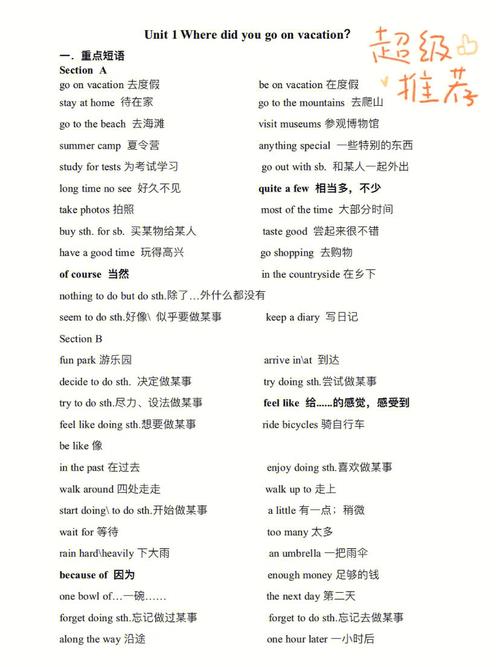
- go on vacation - 去度假
- go to the mountains - 去爬山 (mountains 在这里指“山区”)
- go to the beach - 去沙滩
- visit museums - 参观博物馆
- visit a friend - 拜访朋友
- visit Hong Kong - 参观/游览香港
- study for exams - 备考
- go to summer camp - 参加夏令营
- quite a few - 相当多;不少 (修饰可数名词)
- of course - 自然
- go out - 外出 (游玩)
- buy something special - 买些特别的东西
- in the past - 在过去
- walk around - 四处走动;漫步
- feel like - 感觉像;想要 (后面常跟从句
that或动名词-ing形式) - because of - 因为;由于 (后接名词、代词或动名词)
- one of the + 名词复数 - ...中最...的一个 (后面谓语动词用单数)
- decide to do sth. - 决定做某事
- try something new - 尝试新事物
- look for - 寻找
- keep a diary - 记日记
- in the future - 在未来
- different kinds of - 不同种类的
形容词短语
- something important - 重要的事情
- anything interesting - 有趣的事情
- nothing much - 没什么特别的事
- not bad - 不错;还好
- pretty good - 相当好
- great - 很棒
- really nice - 真的很不错
- wonderful - 极好的;精彩的
- terrible - 糟糕的;很差的
- boring - 无聊的
- busy - 忙碌的
- expensive - 昂贵的
- cheap - 便宜的
- crowded - 拥挤的
- beautiful - 美丽的
- famous - 著名的
重点句型
一般过去时的特殊疑问句
这是本单元的核心语法,用来询问过去的经历。
- Where did you go on vacation? (你假期去哪里了?)
- Where did he/she go on vacation? (他/她假期去哪里了?)
- Where did they go on vacation? (他们假期去哪里了?)
- What did you do on vacation? (你假期做了什么?)
- How was your vacation? (你的假期怎么样?)
- How was the beach? (那个沙滩怎么样?)
- How were the museums? (那些博物馆怎么样?)
- Did you go anywhere interesting? (你去什么有趣的地方了吗?)
- Did you buy anything special? (你买了什么特别的东西吗?)
谈论感受的句型
- — How was the food? — It was delicious. (食物怎么样?——很美味。)
- — How were the people? — They were friendly. (人们怎么样?——他们很友好。)
- — Did everyone have a good time? — Oh, yes. Everything was excellent. (每个人都玩得开心吗?——哦,是的,一切都棒极了。)
- — I feel like I was a bird. (我感觉自己像一只鸟一样。) (描述感受)
陈述句
- I went to the mountains. (我去爬山了。)
- She visited her uncle. (她去看望了她的叔叔。)
- They studied for exams. (他们备考了。)
- We had a great time. (我们玩得很开心。)
- It was a beautiful day. (那是美好的一天。)
- The food was delicious. (食物很美味。)
- The people were very friendly. (人们非常友好。)
- The streets were too crowded. (街道太拥挤了。)
- I didn't do anything special. (我没做什么特别的事。)
- Most people were on vacation. (大部分人都去度假了。)
重要语法点
不定代词
本单元学习了一些表示“一些、任何、没有”的不定代词,它们在句中可作主语或宾语。
| 单数 | 复数 | 含义 | 用法 |
|---|---|---|---|
| something | something (无) | 某事;某物 | 用于肯定句,常与 anything 在疑问句和否定句中对应 |
| anything | anything (无) | 任何事物 | 常用于疑问句和否定句 |
| nothing | nothing (无) | 没有东西 | 用于否定句,表示“没有任何事” |
| everything | everything (无) | 所有事物;一切 | 用于肯定句 |
| somebody/someone | 某人;有人 | 用于肯定句 | |
| anybody/anyone | 任何人 | 用于疑问句和否定句 | |
| nobody/no one | 没有人 | 用于否定句 | |
| everybody/everyone | 每个人;人人 | 用于肯定句 |
用法注意:
- 修饰这些不定代词时,形容词要放在它们后面。
- something interesting (有趣的事情)
- anything important (重要的事情)
- nothing new (新的事情都没有)
because of 和 because 的区别
- because of + 名词/代词/动名词 (-ing形式)
I was late **because of** the rain.(我因为下雨迟到了。)He was sad **because of** his bad grades.(他因为成绩不好而难过。)
- because + 从句 (句子)
I was late **because** it rained.(我迟到了,因为下雨了。)He was sad **because** he got bad grades.(他很难过,因为他得了坏成绩。)
希望这份详细的整理对你的学习有帮助!记得结合课本例句进行理解和记忆,加油!
(图片来源网络,侵删)

(图片来源网络,侵删)