广东学导练七年级上册英语重点难点解析?
校园之窗 2025年12月11日 15:07:10 99ANYc3cd6
下面我为你详细梳理一下这本书的特点、主要内容以及如何高效使用它,希望能对你的英语学习有所帮助。
《广东学导练》的主要特点
- 同步性强:严格按照人教版七年级上册英语教材的单元和话题顺序编排,"Starter Units 1-3" 和 "Units 1-9",方便你随课程进度同步练习。
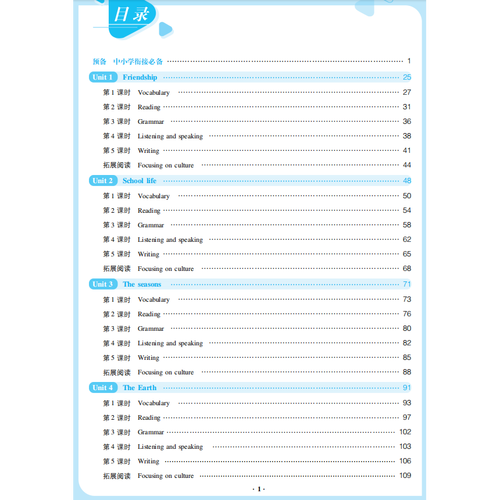
- 结构清晰,功能明确:通常每个单元/模块会包含以下几个核心部分,形成一个完整的“学-练-测”闭环:
- 学前预习/知识梳理:帮你回顾和梳理本单元的重点词汇、句型和语法。
- 课时训练:针对教材中的每一课(如 Section A, Section B)进行专项练习,包括听力、阅读、词汇、语法等。
- 语法专练:对本单元的语法点(如 be动词、名词单复数、代词、一般现在时等)进行集中、深入的讲解和练习。
- 综合能力提升:通常包括完形填空、阅读理解、书面表达等综合性题目,旨在培养你的语言运用能力。
- 单元测试/单元评价:一个单元结束后,进行一次小测,检验你的学习成果,查漏补缺。
- 题型全面:涵盖了中考和各类考试的主要题型,如听力理解、单项选择、完形填空、阅读理解、词汇运用、句型转换、书面表达等,让你提前熟悉考试模式。
- 注重基础与能力并重:既有对基础知识的夯实练习,也有对综合运用能力的拔高训练,适合不同层次的学生。
七年级上册英语核心内容概览(结合《学导练》)
七年级上册的内容主要是为整个初中英语学习打基础,非常重要,以下是核心知识点,你可以对照《学导练》进行复习和练习:
Starter Units 1-3 (预备单元)
- 重点:26个英文字母的认读、书写及顺序;一些最基本的问候和交流用语。
- 核心句型:
What's this in English? It's a/an...Spell it, please. P-E-N.Good morning/afternoon/evening.Hello! / Hi! / Goodbye!
- 《学导练》使用建议:这部分内容相对简单,但字母是基础中的基础,务必通过《学导练》的练习,做到能熟练听、说、读、写所有字母。
Units 1-9 (正式单元)
Unit 1: My name's Gina. (自我介绍与问候)
- 核心词汇:
name, is, am, are, hello, good, morning, afternoon, evening, nice, to, meet, you, what, your, I'm, he, she, it, his, her, yes, no, not - 核心句型:
What's your name? My name's... / I'm...I'm... Nice to meet you.What's his/her name? His/Her name's...He's/She's...
- 语法点:
- be动词:
am, is, are的用法及肯定、否定、疑问形式。 - 形容词性物主代词:
my, your, his, her。
- be动词:
Unit 2: This is my sister. (谈论家庭)
- 核心词汇:
this, that, these, those, is, are, sister, brother, father, mother, parent, grandfather, grandmother, grandparent, family, who, they, well, have, day, bye - 核心句型:
This is/That is... These are/Those are...Who's he/she? He's/She's...Who're they? They're...
- 语法点:
- 指示代词:
this, that, these, those的用法区别。 - 名词复数:规则变化(加-s, -es)和不规则变化。
- 指示代词:
Unit 3: Is this your pencil? (学校用品)
- 核心词汇:
pencil, book, eraser, box, schoolbag, dictionary, his, hers, mine, yours, thank, for, help, welcome, ask, answer, lost, found, call, at - 核心句型:
Is this/that your...? Yes, it is. / No, it isn't.Are these/those your...? Yes, they are. / No, they aren't.What's this/that in English? It's an...How do you spell it? P-E-N.
- 语法点:
- 名词性物主代词:
mine, yours, his, hers。 - 一般疑问句。
- 名词性物主代词:
Unit 4: Where's my schoolbag? (方位介词与物品位置)
- 核心词汇:
where, in, on, under, desk, table, bed, bookcase, sofa, chair, bag, hat, head, know, radio, clock, tape, player, model, plane, tidy, but, our, everywhere, always - 核心句型:
Where's...? It's in/on/under...Where're...? They're in/on/under...
- 语法点:
- 方位介词:
in, on, under的用法。 - where引导的特殊疑问句。
- 方位介词:
Unit 5: Do you have a soccer ball? (拥有物品与提出邀请)
- 核心词汇:
do, does, have, has, soccer, ball, tennis, ping-pong, bat, volleyball, basketball, hey, let's, go, we, late, has, get, great, play, sound, good, sport, many, club, class, interesting, boring, fun, difficult, relaxing, watch, TV, same, love, with, them, only, like, easy - 核心句型:
Do you/they have...? Yes, I/they do. / No, I/they don't.Does he/she have...? Yes, he/she does. / No, he/she doesn't.Let's play... That sounds good/interesting/boring...
- 语法点:
- 实义动词 have 的一般现在时:主语为第三人称单数时用
has,其他人称用have。 - Let's... 句型 (Let us 的缩写,表示“让我们做某事吧”)。
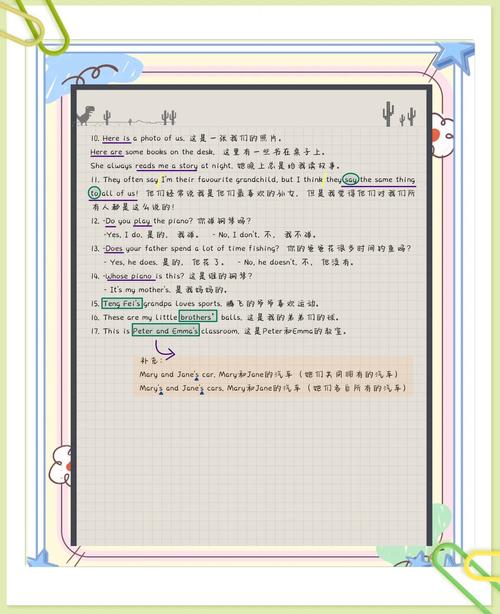
- 名词所有格:
Tom's ball。
- 实义动词 have 的一般现在时:主语为第三人称单数时用
Unit 6: Do you like bananas? (谈论食物)
- 核心词汇:
like, banana, hamburger, tomato, ice-cream, salad, strawberry, pear, milk, bread, birthday, dinner, week, food, sure, vegetable, fruit, right, apple, then, egg, carrot, rice, chicken, so, breakfast, lunch, star, eat, well, habit, healthy, really, question, want, be, fat - 核心句型:
Do you like...? Yes, I do. / No, I don't.Does he/she like...? Yes, he/she does. / No, he/she doesn't.I like... / I don't like...
- 语法点:
- like的用法:
like sth.(喜欢某物) /like doing sth.(喜欢做某事)。 - 可数名词与不可数名词:这是本单元的重点和难点。
- 名词复数的规则与不规则变化。
- like的用法:
Unit 7: How much are these socks? (购物)
- 核心词汇:`much, how much, sock, T-shirt, shorts, sweater, shoe, skirt, dollar, big, small, short, long, woman, need, look, pair, take, here, welcome, ten, eleven, twelve, thirteen, fifteen, eighteen, twenty, thirty, Mr., clothes, store, buy, sell, all, very, price, boy**
- 核心句型:
How much is this/that...? It's... dollar(s).How much are these/those...? They're... dollar(s).Can I help you? I'll take it/them.
- 语法点:
- how much 引导的特殊疑问句 (询问价格)。
- 基数词 (10-31) 的构成和用法。
Unit 8: When is your birthday? (日期与节日)
- 核心词汇:
when, birthday, month, January, February, March, April, May, June, July, August, September, October, November, December, happy, old, party, first, second, third, fifth, eighth, ninth, twelfth, twentieth, test, trip, art, festival, dear, student, thing, term, busy, time, have, there - 核心句型:
When is your/his/her birthday? It's on...How old are you? I'm... years old.
- 语法点:
- when 引导的特殊疑问句 (询问时间)。
- 序数词 (1-31) 的构成和用法。
- 介词 on 用于具体的某一天。
Unit 9: My favorite subject is science. (谈论喜欢的科目)
- 核心词汇:
favorite, subject, science, P.E., music, math, Chinese, geography, history, why, because, Monday, Tuesday, Wednesday, Thursday, Friday, Saturday, Sunday, for, sure, free, cool, Tuesday, Wednesday, Thursday, Friday, Saturday, Sunday, A.M./a.m., P.M./p.m., useful, from, to, Mrs., finish, lesson, hour - 核心句型:
What's your favorite subject? My favorite subject is...Why do you like...? Because it's...When is your... class? It's on... at...
- 语法点:
- why 和 because 的用法。
- 星期表达法。
- 介词 for (因为) 和
at(在...时间)。
如何高效使用《广东学导练》?
-
课前预习,带着问题听课:
- 在学习新课前,先完成《学导练》中“知识梳理”或“学前预习”部分。
- 把不认识的单词、不理解的句子和语法点标记出来,带着这些疑问去听课,效率会大大提高。
-
课中同步,巩固当堂内容:
- 学完教材的 Section A 或 Section B 后,立刻做《学导练》对应的“课时训练”。
- 这能趁热打铁,及时检验你对新知识的掌握程度,发现问题马上解决。
-
课后复习,攻克难点:
- 一个单元学完后,集中精力做“语法专练”,对于七年级学生来说,be动词、名词单复数、代词、一般现在时等是语法难点,一定要通过专项练习彻底搞懂。
- 整理错题本,把《学导练》中做错的题目抄下来,并写下正确答案和解析,定期复习。
-
单元总结,查漏补缺:
- 完成一个单元的所有练习后,认真做“单元测试”。
- 根据测试结果,分析自己的薄弱环节,是词汇量不够?还是某个语法点没掌握?然后回归教材和《学导练》,进行针对性复习。
-
善用听力与阅读材料:
- 《学导练》中的听力部分要坚持听,可以跟读模仿,练习语音语调。
- 阅读理解部分不仅要选对答案,还要学习文章中的好词好句,尝试背诵,为写作积累素材。
《广东学导练》是你学习英语的得力助手。关键在于“坚持”和“方法”,不要把它当成负担,而是看作一个帮助你进步的阶梯,只要你能按照“预习-练习-复习-的步骤,持之以恒地使用它,你的英语基础一定会打得非常牢固,为整个初中阶段的学习打下坚实的基础。
祝你学习进步,英语越来越棒!