八年级上册英语课时练,如何高效提分?
校园之窗 2026年1月31日 06:37:01 99ANYc3cd6
八年级上册英语是整个初中阶段承上启下的关键时期,知识点增多,难度也有所提升,一份好的“课时练”应该紧跟教材,分单元、分课时进行巩固,既能检验学习效果,又能提前应对考试。
下面我为你整理了一份非常全面的八年级上册英语课时练指南,包含核心知识点梳理、各单元课时练重点、练习题示例以及高效使用建议,希望能帮助你更好地学习。
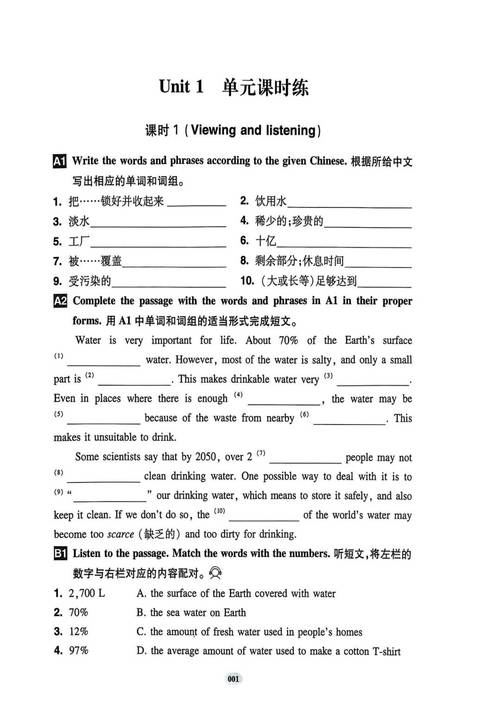
第一部分:八年级上册英语核心知识点概览
在开始练之前,先明确我们要练什么,八年级上册的核心知识点通常围绕以下几个模块展开:
-
一般将来时
- 结构:
will + 动词原形 - 用法: 表示将来要发生的动作或存在的状态,常与
tomorrow, next week, in the future等时间状语连用。 - 句型: 肯定句、否定句、疑问句及回答。
- 结构:
-
情态动词
can,may,must的用法- can: 表示能力或许可(Could 是更委婉的问法)。
- may: 表示请求或许可(比
can更正式)。 - must: 表示“必须”,有强烈的义务感;其否定形式
mustn't表示“禁止”。
-
形容词和副词的比较级与最高级
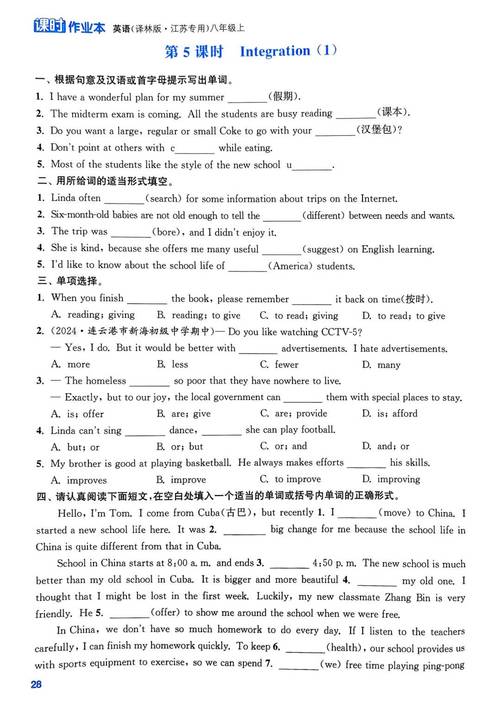 (图片来源网络,侵删)
- 规则变化: 单音节词和部分双音节词通常加
-er,-est;以-y结尾的变y为i再加-er,-est;重读闭音节双写辅音字母再加-er,-est;多音节词前加more,most。 - 不规则变化:
good/well→better→best,bad/badly→worse→worst,many/much→more→most等。 - 常用句型:
as...as...(和...一样),than(比...),one of the + 最高级 + 复数名词(最...之一)。
- 规则变化: 单音节词和部分双音节词通常加
-
方位介词
in(在...内部),on(在...上面),at(在...点),under(在...下面),behind(在...后面),next to(紧挨着),between...and...(在...和...之间) 等。
-
不定代词
some,any,no及其合成词 (somebody,anything,nothing等),注意some常用于肯定句,any常用于否定句和疑问句。
-
动词不定式
- 结构:
to + 动词原形 - 用法: 作宾语、宾语补足语、目的状语等。
want to do,decide to do,It's time to do sth.
- 结构:
-
There be 句型
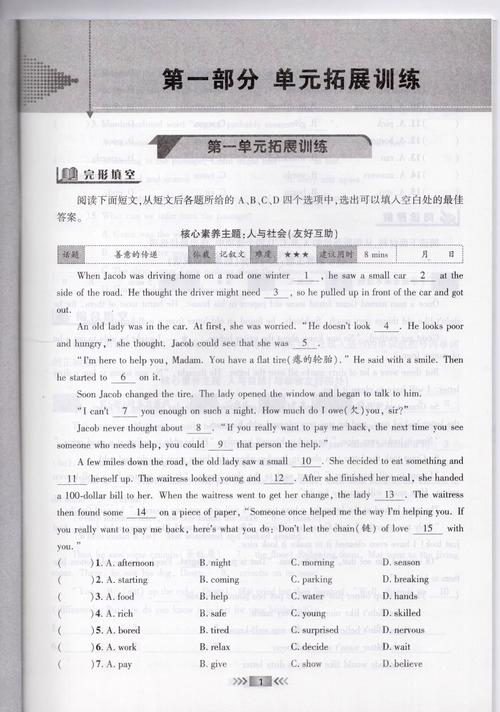 (图片来源网络,侵删)
- 结构:
There is/are + 某物 + 某地. - 用法: 表示“某地存在某物”,注意
be动词的单复数形式要和最近的名词保持一致。
- 结构:
-
常见话题
- 计划与打算 (
How to make plans) - 描述人物 (
Describing people) - 谈论爱好 (
Talking about hobbies) - 描述假期活动 (
Describing vacation activities) - 提出建议 (
Making suggestions)
- 计划与打算 (
第二部分:各单元课时练重点(以人教版Go for it!为例)
这里以最常见的版本为例,为你梳理每个单元的课时练重点。
Unit 1: Where did you go on vacation? (谈论过去发生的事)
- 核心语法: 一般过去时
- 重点词汇:
anyone,anything,everything,someone,everyone,of course,most,something,nothing,everyone,myself,yourself,hen,pig,seem,bored,interested,diary,decide,try,paragliding,feel,like,bird,bicycle,building,trader,wonder,difference,top,wait,waiter,especially,enjoy,corner,cent,tour,quickly,murder - 课时练建议:
- 课时1-2: 动词过去式不规则变化表背诵与默写,练习将动词原形变为过去式。
- 课时3-4: 练习
Did you...?和Where did...?的问答,用一般过去时描述一次假期的经历。 - 课时5-6: 区分
someone/anyone/everyone的用法,练习用bored(感到无聊的) 和boring(令人无聊的) 等词。
Unit 2: How often do you exercise? (谈论日常活动频率)
- 核心语法: 频率副词; 一般现在时
- 重点词汇:
exercise,health,how often,habit,sleep,headache,coffee,dentist,more than,junk food,milk,sleepy,dentist,however,than,maybe,less than,important,balanced,diet,yogurt,fruit,vegetable,habit,stay up late,at least,point,junk food,coffee,health,interviewer,habit,percent,online,television,although,through,mind,body,such as,together,die,writer,dentist - 课时练建议:
- 课时1-2: 背诵频率副词:
always,usually,often,sometimes,hardly ever,never,练习用它们造句。 - 课时3-4: 练习
How often do you...?的问答,用百分比 () 描述调查结果。 - 课时5-6: 区分
healthy(健康的) 和unhealthy(不健康的);a few(修饰可数名词) 和a little(修饰不可数名词)。
- 课时1-2: 背诵频率副词:
Unit 3: I'm more outgoing than my sister. (比较人物和事物)
- 核心语法: 形容词和副词的比较级与最高级
- 重点词汇:
outgoing,better,loudly,quietly,hard-working,competition,fantastic,which,clearly,win,though,talent,care about,truly,be important to,same,as...as...,in fact,mirror,kid,early,fast,late,hard-working,serious,both,however,say,primary,school,information,get on (well) with - 课时练建议:
- 课时1-2: 系统复习形容词/副词比较级和最高级的构成规则,并进行大量练习。
- 课时3-4: 重点练习
A is + 比较级 + than B和A is as + 原级 + as B句型。 - 课时5-6: 学习
both...and...(两者都...) 的用法,练习用比较级描述自己和朋友的异同。
Unit 4: What's the best movie theater? (谈论对事物的看法)
- 核心语法: 形容词和副词的最高级
- 重点词汇:
comfortable,seat,screen,close,ticket,worst,cheaply,song,DJ,fresh,comfortably,worst,service,creative,poor,worst,cheaply,choose,carefully,reporter,so far,fresh,creative,performer,talent,common,beautiful,worse,crowded,pollution,quietly,quickly,badly - 课时练建议:
- 课时1-2: 巩固最高级用法,特别是
one of the + 最高级 + 复数名词结构。 - 课时3-4: 练习使用
the best,the worst,the most等进行评价和比较。Which is the best movie theater? - 课时5-6: 学习使用
so far(到目前为止) 和副词修饰动词的用法。
- 课时1-2: 巩固最高级用法,特别是
Unit 5: Do you want to watch a game show? (谈论喜好与计划)
- 核心语法: 情态动词
want to,hope to; 动词不定式作宾语 - 重点词汇:
sitcom,news,soap opera,sports show,game show,talk show,mind,stand,documentary,action movie,cartoon,culture,famous,appear,become,rich,successful,might,expect,joke,culture,take seriously,plan,do,mean,hero,ready,shirt,cap,beanie,straw,straw hat,silk,square,neck,circle,present,celebrate,piñata,blow out,invite,cut up,advice,half,candle,happy,age,make a wish,popular,get popular,around the world,blow out - 课时练建议:
- 课时1-2: 练习
Do you want to...?和What do you want to watch?的问答。 - 课时3-4: 学习
hope to do和plan to do的用法,练习表达对未来的期望和计划。 - 课时5-6: 学习表达同意或不同意:
I agree./I disagree./I can't stand it.
- 课时1-2: 练习
Unit 6: I'm watching TV. (谈论正在发生的事)
- 核心语法: 现在进行时
- 重点词汇:
use,soup,wash,movie,just,kid,shoe,store,mall,grocery,post office,library,wait,major,beautiful,miss,Canada,Spanish,study,vacation,country,abroad,anywhere,magazine,read,suddenly,man,race,host,life,Australia,finish,run,Russia,salt,dish,dishwasher,borrow,invite,delicious,invitation,capital,Europe,spring,relaxing,Central Park,have a great time,take a message,call back,thank you for - 课时练建议:
- 课时1-2: 掌握现在进行时的构成
am/is/are + doing,练习用now和look等标志词。 - 课时3-4: 练习现在进行时的一般疑问句和特殊疑问句。
Are you doing your homework?/What are you doing? - 课时5-6: 学习打电话常用语:
Can I speak to...?,This is... speaking.,Hold on, please.
- 课时1-2: 掌握现在进行时的构成
第三部分:课时练练习题示例
一般过去时 vs. 一般现在时
选择正确的时态填空。
- He __ (go) to the park yesterday.
- He usually __ (go) to the park on Sundays.
- __ you __ (finish) your homework last night?
- My mother __ (cook) dinner every day.
答案:
- went
- goes
- Did, finish
- cooks
形容词比较级与最高级
用括号内单词的正确形式填空。
- This book is __ (interesting) than that one.
- English is one of __ (important) subjects in our school.
- My bag is __ (new) than Tom's, but Lucy's is the __ (new).
- Which do you think is __ (beautiful), the red dress or the blue one?
答案:
- more interesting
- the most important
- newer, newest
- more beautiful
情景对话
根据情景,选择正确的句子补全对话。
A: Hi, Lily! What are you doing? B: 1. __ A: Sounds fun! 2. __ B: I'm going to watch a new action movie. A: 3. __ I love action movies! B: Great! Let's meet at the cinema gate at 7:00 p.m. A: 4. __ See you then!
A. What do you want to watch? B. I'm watching TV at home. C. I'd love to go with you. D. Can I go with you?
答案:
- B
- A
- D
- C
第四部分:如何高效使用“课时练”
- 课前预习: 在学习新课前,可以先做一下前一课的课时练,检验自己是否真的掌握了,带着问题去听课。
- 课后巩固: 学完一课,立刻做对应的课时练,趁热打铁,效果最好,不要堆积到最后一起做。
- 独立完成: 一定要自己先做,不要一遇到不会的就看答案或问同学,独立思考是进步的关键。
- 认真订正: 做完题后,对答案。重点不是对了多少,而是错了多少,把所有错题整理到“错题本”上,分析错误原因(是单词不认识?语法规则没掌握?还是粗心?)。
- 定期复习: 每周或每单元结束后,把错题本拿出来重新做一遍,确保同样的错误不再犯第二次。
希望这份详细的指南能对你有所帮助!祝你学习进步,英语越来越棒!加油!