7年级下册英语书内容有哪些重点?
校园之窗 2026年1月26日 15:58:51 99ANYc3cd6
的详细梳理,包括核心话题、重点语法、主要词汇和单元结构。
整体概述
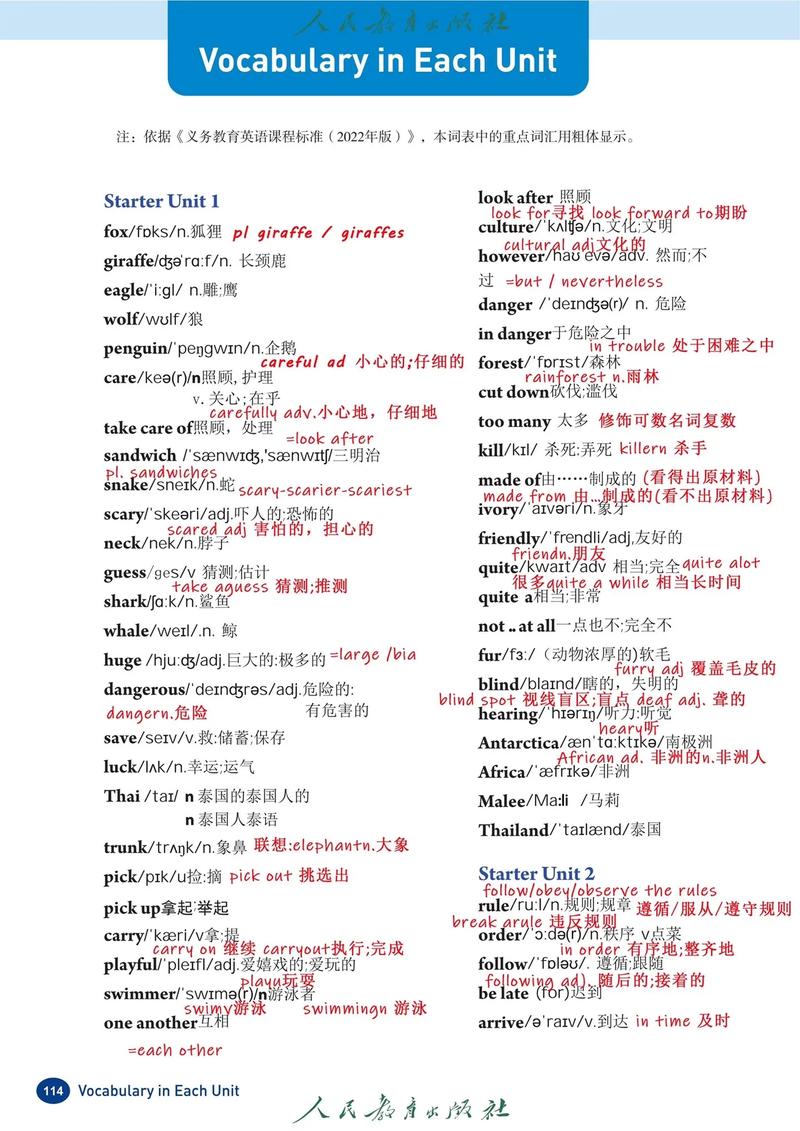
七年级下册的语法核心是一般过去时,全书的各个单元都围绕这个时态展开,引导学生学习如何用英语描述和询问在过去某个时间点或时间段发生的动作或存在的状态。
(图片来源网络,侵删)
核心语法重点
-
一般过去时
- 构成:动词的过去式。
- be 动词的过去式:
was(用于第一、三人称单数) 和were(用于其他人称)。 - 规则动词的过去式:一般在动词词尾加
-ed(e.g.,work->worked);以不发音的e只加-d(e.g.,live->lived);以“辅音字母+y”变y为i再加-ed(e.g.,study->studied);重读闭音节结尾,双写末尾辅音字母再加-ed(e.g.,stop->stopped)。 - 不规则动词的过去式:需要单独记忆,如
go->went,see->saw,eat->ate,have->had,do->did等。
-
一般过去时的特殊疑问句
- 结构:
What/Where/When/Who + did + 主语 + 动词原形 + 其他? - 回答:
主语 + 动词过去式 + ... What did you do last weekend?->I played basketball.
- 结构:
-
反身代词
- 用法:表示“……自己”,通常作宾语或同位语。
- 构成:
myself,yourself,himself,herself,itself,ourselves,yourselves,themselves。 He taught himself English.(他自学了英语。)
-
情态动词
can的过去式could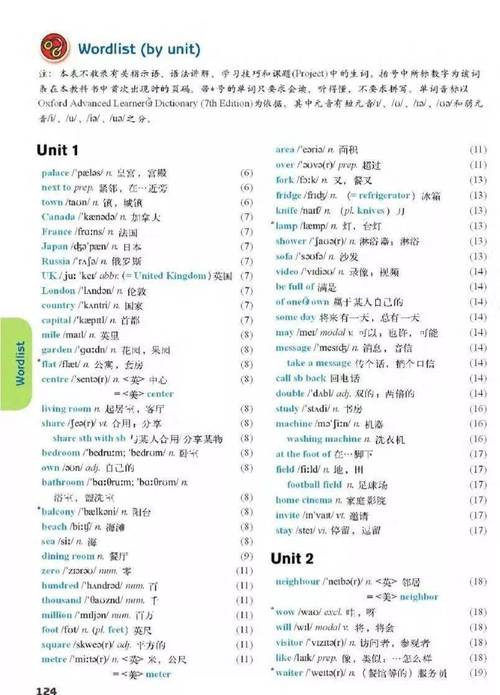 (图片来源网络,侵删)
- 用法:表示“过去能够”或“过去可以”。
When I was 5, I could swim.(我5岁的时候会游泳。)
-
连接词
so和becauseso:表示“,连接有因果关系的两个句子,后跟结果。because:表示“因为”,连接有因果关系的两个句子,后跟原因。It was rainy, so we stayed at home.(因为下雨了,所以我们待在家里。) /We stayed at home because it was rainy.(我们待在家里是因为下雨了。)
主要单元话题与词汇
人教版七年级下册通常有12个单元,内容如下:
Unit 1: Can you play the guitar?
- 话题:谈论能力和意愿,加入社团。
- 核心句型:
Can you/he/she/... + 动词原形?(你会/他会/她会……吗?)Yes, I/he/she can. / No, I/he/she can't.I want to join the ... club.(我想加入……俱乐部。)
- 重点词汇:
- 能力类:
sing,dance,swim,draw,play chess,speak English - 乐器类:
guitar,piano,violin,drums - 俱乐部类:
swimming club,music club,art club,English club,chess club - 其他:
join,tell stories,kung fu
- 能力类:
Unit 2: What time do you go to school?
(图片来源网络,侵删)
- 话题:日常作息时间。
- 核心句型:
What time do you + 动词原形 + ...?(你……几点……?)I + 动词原形 + at + 时间点.(我在……点……。)
- 重点词汇:
- 时间表达:
o'clock,a.m.,p.m.,quarter,half past - 动作类:
go to school,get up,run,eat breakfast,take a shower,go to bed - 其他:
routine,usually,never,early,late
- 时间表达:
Unit 3: How do you get to school?
- 话题:谈论交通方式和距离。
- 核心句型:
How do you get to school?(你怎么去学校?)I take the bus / subway / train./I ride a bike / walk.How long does it take?(它花费多长时间?)It takes about 20 minutes.How far is it from ... to ...?(从……到……有多远?)
- 重点词汇:
- 交通方式:
take the bus/subway/train/plane/boat,ride a bike,walk,by bus/subway/train - 距离与时间:
kilometer,minute,hour,far,transportation - 其他:
cross,river,village,bridge,boat
- 交通方式:
Unit 4: Don't eat in class.
- 话题:学校规则。
- 核心句型:
祈使句(肯定/否定):Be quiet./Don't be late.情态动词 + 动词原形:You must follow the rules./You can eat in the dining hall.What are the rules?(规则是什么?)
- 重点词汇:
- 规则类:
rule,arrive late,listen,fight,eat in class,wear a hat,listen to music,go out,hallway - 其他:
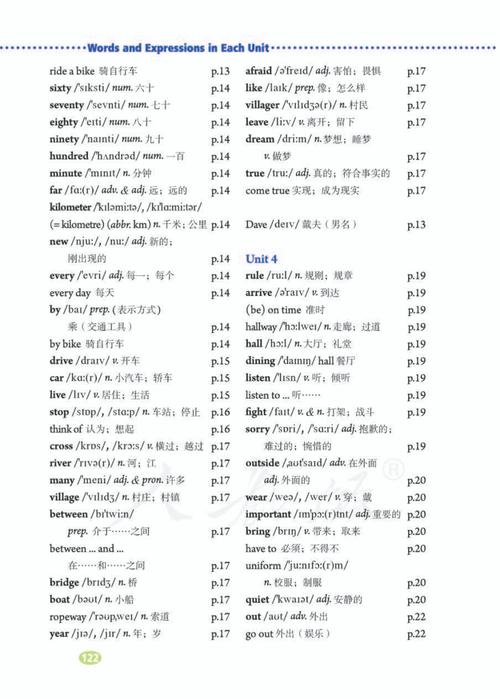
outside,hallway,dining hall,uniform
- 规则类:
Unit 5: Why do you like pandas?
- 话题:谈论动物及其原因。
- 核心句型:
Why do you like ...?(你为什么喜欢……?)Because they are ...(因为它们是……的。)What animals do you like?(你喜欢什么动物?)Let's see ... first.(我们先看……吧。)
- 重点词汇:
- 动物名称:
panda,tiger,elephant,koala,lion,giraffe,zoo,cute,smart,beautiful,ugly,scary,lazy,friendly
- 动物名称:
Unit 6: I'm watching TV.
- 话题:谈论正在发生的事情,即现在进行时。
- 核心句型:
What are you doing?(你正在做什么?)I'm watching TV.(我正在看电视。)Is he/she doing ...?(他/她正在……吗?)Yes, he/she is. / No, he/she isn't.
- 重点词汇:
- 动作类:
watching TV,cleaning,reading a newspaper,talking on the phone,making soup,washing the dishes,exercising - 其他:
newspaper,soup,just
- 动作类:
Unit 7: It's raining!
- 话题:谈论天气和感受。
- 核心句型:
How's the weather?/What's the weather like?(天气怎么样?)It's sunny/cloudy/rainy/windy/snowy.(天气晴朗/多云/下雨/刮风/下雪。)How's it going?(情况怎么样?)
- 重点词汇:
- 天气类:
sunny,cloudy,rainy,windy,snowy,hot,cool,warm,cold - 活动类:
cooking,studying,playing basketball,shopping - 感受类:
great,terrible,not bad,pretty good
- 天气类:
Unit 8: Is there a post office near here?
- 话题:问路与指路,谈论地点方位。
- 核心句型:
Is there a ... near here?(这附近有……吗?)Yes, there is. / No, there isn't.Where is the ...?(……在哪里?)It's on/in/next to/across from/behind...(它在……的旁边/里面/对面/后面……)
- 重点词汇:
- 地点名称:
post office,library,restaurant,bank,hospital,supermarket,street,park,pay phone - 方位介词:
on,in,at,near,next to,across from,behind,between,in front of
- 地点名称:
Unit 9: What does he look like?
- 话题:描述人的外貌。
- 核心句型:
What does he/she look like?(他/她长什么样?)He/She is of medium height/build.(他/她中等身高/体型。)He/She has long straight hair.(他/她留着长直发。)He/She wears glasses.(他/她戴眼镜。)
- 重点词汇:
- 身高体型:
tall,short,of medium height,heavy,of medium build,thin - 头发:
long hair,short hair,curly hair,straight hair,long straight hair - 面部特征:
round face,long face,glasses
- 身高体型:
Unit 10: I'd like some noodles.
- 话题:订餐与食物。
- 核心句型:
What would you like?(你想要点什么?)I'd like ...(我想要……。)What size bowl of noodles would you like?(你想要多大碗的面?)What kind of noodles would you like?(你想要什么种类的面?)
- 重点词汇:
- 食物:
noodles,beef,chicken,mutton,cabbage,potatoes,tomatoes,special,size,bowl,large,medium,small
- 食物:
Unit 11: How was your school trip?
- 话题:谈论过去的经历(一般过去时综合运用)。
- 核心句型:
How was your school trip?(你的学校旅行怎么样?)It was great/good/interesting/boring.(它很棒/好/有趣/无聊。)Did you go to the zoo?(你去动物园了吗?)Yes, I did. / No, I didn't.
- 重点词汇:
- 动词过去式:
go->went,see->saw,visit->visited,buy->bought,eat->ate,take->took - 形容词:
great,interesting,fantastic,lovely,expensive,cheap,terrible - 其他:
gift shop,aquarium,seal,shark,hang out
- 动词过去式:
Unit 12: What did you do last weekend?
- 话题:详细谈论上周末的活动(一般过去时的巩固)。
- 核心句型:
What did you do last weekend?(你上周末做了什么?)I did my homework / visited my grandparents / went boating / camped by the lake.Who did you go with?(你和谁一起去的?)
- 重点词汇:
- 动词过去式:
do->did,visit->visited,go->went,play->played,study->studied,stay->stayed,have->had - 活动:
camp,go camping,go fishing,go boating,the Great Wall
- 动词过去式:
学习建议
- 语法是骨架:务必吃透一般过去时的构成和用法,特别是不规则动词表,这是全册的重点和难点,需要反复背诵和练习。
- 话题是血肉:围绕每个单元的话题,积累相关词汇,比如学Unit 5,就多记一些动物的名称和描述它们的形容词。
- 听说读写要结合:不仅要会做题,更要能用这些句型和词汇进行简单的口头对话和书面写作,可以尝试描述自己的一天、一次旅行或一个周末的活动。
- 多听多模仿:听课本配套的录音,模仿语音语调,对培养语感非常有帮助。
希望这份详细的梳理对你的学习有帮助!