人教版九年级英语总结,重点难点如何高效掌握?
校园之窗 2026年1月15日 18:44:23 99ANYc3cd6
人教版九年级英语全册总结
九年级英语是整个初中阶段的收官之作,不仅词汇量和语法难度都有提升,更侧重于综合语言运用能力的考查,其核心围绕“人与自我”、“人与社会”、“人与自然”三大主题展开,共14个单元。
第一部分:核心知识体系梳理
我们将按照教材的单元顺序,对每个单元的重点进行归纳。
(图片来源网络,侵删)
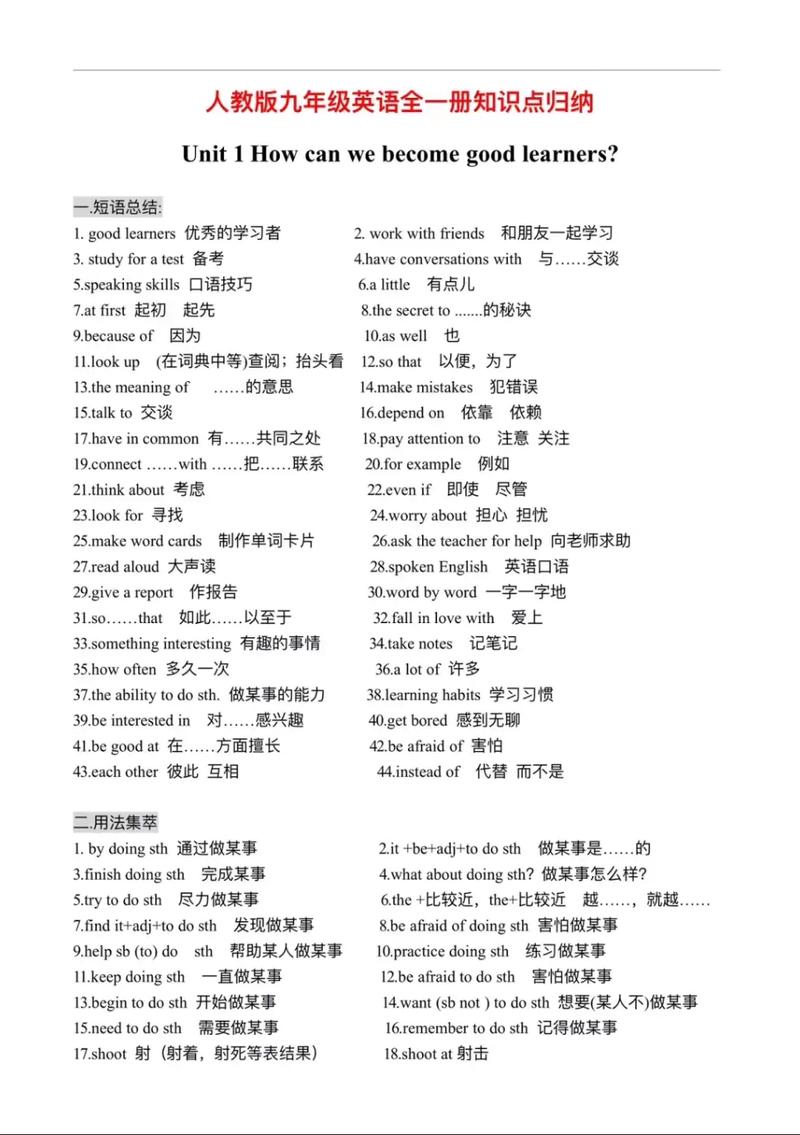
Unit 1 How can we become good learners?
主题: 学习方法与策略 核心词汇:
- 动词:
aloud(大声地),pronounce(发音),spoken(口语的),grammar(语法),frustrate(使沮丧),quickly(快速地),mistake(错误),discover(发现),secret(秘密),look up(查阅),repeat(重复),practice(练习) - 名词:
pronunciation(发音),sentence(句子),partner(同伴),beginner(初学者),notebook(笔记本),physics(物理),pattern(模式),understanding(理解) - 形容词/副词:
frustrated(沮丧的),quick(快的),patient(耐心的),be patient with(对...有耐心),be angry with(对...生气)
重点句型与表达:
- — How do you study for a test? — I study by working with a group. (通过...方式)
- — Have you ever studied with a group? — Yes, I have. I've learned a lot that way. (现在完成时)
- It's too hard to understand the voice. (too...to... 结构)
- Finding a pen pal might help. (动名词作主语)
- She said that memorizing the words of pop songs also helped a little. (宾语从句)
语法重点:
- by + doing sth. (通过做某事)
- 例:
I learn English by watching English movies.
- 例:
- How / What about + doing sth.? (做...怎么样?)
- 例:
What about listening to the tape?
- 例:
- 动名词 作主语或宾语
- 例:
Swimming is my favorite sport.(作主语) /I enjoy reading books.(作宾语)
- 例:
功能意念项目:
(图片来源网络,侵删)
- 谈论学习方法:
talk about how to learn - 提出建议:
give advice
写作话题:
- Write about your English learning methods. (写一篇关于你英语学习方法的短文)
- 结构建议:
- 简述你在学习英语中遇到的困难或总体感受。
- 主体: 详细介绍你使用的几种有效学习方法 (如:听英文歌、看美剧、背单词、和同学练习口语等),并说明为什么有效。
- 总结你的学习心得,或提出未来的学习计划。
- 结构建议:
Unit 2 I think that mooncakes are delicious!
主题: 节日与文化习俗 核心词汇:
- 名词:
mooncake(月饼),lantern(灯笼),relative(亲戚),folk(民间的),goddess(女神),tradition(传统),admire(欣赏),tie(领带),haunted house(鬼屋),Christmas(圣诞节),Santa Claus(圣诞老人),pie(派),gift(礼物),visitor(参观者) - 形容词:
delicious(美味的),traditional(传统的),lucky(幸运的),relative(亲戚),full(满的),warm(温暖的),dead(死的),trick(恶作剧的),treat(款待的) - 动词:
lie(躺,位于),lay(放置),haunt(闹鬼),warn(警告)
重点句型与表达:
- — What do you like best about...? — I love... (谈论喜好)
- **I think that...I believe that...I guess that...` (宾语从句 - 陈述句语序)
- 例:
I think that the dragon boat races are exciting.
- 例:
- **... warn you not to...... warn that...` (警告)
- 例:
He warned us not to play tricks on others.
- 例:
- **The tradition is similar to...The tradition is different from...` (比较异同)
- 例:
The tradition of eating mooncakes is similar to the tradition of eating turkey on Thanksgiving in the US.
- 例:
语法重点:

(图片来源网络,侵删)
- 宾语从句
- 连接词:
that(可省略),if/whether,what,who,when,where,why,how - 语序: 必须使用陈述句语序 (主语 + 谓语)。
- 时态: 主句为现在时,从句可为任何时态;主句为过去时,从句要用相应的过去时态。
- 例:
He said (that) he was tired.(过去时) /She says (that) she likes English.(现在时)
- 连接词:
功能意念项目:
- 谈论节日和习俗:
talk about festivals and customs - 表达个人感受和观点:
express feelings and opinions
写作话题:
- Write about a festival you like. (写一篇关于你喜欢的节日的短文)
- 结构建议:
- 点明你最喜欢的节日是什么。
- 主体: 描述节日的日期、庆祝方式、特色食物、相关传说或故事。
- 解释你喜欢这个节日的原因,以及它带给你的感受。
- 结构建议:
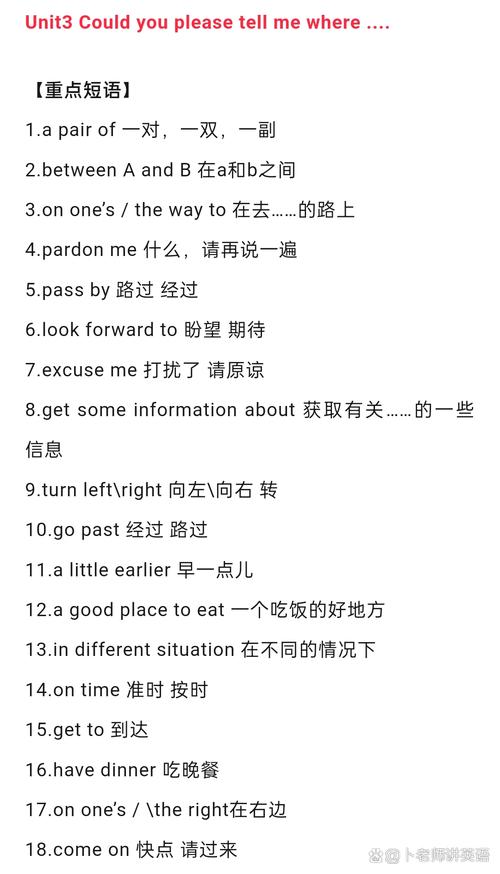
Unit 3 Could you please tell me where the restrooms are?
主题: 问路与指路 核心词汇:
- 名词:
restroom(洗手间),stamp(邮票),bookstore(书店),beside(在...旁边),bank(银行),post office(邮局),supermarket(超市),avenue(大道),direct(方向),order(点餐),menu(菜单),sign(标志) - 动词:
pardon(原谅),request(请求),direction(方向),correct(正确的),polite(礼貌的),impolite(不礼貌的),direct(指引),mention(提及) - 介词短语:
go past(经过),on one's right/left(在某人的右边/左边),next to(紧挨着),between...and...(在...和...之间)
重点句型与表达:
- **Could you please tell me where the restrooms are?Could you please tell me how to get to the post office?` (礼貌地询问信息)
- 这是宾语从句在问路场景中的典型应用。
- Sure, go past the bank and turn left. (指路)
- — Excuse me, do you know where I can...? — I'm sorry, I don't know. You could ask... (委婉拒绝并建议)
- **I'm looking for...I wonder if you could tell me...` (更委婉的表达)
语法重点:
- 宾语从句 (间接问句)
- 当宾语从句由特殊疑问词引导时,语序必须是陈述句语序。
- 直接问句 → 间接问句:
Where is the bank?→Could you tell me where the bank is?How can I get to the station?→Can you tell me how I can get to the station?Is there a post office nearby?→Could you tell me if there is a post office nearby?(注意:if/whether引导的从句用陈述句语序)
功能意念项目:
- 请求帮助:
ask for help - 指引方向:
give directions - 礼貌用语:
polite language
写作话题:
- Write a guide to a place. (写一篇关于某个地方的指南)
- 结构建议:
- 介绍地点: 简要介绍这个地方 (如:我们学校、一个公园)。
- 布局描述: 使用方位词描述其主要设施的位置关系 (如:图书馆在操场的北边,食堂在教学楼的后面)。
- 实用信息: 提供一些有用的信息,如开放时间、注意事项等。
- 结构建议:
Unit 4 I used to be afraid of the dark.
主题: 过去与现在的变化 核心词汇:
- 动词:
used to(过去常常),be afraid of(害怕),fail(不及格),take(花费),influence(影响),proud(自豪的),absent(缺席的),introduce(介绍),exactly(确切地) - 名词:
humor(幽默感),silent(沉默的),helpful(有帮助的),from time to time(不时地),dare(敢于),take up(开始从事),require(要求) - 形容词:
terrified(恐惧的),proud(自豪的),absent(缺席的),influence(有影响力的)
重点句型与表达:
- — Did you use to play the piano? — Yes, I did. / No, I didn't.I used to, but I don't anymore. (谈论过去和现在的对比)
- **I used to be terrified of the dark.` (used to do sth.)
- **I'm proud of you.` (be proud of)
- **...has influenced me a lot.` (influence)
- **He isn't such a quiet person anymore.` (such...a/an... + 名词)
语法重点:
- used to do sth.
- 含义: 过去常常做某事,但现在不做了。
- 形式: 肯定句
主语 + used to do sth.;否定句主语 + didn't use to do sth.或主语 + used not to do sth.;疑问句Did + 主语 + use to do sth.? - 辨析:
be used to doing sth.(习惯于做某事),be used to do sth.(被用来做某事)
功能意念项目:
- 谈论过去的经历和变化:
talk about past experiences and changes
写作话题:
- Write about a change in your life or a friend's life. (写一篇关于你或朋友生活中的一次变化)
- 结构建议:
- 介绍人物和变化的时间点 (如:几年前,我最好的朋友Tom发生了很大变化)。
- 对比:
- 过去: 描述他/她过去的样子、性格、爱好等 (使用
used to)。 - 描述他/她现在的样子、性格、爱好等 (使用
now,nowadays,is/are)。
- 过去: 描述他/她过去的样子、性格、爱好等 (使用
- 原因/结果: 简要分析变化的原因和带来的影响。
- 结构建议:
Unit 5 What are the shirts made of?
主题: 物品的制作材料与产地 核心词汇:
- 名词:
chopstick(筷子),fork(餐叉),blouse(女衬衫),silver(银),glass(玻璃),cotton(棉花),steel(钢),fair(展览会),environment(环境),grass(草),leaf(叶子),produce(产品),widely(广泛地) - 动词:
process(加工),pack(包装),fly(用飞机运),hand(传递),postman(邮递员) - 形容词:
famous(著名的),local(当地的),environmentally friendly(环保的)
重点句型与表达:
- — What is this shirt made of? — **It's made of cotton.It's made in Thailand.` (被动语态)
- **It is known for its tea.` (be known for...)
- **Even though the products were made by hand, they were of good quality.` (even though引导的让步状语从句)
- No matter what you buy, you might think those products were made in those countries. (no matter what引导的让步状语从句)
语法重点:
- 被动语态
- 含义: 强调动作的承受者,而不是执行者。
- 结构:
be + 动词的过去分词 - 各种时态的被动语态:
- 一般现在时:
am/is/are + p.p. - 一般过去时:
was/were + p.p. - 一般将来时:
will be + p.p. - 含情态动词:
can/may/should + be + p.p.
- 一般现在时:
- 介词搭配:
be made of(能看出原材料,物理变化)be made from(看不出原材料,化学变化)be made in(产地)be made by(执行者)
功能意念项目:
- 询问物品的来源和材料:
ask about the origin and materials of things
写作话题:
- Write about a traditional product in your hometown. (写一篇关于你家乡的传统产品)
- 结构建议:
- 介绍这是什么产品,有什么名气。
- 主体:
- 材料: 它是由什么材料制成的?
- 工艺: 它是如何被制作出来的?(使用被动语态)
- 历史/文化: 它有什么历史或文化背景?
- 为什么人们喜欢它?它对你家乡的意义是什么?
- 结构建议:
Unit 6 When was it invented?
主题: 发明的历史与创造 核心词汇:
- 名词:
invention(发明),inventor(发明家),accidental(意外的),crispy(脆的),salty(咸的),customer(顾客),divide(分开),smell(气味),by mistake(错误地),trade(贸易),doubt(怀疑),suitable(合适的) - 动词:
invent(发明),discover(发现),produce(生产),smell(闻起来),taste(尝起来),remain(仍然是),create(创造) - 形容词:
ancient(古老的),pleasant(令人愉快的),crispy(脆的),salty(咸的),sweet(甜的),sour(酸的),bitter(苦的)
重点句型与表达:
- — When was the telephone invented? — **It was invented in 1876.It was invented by Alexander Graham Bell.` (被动语态)
- **They were invented by accident.` (by accident = by mistake)
- **The customer was pleased with the new drink.` (be pleased with...)
- **It is said that...They believe that...` (据说...)
语法重点:
- 被动语态 (一般过去时的被动语态)
- 结构:
was/were + 动词的过去分词 - 用途: 常用于描述历史事件、发明、创造等,因为发明者或执行者有时不重要或不明确。
- 结构:
- 感官系动词:
look(看起来),sound(听起来),smell(闻起来),taste(尝起来),feel(摸起来)- 它们后面接形容词,构成系表结构,而不是被动语态。
- 例:
The flower smells sweet.(花闻起来是甜的。) /The story sounds interesting.(故事听起来很有趣。)
功能意念项目:
- 谈论历史事件和发明:
talk about historical events and inventions
写作话题:
- Write about an important invention. (写一篇关于一项重要发明的短文)
- 结构建议:
- 介绍这项发明是什么,它为什么重要。
- 主体:
- 发明者与时间: 它是谁发明的?什么时候发明的?(被动语态)
- 发明过程: 发明的过程是怎样的?是偶然的吗?
- 影响: 它对我们的生活产生了什么影响?
- 展望未来这项发明可能会有怎样的发展。
- 结构建议:
Unit 9 I like music that I can dance to.
主题: 偏好与喜好 (定语从句) 核心词汇:
- 名词:
lyric(歌词),prefer(更喜欢),gentle(温柔的),electronic(电子的),suppose(假设),director(导演),sense(感觉),war(战争),palace(宫殿),Agatha Christie(阿加莎·克里斯蒂) - 形容词:
lyrical(抒情的),gentle(温柔的),electronic(电子的),beautiful(美丽的),wonderful(精彩的),latest(最新的) - 动词:
prefer(更喜欢),expect(期望),remind(提醒),describe(描述)
重点句型与表达:
- — What kind of music do you like? — **I like music that I can dance to.I prefer music that has great lyrics.` (定语从句)
- **The movie that we saw last week was fantastic.` (定语从句)
- **I prefer... rather than...I like... better than...` (表达偏好)
- 例:
I prefer staying at home rather than going out.
- 例:
语法重点:
- 定语从句
- 作用: 修饰名词或代词,相当于一个形容词。
- 结构:
先行词 + 关系代词/关系副词 + 从句 - 关系代词:
that: 指物或人,在从句中作主语或宾语。which: 指物,在从句中作主语或宾语。who: 指人,在从句中作主语。whom: 指人,在从句中作宾语 (口语中常用who或that代替)。whose: 指人或物,表示“...的”,在从句中作定语。
- 关系副词:
when(指时间,作时间状语),where(指地点,作地点状语),why(指原因,作原因状语)。 - 注意: 关系词在从句中必须充当一个句子成分,且不能省略作主语的关系词。
功能意念项目:
- 表达个人偏好:
express personal preferences
写作话题:
- Write about your favorite movie/book/singer/band. (写一篇关于你最喜欢的电影/书/歌手/乐队的短文)
- 结构建议:
- 介绍你最喜欢的对象是什么。
- 主体:
- 描述: 详细描述它的特点 (如:电影类型、故事情节、音乐风格、歌词内容等)。
- 使用定语从句: 在描述中大量使用定语从句来丰富句子。
I like the singer whose voice is very gentle./The movie that I like best is about a war.
- 解释为什么你喜欢它,它给你带来了什么影响。
- 结构建议:
Unit 10 You're supposed to shake hands.
主题: 礼仪与习俗 核心词汇:
- 名词:
custom(习俗),bow(鞠躬),kiss(吻),greet(问候),table manners(餐桌礼仪),elbow(肘),lap(膝盖),napkin(餐巾),chopstick(筷子),slurp(出声地吃),make noise(发出噪音),basic(基本的),graduation(毕业) - 动词:
suppose(期望,应该),shake(摇动),exchange(交换),value(重视),drop(掉落),point(指),stick(粘住),be full of(充满) - 形容词:
impolite(不礼貌的),basic(基本的),relaxed(放松的),punctual(准时的)
重点句型与表达:
- — What are you supposed to do when you meet someone for the first time? — **You're supposed to shake hands.You should bow.` (be supposed to / should)
- **In Brazil, people are usually very relaxed about time.` (be relaxed about...)
- **...is important in......is considered very important.` (重要性)
- **I was a bit surprised at first.` (be surprised at...)
语法重点:
- be supposed to do sth.
- 含义: “应该做某事”,表示责任、义务或来自他人的期望,语气比
should更强,有时含有“按规定/习俗理应如此”的意思。 - 否定:
be not supposed to do sth.(不应该做某事) - 过去式:
was/were supposed to do sth.(过去本应该做某事,但实际没做)
- 含义: “应该做某事”,表示责任、义务或来自他人的期望,语气比
- 情态动词的用法回顾:
can(能力/许可),may(许可/可能),must(必须/一定),should(应该),need(需要)
功能意念项目:
- 谈论不同国家的礼仪习俗:
talk about customs and manners in different countries
写作话题:
- Write about table manners in China. (写一篇关于中国餐桌礼仪的短文)
- 结构建议:
- 简要介绍餐桌礼仪在文化中的重要性。
- 主体: 分点或分段介绍中国的餐桌礼仪,如:
- 如何使用筷子 (不能插在饭里、不能敲碗等)。
- 等长辈先动筷。
- 喝汤时不要出声。
- 不要把筷子直插在食物里。
- 总结遵守这些礼仪的意义,体现了对他人的尊重。
- 结构建议:
Unit 11 Sad movies make me cry.
主题: 情感与影响 核心词汇:
- 名词:
friendship(友谊),power(力量),king(国王),queen(女王),palace(宫殿),journey(旅行),stepmother(继母),wife(妻子),husband(丈夫),whole(整个),truth(真相),agent(代理人),get married(结婚) - 动词:
marry(结婚),trust(信任),fall in love with(爱上),join(加入),beauty(美丽),unfair(不公平的),regret(后悔),influence(影响) - 形容词:
friendship(友谊的),powerful(强大的),ugly(丑陋的),unfair(不公平的),happy(快乐的),lovely(可爱的)
重点句型与表达:
- — Does the movie make you feel sad? — **Yes, it does. / No, it doesn't.Sad movies make me cry.` (make + 宾语 + 宾语补足语)
- **... is a touching story about...` (描述故事)
- **It makes me want to give up.` (make sb. want to do sth.)
- **I feel like I'm part of that world.` (feel like + 名词/从句)
语法重点:
- make + 宾语 + 宾语补足语
- 含义: “使得某人/某物如何”。
- 形式:
make + sb. + 形容词(使某人感到...)- 例:
The news made him happy.
- 例:
make + sb. + 动词原形(迫使某人做某事)- 例:
The teacher made him stand up.
- 例:
make + sth. + 过去分词(使某物被...)- 例:
This will make your room cleaned.
- 例:
功能意念项目:
- 谈论事物对情感的影响:
talk about how things affect our feelings
写作话题:
- Write about a book or movie that influenced you. (写一篇关于一本影响你的书或电影的短文)
- 结构建议:
- 介绍这本书或电影是什么。
- 主体:
- 内容简介: 简要介绍其主要情节或主题。
- 情感影响: 它如何影响了你的情感?是让你开心、感动还是思考?(使用
make me feel...等句型) - 思想启发: 它带给你了什么启示或改变了你什么看法?
- 总结它对你的长远影响。
- 结构建议:
Unit 12 Life is full of the unexpected.
主题: 过去的事件与经历 核心词汇:
- 名词:
unexpected(意想不到的),alarm(闹钟),ring(铃声),burn(烧伤),by the time(到...时候),run off(跑开),oversleep(睡过头),lock(锁),empty(空的),discover(发现),spill(溢出),mess(凌乱),embarrass(使尴尬),apologize(道歉) - 动词:
burn(燃烧),rush(冲),land(着陆),realize(意识到),block(堵塞),accident(事故),embarrass(使尴尬) - 副词:
unbelievably(难以置信地),fully(完全地)
重点句型与表达:
- **By the time I got up, my brother had already gotten in the shower.` (过去完成时)
- **I had never seen such a beautiful sunset before.` (过去完成时)
- **When I got to school, I realized I had left my backpack at home.` (过去完成时)
- **Life is full of the unexpected.` (be full of...)
语法重点:
- 过去完成时
- 含义: 表示“过去的过去”,即某个动作在过去另一个动作之前就已经完成。
- 结构:
had + 动词的过去分词 - 常用时间状语:
by the time + 过去时,before,when,after,by + 过去时间点 - 例句:
When I arrived at the cinema, the film had already begun.(我到电影院时,电影已经开始了。)
功能意念项目:
- 谈论过去难忘的经历:
talk about unforgettable past experiences
写作话题:
- Write about an embarrassing or funny experience. (写一篇关于一次尴尬或好笑的经历)
- 结构建议:
- 简述这次经历是何时何地发生的,以及它为什么让你感到尴尬或好笑。
- 主体 (按时间顺序):
- 背景: 事情发生前的情景。
- 经过: 详细描述事情的经过,使用一般过去时。
- 高潮: 描述最尴尬或最搞笑的时刻。
- 结果: 事情最后怎么样了?(使用过去完成时来连接)
- 你从这次经历中学到了什么?或者现在回想起来有什么感受?
- 结构建议:
Unit 13 We're trying to save the earth!
主题: 环境问题与保护 核心词汇:
- 名词:
litter(乱扔的杂物),bottom(底部),fisherman(渔民),coal(煤),plastic(塑料),bottle(瓶子),creek(小溪),trash(垃圾),waste(废物),advantage(优点),disadvantage(缺点),recycle(回收),napkin(餐巾),bin(垃圾桶) - 动词:
pollute(污染),save(拯救),affect(影响),harm(伤害),turn off(关掉),use up(用完),throw away(扔掉),collect(收集),sort(分类),pay for(为...付款),fine(罚款) - 形容词:
ugly(丑陋的),harmful(有害的),useful(有用的),dead(死的),endangered(濒危的),recyclable(可回收的)
重点句型与表达:
- — What's the matter? — **The river is polluted.There's too much trash.` (描述问题)
- **We're trying to save the earth.` (现在进行时表现阶段正在进行的动作)
- **... used to be...... has changed a lot.` (对比过去与现在)
- **It's important for us to protect the environment.` (It's + adj. + for sb. + to do sth.)
- **We should take action now.` (提出建议)
语法重点:
- 现在进行时
- 含义: 表示此时此刻或现阶段正在进行的动作。
- 结构:
am/is/are + 动词的-ing形式 - 拓展: 在口语中,现在进行时常与
always,forever等词连用,表示赞扬或厌烦的感情色彩。- 例:
He is always helping others.(他总是乐于助人。)
- 例:
功能意念项目:
- 描述环境问题:
describe environmental problems - 提出解决问题的建议:
suggest solutions to problems
写作话题:
- Write a letter to the newspaper about a local environmental problem. (给报社写一封信,反映一个当地的环境问题)
- 结构建议:
- 自我介绍,并点明写信的目的 (反映问题)。
- 主体:
- 问题描述: 详细描述你所看到的环境问题是什么 (如:河水污染、噪音、垃圾等),最好能举例说明。
- 影响分析: 这个问题对人们的生活、健康或环境造成了什么影响?
- 建议: 提出具体的、可行的建议 (如:政府应该...、市民应该...)。
- 表达希望问题能尽快解决的愿望。
- 结构建议:
Unit 14 I remember meeting all of you in Grade 7.
主题: 回忆与展望 核心词汇:
- 名词:
graduation(毕业),ceremony(典礼),reflect(回忆),memory(记忆),friendship(友谊),future(,promise(诺言),agriculture(农业),industry(工业), technology (技术), entertainment (娱乐), transportation (交通), environment (环境), hope (希望), dream (梦想) - 动词: remember (记得), forget (忘记), regret (后悔), keep in touch (保持联系), look forward to (期待), achieve (实现), create (创造), solve (解决)
- 短语: at the beginning of (在...开始时), be proud of (为...自豪), make a difference (做出贡献), in the future (在未来)
重点句型与表达:
- **I remember meeting all of you in Grade 7.I'll never forget the time we spent together.` (remember/forget doing sth.)
- **Looking back at these three years...` (现在分词短语作状语)
- **How time flies!Time goes by so fast.` (感叹时光飞逝)
- **I'm looking forward to hearing from you.` (look forward to doing sth.)
- **Let's make a promise to each other.` (提出倡议)
语法重点:
- remember/forget/regret + doing sth. / + to do sth.
- remember/forget/regret + doing sth. 记得/忘记/后悔做过某事 (动作已发生)。
- remember/forget/regret + to do sth. 记得/忘记/后悔要去做某事 (动作未发生)。
- look forward to doing sth. (期待做某事)
- 注意:
to在这里是介
- 注意: