八年级下册英语复习资料
校园之窗 2025年12月31日 02:55:44 99ANYc3cd6
八年级下册英语总复习资料
第一部分:核心语法点
八年级下册的语法是初中阶段的重中之重,务必掌握牢固。
情态动词
-
can / could
 (图片来源网络,侵删)
- can: 能力,许可 (
- I can swim. (我会游泳。)
- Can I borrow your pen? (我能借你的笔吗?)
- could:
can的过去式,表示过去的能力;或在现在时中用于更委婉、客气的请求。- He could swim when he was five. (他五岁时会游泳。)
- Could you please help me? (你能帮我一下吗?) - 比
Can you...?更礼貌。
- can: 能力,许可 (
-
may / might
- may: 可能,或许;许可 (比
can更正式)- It may rain tomorrow. (明天可能会下雨。)
- You may go now. (你现在可以走了。)
- might:
may的过去式;或在现在时中表示比may更小的可能性。- He said it might be true. (他说那可能是真的。)
- She might come, but I'm not sure. (她可能会来,但我不确定。)
- may: 可能,或许;许可 (比
-
must / have to
- must: 必须,一定 (表示主观要求或强烈的推断)
- You must finish your homework. (你必须完成作业。)
- He must be at home. The light is on. (他一定在家,灯亮着。)
- 注意:
must的否定形式是mustn't(禁止),而不是don't have to(不必)。
- have to: 不得不,必须 (表示客观需要,有人或环境的压力)
- I have to get up early tomorrow. (我明天必须早起。)
- 否定:
don't/doesn't have to(不必) - 过去式:
had to- He had to stay at home yesterday because of the rain. (他昨天因为下雨不得不待在家里。)
- must: 必须,一定 (表示主观要求或强烈的推断)
-
should / ought to
- 应该 (表示建议、劝告或义务)
- You should eat more vegetables. (你应该多吃蔬菜。)
- We ought to protect the environment. (我们应该保护环境。)
- 否定:
shouldn't / oughtn't to(不应该)
- 应该 (表示建议、劝告或义务)
过去进行时
- 结构:
was/were + V-ing - 用法:
- 表示过去某个时间点正在进行的动作。
- What were you doing at 9 p.m. last night? (你昨晚九点在做什么?)
- I was reading a book. (我正在看书。)
- 表示过去某段时间内持续进行的动作。
- They were building a bridge last year. (他们去年一直在建一座桥。)
- 描述故事背景。
- It was raining when I left home. (我离开家时,正在下雨。)
- 表示过去某个时间点正在进行的动作。
现在完成时
- 结构:
have/has + V过去分词 - 用法:
- 表示过去发生且对现在有影响的动作。
- He has broken his leg. (他腿骨折了。-> 现在他的腿还是断的。)
- 表示从过去开始持续到现在的动作或状态。
- I have lived here for ten years. (我在这里住了十年了。-> 现在还住在这里。)
- She has been a teacher since 2010. (她从2010年起就是一名老师了。)
- 关键时间状语:
already, just, yet, ever, never, since, for- Have you finished your work yet? (你完成工作了吗?) - 用于疑问句和否定句。
- I have already seen this movie. (我已经看过这部电影了。) - 用于肯定句。
- Have you ever been to Beijing? (你去过北京吗?)
- I have never been there. (我从没去过那里。)
- 表示过去发生且对现在有影响的动作。
过去完成时
- 结构:
had + V过去分词 - 用法: 表示“过去的过去”,即在过去某一时间点或动作之前已经发生或完成的动作。
- When I arrived at the cinema, the movie had already started. (当我到达电影院时,电影已经开始了。)
- (
arrived是过去的时间点,started发生在arrived之前)
- (
- He said he had never seen such a beautiful sunset. (他说他从未见过如此美丽的日落。)
- (
said是过去,seen发生在said之前)
- (
- When I arrived at the cinema, the movie had already started. (当我到达电影院时,电影已经开始了。)
被动语态
- 结构:
be + V过去分词 - 用法: 当动作的执行者不重要、不知道或不需提及,或想强调动作的承受者时使用。
- 一般现在时:
am/is/are + V过去分词- The classroom is cleaned every day. (教室每天都被打扫。)
- 一般过去时:
was/were + V过去分词- This bridge was built in 2008. (这座桥建于2008年。)
- 现在完成时:
have/has been + V过去分词- The problem has been solved. (问题已经被解决了。)
- 情态动词被动:
情态动词 + be + V过去分词- The window must be closed. (窗户必须关上。)
- The car can be repaired here. (这辆车可以在这里修理。)
- 一般现在时:
第二部分:重点词汇与短语
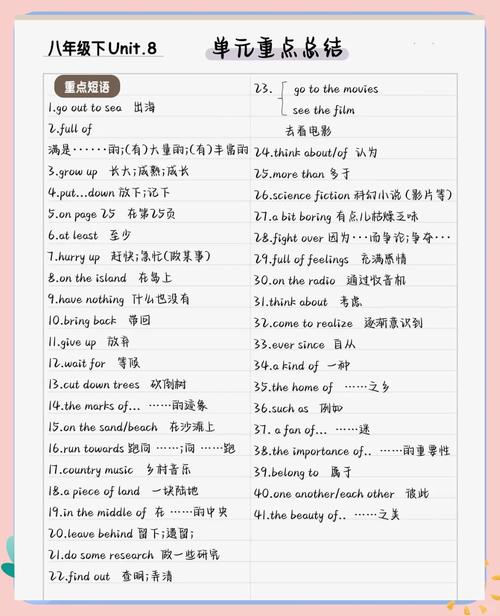
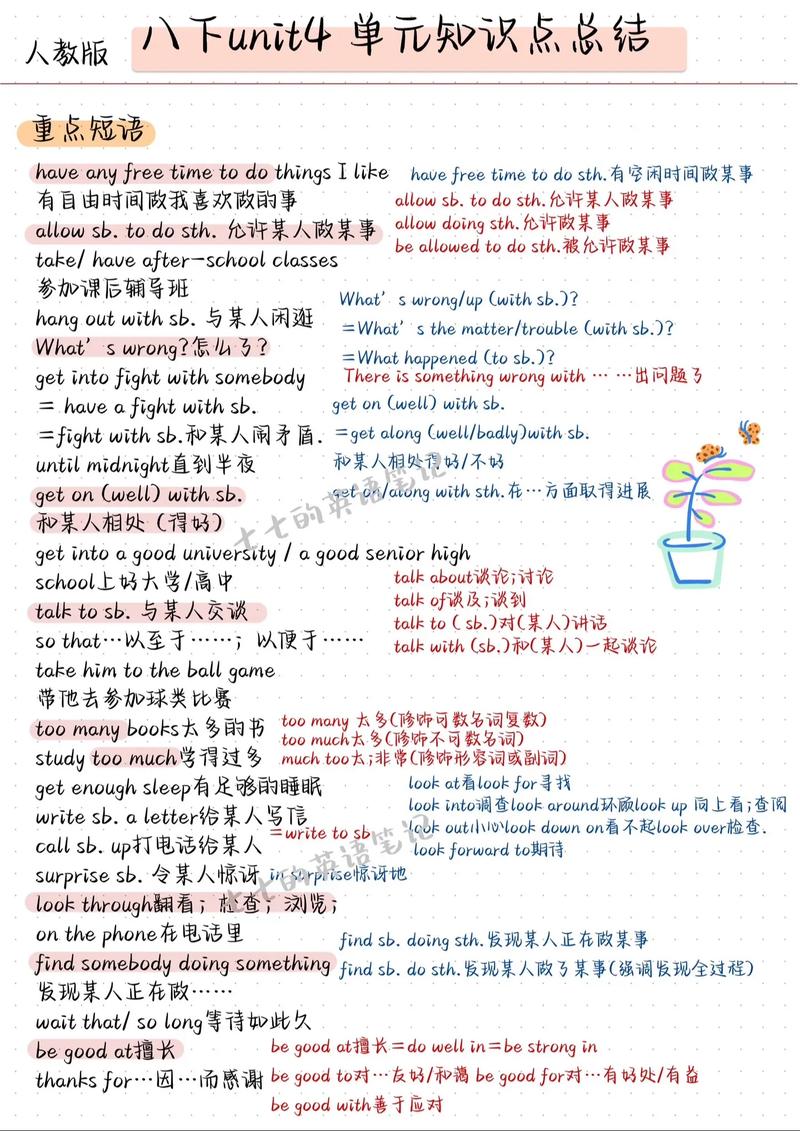
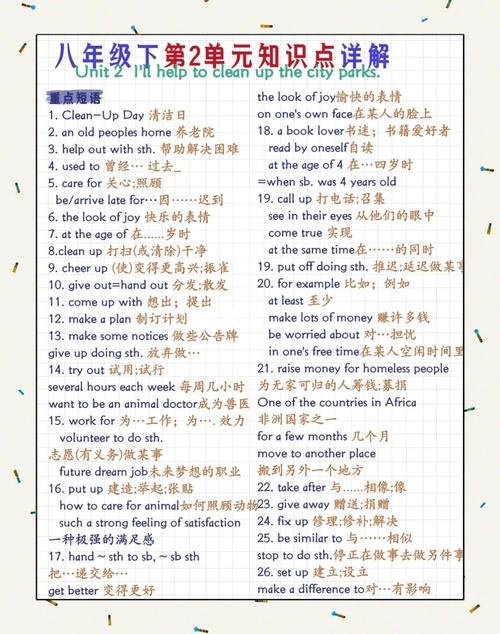
这里列出了一些核心词汇和短语,请务必会读、会拼、会用。
(图片来源网络,侵删)
| 主题 | 词汇/短语 |
|---|---|
| 旅行与交通 | transportation, subway, flight, expensive, comfortable, crowded, take a taxi, by air, get to, take off, land |
| 自然与环保 | pollution, environment, litter, protect, recycle, plastic, paper, plant trees, save energy, turn off |
| 健康与医疗 | fever, cough, toothache, headache, medicine, dentist, health, stay healthy, see a doctor, take some medicine |
| 文学与艺术 | novel, poem, famous, character, setting, plot, science fiction, at the end of, be interested in, grow up |
| 日常活动 | housework, chore, sweep the floor, do the dishes, make the bed, take out the trash, borrow, lend |
| 情感与观点 | annoying, relaxing, boring, exciting, surprising, disappointing, in my opinion, agree with, disagree with |
| 连接词 | although, though, unless, so that, as soon as, so...that..., such...that... |
第三部分:重点句型结构
掌握这些句型,能让你的表达更地道、更准确。
-
It's + adj. + for sb. + to do sth.
- It's important for us to learn English well. (学好英语对我们来说很重要。)
-
spend time/money (in) doing sth. / on sth.
- He spends an hour (in) reading every day. (他每天花一小时阅读。)
- I spent 20 yuan on this book. (我花了20块钱买这本书。)
-
find it + adj. + to do sth.
 (图片来源网络,侵删)
- I find it difficult to learn math. (我发现学数学很难。)
-
... so/such ... that ... (..以至于...)
- The box is so heavy that I can't lift it. (箱子太重了,我搬不动。)
- It was such a nice day that we went out for a picnic. (天气如此之好,以至于我们出去野餐了。)
-
... unless ... (除非,如果不...)
- You will fail the exam unless you study hard. (除非你努力学习,否则你会考试不及格。)
-
... although/though ... (虽然.....)
- Although he is very rich, he is not happy. (虽然他很有钱,但他并不快乐。)
-
... so that ... (为了,以便...)
- He got up early so that he could catch the first bus. (他早起是为了能赶上第一班公交车。)
-
... as soon as ... (一...就...)
- As soon as he arrived home, he started to cook. (他一到家就开始做饭。)
第四部分:备考建议
- 回归课本: 课本是复习的根本,重新朗读课文,回顾每个单元的对话和文章,巩固语感和词汇。
- 整理错题: 把平时作业和考试中的错题整理到一个本子上,分析错误原因(是语法不会、单词不认识还是粗心),重点复习。
- 专项突破: 针对自己的薄弱环节进行专项练习,如果被动语态总错,就多做几道相关的题。
- 模拟测试: 找一些模拟题或往年真题,在规定时间内完成,提前适应考试节奏,查漏补缺。
- 听说练习:
- 听力: 每天坚持听15-20分钟,可以是课本录音、英文歌曲或简单的英文新闻,注意捕捉关键词。
- 口语: 可以和同学用英语对话,或者自己描述一天的日常,大声朗读课文也是很好的口语练习。
- 写作练习: 每周写1-2篇小作文,比如日记、书信或介绍某个事物,写完后可以请老师或同学帮忙修改,注意使用学过的句型和词汇。
保持积极的心态,相信自己!祝你复习顺利,考试成功!