九年级英语上册句型有哪些重点和难点?
校园之窗 2026年1月11日 08:04:36 99ANYc3cd6
下面我将人教版九年级上册的核心句型按照“核心句型”、“重点语法句型”和“功能性话题句型”三个维度进行梳理,并附上例句和用法解析,希望能帮助你系统地掌握。
第一部分:核心句型(Unit 1-Unit 6)
这些是九年级上册最基础、最核心的句型,贯穿各个单元。
(图片来源网络,侵删)
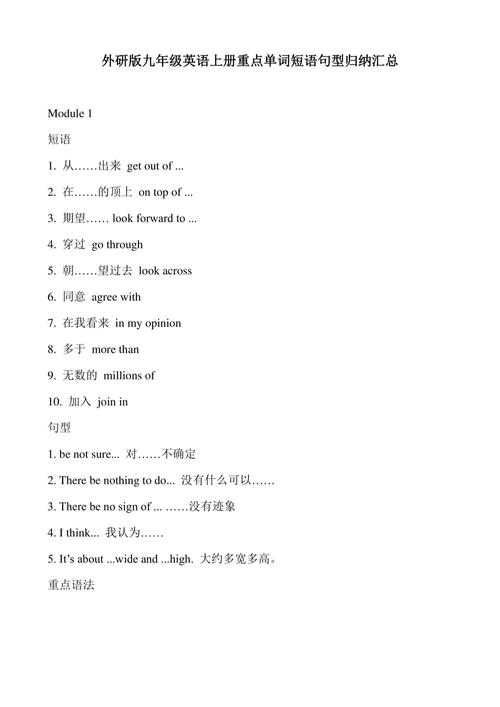
情态动词 should 的用法
表示“应该”,用来提出建议或劝告。
- 句型结构:
主语 + should + 动词原形 + 其他... - 否定句:
主语 + shouldn't (should not) + 动词原形 + 其他... - 例句:
- You should read English every morning. (你应该每天早上读英语。)
- He shouldn't stay up too late. (他不应该熬夜太晚。)
- —What should I do? (我该怎么办?) —You should talk to your teacher. (你应该和你的老师谈谈。)
used to 的用法
表示“过去常常做某事(但现在不做了)”。
- 句型结构:
主语 + used to + 动词原形 + 其他... - 否定句/疑问句:
Did + 主语 + use to + 动词原形...?/主语 + didn't + use to + 动词原形... - 例句:
- I used to be afraid of the dark. (我过去害怕黑暗。)
- She didn't use to like math, but now she loves it. (她过去不喜欢数学,但现在她很喜欢。)
- Did he use to play basketball? (他过去常打篮球吗?)
I'm not sure if... / I wonder if... 句型
表示“我不确定是否……”或“我想知道是否……”,常用来引导宾语从句。
- 句型结构:
I'm not sure / I wonder + if + 从句 (从句用陈述句语序) - 例句:
- I'm not sure if he will come to the party. (我不确定他是否会来参加派对。)
- I wonder if it will rain tomorrow. (我想知道明天是否会下雨。)
It's + adj. + for/of sb. + to do sth. 句型
表示“做某事对某人来说是……的”。

(图片来源网络,侵删)
- 句型结构:
It's + 形容词 + for sb. + to do sth.(形容事情的性质)It's + 形容词 + of sb. + to do sth.(形容人的品格)
- 例句:
- It's important for us to learn English well. (学好英语对我们来说很重要。) - 事情本身重要
- It's very kind of you to help me. (你帮助我真是太好了。) - 人的品格好
make + 宾语 + 宾语补足语
表示“使/让某人/某物怎么样”。
- 句型结构:
make + sb./sth. + adj. / n. / do sth.- 注意: 当宾语是
sb.,宾补是do sth.时,to要省略。
- 注意: 当宾语是
- 例句:
- The good news made us happy. (这个好消息让我们很高兴。)
- His words made me angry. (他的话让我很生气。)
- The teacher made him stand up. (老师让他站起来。)
find + 宾语 + 宾语补足语
表示“发现某人/某物怎么样”。
- 句型结构:
find + sb./sth. + adj. / doing sth. - 例句:
- I find this book very interesting. (我发现这本书非常有趣。)
- When I got home, I found my mother cooking. (当我到家时,我发现我妈妈正在做饭。)
第二部分:重点语法句型(Unit 7-Unit 14)
这些句型与九年级上册的核心语法点紧密相关。
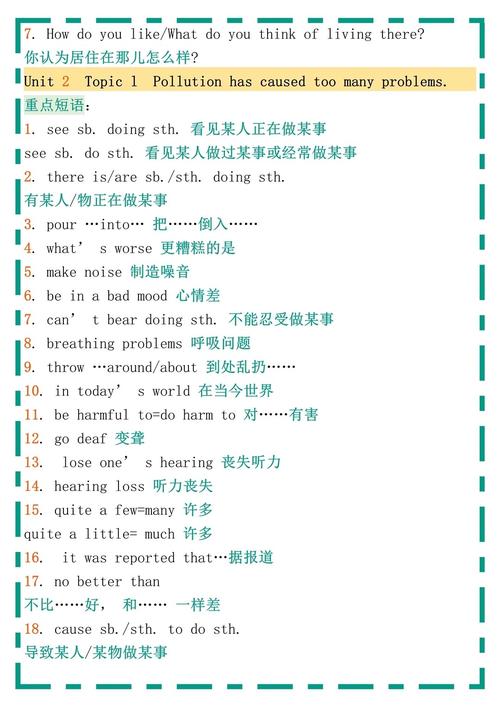
宾语从句
在句子中作宾语的从句,由 that, if, whether, what, who 等词引导。
(图片来源网络,侵删)
- 连接词:
that(无实际意义,可省略,引导陈述句)if / whether(是否,引导一般疑问句)what, which, who, when, where, why, how(引导特殊疑问句)
- 语序: 宾语从句必须使用陈述句语序 (主语 + 谓语)。
- 时态: 如果主句是现在时,从句可以用任何所需的时态;如果主句是过去时,从句通常要用过去的某种时态。
- 例句:
- He said (that) he was busy. (他说他很忙。)
- Can you tell me where the library is? (你能告诉我图书馆在哪里吗?)
- I don't know if she will arrive on time. (我不知道她是否会准时到达。)
- Please tell me what you need. (请告诉我你需要什么。)
过去完成时
表示“过去的过去”,即在过去某个时间点或动作之前已经发生或完成的动作。
- 句型结构:
had + 动词的过去分词 - 例句:
- By the time I got to the cinema, the movie had already started. (当我到达电影院时,电影已经开始了。)
- She told me she had finished her homework. (她告诉我她已经完成了作业。)
被动语态
强调动作的承受者,而不是执行者。
- 句型结构:
be + 动词的过去分词 - 各种时态的被动语态:
- 一般现在时:
am/is/are + p.p.- English is spoken in many countries. (英语在许多国家被使用。)
- 一般过去时:
was/were + p.p.- This bridge was built in 2010. (这座桥建于2010年。)
- 一般将来时:
will be + p.p./am/is/are going to be + p.p.- A new school will be built next year. (一所新学校将在明年建成。)
- 含有情态动词:
can/may/should + be + p.p.- The room must be cleaned every day. (这个房间必须每天打扫。)
- 一般现在时:
It's time (for sb.) to do sth. / It's time (for sb.) that + 从句
表示“是某人做某事的时候了”。
- 句型结构:
It's time (for sb.) + to do sth.It's time + that + 主语 + 动词过去式(从句用虚拟语气)
- 例句:
- It's time for lunch. / It's time to have lunch. (是吃午饭的时候了。)
- It's time that we went home. (我们该回家了。)
prefer...to... / prefer doing...to doing... / prefer to do...rather than do...
表示“更喜欢……而不喜欢……”。
- 句型结构:
prefer A to B(A 和 B 都是名词或动名词)prefer doing A to doing Bprefer to do A rather than do B
- 例句:
- I prefer tea to coffee. (比起咖啡,我更喜欢茶。)
- He prefers reading to watching TV. (比起看电视,他更喜欢阅读。)
- She prefers to stay at home rather than go out. (她宁愿待在家里也不愿出去。)
第三部分:功能性话题句型(Unit 1-Unit 14)
这些是围绕课本各个单元话题展开的实用句型。
How to learn English (如何学习英语)
- I have trouble (in) memorizing new words.
- Why don't you listen to English songs?
- You should try to guess the meaning of new words.
- It's a good idea to read English newspapers.
I used to be afraid of the dark. (过去与现在)
- I used to be short, but now I'm tall.
- Did you use to play the piano?
- I'm not afraid of the dark anymore.
What are you supposed to do in China? (习俗与礼仪)
- You're supposed to shake hands when you meet someone for the first time.
- In Brazil, you're not supposed to kiss when you greet friends.
- Making noise is considered very rude.
What would you do? (虚拟语气,假设)
- If I were you, I would talk to him about it.
- If I won a million dollars, I would buy a big house.
- What would you do if you had a problem like this?
Music that I can dance to. (定语从句)
- I prefer music that has great lyrics. (歌词)
- The band that we saw last night was fantastic.
- She likes musicians who write their own songs.
Rainy days make me sad. (情感与感受)
- Loud music makes me nervous.
- Waiting for him always makes me angry.
- It's important to learn how to relax.
Have you ever been to a museum? (现在完成时表经历)
- Yes, I have. / No, I haven't.
- I've never been to an amusement park.
- Have you ever tried Chinese food?
I like music that I can dance to. (定语从句)
- This is the book (that/which) I told you about.
- The man who is wearing a blue coat is my uncle.
- We visited the town where my grandfather was born.
We're trying to save the earth. (环保话题)
- Littering is a big problem.
- We should stop using plastic bags.
- Everyone should play a part in saving the earth.
You should use a bygone. (提出建议)
- Why not ride a bike to school?
- How about turning off the lights when you leave?
- We need to take action now.
学习建议
- 分类整理: 将以上句型抄录在自己的笔记本上,按照“核心句型”、“语法句型”、“话题句型”分类,形成自己的知识体系。
- 造句练习: 不要只看不练,每个句型至少自己造3-5个句子,确保真正理解其用法。
- 情景运用: 结合课本单元话题,想象一个情景,尝试用这些句型进行对话或小写作,和朋友讨论学习英语的方法,或者描述你过去和现在的变化。
- 错题回顾: 在做练习和考试时,把用错的句型记录下来,反复研究,直到完全掌握。
希望这份详细的句型总结对你有帮助!加油,祝你英语学习进步!