9年级上册英语知识点
校园之窗 2026年1月9日 11:46:23 99ANYc3cd6
下面我将为你系统地梳理九年级上册的核心知识点,分为 【核心语法】、【核心词汇与短语】、【重要句型与话题】 和 【学习建议】 四个部分,希望能帮助你高效复习。
核心语法
九年级上册的语法是重点和难点,务必吃透。
宾语从句
这是九年级最重要的语法点之一,贯穿整个学期。
-
定义: 在句子中充当宾语成分的从句,通常跟在动词、介词或形容词后面。
-
三大要素 (必须掌握):
-
连接词
that: 无实际意义,只起连接作用,在从句中不充当任何成分,口语中常可省略。例: I think (that) you are right.
if / whether: “是否”,不能省略。if和whether常常可以互换,但在以下情况用whether:- 在介词后: I'm worried about whether he can come.
- 与 or not 连用: I don't know whether or not he is free.
- 疑问词 (
who,what,which,when,where,why,how): 它们在从句中充当相应的句子成分(主、宾、状等),且不可省略。- 例: Can you tell me where the post office is? (where 在从句中作地点状语)
-
语序
- 宾语从句必须使用陈述句语序 (主语 + 谓语),即使连接词本身是疑问词。
- 错误: Can you tell me where is the post office?
- 正确: Can you tell me where the post office is?
-
时态
- 主句为现在时或将来时,从句可以根据实际情况使用任何所需的时态。
- 例: He says (that) he is a student. (He says 是现在时,从句用现在时)
- 例: He says (that) he was a student last year. (He says 是现在时,从句用过去时)
- 主句为过去时,从句的时态要相应“退一步”,即“过去的过去”。
- 一般现在时 → 一般过去时
- 现在进行时 → 过去进行时
- 现在完成时 → 过去完成时
- 一般将来时 → 过去将来时
- 例: He said (that) he was a student. (He said 是过去时,从句用过去时)
- 例: He told me that he would go to Beijing. (told 是过去时,从句用过去将来时)
- 客观真理、事实、格言,无论主句是什么时态,从句都用一般现在时。
- 例: The teacher told us that the earth moves around the sun.
- 主句为现在时或将来时,从句可以根据实际情况使用任何所需的时态。
-
被动语态
被动语态是中考的必考点,要熟练掌握各种时态的被动形式。
- 基本结构:
be + 动词的过去分词 - 核心用法: 强调动作的承受者,或不知道/不关心动作的执行者。
- 重要时态被动语态:
- 一般现在时: am/is/are + p.p.
- 例: Trees are planted in spring.
- 一般过去时: was/were + p.p.
- 例: This house was built in 1990.
- 一般将来时: will be + p.p. / am/is/are going to be + p.p.
- 例: A new bridge will be built next year.
- 现在完成时: have/has been + p.p.
- 例: This book has been read by many students.
- 情态动词被动语态: 情态动词 + be + p.p.
- 例: The work must be finished by 5 o'clock.
- 一般现在时: am/is/are + p.p.
- 注意:
get也可以表示被动,通常指“突然”或“不幸”地发生某事。- 例: He got hurt in the accident.
- 动词短语变被动时,介副词不能省略。
- 例: The problem must be dealt with carefully. (不能说 ... be dealt)
情态动词
九年级主要学习 must, could, should, might 等情态动词的用法。
- must: “必须”,表示强烈的建议或命令,其否定形式
mustn't表示“禁止,不准”。- 例: You must finish your homework.
- 例: You mustn't play on the road.
- should: “应该”,表示建议或劝告,其否定形式
shouldn't表示“不应该”。- 例: You should listen to your parents.
- 例: He shouldn't stay up late.
- could: “可以”,比
can更委婉、更客气,用于提出请求或建议。- 例: Could you help me, please?
- 例: We could go to the park this weekend.
- might: “可能”,比
may语气更不确定,表示可能性更小。- 例: It might rain tomorrow.
非谓语动词
主要包括不定式和动名词,在句子中可以充当主语、宾语、定语、状语等。
- 动词不定式:
- 作宾语: 某些动词后只跟不定式作宾语,可记为“agree to do, decide to do, hope to do, learn to do, manage to do, offer to do, plan to do, refuse to do, want to do, wish to do”。
- 作目的状语: 为了...,常放在句末或句首 (To do...)。
- 例: He studies hard to get good grades.
- 作定语: 放在名词后面,表示“做某事的”。
- 例: I have a lot of homework to do.
- 动名词:
- 作主语: 动名词作主语时,谓语动词用单数。
- 例: Swimming is my favorite sport.
- 作宾语: 某些动词或介词后只跟动名词作宾语,可记为“enjoy doing, finish doing, mind doing, practice doing, be busy doing, keep doing, suggest doing”。
- 例: She enjoys listening to music.
- 例: Thank you for helping me.
- 作主语: 动名词作主语时,谓语动词用单数。
核心词汇与短语
九年级词汇量要求更高,且更注重短语搭配和运用。
-
Unit 1 How can we become good learners?
- 核心词:
textbook,conversation,aloud,pronunciation,sentence,patient,discover,secret,look up,repeat,note,friendship - 核心短语:
work with friends和朋友一起学习read aloud大声朗读make mistakes犯错be afraid to do sth.害怕做某事laugh at嘲笑take notes做笔记pay attention to注意connect...with...把...和...联系起来
- 核心词:
-
Unit 2 I think that mooncakes are delicious!
- 核心词:
mooncake,relative,pound,stranger,lie,dead,business,give out,folk,warmth,admire - 核心短语:
put on上演,增加(体重)in the shape of呈...的形状give out分发,发放end up最终成为,最后处于share sth. with sb.与...分享...as a result结果not only...but also...不仅.....so...that.....以至于...
- 核心词:
-
Unit 3 Could you please tell me where the restrooms are?
- 核心词:
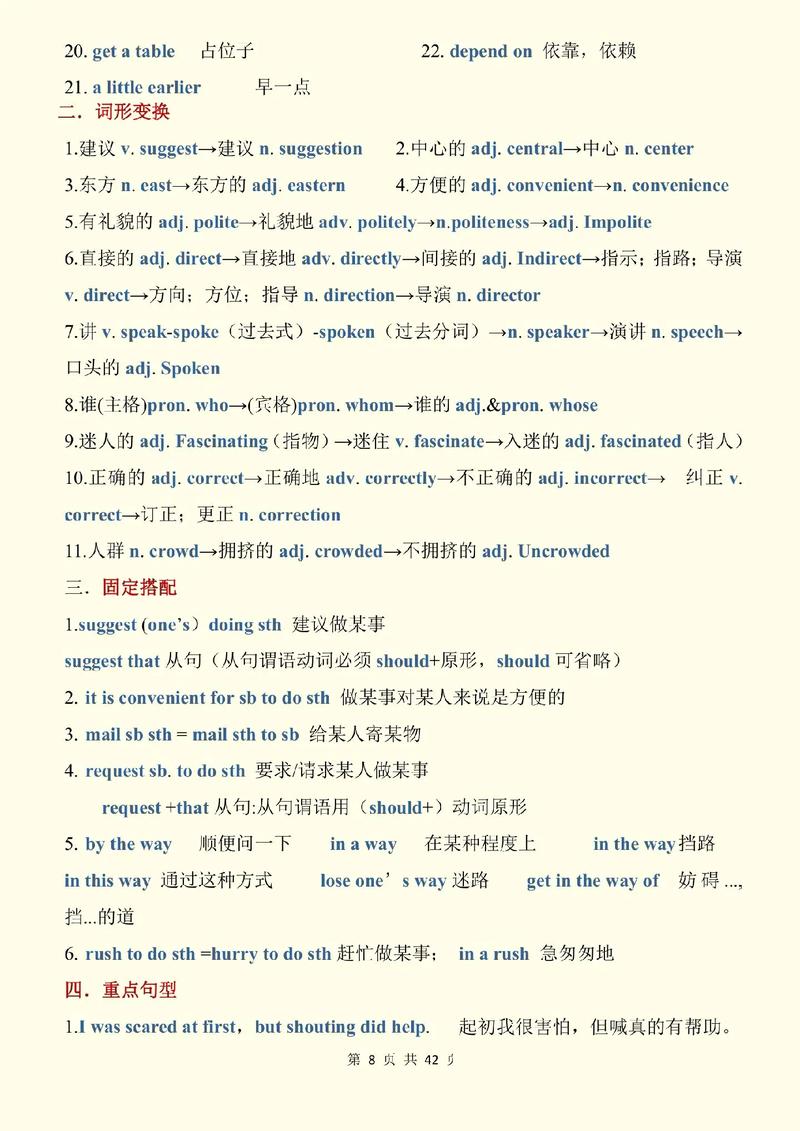
restroom,pardon,direction,correct,polite,request,direct,mention,opinion,whom,whenever - 核心短语:
pass by路过on one's way to...在去...的路上get to到达lead to通向go past经过on time准时drop by顺便拜访wait in line排队等候
- 核心词:
-
Unit 4 I used to be afraid of the dark.
- 核心词:
humorous,silent,helpful,from time to time,score,influence,absent,fail,examination,exactly,pride,seldom,be proud of - 核心短语:
used to do sth.过去常常做某事be afraid of害怕be interested in对...感兴趣pay attention to注意make a decision做决定in the end终于take pride in为...感到自豪even though即使,尽管
- 核心词:
-
Unit 5 What are the shirts made of?
- 核心词:
chopsticks,coin,fork,blouse,silver,steel,cotton,fair,environment,be made of/from,be known for - 核心短语:
be made of由...制成 (看得出原材料)be made from由...制成 (看不出原材料)be made in在...制造be made by被...制造as far as I know据我所知no matter + 疑问词无论...environmental protection环境保护
- 核心词:
-
Unit 6 When was it invented?
- 核心词:
invent,invention,accidental,by mistake,divide,remain,smell,customer,crispy,salty,take place - 核心短语:
by accident偶然地,意外地by mistake错误地without doubt毫无疑问at that time在那时the number of......的数量 (谓语用单数)a number of...许多... (谓语用复数)
- 核心词:
-
Unit 7 Teenagers should be allowed to choose their own clothes.
- 核心词:
license,safety,emotional,society,manage,choose,instead of,pressue,succeed,get in the way of - 核心短语:
be allowed to do sth.被允许做某事sixteen-year-olds16岁的青少年 (用连字符,作名词)instead of代替,而不是stay up熬夜look after照顾concentrate on专注于at present现在in the future在将来
- 核心词:
-
Unit 8 It must belong to Carla.
- 核心词:
belong,possibility,must,owner,picnic,rabbit,noise,wolf,laboratory,coat,sleepy,drop - 核心短语:
belong to属于because of因为make noise制造噪音in silence安静地,沉默地at least至少even if即使in the end最后a piece of一片,一张,一块
- 核心词:
重要句型与话题
重要句型
- 提建议:
How/What about doing sth.?(做...怎么样?)Why not do sth.? / Why don't you do sth.?(为什么不做...呢?)You should/could/might do sth.(你应该/可以/或许做...)
- 表达喜好与厌恶:
I love/like/enjoy/prefer doing sth.(我喜欢/享受/更喜欢做...)I hate/dislike doing sth.(我讨厌做...)I'm interested in...(我对...感兴趣)
- 谈论变化:
I used to do sth.(我过去常常做...)I didn't use to do sth.(我过去不常做...)I'm used to doing sth.(我习惯于做...)
- 谈论物品的来源与构成:
Where is/are ... made?(...是哪里制造的?)It's made in...(它是在...制造的。)What is/are ... made of/from?(...是由什么制成的?)It's made of/from...(它是由...制成的。)
- 表达推测与判断:
It must be...(那肯定是...)It could/might be...(那可能是/也许是...)It can't be...(那不可能是...)It may/might belong to...(它可能属于...)
单元话题
- Unit 1: 学习方法与建议
- Unit 2: 节日与文化
- Unit 3: 问路与指路
- Unit 4: 过去与现在的变化
- Unit 5: 物品的材料与产地
- Unit 6: 发明与创造
- Unit 7: 规则与同意/不同意
- Unit 8: 推测与可能性
学习建议
- 语法体系化: 不要孤立地学语法,将宾语从句、被动语态等核心语法点串联起来,形成一个知识网络,准备一个语法错题本,反复研究错题。
- 词汇语境化: 不要死记硬背单词表,在课文的语境、例句中记忆单词,并结合短语搭配一起记,尝试用新学的单词和短语造句。
- 听说读写并进:
- 听: 每天坚持听课文录音或简单的英文材料,培养语感。
- 说: 大胆开口,朗读课文,尝试和同学用英语讨论话题。
- 读: 精读课本文章,理解其结构和深层含义,可以适当阅读一些简单的英文读物。
- 写: 坚持用英语写日记、周记,或者针对单元话题进行小练笔,这是检验你综合运用能力的最好方式。
- 善用工具: 充分利用课本、练习册、教师提供的补充材料,善用词典(推荐使用英英词典或英汉双解词典)。
- 及时复习: 遵循艾宾浩斯遗忘曲线,及时复习学过的知识点,做到温故而知新。
九年级上册的内容非常有挑战性,但只要你能跟上老师的节奏,扎实地掌握以上知识点,并保持良好的学习习惯,就一定能取得优异的成绩,为九年级下学期和中考打下坚实的基础,加油!