九年级英语人教版知识点有哪些重点?
校园之窗 2026年1月2日 07:36:09 99ANYc3cd6
第一部分:按单元划分的核心知识点
九年级上册通常共14个单元,下册共10个单元,以下是重点单元的核心内容概览。
九年级上册 (Units 1-14)
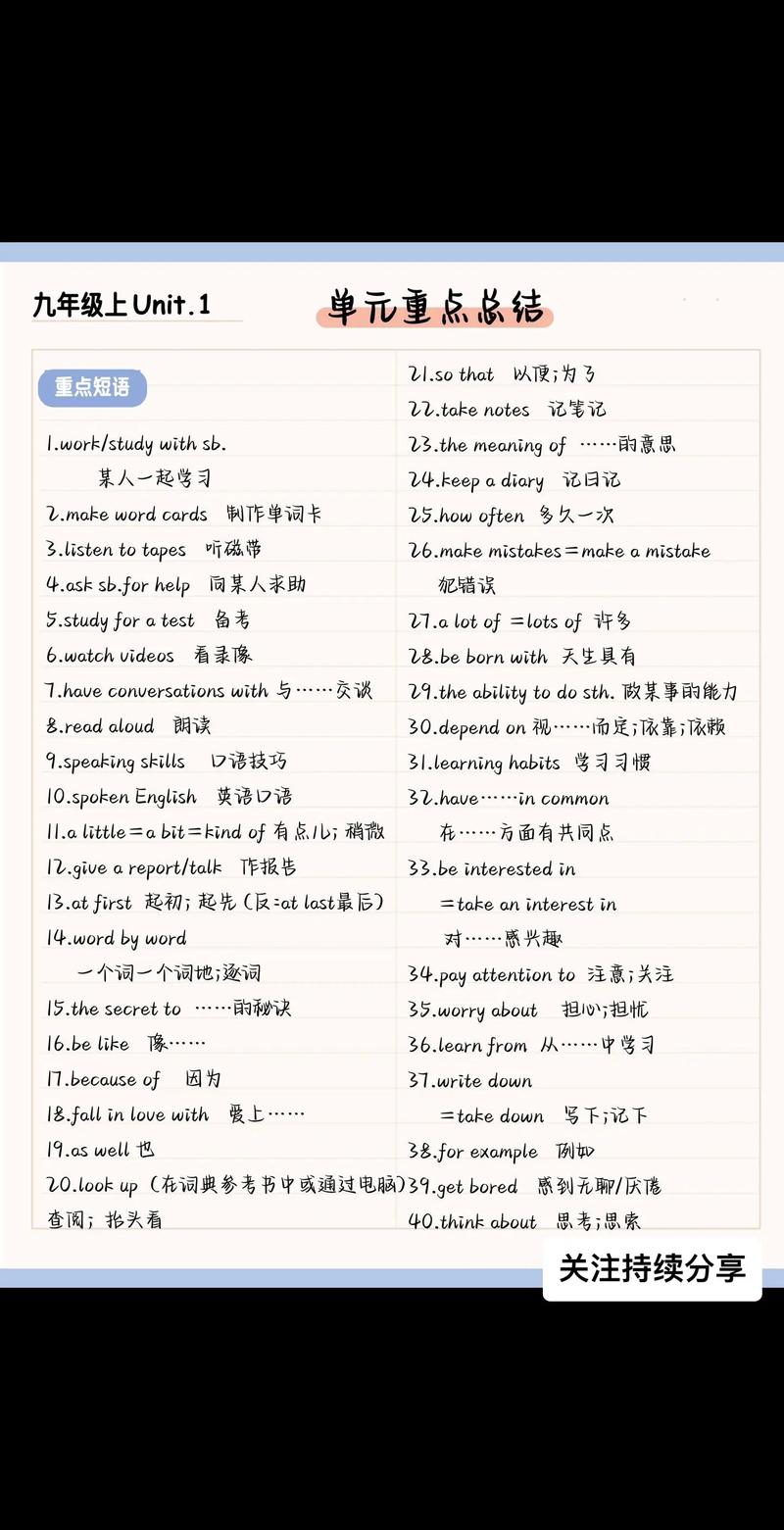
Unit 1 How can we become good learners?

- 核心词汇: textbook, conversation, aloud, pronunciation, sentence, patient, express, discover, secret, look up, grammar, repeat, note, physics, chemistry, partner, improve
- 核心句型:
- How do you study for a test? -- I study by working with a group.
- Have you ever studied with a group? -- Yes, I have. / No, I haven't.
- I learn by working with friends.
- It's too hard to understand the voice.
- 重点语法: by + doing sth. (通过做某事),用来表达方式方法。
e.g., learn English by watching movies.
Unit 2 I think that mooncakes are delicious!
- 核心词汇: mooncake, lantern, stranger, relative, pound, put on, perform, Christmas, lie, dead, business, punish, warn, end up
- 核心句型:
- What do you like about...? -- I love...
- What do you think of...? -- I think they're wonderful.
- I believe that the Spring Festival is the most important holiday in China.
- I wonder if... (我想知道是否...)
- 重点语法: 宾语从句
- 连接词: that (可省略), if/whether (是否), wh-疑问词 (what, which, who, when, where, why, how)。
- 语序: 宾语从句必须使用陈述句语序 (主语 + 谓语)。
- 时态: 主句为现在/将来时,从句可用任何时态;主句为过去时,从句要用相应的过去时态。
Unit 3 Could you please tell me where the restrooms are?
- 核心词汇: restroom, stamp, pardon, rush, suggest, correct, direct, politely, request, direction, correct, impolite, address, nearby, wherever
- 核心句型:
- Could you please tell me where I can get a dictionary? -- Sure. There's a bookstore on Center Street.
- Excuse me, could you please tell me how to get to the post office?
- Pardon? / Sorry? / I beg your pardon?
- 重点语法: 宾语从句 (特殊疑问句引导)
- 由特殊疑问词引导的宾语从句,语序为特殊疑问词 + 陈述句语序。
- e.g., He asks where the library is. (错误: where is the library)
- 礼貌用语: Could you please...? / Would you mind...?
Unit 4 I used to be afraid of the dark.

- 核心词汇: used to, be afraid of, dark, silence, absent, fail, examination, exactly, pride, take pride in, spoken, influence, seldom, be proud of, grade, in the past
- 核心句型:
- I used to be afraid of the dark.
- Did you use to play the piano? -- Yes, I did. / No, I didn't.
- I'm not afraid of the dark anymore.
- 重点语法: used to do sth. (过去常常做某事)
- 含义: 表示过去存在但现在已不再有的习惯或状态。
- 构成: used to + 动词原形。
- 疑问句和否定句: 可用
did或didn't,也可用use(d)。- Did you use to...? / Used you to...?
- I didn't use to... / I used not to...
Unit 5 What are the shirts made of?
- 核心词汇: fork, knife, chopsticks, blouse, silver, gold, glass, cotton, steel, grass, leaf, produce, widely, be known for, process, pack
- 核心句型:
- What is this shirt made of? -- It's made of cotton.
- Where are these products made? -- They are made in China.
- How is tea produced? -- It is picked by hand and then sent for processing.
- 重点语法: 被动语态
- 结构: be + 动词的过去分词。
- 一般现在时: am/is/are + p.p.
- 一般过去时: was/were + p.p.
- 用法: 强调动作的承受者,或不知道/不关心动作的执行者。
Unit 6 When was it invented?
- 核心词汇: invent, heater, scoop, adjustable, crispy, salty, by mistake, customer, divide, smell, take place, accident, nearly, rise, temperature, boil, fall into
- 核心句型:
- When was the telephone invented? -- It was invented in 1876.
- What is it used for? -- It's used for seeing in the dark.
- 重点语法: 被动语态 (一般过去时)
- 结构: was/were + p.p.
- e.g., The light bulb was invented by Thomas Edison.
Unit 7 Teenagers should be allowed to choose their own clothes.
- 核心词汇: license, safety, smoke, pier, cry, field, hug, lift, awful, regret, poem, community, manage, society, pressure, instead of
- 核心句型:
- Do you think teenagers should be allowed to work part-time? -- Yes, I do. / No, I don't.
- Sixteen-year-olds should not be allowed to drive.
- I agree. / I disagree.
- 重点语法: 情态动词的被动语态
- 结构: can/may/must/should + be + p.p.
- e.g., Students should be given more free time.
- should be allowed to do sth. (应该被允许做某事)
Unit 8 It must belong to Carla.
- 核心词汇: belong, belong to, picnic, possibly, drop, truck, rabbit, escape, neighbor, noise, wolf, lady, worried, final, anxious, owner
- 核心句型:
- Whose volleyball is this? -- It must be Carla's. She loves volleyball.
- It could be Mei's. It might be hers.
- It can't be Tom's. He doesn't like music.
- 重点语法: 情态动词表推测
- must: 表示肯定的推测,意为“一定是,肯定是”,100%肯定。
- could/might: 表示不确定的推测,意为“可能是,也许”,可能性较小。
- can't: 表示否定的推测,意为“不可能是”,100%否定。
- 后接: 名词所有格或名词性物主代词。
Unit 9 I like music that I can dance to.
- 核心词汇: prefer, lyric, gentle, electronic, spare, sadness, wound, express, musician, perform, praise, stick, once in a while, feel like, in that case
- 核心句型:
- What kind of music do you like? -- I like music that I can dance to.
- I prefer music that has great lyrics.
- The music that was popular in the 1990s is great.
- 重点语法: 定语从句
- 作用: 在句子中修饰名词或代词的从句。
- 引导词: that, which, who, whom, whose。
- that: 指物或人,在从句中作主语或宾语。
- The book (that) I bought yesterday is interesting. (作宾语,可省略)
- The boy (that) is playing basketball is my brother. (作主语,不可省略)
- which: 指物,在从句中作主语或宾语。
The movie (which) we saw last night was boring. (作宾语,可省略)
- who: 指人,在从句中作主语。
The person who is talking to our teacher is my father. (作主语,不可省略)
Unit 10 You're supposed to shake hands.
- 核心词汇: be supposed to, shake, bow, kiss, greet, value, capital, noon, mad, get mad, basic, exchange, point, stick, drop, fork, full, knife
- 核心句型:
- What are people in Korea supposed to do when they meet for the first time? -- They're supposed to bow.
- You should also knock before you enter someone's house.
- I was supposed to arrive at 7:00, but I arrived at 8:00.
- 重点语法: be supposed to do sth. (应该做某事;被期望做某事)
- 表示按规定、习俗或常识应该做的事情。
- e.g., You are supposed to wear a uniform at school.
Unit 11 Sad movies make me cry.
- 核心词汇: license, soft, influence, friendship, trust, war, power, instead, drive, exam, fail, recent, themselves, deal, friendship, in order to
- 核心句型:
- What did you do? -- We watched a sad movie.
- It made me sad.
- Loud music makes me tense.
- Waiting for him made me angry.
- 重点语法: make sb. do sth. (使某人做某事)
- 结构: make + 宾语 + 动词原形。
- 被动语态: sb. be made to do sth.
- 类似用法: let sb. do sth. (让某人做某事), have sb. do sth. (让某人做某事)。
Unit 12 Life is full of the unexpected.
- 核心词汇: unexpected, by the time, backpack, oversleep, ring, off, give...a lift, lock, break down, stare, in surprise, stare at, ahead, event, April Fool's, announce, expose, reveal, lead to
- 核心句型:
- By the time I got outside, the bus had already left.
- When I got to school, I realized I had left my backpack at home.
- 重点语法: 过去完成时
- 结构: had + 动词的过去分词。
- 用法: 表示在过去某个时间点或动作之前已经发生或完成的动作,即“过去的过去”。
- 标志词: by the time, before, when, after 等。
Unit 13 We're trying to save the earth!
- 核心词汇: litter, bottom, fisherman, coal, ugly, advantage, disadvantage, cost, wooden, plastic, takeaway, bin, recycle, reuse, napkin, sort, harmful, pay for
- 核心句型:
- The river used to be so clean.
- We're trying to save the earth.
- The air is badly polluted.
- Everyone should play a part in saving the earth.
- 重点语法: 现在进行时表将来
- 结构: am/is/are + v.-ing。
- 用法: 表示已经安排好的、即将发生的动作,通常有表示将来的时间状语。
- e.g., I am meeting my friend at the airport tomorrow.
Unit 14 I remember meeting all of you in Grade 7.
- 核心词汇: remember, forget, recall, introduce, textbook, final, exam, nervous, congratulate, proud, forward, task, double, challenge, overcome, graduate, separate, look forward to
- 核心句型:
- I remember seeing you for the first time.
- I will never forget the time we spent together.
- I hope you have a bright future.
- I'm looking forward to hearing from you.
- 重点语法: remember/forget + doing sth. vs. + to do sth.
- remember/forget + doing sth.: 记得/忘记做过某事 (动作已发生)。
- remember/forget + to do sth.: 记得/忘记要去做某事 (动作未发生)。
- e.g., I remember locking the door. (我记得锁了门) vs. I remember to lock the door. (我没忘记要锁门)。
第二部分:核心语法大盘点
除了单元语法,九年级还集中学习了一些非常重要的语法点。
宾语从句
- 功能: 在句子中充当宾语。
- 引导词:
that(无实际意义,可省略)。if/whether(是否,不能省略)。wh-(what, which, who, whom, whose, when, where, why, how)。
- 语序: 无论主句是什么时态,宾语从句一律使用陈述句语序。
- 时态一致性: 主句为过去时,从句要用相应的过去时态(一般过去时、过去进行时、过去完成时、过去将来时等),如果从句表示的是客观真理或事实,则用一般现在时。
- He said (that) he was tired.
- He said (that) the earth moves around the sun.
被动语态
- 定义: 强调动作的承受者,而不是执行者。
- 基本结构: be + 动词的过去分词。
- 常见时态被动语态:
- 一般现在时: am/is/are + p.p.
- 一般过去时: was/were + p.p.
- 一般将来时: will be + p.p.
- 含情态动词: can/may/must/should + be + p.p.
- 现在进行时: am/is/are + being + p.p.
- 过去完成时: had + been + p.p.
定语从句
- 功能: 修饰名词或代词的从句。
- 核心: 找出先行词(被修饰的名词),选择合适的引导词,引导词在从句中充当句子成分。
- 常用引导词:
- that: 指人或物,在从句中作主语或宾语(作宾语时常可省略)。
- which: 指物,在从句中作主语或宾语(作宾语时常可省略)。
- who: 指人,在从句中作主语。
- whom: 指人,在从句中作宾语(较正式,口语中常用 who/that 代替)。
- whose: 指人/物,在从句中作定语,表示“……的”。
过去完成时
- 定义: 表示在过去某一时间点或动作之前已经完成的动作。
- 结构: had + 动词的过去分词。
- 标志词:
by the time,before,when,after等。 - 例句: By the end of last year, I had learned 2000 English words. (到去年年底,我已经学会了2000个英语单词。)
情态动词表推测
- must: 肯定推测,意为“一定是,肯定是”。
- could/might: 不确定推测,意为“可能是,也许”。
- can't: 否定推测,意为“不可能是”。
- 注意: 后面通常跟名词所有格或名词性物主代词。
- This must be Tom's book. (这一定是汤姆的书。)
- The phone could be Li Ming's. (这个手机可能是李明的。)
- It can't be her bike. (这不可能是她的自行车。)
第三部分:重点词汇与短语
- 与学习有关: by doing sth., look up, take notes, make mistakes, work hard, get good grades
- 与节日有关: Spring Festival, Christmas, Mid-Autumn Festival, be similar to, be different from, celebrate
- 与问路有关: excuse me, could you please tell me..., go along, turn left/right, on the left/right, next to, between
- 与变化有关: used to do sth., be afraid of, be interested in, no longer, not...anymore
- 与制作有关: be made of/from, be made in/by, be used for doing sth./to do sth.
- 与规则有关: should be allowed to, be supposed to, have to, must
- 与情感有关: make sb. do sth., make sb. + adj., be happy/angry/sad about sth.
- 与意外有关: by the time, get up, oversleep, be late for, happen to sb.
- 与环境有关: pollution, environment, save, protect, reuse, recycle, throw away, a number of, the number of
- 与回忆有关: remember/forget doing/to do, look forward to doing sth., graduate from, be proud of, hope to do sth.
第四部分:中考备考建议
- 回归课本: 熟读课文,掌握课文中出现的核心词汇、短语和句型。
- 梳理语法: 将以上核心语法点系统整理,形成自己的知识网络,多做专项练习。
- 整理错题: 准备一个错题本,记录做错的题目,特别是语法题,分析错误原因,定期回顾。
- 专项突破: 针对自己的薄弱环节(如完形填空、阅读理解、书面表达)进行集中训练。
- 模拟演练: 在中考前,进行几套完整的模拟试题,严格计时,适应考试节奏。
- 积累范文: 对于书面表达,背诵一些优秀的范文和万能句型,并尝试模仿写作。
希望这份详细的总结能对你的九年级英语学习有所帮助!祝你学习进步,中考取得优异成绩!