
古诗词赏析英文PPT如何传递文化精髓?
经典古诗 2025年12月13日 22:26:49 99ANYc3cd6
Of course! Here is a comprehensive structure and content for an English PowerPoint presentation on the appreciation of classical Chinese poetry. This PPT is designed to be both informative and visually engaging, suitable for a university-level class, a cultural club, or a personal presentation.
PPT Title: The Soul of an Ancient Civilization: An Appreciation of Classical Chinese Poetry
** A Journey Through Imagery, Emotion, and Philosophy
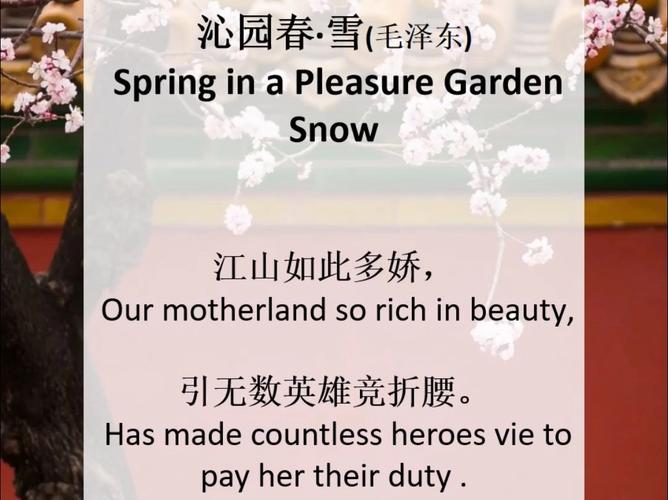
Slide 1: Title Slide
(Background Image: A classic Chinese ink wash painting of a misty mountain range with a small pavilion.)
- Title: The Soul of an Ancient Civilization
- Subtitle: An Appreciation of Classical Chinese Poetry
- Presenter: [Your Name]
- Date: [Date]
Slide 2: Introduction - What is Classical Chinese Poetry?
(Background Image: A close-up of an ancient bamboo or silk scroll with calligraphy.)
- Title: More Than Just Words
- Content:
- A Living Tradition: Spanning over 3,000 years, from the Shijing (Classic of Poetry) to the Qing Dynasty.
- A Cultural Cornerstone: It's not just literature; it's philosophy, history, and the very lens through which ancient Chinese people viewed the world.
- Concise & Evocative: Characterized by extreme conciseness, rhythmic patterns, and rich, layered imagery. A few characters can paint a vast picture and convey deep emotion.
- Key Genres: Shi (Poetry), Ci (Lyric Verse), Qu (Songs).
Slide 3: The Four Great Masters - A Pantheon of Poets
(Background Image: Four stylized portraits of the four poets.)
- Title: Giants of the Verse
- Content:
- Li Bai (李白, 701-762): The "Immortal Poet." Romantic, free-spirited, and mystical. His poetry celebrates wine, friendship, and the beauty of nature.
- Du Fu (杜甫, 712-770): The "Poet-Sage." Realistic, compassionate, and profound. His work often reflects the social turmoil and suffering of his time.
- Wang Wei (王维, 701-761): The "Poet-Painter." A master of "painterly poetry" (shishi hua), his verses are serene, meditative, and deeply connected to Zen Buddhism.
- Li Qingzhao (李清照, 1084-1155): The "Matchless Female Poet." Her Ci poetry is celebrated for its delicate, poignant, and deeply personal expressions of love, loss, and longing.
Slide 4: Core Elements - The Building Blocks of a Poem
(Background Image: A graphic showing the four elements: Brush, Ink, Paper, Mountain.)

- Title: The Poet's Toolkit
- Content:
- Imagery (意象 - yìxiàng): The soul of Chinese poetry. Not just visual pictures, but a fusion of sight, sound, smell, and feeling. A single image (e.g., "autumn moon," "withered vine") can carry immense cultural and emotional weight.
- Emotion (情感 - qínggǎn): The heart of the poem. Poetry is a vehicle for expressing the full spectrum of human feelings—joy, sorrow, nostalgia, anger, and tranquility.
- Allusion (用典 - yòngdiǎn): Referencing historical stories, myths, or other poems. It adds layers of meaning for the educated reader, creating a conversation across time.
- Sound & Rhythm (格律 - gélǜ): Strict rules on tone patterns, line length, and rhyme. This musicality is crucial to the poem's impact and is often lost in translation but is felt in its cadence.
Slide 5: Case Study 1 - Li Bai's "Quiet Night Thought" (静夜思)
(Background Image: A simple, elegant picture of a bright moon shining through a window.)
-
Title: Li Bai - Quiet Night Thought (静夜思)
-
Original Text (with Pinyin):
床前明月光 (Chuáng qián míng yuè guāng) 疑是地上霜 (Yí shì dì shàng shuāng) 举头望明月 (Jǔ tóu wàng míng yuè) 低头思故乡 (Dī tóu sī gù xiāng)
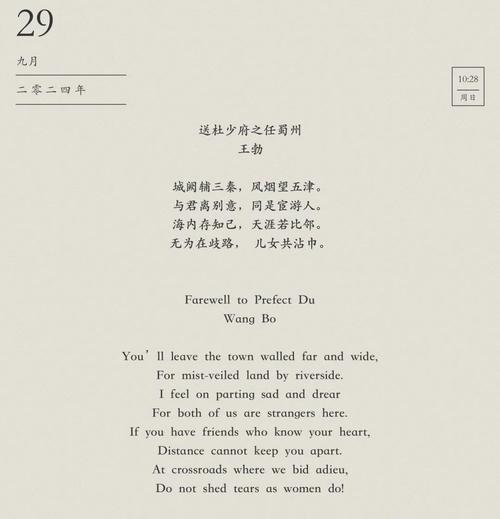 (图片来源网络,侵删)
 -
English Translation (by Witter Bynner):
Before my bed a pool of light, Can it be hoarfrost on the ground? Looking up, I find the moon bright; Bowing, in homesickness I'm drowned.
-
Appreciation:
- Universal Emotion: A perfect example of expressing profound homesickness (sī gù xiāng) through simple, accessible imagery.
- The Power of the Moon: The moon is a central symbol in Chinese poetry, representing purity, reunion, and distant loved ones.
- Journey of the Gaze: The physical movement—from looking up at the moon to bowing one's head in thought—perfectly mirrors the poet's internal journey from observation to deep emotion.
Slide 6: Case Study 2 - Wang Wei's "Deer Park" (鹿柴)
(Background Image: A tranquil, misty forest scene with dappled sunlight.)
-
Title: Wang Wei - Deer Park (鹿柴)
-
Original Text (with Pinyin):
空山不见人 (Kōng shān bù jiàn rén) 但闻人语响 (Dàn wén rén yǔ xiǎng) 返景入深林 (Fǎn jǐng rù shēn lín) 复照青苔上 (Fù zhào qīng tái shàng)
-
English Translation (by Burton Watson):
The empty mountains see no one, Yet hear the sound of a voice. Sunlight re-enters the deep wood, And shines again on the green moss.
-
Appreciation:
- Painterly Poetry (Shishi Hua): This poem reads like a scene from a scroll painting. It captures a moment of perfect stillness and light.
- Zen Philosophy: The concept of "emptiness" (kong) is central. The mountain is "empty" of people, yet it is full of sound and life. It invites the reader to find peace and enlightenment in nature.
- Play of Light and Sound: The poem masterfully contrasts the visual (sunlight on moss) with the auditory (human voice in an empty mountain), creating a multi-sensory experience.
Slide 7: The Challenge & Beauty of Translation
(Background Image: A split image: on one side, Chinese calligraphy; on the other, the English alphabet.)
- Title: The Art of Loss and Gain
- Content:
- The Challenge:
- Tonal Language: The musicality of Mandarin tones is impossible to replicate.
- Conciseness: Classical Chinese packs dense meaning into 4-5 characters. English requires more words, diluting the impact.
- Cultural Context: Allusions and symbols (like the chrysanthemum or the qin zither) may not resonate with a Western audience.
- The Goal of a Good Translation:
- To capture the spirit and emotion of the original.
- To recreate a similar rhythmic and musical quality.
- To provide context through footnotes or brief explanations.
- It's a Re-creation, Not a Copy: A good translation is an interpretation, offering a new lens through which to appreciate the original's genius.
- The Challenge:
Slide 8: Why Appreciate Classical Chinese Poetry Today?
(Background Image: A modern person sitting in a park, looking at their phone, but with a classical poem superimposed.)
- Title: A Bridge to the Human Soul
- Content:
- Universal Themes: Love, loss, joy, sorrow, nature, and the passage of time are timeless.
- A Different Way of Seeing: It teaches us to slow down, observe our surroundings, and find beauty in simplicity.
- A Window to Chinese Culture: It offers profound insights into the values, aesthetics, and philosophical foundations of East Asia.
- Enduring Beauty: The power of great poetry lies in its ability to move us across centuries and cultures. As the poet Tu Fu wrote, "A good poem lasts a thousand years."
Slide 9: Conclusion
(Background Image: A serene landscape at sunset, symbolizing the timeless nature of the art.)
- Title: Thank You
- Summary:
- Classical Chinese poetry is a treasure trove of human expression.
- It combines masterful imagery, deep emotion, and philosophical insight.
- Through poets like Li Bai and Wang Wei, we can glimpse the soul of an ancient civilization.
- Its beauty and wisdom continue to inspire and resonate with us today.
- Final Thought: "To read a poem is to walk in the shoes of another soul, across a vast ocean of time." — Adapted from a famous saying.
Slide 10: Q&A
(Background Image: A simple, elegant background with the text "Questions?")
- Title: Questions & Discussion
- Contact: [Your Email/Name]
Tips for Delivery:
- Speak Passionately: Your own enthusiasm for the subject is contagious.
- Use Your Voice: Vary your tone and pace when reading the poems aloud. Let their rhythm come through.
- Pause for Effect: After showing a poem or a beautiful image, give the audience a moment to absorb it.
- Tell Stories: Brief anecdotes about the poets' lives (like Li Bai's love of wine or Du Fu's poverty) can make them more relatable.
- Encourage Interaction: Ask the audience what emotions a particular image or line evokes for them.