人教版七上英语教案如何高效设计?
校园之窗 2025年12月14日 12:32:47 99ANYc3cd6
人教版英语七年级上册教案整体框架
课程总体目标
-
知识与技能:
- 能听懂、会说、认读并拼写本册核心词汇(约700个单词和200个习惯用语/固定搭配)。
- 能听懂课堂指令、简短对话和简单语篇,获取关键信息。
- 能运用本册核心句型(如问候、介绍、询问物品、谈论喜好等)进行简单的口头交流。
- 能读懂简单的通知、书信、故事等语篇材料,理解其主要意思。
- 能根据图片或提示,写出简单的句子和短文,语法错误较少。
- 初步掌握26个字母的读音、笔顺和格式,并能熟练运用音标进行拼读。
-
过程与方法:
 (图片来源网络,侵删)
- 通过情景对话、小组合作、角色扮演、游戏等方式,激发学习兴趣,培养综合语言运用能力。
- 学会使用词典、网络等工具辅助学习。
- 培养自主学习和合作探究的学习习惯。
-
情感态度与价值观:
- 培养学习英语的积极态度和自信心,敢于开口说英语。
- 了解中西方文化差异,培养跨文化交际意识。
- 学会尊重他人,乐于与人合作,形成健康向上的品格。
教学重难点
-
重点:
- 核心词汇和句型的听、说、读、写。
- 一般现在时、名词单复数、人称代词、物主代词等基础语法。
- 运用所学知识进行简单的日常交际。
-
难点:
- 语音语调的准确模仿和运用。
- 名词复数的变化规则。
- 人称代词和物主代词的正确使用。
- 在真实情境中灵活运用所学语言知识。
教学方法
- 交际教学法: 创设真实或接近真实的交际情境,鼓励学生用英语交流。
- 任务型教学法: 设计具体任务,让学生在完成任务的过程中学习和使用语言。
- 情景教学法: 利用图片、实物、多媒体等手段创设生动形象的教学情景。
- 合作学习法: 组织小组活动,促进学生之间的互助与共同进步。
教学资源
- 教材(人教版Go for it! 七年级上册)
- 多媒体课件、录音机、磁带
- 单词卡片、图片、实物
- 黑板、白板、粉笔/白板笔
分单元教案示例
这里以 Unit 1 My name's Gina. 为例,提供一份详细的课时教案。
(图片来源网络,侵删)
Unit 1 My name's Gina.
单元主题: Making new friends (结交新朋友) 功能意念: Greeting and introducing (问候与介绍)
第一课时:Section A (1a-2c)
教学目标
-
知识与技能:
- 能听、说、读、写核心词汇:
name,is,am,are,hello,hi,good,morning,afternoon,evening,nice,to,meet,you,what,your,I'm,he,she,it,his,her。 - 能熟练运用句型:
What's your name?/My name's.../I'm...Nice to meet you./Nice to meet you, too.What's his/her name?/His/Her name is...
- 能听懂并理解关于姓名介绍的简短对话。
- 能听、说、读、写核心词汇:
-
过程与方法:
 (图片来源网络,侵删)
- 通过师生问答、两两对话、小组活动等形式,练习核心句型。
- 通过听录音、模仿跟读,培养正确的语音语调。
-
情感态度与价值观:
- 学会礼貌地问候和介绍他人,乐于结交新朋友。
- 在活动中体验用英语交流的乐趣和成就感。
教学重难点
- 重点:
- 掌握问候和自我介绍的核心句型。
- 区分
What's your name?和What's his/her name?的回答。
- 难点:
- 理解并正确使用
I'm = I am,What's = What is。 - 在实际交流中自然地运用所学句型。
- 理解并正确使用
教学准备
- 多媒体课件,包含图片、音频和视频。
- 单词卡片(
name,hello,nice等)。 - 一些名人或卡通人物的图片。
教学过程
| 环节 | 时间 | 与活动 | 设计意图 |
|---|---|---|---|
| Step 1: Warming-up & Lead-in | 5 mins | Greeting: Teacher greets the students with a smile and says "Hello!" or "Good morning, class!" Song: Play a simple English greeting song (e.g., "Hello, Hello") to create a relaxing atmosphere. Question: Ask students "What's this in English?" pointing to the door/window/blackboard to review simple words and get them ready for English. |
营造英语课堂氛围,激发学生兴趣,自然导入新课。 |
| Step 2: Presentation | 15 mins | Introduce myself: Write "My name's [Teacher's Name]." on the blackboard. Point to myself and say it slowly and clearly. Ask students "What's my name?" and guide them to answer. Dialogue 1 (Self-introduction): - T: (To a student) Hello! What's your name? - S1: My name's... / I'm... - T: Nice to meet you. - S1: Nice to meet you, too. Repeat this with several students. Write the key sentences on the board. **Dialogue 2 (Introducing others): - T: (Point to two students, A and B) Look, this is A. This is B. What's his name? (Ask the class, pointing to A) - Ss: His name's A. - T: What's her name? (Pointing to B) - Ss: Her name's B. Explain his and her with pictures or by gesturing. |
通过师生互动和情景创设,直观呈现核心句型,让学生在语境中理解语言的意义和用法。 |
| Step 3: Practice | 10 mins | Listen and repeat (1b): Play the recording for 1b. Students listen and repeat after the tape. Pay attention to the pronunciation and intonation. Pair work (1c): Ask students to work in pairs. One student acts as Tom, the other as Tina. Practice the dialogue in 1c. Then ask several pairs to act it out. Game: "Find your partner": Give each student a card with a famous name (e.g., Tom Cruise, Messi). Students walk around and ask "What's your name?" When they find the person with the matching card, they say "Nice to meet you!" and sit down together. |
通过机械操练和意义操练,巩固所学句型,游戏化设计能增加趣味性,让学生在“玩中学”。 |
| Step 4: Listening (2a-2b) | 8 mins | Pre-listening: Look at the pictures in 2a. Ask "Who are they? What are they talking about?" to predict the content. While-listening: - Play the recording for 2a. Ask students to listen and circle the names they hear. - Play the recording again for 2b. Ask students to listen and fill in the blanks. Check answers: Play the recording one last time for students to check their answers. |
培养学生通过听力获取关键信息的能力,并为引入第三人称单数做铺垫。 |
| Step 5: Production & Summary | 7 mins | Group work: In groups of 4, students take turns to introduce themselves and one other member of their group. (e.g., "This is Lily. Her name's Lily.") Summary: Ask students: "What have we learned today?" Guide them to summarize the key sentences. Teacher writes a summary on the board. Homework: - Listen and read the dialogues in Section A. - Introduce yourself and your family member (e.g., father, mother) to your parents in English. |
将所学知识应用于产出性活动,检验学习效果,家庭作业联系生活,鼓励学生在真实场景中使用英语。 |
板书设计
                      Unit 1 My name's Gina.
-----------------------------------------------------------------
Greeting & Introduction (问候与介绍)
Key Sentences (核心句型):
1.  A: Hello! / Good morning!
    B: Hello! / Good morning!
2.  A: What's your name?
    B: My name's... / I'm...
3.  A: Nice to meet you.
    B: Nice to meet you, too.
4.  A: What's his name?
    B: His name is...
    A: What's her name?
    B: Her name is...
其他单元教学要点提示
-
Unit 2 This is my sister.
- 核心:
This is... / These are...(单复数),That is... / Those are...,he/she/it,they,who,have/has。 - 活动: "Family Tree" 制作游戏,展示并介绍家人照片,听力练习中区分
this/that和these/those。
- 核心:
-
Unit 3 Is this your pencil?
- 核心: 一般疑问句
Is this/that...? / Are these/those...?, 肯定/否定回答Yes, it is. / No, it isn't.。 - 活动: "Lost and Found" (失物招领) 角色扮演,学生描述自己丢失的物品或询问拾到的物品。
- 核心: 一般疑问句
-
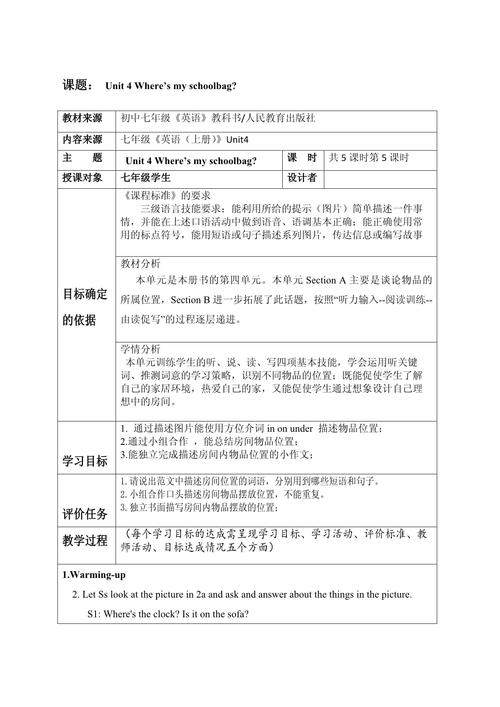
Unit 4 Where's my schoolbag?
- 核心:
Where引导的特殊疑问句,方位介词in, on, under, behind。 - 活动: "Hide and Seek" (寻宝游戏),教师藏起一个物品,用 "Where's...?" 提问,学生用方位介词回答。
- 核心:
-
Unit 5 Do you have a soccer ball?
- 核心:
Do/Does引导的一般疑问句和回答,have的用法,谈论拥有的物品和喜好。 - 活动: "Survey" (调查活动),学生采访组内成员 "Do you have a...?",并做统计报告。
- 核心:
-
Unit 6 Do you like bananas?
- 核心:
like的用法,可数名词和不可数名词,谈论食物喜好。 - 活动: "Make a Menu" (制作菜单),小组合作设计一份健康的午餐或晚餐菜单,并用 "I like... / I don't like..." 介绍。
- 核心:
-
Unit 7 How much are these socks?
- 核心:
How much和How many的区别,询问价格和数量,数字的复习和拓展。 - 活动: "Supermarket Role-play" (超市角色扮演),部分学生扮演店员,部分扮演顾客,进行购物对话。
- 核心:
-
Unit 8 When is your birthday?
- 核心:
When引导的特殊疑问句,谈论日期、月份和序数词。 - 活动: "Class Birthday Calendar" (班级生日日历),制作班级生日表,互相询问生日。
- 核心:
-
Unit 9 My favorite subject is science.
- 核心:
Why和because的用法,谈论喜爱的科目及原因。 - 活动: "A Perfect Week" (完美的一周),学生设计自己理想的一周课程表,并说明理由。
- 核心:
希望这份详细的教案框架和示例能对您的教学有所帮助!祝您教学顺利!