九年级上册英语外研版翻译怎么学?
校园之窗 2025年12月14日 12:34:15 99ANYc3cd6
九年级上册英语外研版(通常指“外研版新标准英语”)的翻译工作,通常包括以下几个核心部分:
- 课文 翻译:这是最重要的部分,需要准确理解并翻译出每个单元的对话、短文和故事。
- 词汇表 翻译:掌握每个单词的中文意思,是学习的基础。
- 模块/单元重点句型/语法 翻译:翻译关键的句型和语法点,帮助你理解其用法。
由于篇幅较长,我无法一次性提供整本书的翻译,我可以为你提供一个详细的翻译框架、核心词汇、以及几个典型模块的完整翻译示例,你可以按照这个模式来学习和翻译其他模块。
整体结构与翻译要点
外研版九年级上册通常有 10个模块 (Modules),每个模块包含 2个单元 (Units)。
- Module 1: How to learn English (如何学习英语)
- Module 2: Public holidays (公共假日)
- Module 3: Heroes (英雄)
- Module 4: Social communication (社会交往)
- Module 5: Museums (博物馆)
- Module 6: Problems (问题)
- Module 7: School clubs (学校社团)
- Module 8: Sports life (运动生活)
- Module 9: Great inventions (伟大的发明)
- Module 10: Fitness (健身)
翻译要点:
- 语境第一:不要孤立地翻译单词,要根据上下文理解其含义。
advice是不可数名词,a piece of advice(一条建议) 才是正确的表达。 - 文化差异:注意中西方文化差异,特别是关于节日、习俗的表达。
Christmas(圣诞节) 和Spring Festival(春节) 的庆祝方式完全不同。 - 语法结构:翻译时要体现英语的语法特点,如时态、语态、从句等。
It's + adj. + for sb. to do sth.这个句型要翻译为“对某人来说做某事是……”。 - 固定搭配:牢记动词短语、介词短语等固定搭配,它们往往是翻译的难点和重点。
look up to(钦佩),give up(放弃)。
核心词汇示例 (Module 1)
以下是 Module 1: How to learn English 的部分核心词汇及其翻译,你可以参考这个格式整理其他模块的词汇。
| English Word | Chinese Translation | Example Sentence (英文) | Example Sentence (中文翻译) |
|---|---|---|---|
| pronunciation | 发音 | My pronunciation is not very good. | 我的发音不太好。 |
| vocabulary | 词汇量 | I need to learn more vocabulary. | 我需要扩大词汇量。 |
| grammar | 语法 | Grammar is sometimes difficult. | 语法有时很难。 |
| mistake | 错误 | Don't be afraid of making mistakes. | 不要害怕犯错误。 |
| correct | 正确的;改正 | Could you correct my homework? | 你能帮我改一下作业吗? |
| advice | 建议 | Let me give you some advice. | 让我给你一些建议。 |
| practice | 练习 | You need more practice. | 你需要多加练习。 |
| improve | 提高 | I want to improve my English. | 我想提高我的英语。 |
| forget | 忘记 | Don't forget to review your lessons. | 不要忘记复习功课。 |
| understand | 理解 | I can understand this word. | 我能理解这个单词。 |
典型模块完整翻译示例 (Module 1)
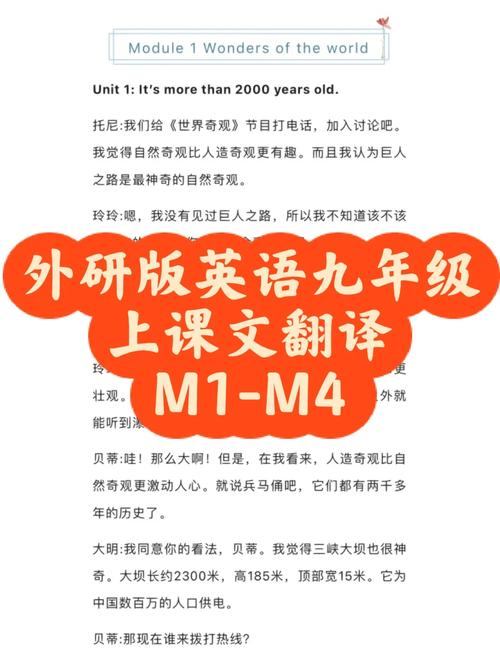
下面我为你提供 Module 1 的完整翻译,包括 Unit 1 和 Unit 2 的课文、重点句型和部分练习,你可以以此为范例。
Module 1: How to learn English
如何学习英语
Unit 1: Try not to translate every word.
第一单元:尽量不要翻译每一个单词。
Reading and Vocabulary (阅读与词汇)
Activity 1: Listen and read. (活动1:听并阅读。)
-
Dialogue (对话):
- Lingling: I'm having trouble learning English. What do you suggest?
- 玲玲:我在学英语时遇到了困难,你有什么建议吗?
- Ms James: Well, don't worry. First, you should try to read English every day.
- 詹姆斯老师:嗯,别担心,你应该试着每天读英语。
- Lingling: What about new words? I always forget them quickly.
- 玲玲:那新单词呢?我总是很快就忘了。
- Ms James: You can write new words in your notebook and try to use them.
- 詹姆斯老师:你可以把新单词写在笔记本上,并试着使用它们。
- Lingling: OK. And what about listening?
- 玲玲:好的,那听力呢?
- Ms James: You should listen to English songs or watch English films.
- 詹姆斯老师:你应该听英文歌或者看英文电影。
- Lingling: That's a good idea. I'll try it.
- 玲玲:好主意,我会试试的。
- Ms James: And remember, try not to translate every word. Just try to understand the main idea.
- 詹姆斯老师:并且记住,尽量不要翻译每一个单词,试着去理解大意就可以了。
- Lingling: I'm having trouble learning English. What do you suggest?
-
Vocabulary (词汇):
- trouble n. 困难,麻烦
- suggest v. 建议
- worry v. 担心,担忧
- pronunciation n. 发音
- mistake n. 错误
- advice n. 建议 (不可数名词)
- correct v. 改正,纠正
Activity 3: Complete the sentences with the correct form of the words from the box. (活动3:用方框中单词的正确形式完成句子。)
- Words:
correct, mistake, advice, suggest, worry, pronunciation - Translation (翻译):
- My English ____ is not very good.
- 我的英语____不太好。
- Answer: pronunciation
- Can you ____ me some good ways to learn English?
- 你能给我____一些学英语的好方法吗?
- Answer: suggest
- Don't ____ about the exam. Just relax.
- 不要____考试了,放松点。
- Answer: worry
- Please ____ my homework.
- 请____我的作业。
- Answer: correct
- I made a ____ in my sentence.
- 我的句子中出了一个____。
- Answer: mistake
- Let me give you some ____.
- 让我给你一些建议。
- Answer: advice
- My English ____ is not very good.
Unit 2: Please help me!
第二单元:请帮帮我!
Reading and Writing (阅读与写作)
Activity 1: Read the letter and answer the questions. (活动1:阅读信件并回答问题。)
-
Letter (信件):
- Dear Ms James,
- 亲爱的詹姆斯老师:
- I'm writing to ask for some advice. I love English, but I find it difficult. My biggest problem is my listening. I can't understand the teacher in class. I always feel nervous when she asks me questions.
我写信是想寻求一些建议,我喜欢英语,但我发现它很难,我最大的问题是听力,我听不懂课上的老师,当她问我问题时,我总是感到紧张。
- Also, I'm afraid of speaking English. I'm afraid of making mistakes. What should I do?
我害怕说英语,我害怕犯错误,我该怎么办呢?
- Best wishes,
- Wang Tao
- 诚挚的祝愿,
- 王涛
- Dear Ms James,
-
Questions and Answers (问题与答案):
- Who is the letter from?
- 这封信是谁写的?
- Answer: It's from Wang Tao.
- (答案:) 来自王涛。
- What is Wang Tao's biggest problem?
- 王涛最大的问题是什么?
- Answer: His biggest problem is his listening.
- (答案:) 他最大的问题是听力。
- Why is he afraid of speaking English?
- 他为什么害怕说英语?
- Answer: Because he's afraid of making mistakes.
- (答案:) 因为他害怕犯错误。
- Who is the letter from?
Activity 3: Write a reply to Wang Tao. (活动3:给王涛写一封回信。)
- Suggested Reply (建议回复):
- Dear Wang Tao,
- 亲爱的王涛:
- Thank you for your letter. Don't worry. Many students have the same problems. Here is some advice.
收到你的来信,谢谢,别担心,很多学生都有同样的问题,这里有一些建议。
- For listening, you should listen to more English every day. You can listen to the radio or watch TV in English. Don't try to understand every word. Just listen for the main ideas.
关于听力,你应该每天多听英语,你可以听广播或看英文电视,不要试图听懂每一个单词,只要听懂大意就可以了。
- For speaking, you must be brave. Don't be afraid of making mistakes. The more you speak, the fewer mistakes you will make. Try to talk with your classmates or friends in English.
关于口语,你必须勇敢,不要害怕犯错误,你说得越多,犯的错误就越少,试着和你的同学或朋友用英语交谈。
- I hope this advice is helpful. Good luck!
希望这些建议对你有帮助,祝你好运!
- Best wishes,
- Ms James
- 诚挚的祝愿,
- 詹姆斯老师
- Dear Wang Tao,
如何自学翻译
- 先自己尝试:拿到一篇课文或对话,先自己通读一遍,尝试理解大意,然后逐句翻译,遇到不懂的单词和句子,先做标记。
- 对照答案:对照参考译文或老师的讲解,检查自己的翻译。
- 分析差异:重点对比自己翻译不准的地方,思考为什么参考译文那么翻译,是因为词汇量不够?还是语法结构没理解?或者是文化背景知识欠缺?
- 整理笔记:将好的翻译、地道的表达、重点的短语和句型整理到笔记本上,时常复习。
- 勤于练习:多做翻译练习,可以是课后练习,也可以是额外的阅读材料,翻译能力是在实践中提高的。
希望这份详细的指南和示例能帮助你更好地学习九年级上册的英语!如果你需要其他特定模块或单元的翻译,可以随时告诉我。