七年级英语知识点有哪些核心要点?
校园之窗 2025年12月13日 21:59:41 99ANYc3cd6
七年级英语核心知识点归纳总结
七年级是英语学习打基础的关键时期,主要目标是掌握基本词汇、核心句型、基础语法,并培养初步的听说读写能力。
第一部分:核心词汇
词汇是语言的基础,需要分模块记忆和运用。
人称代词和物主代词
| 类型 | 单数 | 复数 |
|---|---|---|
| 主格 (作主语) | I (我), you (你/您), he (他), she (她), it (它) | we (我们), you (你们/您们), they (他们/她们/它们) |
| 宾格 (作宾语) | me (我), you (你/您), him (他), her (她), it (它) | us (我们), you (你们/您们), them (他们/她们/它们) |
| 形容词性物主代词 (后接名词) | my (我的), your (你的/您的), his (他的), her (她的), its (它的) | our (我们的), your (你们的/您的), their (他们的/她们的/它们的) |
| 名词性物主代词 (相当于名词) | mine (我的), yours (你的/您的), his (他的), hers (她的), its (它的) | ours (我们的), yours (你们的/您的), theirs (他们的/她们的/它们的) |
口诀:“主宾形名,各有其用,形名同根,形后有名,名后无名。”
核心名词分类
- 人物称呼: family, friend, boy, girl, teacher, student, parent, brother, sister...
- 数字: one, two, three... twelve, thirteen... nineteen, twenty, thirty...
- 星期/月份: Monday, Tuesday... Sunday; January, February... December
- 颜色: red, yellow, blue, green, black, white, purple, orange...
- 食物/水果: apple, banana, orange, egg, rice, chicken, hamburger, bread...
- 学校物品: book, pen, ruler, eraser, notebook, schoolbag, pencil, desk...
- 地点方位: home, school, library, supermarket, park, zoo, room, desk, bed...
- 动物: cat, dog, pig, duck, bird, panda, tiger, lion, elephant...
- 天气: weather, sunny, cloudy, rainy, windy, snowy
核心动词
- be动词: am, is, are (现在时);was, were (过去时)
- 实义动词:
- 系动词: look (看起来), sound (听起来), feel (感觉), become (变得)
- 行为动词: have (有), like (喜欢), go (去), come (来), get (得到), eat (吃), play (玩/打), see (看见), watch (观看), read (读), sing (唱), dance (跳舞), swim (游泳), run (跑), draw (画), help (帮助), love (爱), want (想要)
核心形容词
- 描述外貌: tall (高的), short (矮的), long (长的), big (大的), small (小的), young (年轻的), old (老的)
- 描述性格/心情: good (好的), great (很棒的), OK (好的), happy (开心的), sad (伤心的), tired (累的), busy (忙碌的), funny (滑稽的)
- 描述物品: new (新的), old (旧的), cheap (便宜的), expensive (昂贵的), beautiful (漂亮的), nice (美好的), cool (酷的)
第二部分:核心句型
句型是表达思想的基本框架。
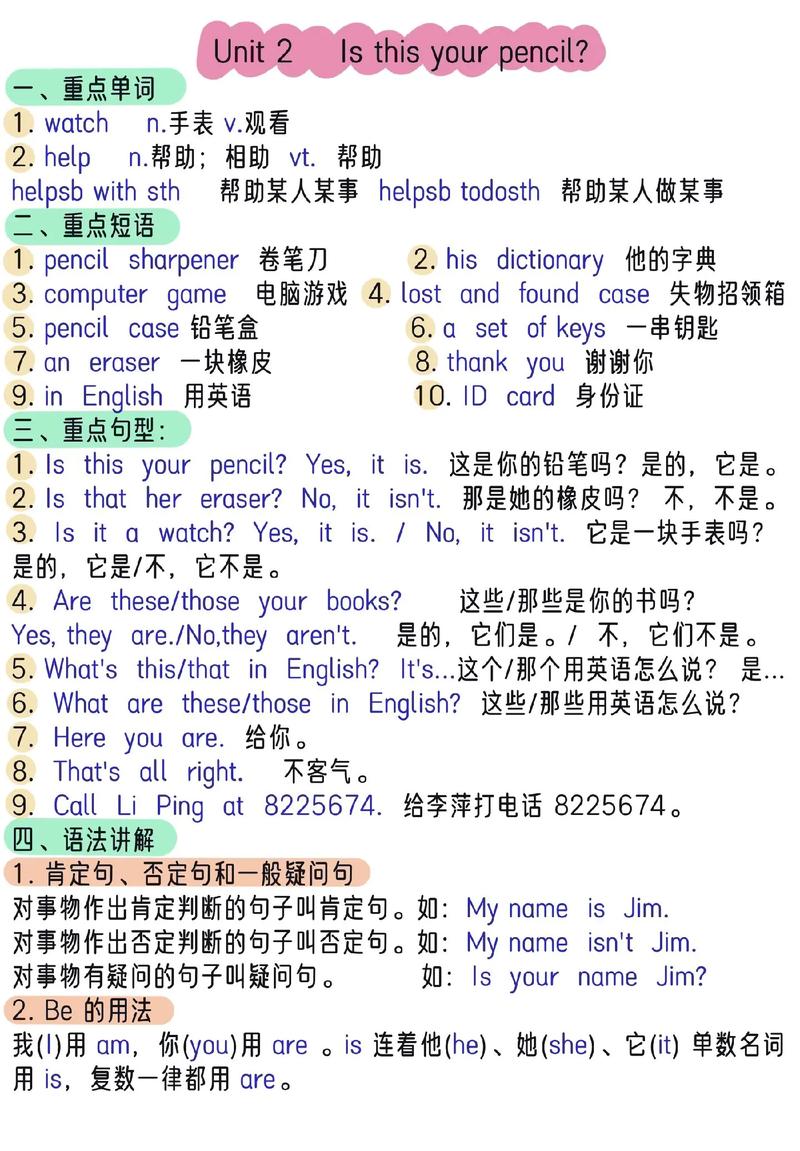
Be 动词句型
这是七年级最核心、最基础的句型。
-
肯定句: 主语 + am/is/are + ...
 (图片来源网络,侵删)
- I am a student. (我是一个学生。)
- He is my friend. (他是我的朋友。)
- They are from China. (他们来自中国。)
-
否定句: 主语 + am/is/are + not + ...
- I am not a teacher. (我不是老师。)
- It is not cold today. (今天不冷。)
-
一般疑问句: Am/Is/Are + 主语 + ...?
- Are you Tom? - Yes, I am. / No, I'm not.
- Is she your sister? - Yes, she is. / No, she isn't.
-
特殊疑问句: 疑问词 + am/is/are + 主语 + ...?
- What's your name? - My name is Gina.
- How old are you? - I'm twelve.
- Where is the book? - It's on the desk.
- What color is it? - It's red.
- Who is he? - He is my brother.
实义动词句型 (主谓宾结构)
当句子的主要动词不是 be 动词时(如 have, like, play 等),使用此结构。
-
肯定句: 主语 + 动词原形 + (宾语) + ...
- I like apples. (我喜欢苹果。)
- She plays basketball every day. (她每天都打篮球。)
-
否定句: 主语 + don't/doesn't + 动词原形 + (宾语) + ...
- I don't like math. (我不喜欢数学。)
- He doesn't have a brother. (他没有兄弟。)
-
一般疑问句: Do/Does + 主语 + 动词原形 + (宾语) + ...?
- Do you like bananas? - Yes, I do. / No, I don't.
- Does she have a dictionary? - Yes, she does. / No, she doesn't.
-
特殊疑问句: 疑问词 + do/does + 主语 + 动词原形 + ...?
- What do you want? - I want a pen.
- Where does he live? - He lives in Beijing.
- Why do you like him? - Because he is funny.
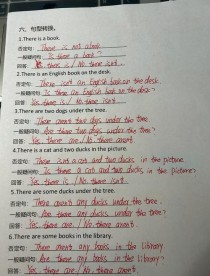
There be 句型
表示“某地存在某物”。
-
肯定句: There is/are + ...
- There is a book on the desk. (桌上有一本书。)
- There are some birds in the tree. (树上有一些鸟。)
-
否定句: There isn't/aren't + ...
- There isn't a cat here. (这里没有猫。)
- There aren't any students in the room. (房间里没有学生。)
-
一般疑问句: Is/Are there + ...?
- Is there a pen in your pencil box? - Yes, there is. / No, there isn't.
- Are there any computers in the library? - Yes, there are. / No, there aren't.
-
特殊疑问句: How many + 复数名词 + are there + ...? (询问数量)
- How many students are there in your class? - There are forty.
第三部分:核心语法
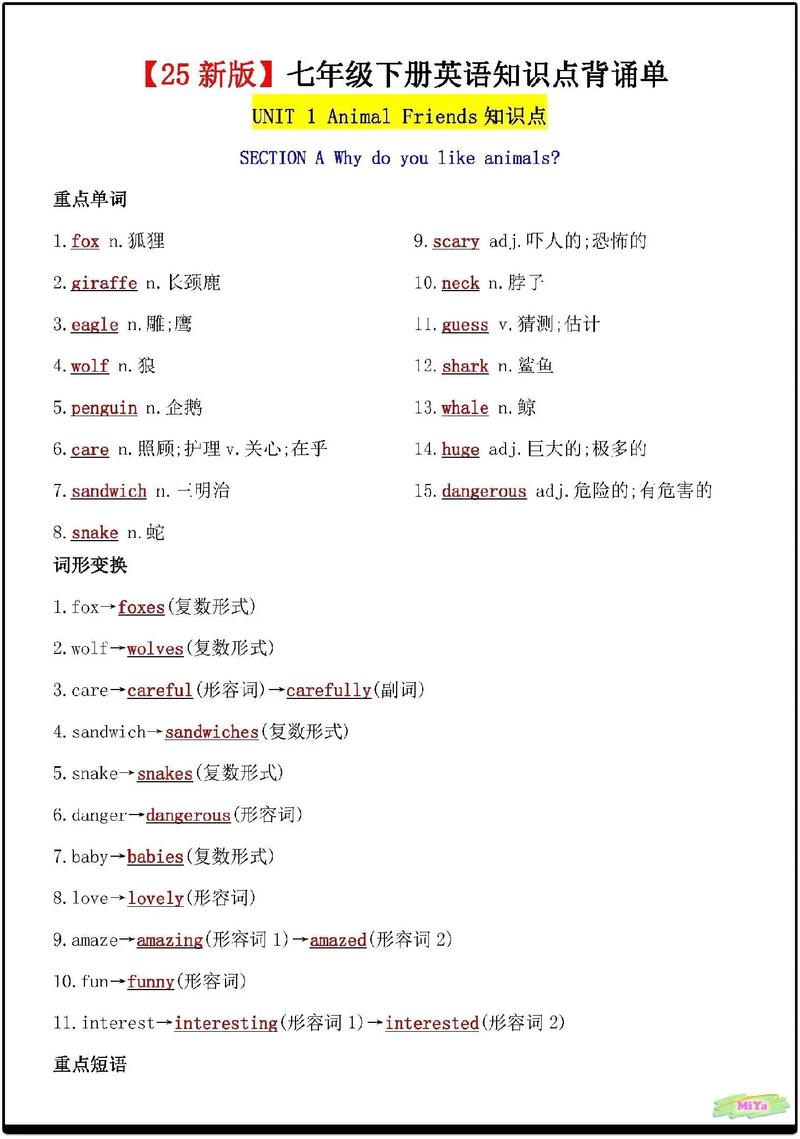
名词
-
可数名词与不可数名词
- 可数名词: 有单复数之分,复数形式通常在词尾加 -s 或 -es。
apple -> apples, book -> books, bus -> buses
- 不可数名词: 没有复数形式,不能直接用 a/an 修饰,不能加 s。
water (水), milk (牛奶), rice (米饭), bread (面包), meat (肉)
- 如何修饰不可数名词: 用 "some", "much", "a lot of", "a bottle of/a cup of" 等。
some water, much money, a cup of tea
- 可数名词: 有单复数之分,复数形式通常在词尾加 -s 或 -es。
-
名词所有格
- 表示“...的”,一般在名词后加 's。
Tom's book (汤姆的书), my mother's car (我妈妈的车)
- 如果是以 s 结尾的复数名词,只在词尾加 '。
the teachers' office (老师们的办公室), the students' books (学生们的书)
- 表示“...的”,一般在名词后加 's。
代词
- 人称代词: 见核心词汇部分。
- 物主代词: 见核心词汇部分。
- 指示代词: this (这个), that (那个), these (这些), those (那些)
- this -> these (单数变复数)
- that -> those (单数变复数)
- 疑问代词: what (什么), who (谁), where (哪里), why (为什么), how (怎样)
冠词
- a/an: 用于单数可数名词前,表示“一个”。
- a 用于以辅音音素开头的词前:a book, a pen, a university (ju:nɪ'vɜ:səti - 以辅音/j/开头)
- an 用于以元音音素开头的词前:an apple, an egg, an hour (aʊər - 以元音音素/aʊ/开头)
- the: 定冠词,特指某个或某些事物,表示双方都知道的人或物。
- The book on the desk is mine. (桌上的那本书是我的。)
- I like the red apple. (我喜欢那个红色的苹果。)
数词
- 基数词: one, two, three... twenty, thirty... hundred (百), thousand (千)
- 21-99: 二十-one (twenty-one), 三十五 (thirty-five)
- 101-999: 一百零一 (one hundred and one), 三百四十五 (three hundred and forty-five)
- 序数词: 表示顺序,通常在基数词后加 -th。
- one -> first (1st), two -> second (2nd), three -> third (3rd)
- four -> fourth (4th), five -> fifth (5th), eight -> eighth (8th)
- twenty -> twentieth (20th), twenty-one -> twenty-first (21st)
介词
表示词与词之间的关系。
- 表示地点: in (在...里面), on (在...上面), at (在...某点), under (在...下面), near (在...附近), behind (在...后面), next to (紧挨着)
- 表示时间: in (在...月/年), on (在...日/星期几), at (在...点钟)
in May, in 2025, on Monday, on May 1st, at 8 o'clock
- 表示方向: to (到...), from (从...), for (为了...)
情态动词 Can
- 用法: 表示能力“能,会”或请求许可“可以”。
- 句型结构: 主语 + can + 动词原形 + ...
- 否定句: 主语 + can't/cannot + 动词原形 + ...
- 一般疑问句: Can + 主语 + 动词原形 + ...?
- I can swim. (我会游泳。)
- She can't speak English. (她不会说英语。)
- Can you help me? - Yes, I can. / No, I can't.
第四部分:时态
七年级主要掌握两种基本时态。
一般现在时
- 用法:
- 描述经常性、习惯性的动作或状态。
- 描述客观事实或真理。
- 结构:
- Be 动词: 主语 + am/is/are + ...
- 实义动词:
- 主语 (I/We/You/They) + 动词原形 + ...
- 主语 (He/She/It) + 动词原形 + s/es + ...
- 特殊疑问句: 疑问词 + do/does + 主语 + 动词原形 + ...?
现在进行时
- 用法: 表示说话时正在发生的动作或当前一段时间内的活动。
- 结构: 主语 + am/is/are + 动词的-ing形式 + ...
- 动词-ing构成规则:
- 一般情况直接加 -ing: do -> doing, read -> reading
- 以不发音的 e 去 e 加 -ing: write -> writing, make -> making
- 重读闭音节,末尾只有一个辅音字母,双写该字母再加 -ing: run -> running, swim -> swimming, sit -> sitting
- 句型:
- 肯定句: I am reading a book. (我正在看书。)
- 否定句: He is not/isn't playing basketball. (他没在打篮球。)
- 疑问句: Are they having lunch? - Yes, they are. / No, they aren't.
第五部分:话题模块
七年级英语围绕不同话题展开学习,将知识点融入实际语境。
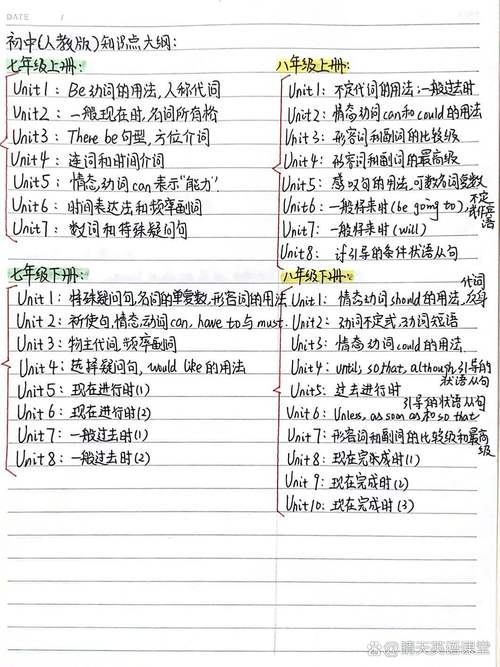
- Unit 1-3: Personal Information (个人信息)
- 问候与介绍: Hello! / What's your name? / I'm... / Nice to meet you.
- 询问电话号码/身份证号: What's your phone number? / It's...
- Unit 4-6: Family and Friends (家人和朋友)
- 介绍家人: This is my sister. / She is my mother.
- 描述人物外貌: He is tall and thin. / She has long hair.
- Unit 7-9: Things and Places (物品与地点)
- 询问物品位置: Where is my backpack? - It's in the desk.
- 询问价格: How much is this T-shirt? - It's 7 dollars.
- 谈论食物: Do you like bananas? - Yes, I do. / No, I don't.
- Unit 10-12: Daily Life and Activities (日常生活与活动)
- 谈论日常活动: I get up at 6:30. / He plays sports in the afternoon.
- 描述能力: Can you swim? - Yes, I can. / No, I can't.
- 谈论天气: How's the weather? - It's sunny.
学习建议
- 词汇为王,每日坚持: 利用单词卡、App等工具,每天坚持背诵和复习新单词。
- 句型为纲,灵活套用: 牢记核心句型,尝试用不同的单词去替换,进行造句练习。
- 语法为基,理解为主: 不要死记硬背语法规则,要通过例句去理解其用法和语境。
- 听说领先,读写跟上: 多听英文歌、看简单的英文动画,模仿语音语调,多读课本和简单的英文读物,尝试用英语写日记或小短文。
- 整理错题,查漏补缺: 准备一个错题本,记录做错的题目,分析原因,定期回顾。
希望这份总结能帮助你系统地梳理七年级英语知识,祝你学习进步!