九年级英语知识点有哪些重点难点?
校园之窗 2025年12月9日 14:25:20 99ANYc3cd6
人教版九年级英语知识点总览
九年级英语的核心在于综合运用,它不仅要求掌握新的语法和词汇,更重要的是将整个初中阶段的知识融会贯通,能够进行复杂的阅读、写作和口语交际。
我们将总结分为以下几个部分:

- 核心语法
- 重点词汇与短语
- 功能意念项目 (常考话题)
- 各单元核心知识点
- 备考建议
第一部分:核心语法 (重中之重)
九年级的语法是初中语法的拔高和总结,是中考的绝对核心。
宾语从句
在句子中作宾语的句子。
- 引导词:
- that: 无实际意义,可省略 (I think that he is right.)
- if/whether: “是否”,不能省略 (I wonder if/whether he will come.)
- 特殊疑问词 (what, who, which, when, where, why, how): 意义为它本身,语序用陈述句语序 (Can you tell me where he is? 错误:where is he)
- 语序: 永远是陈述句语序。
- 时态:
- 主句是现在时/将来时,从句可用任何时态。
- 主句是过去时,从句要用过去的某种时态 (一般过去时、过去进行时、过去将来时、过去完成时)。
- 客观真理用一般现在时,不受主句时态影响。 (The teacher told us that the earth moves around the sun.)
状语从句
在句子中作状语,修饰主句的动词、形容词或副词。
- 时间状语从句: when (当...时), while (在...期间), as (一边...一边...), before (在...之前), after (在...之后), since (自从...), until/till (直到...), as soon as (一...就...)
- 时态: 当主句用将来时,从句通常用一般现在时表示将来。 (I'll call you as soon as I arrive.)
- 条件状语从句: if (, unless (除非)
- 时态: 同上,主句将来,从句现在。 (If it rains tomorrow, we will cancel the picnic.)
- 原因状语从句: because (因为), since (既然, 因为), as (因为)
- because: 语气最强,回答 why 的提问。
- since/as: 语气较弱,表示对方已知的事实或理由。
- 目的状语从句: so that (以便), in order that (为了)
- 结果状语从句: ...so + 形容词/副词 + that... (..以至于...), ...such + (a/an) + 形容词 + 名词 + that... (..的一个...以至于...)
- He is so young that he can't go to school. (他太小了,不能去上学。)
- He is such a young boy that he can't go to school. (他是如此小的一个男孩,以至于不能去上学。)
- 让步状语从句: although/though (虽然, 尽管), even though/even if (即使), whether...or... (无论...还是...)
- 注意: 不能与
but连用。 (错:Although he is tired, but he works hard. 对:Although he is tired, he works hard. / He is tired, but he works hard.)
- 注意: 不能与
情态动词
- can/could: 能力,许可,可能性
- may/might: 可能,许可 (可能性比 could 小)
- must: 必须,一定 (表示推测时,用于肯定句)
- have to: 不得不 (强调客观需要)
- should/ought to: 应该
- will/would: 意愿,请求 (would 更委婉)
- need: 需要 (作情态动词时,多用于否定句和疑问句)
- dare: 敢 (同上)
- 情态动词 + have done (对过去的推测):
- must have done: 肯定做过某事 (You're wet. You must have been caught in the rain.)
- can't/couldn't have done: 肯定没做过某事 (He can't have finished the work so soon.)
- may/might have done: 可能做过某事 (She may have missed the bus.)
- should/ought to have done: 本应该做某事 (但没做) (You should have told me earlier.)
- needn't have done: 本没必要做某事 (但做了) (You needn't have bought so much food.)
被动语态
强调动作的承受者。

- 基本结构:
be + 动词的过去分词 - 时态变化:
- 一般现在时: am/is/are + done
- 一般过去时: was/were + done
- 一般将来时: will be done / am/is/are going to be done
- 现在进行时: am/is/are being done
- 过去进行时: was/were being done
- 现在完成时: have/has been done
- 过去完成时: had been done
- 特殊形式:
- 含情态动词的被动语态:
情态动词 + be + done(The work must be finished on time.) - 不定式的被动语态:
to be done(The problem to be solved is very difficult.)
- 含情态动词的被动语态:
非谓语动词
- 动词不定式:
- 作主语、宾语、表语、定语、状语、宾补。
- 常用结构:
want/decide/hope/plan + to do,find/think/feel it + adj. + to do,too...to...(太...而不能...),enough to...(足够...可以...)
- 动名词:
- 作主语、宾语、表语、定语。
- 常用结构:
enjoy/finish/mind/practice + doing,be used to doing(习惯于做某事)
- 现在分词:
- 作定语、表语、宾补、状语 (表示主动或进行)。
a sleeping baby,The story is interesting,I saw him crossing the street.
- 过去分词:
- 作定语、表语、宾补、状语 (表示被动或完成)。
a broken window,I am interested in the story,I had my hair cut yesterday.
过去完成时
表示“过去的过去”。
- 结构:
had + 动词过去分词 - 用法: 在一个过去的动作之前已经发生的动作。 (By the end of last year, we had learned five English songs.)
第二部分:重点词汇与短语
九年级的词汇量要求更高,且更注重短语的搭配和运用。
常用动词短语
- look up: 查阅
- look for: 寻找
- look after: 照顾
- look forward to: 期待
- give up: 放弃
- give away: 赠送,分发
- put off: 推迟
- put up: 搭建,张贴
- turn on/off: 开/关
- turn down: 调低音量,拒绝
- pick up: 捡起,用车接人
- take off: 脱下,起飞
- put on: 穿上,上演
- deal with: 处理,应对
- run out of: 用完
- depend on: 依赖,取决于
- agree with: 同意某人/某话
- agree to: 同意某个计划/建议
- pay for: 支付...的费用
- instead of: 代替,而不是
重要形容词与副词
- 表示“必须”的词: necessary, essential, important
- 表示“惊讶”的词: surprised, amazing, astonishing
- 表示“困惑”的词: confused, confusing
- 表示“有能力的”词: able, capable
- 表示“困难的”词: difficult, hard, tough
- 表示“可能的”词: possible, probable, likely
第三部分:功能意念项目 (常考话题)
中考口语和书面表达常围绕以下话题展开:
- 建议与请求: How about...? / Why not...? / Let's... / Could you...? / Would you mind...?
- 同意与不同意: I agree. / I can't agree more. / I don't think so. / That's a good idea.
- 喜好与厌恶: I like/enjoy... / I prefer... to... / I can't stand...
- 计划与意图: I'm going to... / I plan to... / I intend to...
- 邀请与应答: Would you like to...? / I'd love to. / I'm sorry, but...
- 感谢与道歉: Thank you. / I appreciate it. / I'm sorry. / Forgive me.
- 道歉与原谅: I'm sorry for... / It doesn't matter. / That's OK.
- 祝贺与祝愿: Congratulations! / Best wishes! / Good luck!
- 同意与许可: Sure. / Of course. / You'd better not. / No, you can't.
- 可能性与 certainty: Maybe / Perhaps / Probably / It's certain that...
第四部分:各单元核心知识点 (按教材顺序)
-
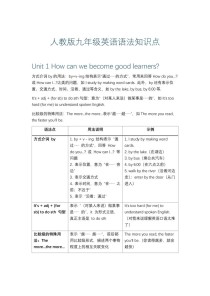
Unit 1 How can we become good learners?
 (图片来源网络,侵删)
- 话题: 学习方法
- 重点短语: by working with friends, by reading the textbook, ask the teacher for help, have conversations with, take notes, write down, look up, practice pronunciation, connect...with...
- 语法:
How和What引导的特殊疑问句 (How do you learn English? What about reading aloud to practice pronunciation?)
-
Unit 2 I think that mooncakes are delicious!
- 话题: 节日与习俗
- 重点短语: put on, end up, share sth. with sb., in the shape of, as a result, so...that...
- 语法: 宾语从句 (I believe that the Water Festival is really fun.)
-
Unit 3 Could you please tell me where the restrooms are?
- 话题: 问路与指路
- 重点短语: go along, turn left/right, on the left/right, next to, between...and..., excuse me, pardon me, could you please...?
- 语法: 宾语从句 (Could you please tell me where the restrooms are?) + 礼貌的问路方式
-
Unit 4 I used to be afraid of the dark.
- 话题: 过去与现在的对比
- 重点短语: used to do sth., be afraid of, be interested in, take up, deal with, be proud of, on the swim team
- 语法: used to do sth. (过去常常做某事) 和 be used to doing sth. (习惯于做某事) 的区别。
-
Unit 5 What are the shirts made of?
- 话题: 物品的制作材料与产地
- 重点短语: be made of (看得出原材料), be made from (看不出原材料), be made in (产地), be made by (制造者), environmental protection, even though, no matter
- 语法: 一般现在时的被动语态 (Where are these products made? / They are made in China.)
-
Unit 6 When was it invented?
- 话题: 发明与创造
- 重点短语: by accident, be invented by, be used for, without doubt, at that time, divide...into...
- 语法: 一般过去时的被动语态 (When was the telephone invented? / It was invented in 1876.)
-
Unit 7 Teenagers should be allowed to choose their own clothes.
- 话题: 规则与建议
- 重点短语: allow sb. to do sth., be strict with sb., get a driver's license, instead of, spend...on... / spend...(in) doing..., worry about
- 语法: 情态动词的被动语态 (Teenagers should be allowed to choose their own clothes.)
-
Unit 8 It must belong to Carla.
- 话题: 推测与可能性
- 重点短语: belong to, must be, could be, might be, can't be, hair band, pick up, in the neighborhood, as a matter of fact
- 语法: 情态动词表推测 (肯定用 must, 否定用 can't, 可能用 could/might)
-
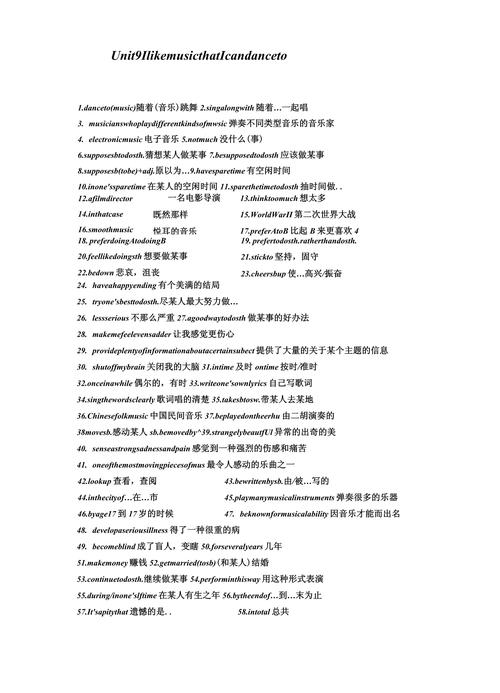
Unit 9 I like music that I can dance to.
- 话题: 喜好
- 重点短语: prefer...to... / prefer doing...to doing..., lyrics, gentle, remind sb. of sth., take it easy, feel down
- 语法: 定语从句 (关系代词 that, which, who) (I like music that I can dance to. / The movie which we saw yesterday was boring. / The man who is talking to my father is a doctor.)
-
Unit 10 You're supposed to shake hands.
- 话题: 文化习俗与礼仪
- 重点短语: be supposed to do sth., shake hands, kiss sb. on the cheek, drop by, for the first time, table manners, make noise
- 语法: be supposed to do sth. (应该做某事,表示义务或期望)
-
Unit 11 Sad movies make me cry.
- 话题: 情感与影响
- 重点短语: make sb. do sth. / make sb. adj., drive sb. crazy, be friends with, in fact, would rather...than..., not...at all
- 语法: make 的用法 (make sb. do sth. / make sb. adj. / make sth. done)
-
Unit 12 Life is full of the unexpected.
- 话题: 意外事件
- 重点短语: by the time, by the end of, give up, in time, on time, be full of, take place, get married
- 语法: 过去完成时 (By the time I got up, my brother had already gotten in the shower.)
-
Unit 13 We're trying to save the earth!
- 话题: 环境保护
- 重点短语: be full of, take away, throw away, put to use, turn off, pay for, recycle, reuse, pollution, environment, litter
- 语法: 现在进行时表将来 (The government is taking measures to solve the problem.)
-
Unit 14 I remember meeting all of you in Grade 7.
- 话题: 回忆与展望
- 重点短语: remember to do (记得要做某事) / remember doing (记得做过某事), look forward to, one another, the first time, make a difference, take pride in, graduate from
- 语法: 非谓语动词 (I remember meeting you for the first time.)
第五部分:备考建议
- 回归课本,夯实基础: 九年级的知识点都是基于七、八年级的,确保课本上的单词、短语和基本句型都掌握牢固。
- 专项突破,攻克语法: 针对宾语从句、状语从句、被动语态等核心语法,进行专项练习,理解其规则并能灵活运用。
- 整理错题,查漏补缺: 准备一个错题本,记录自己做错的题目,特别是语法题和完形填空,定期回顾,分析错误原因。
- 精读泛读,提升语感: 每天坚持阅读,可以是课本、简单的英文读物或中考真题阅读理解,这不仅能巩固词汇,还能培养语感和阅读速度。
- 勤于动笔,练习写作: 每周至少写一到两篇作文,可以围绕常考话题(环保、建议、计划等)进行练习,写完后可以请老师或同学批改,注意语法错误和逻辑连贯性。
- 模拟考试,适应节奏: 在中考前,进行几次完整的模拟考试,严格按照考试时间,熟悉考试流程和时间分配,锻炼应试心态。
希望这份总结能对你的九年级英语学习有所帮助!祝你学习进步,在中考中取得优异成绩!