八年级上册英语语法重点有哪些?
校园之窗 2026年1月14日 17:13:44 99ANYc3cd6
八年级上册核心语法点概览
- 一般将来时
- 形容词和副词的比较级与最高级
- 情态动词
- 动词不定式
- There be 句型的将来时
- 可数名词与不可数名词
- 过去进行时
- 反身代词
- 状语从句(if引导的条件状语从句)
语法点详解
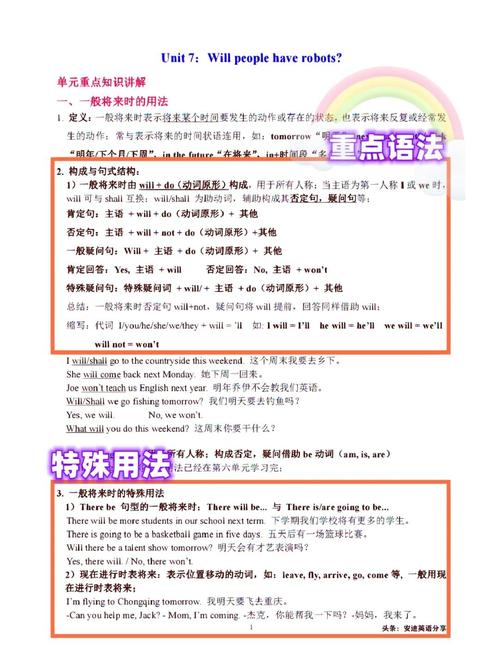
一般将来时
核心用法:表示将来某个时间要发生的动作或存在的状态。
构成方式: 主要有两种,在八年级上册都非常重要。
-
will + 动词原形- 特点:表示意愿、预测或临时决定。
- 例句:
- I will call you as soon as I arrive. (我一到就会给你打电话。)
- It will be sunny tomorrow. (明天会是晴天。)
- The phone is ringing. I will get it. (电话响了,我去接。)
-
be going to + 动词原形- 特点:表示计划好的、有准备的动作,或根据现有迹象做出的预测。
- 例句:
- We are going to watch a movie this weekend. (我们这周末打算去看电影。)
- Look at the dark clouds. It is going to rain. (看那些乌云,要下雨了。)
否定句和疑问句:
- 否定句:
will not = won't;be not going to - 疑问句:
Will + 主语 + ...?;Be (Am/Is/Are) + 主语 + going to + ...?
形容词和副词的比较级与最高级
这是八年级的绝对重点,用于两者或多者之间的比较。
规则变化:
| 类型 | 构成方法 | 原级 | 比较级 | 最高级 | 例句 |
|---|---|---|---|---|---|
| 单音节词和部分双音节词 | 一般直接加-er / -est | tall (高的) | taller | tallest | He is taller than his brother. (他比他哥哥高。) He is the tallest in his class. (他是班里最高的。) |
| 以不发音的e结尾 | nice (好的) | nicer | nicest | This story is nicer than that one. | |
| 以“辅音+y”结尾 | happy (快乐的) | happier | happiest | She is happier today. | |
| 以“重读闭音节”且末尾只有一个辅音字母 | big (大的) | bigger | biggest | The box is bigger than that one. | |
| 多音节词和部分双音节词 | 在词前加 more / most | beautiful (美丽的) | more beautiful | most beautiful | This city is more beautiful than that one. (这个城市比那个更美。) This is the most beautiful city I've ever seen. |
| 不规则变化 | 不规则变化 | good / well (好的) | better | best | This book is better than that one. (这本书比那本好。) He is the best student. |
| bad / badly (坏的) | worse | worst | His exam result is worse than mine. | ||
| many / much (许多) | more | most | I have more books than you. | ||
| far (远) | farther/further | farthest/furthest | Beijing is farther from here than Shanghai. |
句型结构:
- 比较级:
- A +
比较级+ than + B (A比B更...) - This apple is bigger than that one.
- A +
- 最高级:
- A +
the + 最高级+ (in/of...) (A是最...的) - Tom is the tallest (boy) in his class. (汤姆是他班里最高的男孩。)
- This is the most interesting book (of all). (这是所有书里最有趣的。)
- A +
情态动词
八年级主要学习 can, may, must, should, could, would。
| 情态动词 | 用法 | 否定形式 | 例句 |
|---|---|---|---|
| can / could | 能力 (can/could) 2. 请求许可 (could更委婉) 3. 可能性 (理论上的可能) |
can't / couldn't | I can swim. (我会游泳。) 2. Could I borrow your pen? (我能借下你的笔吗?) 3. It could be true. (这可能是真的。) |
| may / might | 请求许可 (may/might) 2. 可能性 (might可能性更小) |
may not / might not | May I come in? (我能进来吗?) 2. He may/might be at home now. (他现在可能在家。) |
| must | 必须义务 (主观) 2. 肯定的推测 (一定,肯定) |
mustn't (禁止,表示强烈的命令) | You must finish your homework. (你必须完成作业。) 2. He looks tired. He must be ill. (他看起来很累,肯定是病了。) |
| should / ought to | 应该 (表示建议或义务) 2. 推测 (有很大的可能性) |
shouldn't / oughtn't to | You should eat more vegetables. (你应该多吃蔬菜。) 2. The train should arrive on time. (火车应该会准时到达。) |
动词不定式
动词不定式是 to + 动词原形,在句子中可以充当多种成分。
-
作目的状语:表示“为了...”
- He came to see you. (他来看你了。)
- I study hard to get good grades. (我努力学习为了取得好成绩。)
-
作宾语:跟在某些动词后面,如
want,hope,decide,plan,would like等。- I want to buy a new phone. (我想买一部新手机。)
- She decided to learn the piano. (她决定学钢琴。)
-
作宾语补足语:跟在某些动词后面,补充说明宾语。
- The teacher asked us to keep quiet. (老师让我们保持安静。)
- Please tell him to come here. (请告诉他来这里。)
There be 句型的将来时
表示“将会有...”。
- 结构:
There will be + 名词 + (其他成分)或There is/are going to be + 名词 + (其他成分) - 注意:
be动词的单复数由它后面的名词决定。 - 例句:
- There will be a meeting tomorrow. (明天将会有一个会议。)
- There is going to be a basketball game this afternoon. (今天下午将有一场篮球赛。)
可数名词与不可数名词
-
可数名词:有单复数之分。
- 规则复数:加-s, -es, -ies, -ves 等。
- 不规则复数:man -> men, child -> children, foot -> feet 等。
-
不可数名词:通常没有复数形式,不能直接用
a/an或数词修饰。- 常见类别:液体、气体、物质、抽象概念、学科等。
- water (水), milk (牛奶), rice (米饭), bread (面包), tea (茶)
- air (空气), smoke (烟)
- money (钱), time (时间), advice (建议), information (信息)
- physics (物理), music (音乐)
- 常见类别:液体、气体、物质、抽象概念、学科等。
如何修饰不可数名词:
- 表示“多少”:用
much,a little,a lot of,some,any等。- I need a little sugar. (我需要一点糖。)
- There is much water in the bottle. (瓶子里有很多水。)
- 表示“几个”:用
a piece of,a bottle of,a cup of等量词。- two pieces of paper (两张纸)
- three bottles of milk (三瓶牛奶)
过去进行时
核心用法:表示过去某个具体时间点正在进行的动作。
构成:was/were + 动词-ing
- 肯定句:I/He/She/It was doing. We/You/They were doing.
- 否定句:I/He/She/It was not (wasn't) doing. We/You/They were not (weren't) doing.
- 疑问句:Was I/He/She/It doing? Were We/You/They doing?
例句:
- I was reading a book at 8 o'clock last night. (昨晚8点我正在看书。)
- They were having an English class when the teacher came in. (当老师进来时,他们正在上英语课。)
反身代词
表示“...自己”,由 形容词性物主代词 + self / selves 构成。
| 人称 | 单数 | 复数 |
|---|---|---|
| 第一人称 | myself (我自己) | ourselves (我们自己) |
| 第二人称 | yourself (你自己) | yourselves (你们自己) |
| 第三人称 | himself (他自己), herself (她自己), itself (它自己) | themselves (他们/她们/它们自己) |
用法:
- 作宾语:动词或介词的宾语。
- He taught himself English. (他自学了英语。)
- Please take care of yourself. (请照顾好你自己。)
- 作同位语:表示强调,放在名词或代词后面。
- I saw the president himself. (我亲眼见到了总统本人。)
状语从句
八年级主要学习 if引导的条件状语从句。
核心用法:表示“..就...”,说明在某种条件下可能产生的结果。
结构:If + 一般现在时, ... + 主句 (will/can/may/might + 动词原形)
重要规则:在 if 条件状语从句中,如果主句是将来时,从句要用一般现在时表示将来,这是一个高频考点!
例句:
- If it rains tomorrow, we will stay at home. (如果明天下雨,我们就待在家里。)
(错误:If it will rain tomorrow...)
- If you study hard, you will pass the exam. (如果你努力学习,你就会通过考试。)
- If he is free, he will help us. (如果他有空,他会帮助我们的。)
学习建议
- 理解大于死记:不要只背规则,要理解每个语法的核心含义和使用场景。
- 多做专项练习:针对每个语法点,找一些选择题、填空题和句型转换题来巩固。
- 在语境中学习:多读课文,注意观察语法点在句子和文章中是如何被运用的。
- 建立错题本:把自己做错的题目整理下来,分析错误原因,定期回顾,效果会非常好。
- 大胆开口说,动手写:尝试用新学的语法点造句,或者写一篇小短文,将知识转化为自己的能力。
希望这份详细的语法点总结能帮助你更好地学习八年级上册的英语!加油!