八年级下册英语知识点有哪些重点难点?
校园之窗 2025年12月28日 15:49:59 99ANYc3cd6
核心语法知识点
情态动词
这是八年级下册的重点和难点,主要学习 can, may, must, should, could, would, need 等的用法。
- can / could
- can: 能力,许可(现在时)。
I can swim. - could:
can的过去式;表示更委婉的请求或建议。Could you please help me?(比Can you...?更礼貌)
- can: 能力,许可(现在时)。
- may / might
- may: 表示许可,比
can更正式。May I come in? - might:
may的过去式;表示可能性,比may更小。It might rain tomorrow.
- may: 表示许可,比
- must / have to
- must: 表示“必须”,强调主观意愿,回答否定句用
needn't或don't have to。You must finish your homework. - have to: 表示“不得不”,强调客观需要,有人称和数的变化,也有过去式
had to。I have to get up early tomorrow. - mustn't: 表示“禁止,千万不要”。
You mustn't play on the road.
- must: 表示“必须”,强调主观意愿,回答否定句用
- should / shouldn't
- 表示建议、劝告或义务。
You should exercise more.(你应该多锻炼。)You shouldn't stay up late.(你不应该熬夜。)
- 表示建议、劝告或义务。
- need
- 实义动词: 需要,有人称和数的变化。
He needs help. - 情态动词: 主要用于否定句和疑问句。
Need I go now?(我需要现在走吗?)You needn't worry.(你不必担心。)
- 实义动词: 需要,有人称和数的变化。
现在进行时表将来
这是八年级下册非常重要的一个语法点。
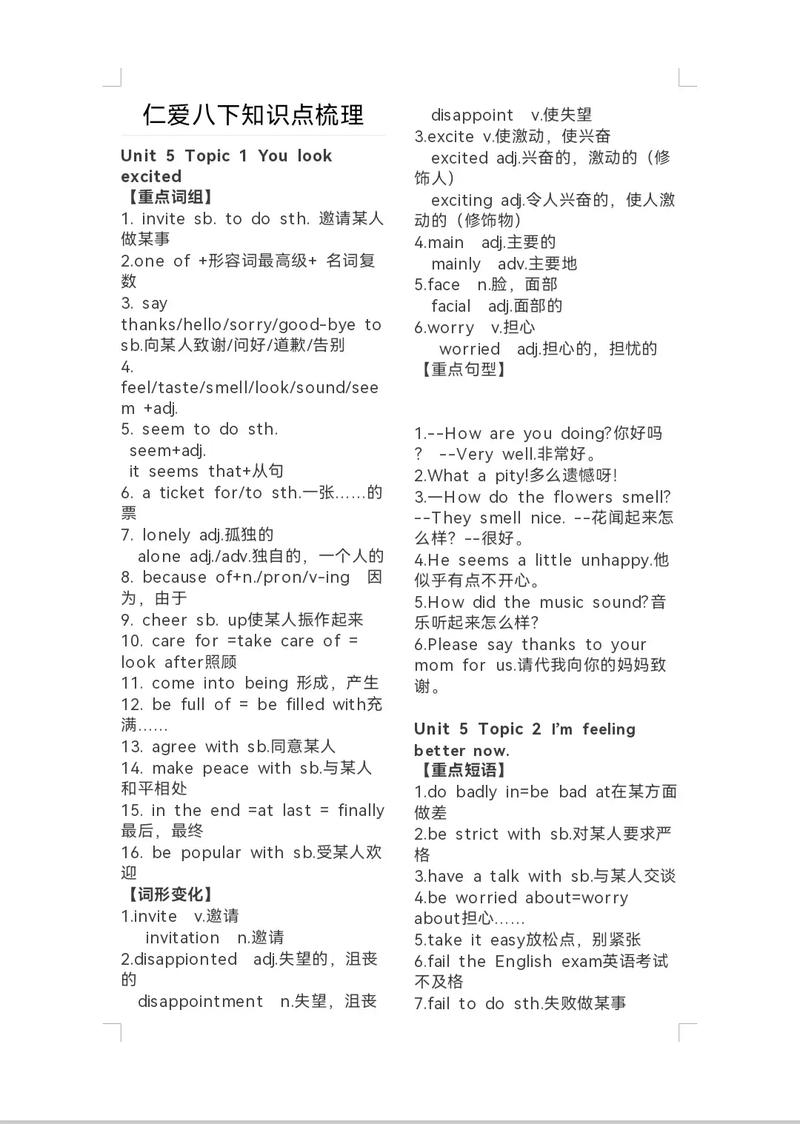
(图片来源网络,侵删)
- 结构:
am/is/are + doing - 用法: 表示已经安排好的、即将发生的计划或约定。
- 标志词:
tonight,tomorrow,this afternoon,next week,soon等。 - 例句:
I am visiting my grandparents this weekend.(我这个周末要去看望我的祖父母。)They are having a party on Friday night.(他们周五晚上要举办一个派对。)
过去进行时
- 结构:
was/were + doing - 用法:
- 表示过去某个时间点正在进行的动作。
What were you doing at 9 p.m. last night?(昨晚9点你在做什么?) - 表示过去某个时间段持续进行的动作。
I was reading a book the whole afternoon.(整个下午我都在看书。) - 描述故事发生的背景。
It was raining when I left home.(我离开家时正在下雨。)
- 表示过去某个时间点正在进行的动作。
- 例句:
He was sleeping when I called him.(我给他打电话时,他正在睡觉。)
定语从句
这是初中阶段接触的第一个从句,是重点也是难点。
- 作用: 修饰名词或代词,相当于一个形容词。
- 结构: 先行词 + 关系代词 + 从句
- 常见关系代词:
- that: 指物或人,在从句中作主语或宾语。
The book (that) I bought yesterday is interesting.(我昨天买的那本书很有趣。) - which: 指物,在从句中作主语或宾语。
The movie (which) we saw last week was great.(我们上周看的那部电影很棒。) - who: 指人,在从句中作主语或宾语。
The man (who) is talking to my teacher is my father.(那个正在和我老师说话的男人是我父亲。)
- that: 指物或人,在从句中作主语或宾语。
- 注意:
- 关系代词
that和which在指物时通常可以互换。 - 当关系代词在从句中作宾语时,可以省略,如上面的例子。
- 当关系代词在从句中作主语时,不能省略。
The boy who is wearing a blue coat is my brother.(那个穿蓝色外套的男孩是我弟弟。)
- 关系代词
反意疑问句
- 结构: 陈述句 + 简短的疑问句
- 原则:
- 前后肯定/否定相反。
- 时态和人称一致。
- 常用规则:
- 肯定的陈述句 + 否定的疑问句。
You are a student, aren't you?He can swim, can't he?They will come, won't they?
- 否定的陈述句 + 肯定的疑问句。
It isn't sunny, is it?She doesn't like apples, does she?You shouldn't be late, should you?
- 特殊词:
I am的反意疑问句用aren't I?。Let's的反意疑问句用shall we?。Let us的反意疑问句用will you?。
- 肯定的陈述句 + 否定的疑问句。
过去完成时
- 结构:
had + done - 用法: 表示“过去的过去”,即在过去某个时间点或动作之前已经发生或完成的动作。
- 标志词:
by the time...,before,when等。 - 例句:
By the time I got to the cinema, the movie had already started.(当我到达电影院时,电影已经开始了。)He said he had finished his homework.他说他已经完成了作业。)
核心词汇与短语
词汇是学习的基础,以下是各单元常见的重点词汇和短语。
-
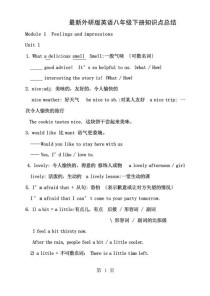
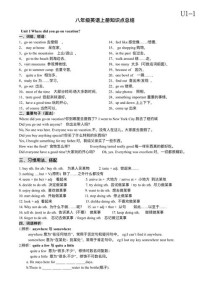
Unit 1: What's the matter?
- 身体部位:
head,eye,ear,nose,mouth,arm,hand,finger,leg,foot/feet,stomach,throat,tooth/teeth - 疾病:
have a fever,have a cold,have a cough,have a sore throat,have a stomachache,have a toothache,have a headache,have a nosebleed,hurt,sore,tired,stressed out - 建议:
should,shouldn't,drink hot tea with honey,see a dentist,lie down and rest,listen to music
- 身体部位:
-
Unit 2: I'll help to clean up the city parks.
 (图片来源网络,侵删)
- 动词短语:
clean up,cheer up,give out,come up with,put off,write down,hand out,call up - 志愿者相关:
volunteer,sign up for,community,take after,fix up,give away - 情感:
happy,sad,lonely,interested,excited
- 动词短语:
-
Unit 3: Could you please clean your room?
- 家务劳动:
do the dishes,sweep the floor,make the bed,fold the clothes,take out the trash,living room,bedroom,bathroom - 请求与许可:
Could you please...?,Could I...?,I have to...,I agree.,I disagree. - 频率副词:
always,usually,often,sometimes,hardly ever,never
- 家务劳动:
-
Unit 4: Why don't you talk to your parents?
- 问题与建议:
allow,wrong,instead of,argue,communicate,get on (well) with,clear up,work out,pressure,compete - 情绪与关系:
angry,annoyed,worried,friendship,relationship
- 问题与建议:
-
Unit 5: What were you doing when the rainstorm came?
- 过去进行时相关:
at the time of,when,while,suddenly - 天气:
rainstorm,sunny,cloudy,windy,foggy,snowy - 事件:
alarm,begin,heavily,suddenly,reporter,area,community
- 过去进行时相关:
-
Unit 6: An old man tried to move the mountains.
 (图片来源网络,侵删)
- 神话故事:
once upon a time,shoot,stone,weak,remind,bit,fit,instead of,turn...into... - 人物与情节:
god,emperor,stick,excited,continue
- 神话故事:
-
Unit 7: What's the highest mountain in the world?
- 地理名词:
Qomolangma,Himalayas,Amazon River,Nile,Casablanca,Marrakesh - 形容词:
high,long,big,deep,old,famous - 比较级与最高级:
the highest,the longest,the biggest,the deepest,the oldest,the most famous
- 地理名词:
-
Unit 8: Have you read Treasure Island yet?
- 文学与电影:
treasure,island,classic,page,already,yet,ever,just - 现在完成时标志词:
already,yet,ever,never,just,so far,since,for - 海盗相关:
pirate,captain,gold
- 文学与电影:
-
Unit 9: Have you ever been to a museum?
- 地点:
museum,art museum,history museum,water park,zoo,cinema,space museum - 交通方式:
subway,train,bus,bike,car,plane - 经历:
have been to(去过某地,人已回来),have gone to(去了某地,人不在),have been in(在某地待了多久)
- 地点:
-
Unit 10: I've had this bike for three years.
- 拥有:
have/has had(表示持续到现在的拥有) - 时间长度:
for + 一段时间,since + 过去的时间点 - 物品:
bike,camera,toy,bear,soft,board,crayon,anymore
- 拥有:
功能意念项目
- 提出建议与请求:
Could you please...?,Why don't you...?,You should...,Let's... - 表达同意与不同意:
I agree.,I don't agree.,That's a good idea.,I'm afraid not. - 谈论问题与感受:
What's the matter?,I have a headache.,I feel stressed out. - 描述过去的经历:
Have you ever been to...?,I have already done...,I haven't done yet. - 讲述故事:
While he was sleeping...,By the time he got up...,Suddenly... - 比较事物:
A is bigger than B.,C is the biggest of all.
学习建议
- 语法系统化学习: 不要孤立地记语法规则,要结合例句和语境去理解,可以制作思维导图,将各个知识点串联起来。
- 词汇在语境中记忆: 把单词放在课文、对话和例句中去记,这样不仅记得牢,还能学会如何使用。
- 听说读写全面发展:
- 听: 多听课本录音、英文歌曲、简单英文动画。
- 说: 大胆开口,和同学用英语对话,朗读课文。
- 读: 坚持阅读简单的英文故事、新闻,培养语感。
- 写: 坚持写英语日记,仿写课文中的好句型。
- 错题本是法宝: 准备一个错题本,把做错的题(尤其是语法题)抄录下来,分析错误原因,定期复习。
- 利用好课本和练习册: 课本是根本,所有考点都源于课本,吃透课本,认真完成练习册上的每一道题,是取得好成绩的关键。
希望这份详细的总结能帮助你更好地复习和掌握八年级下册的英语知识!祝你学习进步!