译林九年级上册Unit重点难点解析?
校园之窗 2025年12月19日 04:01:00 99ANYc3cd6
总体概览
九年级上册是初中英语学习的关键时期,承上启下,本册书重点围绕定语从句、被动语态和各种复合句(如宾语从句、状语从句等)展开,同时话题也更加贴近社会生活和个人成长。
Unit 1: Know yourself
核心话题
职业与性格,谈论理想工作,分析个人优缺点。

重点词汇
- n. (名词): character, personality, leader, engineer, scientist, secretary, prefer, decision, grade, review
- adj. (形容词): organized, patient, honest, energetic, creative, outgoing, serious, generous
- v. (动词): prefer, organize, review
- 短语: would rather do sth., be suitable for, in one's free time, make a decision, at the same time
核心句型
- 询问职业和理想:
- — What do you want to be when you grow up? (你长大后想做什么?)
- — I want to be a/an... (我想成为一名……)
- 表达偏好:
- — Which would you prefer, A or B? (你更喜欢A还是B?)
- — I prefer A to B. / I would rather do A than do B. (比起B我更喜欢A。/ 我宁愿做A也不愿做B。)
- 谈论性格特点:
- He is outgoing and gets along well with others. (他外向,与他人相处融洽。)
- She is organized and always keeps her things in order. (她很有条理,总是把东西整理得井井有条。)
重点语法
- 定语从句 (Attributive Clause) - 关系代词
that,which,who- 定义: 在复合句中修饰名词或代词的从句。
- 引导词:
that: 指物或人,在从句中作主语或宾语。- The book that you lent me is very interesting. (你借给我的那本书很有趣。)
which: 指物,在从句中作主语或宾语。- The story which he told us is true. (他告诉我们的那个故事是真的。)
who: 指人,在从句中作主语或宾语。- The man who is standing over there is our teacher. (站在那边的那个男人是我们的老师。)
- 注意: 当关系代词在从句中作宾语时,可以省略。
The book (that/which) I bought yesterday is lost. (我昨天买的那本书丢了。)
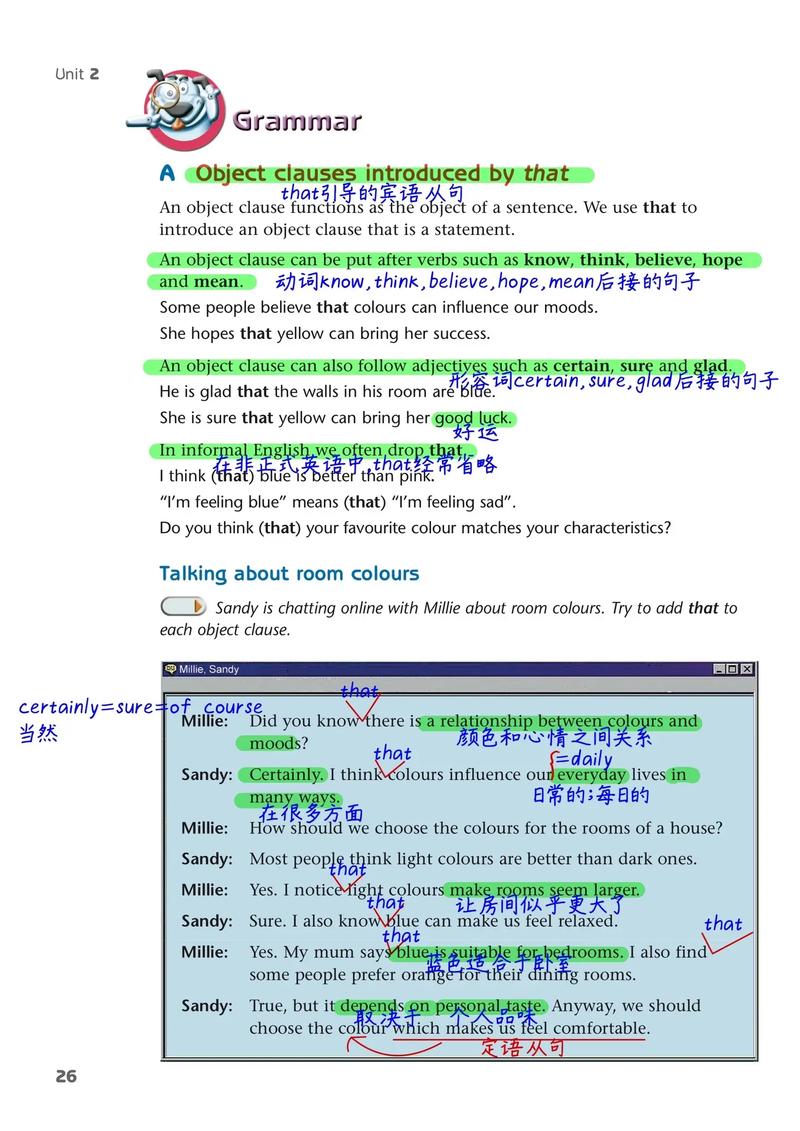
Unit 2: Colour
核心话题
颜色与情绪、性格、文化的关系,表达喜好和感受。
重点词汇
- n. (名词): colour, red, blue, green, yellow, purple, pink, orange, white, black, power, energy, peace, wisdom, sadness
- adj. (形容词): energetic, peaceful, wise, powerful, sad, warm, cool
- v. (动词): prefer, represent, affect
- 短语: be related to, at the end of, feel blue, in the dark, turn green with envy
核心句型
- 表达颜色喜好及原因:
- — What's your favourite colour? (你最喜欢的颜色是什么?)
- — My favourite colour is blue, because it represents wisdom and peace. (我最喜欢蓝色,因为它代表智慧和宁静。)
- 描述颜色的影响:
- Different colours can affect our moods. (不同的颜色会影响我们的情绪。)
- Red can make us feel energetic and excited. (红色能让我们感到充满活力和兴奋。)
重点语法
- 定语从句 - 关系代词
whom,whosewhom: 指人,在从句中作宾语,可省略。The girl (whom/who/that) we met yesterday is very friendly. (我们昨天遇到的那个女孩很友好。)
whose: 表示“……的”,指人或物,在从句中作定语。- This is the boy whose father is a doctor. (这是那个父亲是医生的男孩。)
- I live in a room whose window faces south. (我住在一扇窗户朝南的房间里。)
Unit 3: Teenage problems
核心话题
青少年常见问题(学业压力、与父母沟通、交友等),寻求建议并给出建议。
重点词汇
- n. (名词): problem, pressure, exam, friendship, communication, opinion, suggestion, choice
- adj. (形容词): stressed, worried, upset, nervous, serious
- v. (动词): refuse, communicate, expect, achieve, explain
- 短语: have too much pressure, get on well with, argue with sb., communicate with sb., make a choice, feel lonely
核心句型
- 提出问题和担忧:
- I have a problem and I need your advice. (我有个问题,需要你的建议。)
- I'm stressed out because of too much homework. (因为家庭作业太多,我感到压力很大。)
- 征求和给出建议:
- — What should I do? (我该怎么办?)
- — You should talk to your parents about it. / Why don't you discuss it with your teacher? (你应该和父母谈谈。/ 你为什么不和老师讨论一下呢?)
- You'd better not stay up late. (你最好不要熬夜。)
重点语法
- 定语从句 - 关系副词
when,where,whywhen: 指时间,在从句中作时间状语,相当于on/at/in which。- I still remember the day when we first met. (我仍然记得我们初次见面的那一天。)
where: 指地点,在从句中作地点状语,相当于in/at/on which。- This is the school where I studied for three years. (这就是我上了三年学的学校。)
why: 指原因,在从句中作原因状语,相当于for which,通常修饰reason。- That is the reason why he was late. (那就是他迟到的原因。)
Unit 4: Great people
核心话题
介绍历史伟人(如科学家、发明家)的生平、成就和精神品质。
重点词汇
- n. (名词): scientist, inventor, theory, law, achievement, contribution, spirit, university, education
- adj. (形容词): great, outstanding, important, successful, determined, creative
- v. (动词): invent, discover, achieve, graduate, contribute, educate
- 短语: work on, at the age of, be born, pass away, be famous for, make a contribution to
核心句型
- 介绍人物生平:
- Albert Einstein was born in Germany in 1879. (阿尔伯特·爱因斯坦于1879年出生在德国。)
- He is famous for his Theory of Relativity. (他以他的相对论而闻名。)
- 评价人物贡献:
- His great achievements have changed the world. (他的伟大成就改变了世界。)
- We should learn from his spirit of determination. (我们应该学习他坚持不懈的精神。)
重点语法
- 被动语态
- 定义: 强调动作的承受者,而非执行者。
- 构成:
be + 动词的过去分词 - 各种时态下的被动语态:
- 一般现在时: am/is/are + done
English is spoken all over the world. (英语在全世界被使用。)
- 一般过去时: was/were + done
The book was written by Lu Xun. (这本书是鲁迅写的。)
- 一般将来时: will be + done / am/is/are going to be + done
A new school will be built next year. (一所新学校将在明年建成。)
 (图片来源网络,侵删)
 - 含情态动词: can/may/must/should be + done
The work must be finished on time. (这项工作必须按时完成。)
- 一般现在时: am/is/are + done
Unit 5: Art world
核心话题
艺术形式(音乐、绘画、电影等),谈论艺术作品和个人感受。
重点词汇
- n. (名词): art, music, painting, film, director, musician, concert, gallery, masterpiece, character
- adj. (形容词): famous, successful, moving, wonderful, creative
- v. (动词): direct, perform, compose, enjoy
- 短语: be interested in, take one's place, in one's opinion, on show, a number of
核心句型
- 谈论艺术作品:
- What do you think of this film/song/painting? (你觉得这部电影/这首歌/这幅画怎么样?)
- I enjoy listening to classical music. (我喜欢听古典音乐。)
- 表达个人观点:
- In my opinion, this is a masterpiece. (在我看来,这是一件杰作。)
- The film was so moving that I cried. (这部电影如此感人,以至于我哭了。)
重点语法
- 宾语从句 (Object Clause)
- 定义: 在句子中作宾语的从句。
- 引导词:
that,if/whether,what,when,where,how等。 - 语序: 宾语从句必须使用陈述句语序 (主语 + 谓语)。
- I know (that) he is right. (我知道他是对的。)
- Can you tell me where the nearest bank is? (你能告诉我最近的银行在哪里吗?)
- I wonder if/whether it will rain tomorrow. (我想知道明天是否会下雨。)
Unit 6: TV programmes
核心话题
电视节目类型,表达喜好,描述节目内容。
重点词汇
- n. (名词): programme, news, soap opera, sports show, documentary, cartoon, channel, host, culture
- adj. (形容词): interesting, boring, educational, meaningful, popular
- v. (动词): discuss, review, learn, prefer
- 短语: all kinds of, watch TV, be famous for, so...that..., not only...but also...
核心句型
- 谈论电视节目:
- — What kind of TV programmes do you like? (你喜欢什么类型的电视节目?)
- — I prefer documentaries because they are educational. (我喜欢纪录片,因为它们有教育意义。)
- 表达观点:
- I think sports shows are more exciting than soap operas. (我认为体育节目比肥皂剧更刺激。)
- Not only children but also adults like watching cartoons. (不仅孩子们,成年人也喜欢看动画片。)
重点语法
not only...but also...句型- 用法: 连接两个并列的成分(主语、谓语、宾语、状语等)。
- 特点: 连接两个主语时,谓语动词遵循就近原则,与
but also后面的主语保持一致。Not only the students but also the teacher is against the plan. (不仅学生们,而且老师也反对这个计划。)
- 部分倒装:
Not only放在句首时,其所在句子需要部分倒装(将助动词/情态动词提到主语前)。- Not only did he finish his homework, but also he helped his mother with the housework. (他不仅完成了作业,还帮妈妈做了家务。)
Unit 7: Films
核心话题
电影类型,谈论电影情节和感受,比较电影。
重点词汇
- n. (名词): film, movie, scene, actor, actress, director, award, action film, comedy, horror film
- adj. (形容词): exciting, moving, funny, frightening, wonderful, fantastic
- v. (动词): act, direct, win, act as, take part in
- 短语: one of the + 最高级, be based on, be set in, in the 1990s, win an award
核心句型
- 描述电影:
- It is one of the most moving films I have ever seen. (它是我看过的最感人的电影之一。)
- The film is based on a true story. (这部电影是根据一个真实故事改编的。)
- 表达感受:
The scene was so exciting that I couldn't help cheering. (那个场景如此激动人心,我忍不住欢呼起来。)
重点语法
- 最高级
- 构成:
the + 最高级 + (名词) + in/of... - 用法: 三者或三者以上进行比较。
- Tom is the tallest boy in our class. (汤姆是我们班最高的男孩。)
- This is the most interesting book of all. (这是所有书中最有趣的一本。)
- 构成:
- 现在完成时
- 构成:
have/has + 动词的过去分词 - 用法: 表示过去发生且对现在有影响的动作,或从过去持续到现在的动作/状态。
- I have seen this film twice. (这部电影我已经看过两次了。)
- He has lived here since 2010. (他从2010年起就住在这里了。)
- 构成:
Unit 8: Detective stories
核心话题
侦探故事,描述事件经过,推测可能性,表达不确定性。
重点词汇
- n. (名词): detective, crime, murder, suspect, evidence, witness, scene, secret, mystery
- adj. (形容词): strange, impossible, guilty, innocent, nervous
- v. (动词): steal, murder, suspect, search, discover, hide
- 短语: steal sth. from sb., be guilty of, search for, at the crime scene, in the end
核心句型
- 推测和可能性:
- It might/could be the butler. (可能是管家。)
- The thief must have run away through the back door. (小偷一定是从后门逃走了。)
- 描述事件:
- A valuable painting was stolen from the museum last night. (昨晚一幅名画从博物馆被偷了。)
- The police are searching for the suspect. (警方正在搜寻嫌疑人。)
重点语法
-
情态表推测
- must + do/be: 表示肯定的推测,意为“一定,肯定”。
- He looks tired. He must be ill. (他看起来很累,肯定是生病了。)
- may/might/could + do/be: 表示不确定的推测,意为“可能,也许”,可能性依次递减。
- It may/might/could rain this afternoon. (今天下午可能会下雨。)
- can't/couldn't + do/be: 表示否定的推测,意为“不可能”。
He can't be at home, because the light is off. (他不可能在家,因为灯是关着的。)
- must + do/be: 表示肯定的推测,意为“一定,肯定”。
-
现在完成时
- (本单元再次强调和巩固)
- The police have already found some clues. (警方已经发现了一些线索。)
- I have just finished reading the book. (我刚刚读完这本书。)
总结与建议
- 语法是核心: 九年级上册的定语从句和被动语态是中考的重中之重,务必通过大量练习熟练掌握。
- 词汇是基础: 每个单元的重点词汇和短语不仅要认识,更要会读、会写、会用。
- 话题是载体: 围绕每个话题(职业、颜色、问题、伟人、艺术、电视、电影、侦探),练习口语和写作,将所学知识融会贯通。
- 多做真题: 结合历年中考题,检验学习成果,熟悉题型和考点。
希望这份详细的总结对您有帮助!祝您学习进步!