人教版八上英语知识点总结有哪些重点?
校园之窗 2025年11月29日 14:47:54 99ANYc3cd6
人教版八年级上册英语知识点总结
八年级上册的英语学习是整个初中阶段的关键期,它承上启下,不仅加深了对七年级知识的运用,还引入了许多新的、重要的语法点,本册书共分为10个单元,主题围绕日常生活展开。
第一部分:核心语法要点
这是本册书的重中之重,必须彻底理解并熟练运用。
(图片来源网络,侵删)
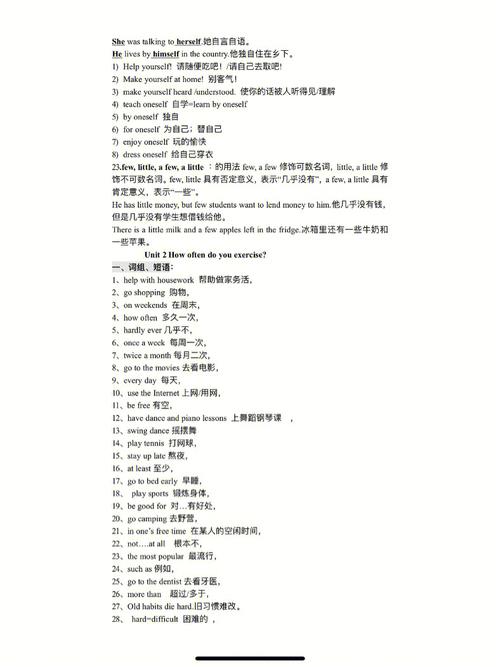
Unit 1: How often do you exercise? (频率副词)
-
频率副词
- 定义:表示动作发生的频率。
- 排序:
always(总是) >usually( >often(经常) >sometimes(有时) >hardly ever(几乎不) >never(从不) - 用法:放在实义动词之前,be动词、情态动词、助动词之后。
- 例句:
- I always get up at 6:00. (我总是6点起床。)
- She usually goes to school by bike. (她通常骑自行车去上学。)
- They are never late for class. (他们上课从不迟到。)
-
How often引导的特殊疑问句- 结构:
How often + do/does + 主语 + 动词原形...? - 回答:用频率副词或
once/twice/three times + a week/month/year等短语。 - 例句:
- A: How often do you watch TV? (你多久看一次电视?)
- B: I watch TV twice a week. (我一周看两次。) / I hardly ever watch TV. (我几乎不看电视。)
- 结构:
Unit 2: How do you get to school? (how引导的特殊疑问句)
-
How引导的特殊疑问句- How do you get to school? 你怎么去上学?
- 回答:
I get to school by bus / on foot / by subway...(我乘公交车/步行/乘地铁去上学。)
- 回答:
- How far is it from...to...? 从……到……有多远?
- 回答:
It's about ten kilometers away.(大约十公里远。)
- 回答:
- How long does it take? 这需要多长时间?
- 回答:
It takes about 20 minutes.(大约需要20分钟。)
- 回答:
- How do you like...? / What do you think of...? 你觉得……怎么样?
- 回答:
It's interesting / great / boring...(它很有趣/很棒/很无聊……)
- 回答:
- How do you get to school? 你怎么去上学?
-
表示交通方式的介词
 (图片来源网络,侵删)
by + 交通工具(表示泛指的交通方式,名词前不加冠词)by bus,by train,by plane,by subway,by car
on + a/an/the + 限定词 + 交通工具(表示特指的、有轮子的交通工具)on a bus,on the train,on a bike
in + a/an/the + 限定词 + 交通工具(表示在有空间的交通工具里)in a car,in a taxi
Unit 3: What are you doing for vacation? (现在进行表将来)
-
现在进行时表将来
- 结构:
am/is/are + 动词ing - 用法:表示已经安排好、计划好的近期或即将发生的动作,常与表示将来的时间状语连用,如
tomorrow,next week,soon,this weekend等。 - 例句:
- I am going hiking this weekend. (我这个周末要去远足。)
- What is he doing for vacation? (他假期要做什么?)
- They are leaving for Beijing tomorrow. (他们明天动身去北京。)
- 结构:
-
leave,spend,decide等动词的用法leave for + 地点:动身去某地He is leaving for Shanghai.他要去上海了。
spend time (in) doing sth.或spend time on sth.:花时间做某事I spent two hours (in) doing my homework.我花了两个小时做作业。
decide to do sth.:决定做某事She decided to learn the piano.她决定学钢琴。
Unit 4: How do you get to school? (数量词)
-
表示数量的短语
hundreds of(数百的)thousands of(成千上万的)millions of(数百万的)one hundred / thousand / million(具体的百/千/百万,不加s或of)two hundred students(两百名学生)millions of trees(数百万棵树)
-
How引导的特殊疑问句复习与拓展- How many + 复数名词 + ...? 多少……?
How many students are there in your class?
- How much + 不可数名词 + ...? 多少……?
How much water do you drink every day?
- How many + 复数名词 + ...? 多少……?
Unit 5: Can you come to my party? (情态动词 can, have to, must)
-
情态动词
can的用法- 请求许可:
Can you...?(可以……吗?)Can you come to my party?(你能来我的派对吗?)
- 能力:
I can swim.(我会游泳。) - 邀请:
Can you go to the movies?(你能去看电影吗?) - 回答:
- 肯定:
Sure, I'd love to./Yes, I can. - 否定委婉:
Sorry, I can't. I have to...(抱歉,我不能,我必须……)
- 肯定:
- 请求许可:
-
have to与must的区别have to:表示客观需要,意为“不得不”,有人称和数的变化,并有多种时态。I have to finish my homework now.(我现在必须完成作业。)He had to get up early yesterday.(他昨天不得不早起。)
must:表示主观意愿或命令,意为“必须”,没有人称和数的变化,通常只用于现在时。You must be quiet in the library.(在图书馆里你必须保持安静。)
Unit 6: I'm more outgoing than my sister. (形容词和副词的比较级和最高级)
-
形容词/副词的比较级和最高级
- 规则变化:
- 一般直接加
-er/-est:tall->taller->tallest - 以不发音的
e加-r/-st:nice->nicer->nicest - 以“辅音字母 + y”变
y为i再加-er/-est:happy->happier->happiest - 重读闭音节,双写末尾辅音字母再加
-er/-est:big->bigger->biggest - 多音节和部分双音节词,在词前加
more/most:beautiful->more beautiful->most beautiful
- 一般直接加
- 不规则变化:
good/well->better->bestbad/badly->worse->worstmany/much->more->mostlittle->less->leastfar->farther/further->farthest/furthest
- 规则变化:
-
比较级的常用句型
- A + 比较级 + than + B (A比B更……)
`
- A + 比较级 + than + B (A比B更……)