人教版八上英语语法重点有哪些?
校园之窗 2025年12月13日 08:46:27 99ANYc3cd6
人教版英语八年级上册核心语法点
一般将来时
八年级上册重点学习了两种表达将来时的方式。
will + 动词原形

(图片来源网络,侵删)
- 核心用法:表示对未来的预测、意愿、承诺或临时决定。
- 结构:
- 肯定句:
主语 + will + 动词原形 + 其他. - 否定句:
主语 + won't (will not) + 动词原形 + 其他. - 一般疑问句:
Will + 主语 + 动词原形 + 其他?- 肯定回答:
Yes, 主语 + will. - 否定回答:
No, 主语 + won't.
- 肯定回答:
- 肯定句:
- 标志词:
tomorrow, next week/month/year, in the future, soon等。 - 例句:
- I think it will rain tomorrow. (预测)
- She promised that she would help me. (承诺)
- The phone is ringing. I will get it. (临时决定)
be going to + 动词原形
- 核心用法:表示已经计划好或打算要做某事,或根据现有迹象预测即将要发生某事。
- 结构:
- 肯定句:
主语 + am/is/are + going to + 动词原形 + 其他. - 否定句:
主语 + am/is/are + not + going to + 动词原形 + 其他. - 一般疑问句:
Am/Is/Are + 主语 + going to + 动词原形 + 其他?- 肯定回答:
Yes, 主语 + am/is/are. - 否定回答:
No, 主语 + am/is/are + not.
- 肯定回答:
- 肯定句:
- 标志词:
plan, decide, want, hope等表示计划的词。 - 例句:
- I am going to visit my grandparents this weekend. (计划)
- Look at the dark clouds. It is going to rain. (迹象预测)
【重点区分】
- 计划 vs. 预测:
be going to侧重计划,will侧重预测或临时决定。- I'm going to watch a movie tonight. (我计划好了)
- I'm tired. I will go to bed early. (临时决定)
- 计划 vs. 意愿:
be going to表示计划,will表示意愿。- I'm going to call him. (我打算打电话)
- I will call him. (我愿意打电话/我会打电话的)
情态动词
八年级上册主要学习了 should 和 could。
should
(图片来源网络,侵删)
- 核心用法:表示建议、应该做某事。
- 结构:
should + 动词原形 - 否定形式:
shouldn't (should not) + 动词原形 - 例句:
- You should eat more vegetables. (建议)
- He shouldn't stay up late. (不应该)
could
- 核心用法:
can的过去式:表示过去的能力。- I could swim when I was five.
- 委婉的请求或许可:比
can更客气。- Could you please help me? (比 Can you...? 更礼貌)
- Yes, I can. / No, sorry, I can't.
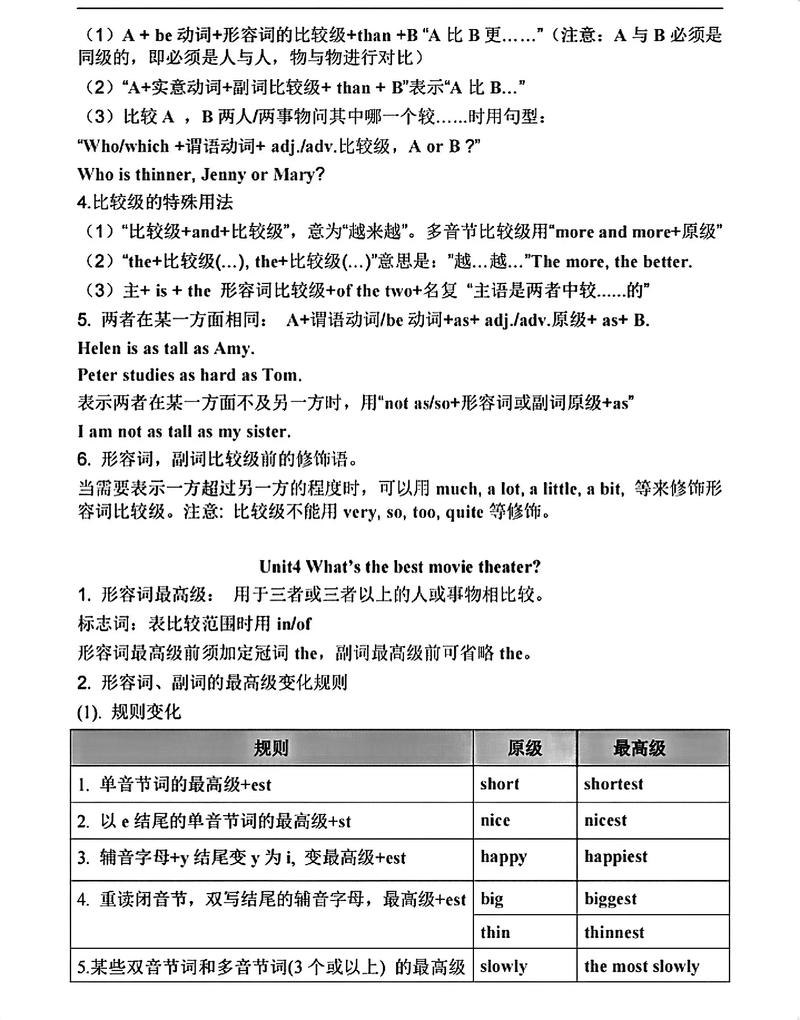
形容词和副词的比较级和最高级
这是八年级上册的绝对重点和难点。
构成规则
| 类型 | 构成方法 | 原级 | 比较级 | 最高级 | 例句 |
|---|---|---|---|---|---|
| 单音节词 | 直接加 -er / -est |
tall |
taller |
tallest |
He is taller than his brother. |
以不发音的 e
| |||||
| 以“辅音字母+y”结尾 | happy |
happier |
happiest |
She is happier now. | |
| 以重读闭音节结尾,且末尾只有一个辅音字母 | big |
bigger |
biggest |
A elephant is bigger than a tiger. | |
| 多音节词 | 在词前加 more / most |
beautiful |
more beautiful |
most beautiful |
The garden is more beautiful. |
| 部分双音节词 | 可加 -er / -est 或 more / most |
clever |
cleverer / more clever |
cleverest / most clever |
He is cleverer than I. |
基本句型
(图片来源网络,侵删)
- 比较级:
A + be + 比较级 + than + B(A比B更...)- Tom is taller than Mike.
A + 动词 + 副词比较级 + than + B- She runs faster than me.
- 最高级:
A + be + the + 最高级 + (in/of...)(A在...中最...)- Tom is the tallest (in his class).
- This is the most beautiful (of all the pictures).
One of the + 最高级 + 复数名词(最...的之一)- The Yellow River is one of the longest rivers in China.
【重点注意】
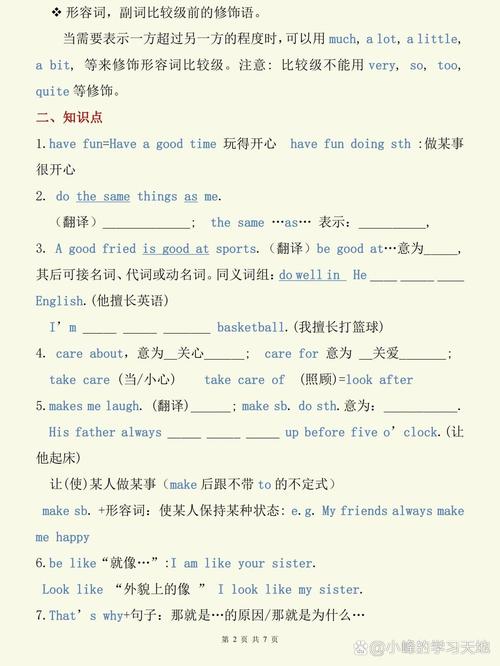
- 比较级前可用
much, a lot, even, still, a little, bit等修饰,表示程度。- This book is much more interesting than that one.
- 两者比较用比较级,三者或以上比较用最高级。
- 自身不能和自身比较,错误:He is taller than himself. 正确:He is taller than his brother.
比较特殊的句型
too...to... 句型
- 含义:“太...以至于不能...”,表示否定。
- 结构:
too + 形容词/副词 + to + 动词原形 - 例句:
- The box is too heavy to carry. (这个箱子太重了,搬不动。)
- He runs too fast to follow. (他跑得太快了,跟不上。)
so...that... 句型
- 含义:“..以至于...”,
so修饰形容词或副词,that引导结果状语从句。 - 结构:
so + 形容词/副词 + that + 从句 - 例句:
- He was so excited that he couldn't speak. (他如此激动以至于说不出话来。)
- The music is so loud that I can't hear you. (音乐太大声了,我听不见你说话。)
【too...to... 和 so...that... 的转换】
too...to...=so...that... + can't/couldn't- The box is too heavy to carry.
- The box is so heavy that I can't carry it.
宾语从句
宾语从句在句子中充当宾语,通常由 that, if, whether, what, when, where, how, why 等引导。
引导词
that:无实际意义,只起连接作用,在口语和非正式文体中常省略。I know (that) he is a good student.
if / whether:意为“是否”,if通常口语化,whether更正式,且可与or not连用。- I don't know if/whether he will come.
- I wonder whether or not it is true.
- 特殊疑问词:
what, who, which, when, where, why, how等,它们在从句中要充当相应的句子成分。- Can you tell me where the library is? (where 在从句中作地点状语)
- I don't know what he wants. (what 在从句中作 wants 的宾语)
语序
- 宾语从句必须使用陈述句语序 (主语 + 谓语),即使主句是疑问句。
- 错误:Do you know where is he from?
- 正确:Do you know where he is from?
时态一致
- 主句是现在时或将来时,从句可用任何所需要的时态。
- He says he will finish his homework tomorrow.
- 主句是过去时,从句的时态要相应地“后退”一步(即“过去的过去”)。
- He said he was busy. (现在时 is -> 过去时 was)
- He said he would come. (将来时 will -> 过去将来时 would)
- He said he had seen the film. (现在完成时 have seen -> 过去完成时 had seen)
总结与建议
八年级上册的语法知识环环相扣,学好它们对后续学习至关重要。
- 多归纳,多总结:特别是形容词/副词的比较级和最高级,规则多,不规则词也要单独记忆。
- 在语境中学习:不要孤立地背语法规则,要把它们放到课文、对话和练习中去理解和使用。
- 勤于练习:通过做单选、完形填空、写作等练习来巩固语法知识,特别是宾语从句的语序和时态。
- 建立错题本:将自己做错的题目记录下来,分析错误原因,定期复习,效果会非常好。
希望这份详细的梳理能帮助你更好地掌握八年级上册的英语语法!祝你学习进步!