学校规则该如何有效遵守与理解?
作文示例 2025年11月28日 08:10:53 tjadmin
初中版(基础版,约100-120词)
Why We Need School Rules**
Every school has its own rules. At first, some students may think these rules are too strict and not necessary. However, school rules are actually very important for us.
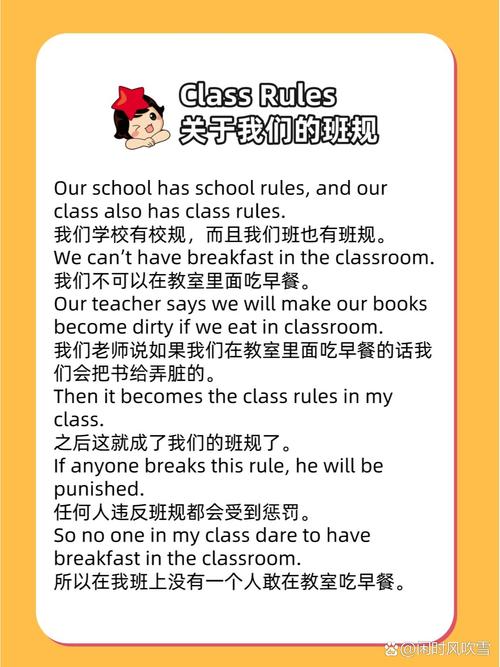
First, rules help us create a good learning environment. For example, the rule of "no talking in class" ensures that everyone can listen to the teacher and concentrate on their studies. Second, they teach us discipline and responsibility. By following the rules, we learn to respect others and manage our own behavior. Finally, rules keep us safe. Rules like "no running in the hallways" prevent accidents.
In conclusion, school rules are not just about restrictions. They are there to help us build good habits and grow into better people. Let's all follow the rules to make our school a better place.
高中版(进阶版,约150-180词)
The Significance of School Rules**
School rules, often perceived as a set of constraints by students, are in fact the fundamental pillars upon which a safe, orderly, and productive academic community is built. They serve as more than just a list of "don'ts"; they are essential guidelines for personal and collective development.
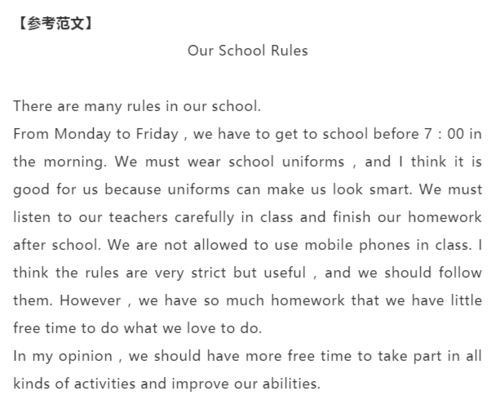
The primary function of school rules is to establish a conducive learning atmosphere. Imagine a classroom without rules: students talking loudly, phones ringing, and chaos reigning. Such an environment would make effective teaching and learning impossible. Rules, such as punctuality and proper classroom etiquette, ensure that the focus remains on education.
Furthermore, adhering to these rules is a crucial lesson in civic responsibility. By following regulations like wearing the uniform or submitting homework on time, we learn the importance of discipline, respect for authority, and commitment to our community. These are qualities that are invaluable for our future as responsible members of society.
In essence, school rules are not designed to stifle our freedom but to cultivate it within a structured framework. They teach us self-control and prepare us for the greater responsibilities that lie ahead. Therefore, we should not only follow them but also understand and appreciate their purpose.
议论文版(深度版,约250-300词)
School Rules: The Framework for Freedom and Responsibility**
The debate over school rules is a perennial one, with students often viewing them as an infringement on their personal freedom. However, this perspective misses a deeper truth: well-conceived school rules are not the antithesis of freedom, but rather its essential framework. They are the silent architects of a community that balances individual expression with collective well-being.
Firstly, rules provide the structure necessary for true intellectual freedom. A library, for instance, operates on the simple rule of maintaining silence. This rule does not suppress speech; rather, it creates an environment where every student is free to read, think, and learn without distraction. Without this structure, the "freedom" to talk would deprive others of their freedom to learn. Similarly, dress codes may seem restrictive, but they can foster a sense of unity and minimize social pressures, allowing students to be judged by their character and intellect, not their attire.
Secondly, school rules are the first and most practical lesson in civic responsibility. In the microcosm of a school, we learn that our actions have consequences for others. A rule against cheating is not just about academic honesty; it's about upholding the integrity of the entire community. A rule against bullying is a lesson in empathy and respect for human dignity. These lessons are the bedrock of a functioning society, and school is where we first practice them.
In conclusion, to dismiss school rules is to misunderstand their purpose. They are not chains that bind us, but the guardrails that guide us toward becoming disciplined, responsible, and compassionate individuals. By embracing these rules, we do not lose our freedom; we learn how to exercise it wisely, preparing ourselves for the complex and structured world beyond the school gates.
核心词汇与句型
核心词汇:
-
n. (名词)
- rule - 规则
- regulation - 规章,条例 (比 rule 更正式)
- discipline - 纪律
- responsibility - 责任
- environment - 环境
- atmosphere - 氛围
- restriction - 限制
- framework - 框架
- order - 秩序
- safety - 安全
- punctuality - 守时
- etiquette - 礼仪,规矩
- civic responsibility - 公民责任
- integrity - 正直,诚信
-
v. (动词)
- follow/obey - 遵守
- establish/create - 建立
- ensure - 确保
- respect - 尊重
- cultivate - 培养
- stifle - 抑制,扼杀
- perceive - 看待,认为
- infringe on - 侵犯
-
adj. (形容词)
- important/significant/crucial/essential - 重要的
- strict - 严格的
- necessary - 必要的
- conducive - 有助于...的
- productive - 高效的,有成效的
- orderly - 有序的
- restrictive - 限制性的
- structured - 有结构的
高级句型:
-
开篇句:
- "Every school has its own rules." (简单直接)
- "School rules, often perceived as a set of constraints by students, are in fact the fundamental pillars upon which a safe, orderly, and productive academic community is built." (高级,使用插入语和比喻)
- "The debate over school rules is a perennial one..." (议论文常用开头,引出话题)
-
观点表达:
- "The primary function of school rules is to..." (阐述主要功能)
- "Furthermore, adhering to these rules is a crucial lesson in..." (进一步阐述)
- "In essence, school rules are not designed to... but to..." (总结核心目的,使用 not... but... 结构)
-
举例论证:
- "For example, the rule of 'no talking in class' ensures that..." (初中版举例)
- "Imagine a classroom without rules: chaos reigning. Such an environment would make... impossible." (高中版,用假设和结果论证)
- "A library, for instance, operates on the simple rule of maintaining silence. This rule does not suppress speech; rather, it creates an environment where..." (深度版,用具体例子进行正反论证)
-
结尾句:
- "In conclusion, school rules are not just about restrictions." (简单总结)
- "Therefore, we should not only follow them but also understand and appreciate their purpose." (提出更高要求)
- "By embracing these rules, we do not lose our freedom; we learn how to exercise it wisely, preparing ourselves for the complex and structured world beyond the school gates." (升华主题,展望未来)
希望这些版本和资料能对您有所帮助!