七年级上册英语知识点有哪些重点难点?
校园之窗 2026年1月25日 23:13:55 99ANYc3cd6
七年级上册英语核心知识点总结
七年级上册是整个初中英语学习的基础,主要目标是打好扎实的语音、词汇、语法基础,并培养基本的听、说、读、写能力。
第一部分:核心词汇
词汇是语言的基石,以下是七年级上册需要掌握的核心词汇分类:
(图片来源网络,侵删)
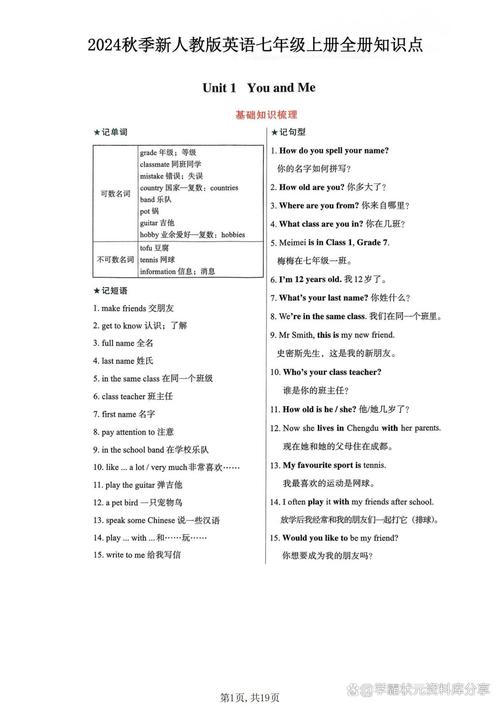
人称代词和物主代词
- 人称代词: I, you, he, she, it, we, they
- 物主代词:
- 形容词性物主代词: my, your, his, her, its, our, their (后面必须跟名词)
- 名词性物主代词: mine, yours, his, hers, its, ours, theirs (本身相当于名词,后面不跟名词)
数字
- 0-100: zero, one, two, ..., ten, eleven, ..., twenty, thirty, ..., forty, ..., fifty, ..., sixty, ..., seventy, ..., eighty, ..., ninety, one hundred
- 日期: January (Jan.), February (Feb.), March (Mar.), April (Apr.), May, June, July, August (Aug.), September (Sept.), October (Oct.), November (Nov.), December (Dec.)
- 星期: Monday (Mon.), Tuesday (Tues.), Wednesday (Wed.), Thursday (Thurs.), Friday (Fri.), Saturday (Sat.), Sunday (Sun.)
颜色
- red, yellow, blue, green, black, white, brown, orange, purple, pink, gray/grey
学校与学习
- 科目: English, math, Chinese, music, art, P.E. (Physical Education), science, history, geography
- 物品: book, notebook, dictionary, pen, pencil, ruler, eraser, schoolbag, backpack
- 人物: teacher, student, classmate, friend, parent
- 地点: classroom, school, library, office
家庭与朋友
- 家庭成员: family, father/dad, mother/mom, parent, brother, sister, grandfather/grandpa, grandmother/grandma, grandparent, uncle, aunt, cousin
- 人物: friend, boy, girl
食物与饮料
- 主食: rice, bread, noodles, egg, hamburger
- 蔬菜: vegetable, carrot, tomato, potato
- 水果: apple, banana, orange, pear, strawberry, grape
- 饮品: water, milk, tea, juice, soda
- 其他: food, breakfast, lunch, dinner, meal, apple pie, banana ice cream, chicken, fish
地点与方位
- 地点: home, room, bed, desk, table, chair, window, door, wall, floor, garden, zoo, park, supermarket, bank, post office, library, restaurant
- 方位介词: in, on, under, near, next to, behind, in front of
动物
- panda, tiger, elephant, lion, monkey, dog, cat, bird, zoo
其他高频词汇
- be动词: am, is, are
- 情态动词: can
- 形容词: good, nice, great, OK, bad, happy, sad, tired, hungry, thirsty, big, small, long, short, new, old
- 疑问词: what, who, where, when, why, how, how old, how much
- 名词: name, number, phone, telephone, ID card, key, color, question, answer, boy, girl, year, month, time, price, sale, sell, buy
第二部分:核心语法
语法是语言的规则,七年级上册的语法是整个初中语法的根基。
be 动词的用法
be 动词 (am, is, are) 是最重要的动词之一,用来表示“是”或状态。
- 口诀: 我用am,你用are,is连着他她它。
- 句型结构:
- 肯定句: 主语 + be动词 + 其他.
- I am a student. (我是学生。)
- He is my friend. (他是我的朋友。)
- They are in the classroom. (他们在教室里。)
- 否定句: 主语 + be动词 + not + 其他.
- I am not a teacher. (我不是老师。)
- She is not from China. (她不是来自中国。)
- 一般疑问句: Be动词 + 主语 + 其他?
- Are you Tom? (你是汤姆吗?)
- Is this your book? (这是你的书吗?)
- 特殊疑问句: 特殊疑问词 + be动词 + 主语 + 其他?
- What is your name? (你叫什么名字?)
- Where are they from? (他们来自哪里?)
- 肯定句: 主语 + be动词 + 其他.
人称代词和物主代词的用法
- 人称代词作主语:
- I like English. (我喜欢英语。)
- He is playing basketball. (他正在打篮球。)
- 物主代词:
- 形容词性物主代词: 修饰名词,说明“某人的”。
- This is my book. (这是我的书。)
- Is that his pen? (那是他的钢笔吗?)
- 名词性物主代词: 相当于“名词”,后面不跟名词。
- This book is mine. (这本书是我的。)
- The blue pen is hers. (那支蓝色的笔是她的。)
- 形容词性物主代词: 修饰名词,说明“某人的”。
名词
- 可数名词:
- 单数: a book, an apple (注意:元音音素开头的单词前用an)
- 复数: 规则变化 (加-s, -es, -ies, -ves等) 和不规则变化 (child-children, man-men, woman-women, foot-feet等)
- 不可数名词: water, milk, rice, bread, money (通常没有复数形式,不能直接用a/an修饰)
情态动词 can 的用法
can 表示“能,会”,没有人称和数的变化。
- 结构: 主语 + can + 动词原形 + 其他.
- 肯定句: I can sing. (我会唱歌。)
- 否定句: 主语 + can't (cannot) + 动词原形 + 其他.
She can't swim. (她不会游泳。)
 (图片来源网络,侵删)
 - 一般疑问句: Can + 主语 + 动词原形 + 其他?
Can you play the guitar? (你会弹吉他吗?)
- 肯/否回答: Yes, 主语 + can. / No, 主语 + can't.
— Can he speak English? — Yes, he can. / No, he can't.
名词所有格
表示“……的”。
- 规则:
- 有生命的: 通常在名词后加 's。
- Tom's book (汤姆的书)
- my mother's car (我妈妈的车)
- 无生命的: 通常用 "of" 短语。
the door of the room (房间的门)
- 共同所有: 在最后一个名词后加 's。
Lucy and Lily's room (露西和莉莉共有的房间)
- 各自所有: 在每个名词后都加 's。
Lucy's and Lily's rooms (露西的和莉莉的各自的房间)
- 有生命的: 通常在名词后加 's。
祈使句
用于表达命令、请求、建议等,通常以动词原形开头。
- 肯定: Open the door, please. (请开门。)
- 否定: Don't be late. (不要迟到。) / Don't open the door. (别开门。)
介词
主要掌握表示方位的介词短语。
- in: 在...里面 (in the box, in the classroom)
- on: 在...上面 (on the desk, on the wall)
- under: 在...下面 (under the chair, under the bed)
- near: 在...附近 (near the school)
- next to: 紧挨着 (next to the library)
- behind: 在...后面 (behind the tree)
- in front of: 在...前面 (in front of the house)
第三部分:核心句型与功能意念
问候与介绍
- 问候:
- Hello! / Hi!
- Good morning! / Good afternoon! / Good evening!
- How are you? — I'm fine, thanks. / I'm OK.
- 介绍:
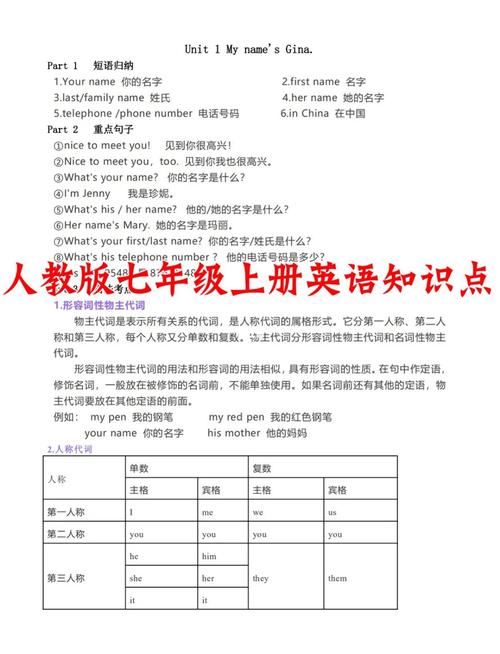
- What's your name? — My name is... / I'm...
- I'm... (我是...)
- This is... (这是...)
- Nice to meet you. — Nice to meet you, too.
关于物品所属
- What's this in English? — It's a/an...
- Spell it, please. — P-E-N.
- Is this/that your...? — Yes, it is. / No, it isn't.
- Are these/those your...? — Yes, they are. / No, they aren't.
- What color is it? — It's red.
- How much is this/that? — It's ten dollars.
- How much are these/those? — They are twenty dollars.
关于个人信息
- What's your phone number? — It's 138-XXXX-XXXX.
- Where are you from? — I'm from China.
- What's your favorite subject? — My favorite subject is English.
关于能力
- Can you...? — Yes, I can. / No, I can't.
- What can you do? — I can dance/sing/swim.
关于喜好与食物
- Do you like...? — Yes, I do. / No, I don't.
- Does he/she like...? — Yes, he/she does. / No, he/she doesn't.
- I like... / I don't like...
- Let's get... (让我们买/吃...)
关于时间与日期
- What time is it? — It's eight o'clock. / It's half past seven.
- What day is it today? — It's Monday.
- When is your birthday? — It's on October 1st.
第四部分:学习建议
- 词汇是王道: 每天坚持背诵和复习单词,利用词根词缀、联想记忆法等多种方法,不要死记硬背,准备一个词汇本,随时记录和复习。
- 语法要理解: 不要死记硬背语法规则,通过大量的例句去理解语法的使用场景,多做练习,尤其是句型转换和情景交际题。
- 开口说英语: 不要害怕犯错,可以跟着录音模仿朗读,或者和同学、家人进行简单的英语对话,语感是通过“说”来培养的。
- 多听多读: 听课本录音、简单的英文歌曲或看英文动画片,读课文、简单的英文小故事,这有助于培养你的语感和理解能力。
- 整理错题本: 把做错的题目(尤其是语法题)抄录下来,并写下正确答案和解析,定期回顾错题本,确保同样的错误不再犯第二次。
- 利用好课本: 课本是学习的根本,吃透课本里的每一个对话、课文和练习,你的基础就会非常牢固。
希望这份详细的总结能对你的学习有所帮助!祝你学习进步!