人教版七年级英语重点有哪些?
校园之窗 2026年1月17日 15:38:34 99ANYc3cd6
核心知识模块
七年级英语主要围绕“话题”展开,每个单元都有特定主题,掌握这些主题下的核心词汇和句型是关键。
上册重点
Unit 1: My name's Gina. (自我介绍与问候)
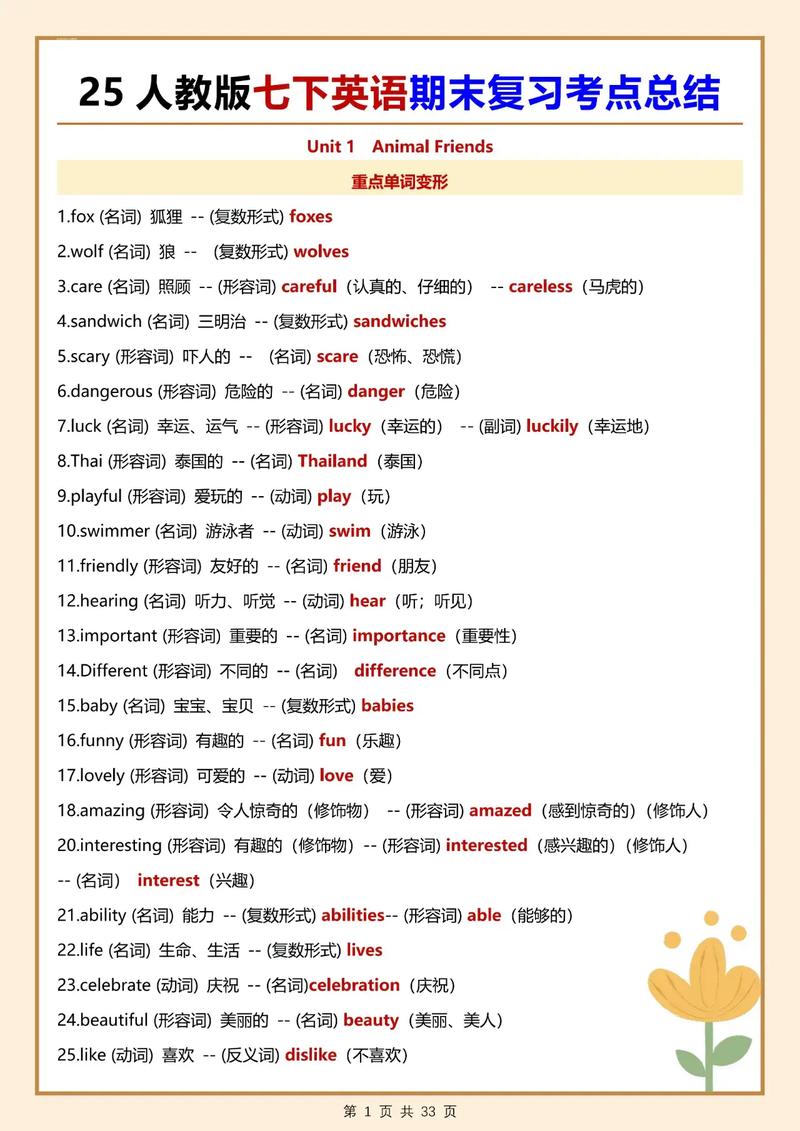
- 核心词汇:
- 名字: name, first name / given name, last name / family name
- 问候: hello, hi, good morning/afternoon/evening
- 数字: zero - one - two - nine (0-9)
- 国家: China, Japan, USA, England
- 形容词: nice, great
- 核心句型:
- 问候:
Hello! / Hi! - 自我介绍:
My name's... / I'm...(e.g.,My name's Gina./I'm Gina.) - 询问姓名:
What's your name? - 回答姓名:
My name's... / I'm... - 询问电话号码:
What's your telephone number? - 回答电话号码:
It's... / My phone number is... - 询问是/否:
Are you...?(e.g.,Are you Helen?) - 回答:
Yes, I am. / No, I'm not.
- 问候:
Unit 2: This is my sister. (家庭与朋友)
- 核心词汇:
- 家庭成员: father / dad, mother / mom, parents, brother, sister, grandfather / grandpa, grandmother / grandma, family
- 指示代词: this, that, these, those
- 形容词: old, young
- 核心句型:
- 介绍他人:
This is... / That is...(e.g.,This is my sister.) - 询问:
Is this/that your...? - 回答:
Yes, it is. / No, it isn't. - 复数介绍:
These are... / Those are...(e.g.,Those are my parents.) - 询问:
Are these/those your...? - 回答:
Yes, they are. / No, they aren't.
- 介绍他人:
Unit 3: Is this your pencil? (学校用品)
- 核心词汇:
- 文具: pencil, pen, book, eraser, box, schoolbag, dictionary, notebook
- 疑问词: What, How
- 核心句型:
- 确认物品:
Is this/that your...? - 回答:
Yes, it is. / No, it isn't. It's his/hers.(注意物主代词) - 询问物品:
What's this/that in English? - 回答:
It's a/an... - 拼写:
Spell it, please.->P-E-N.
- 确认物品:
Unit 4: Where's my schoolbag? (方位与位置)
- 核心词汇:
- 方位介词: in, on, under
- 名词: table, bed, bookcase, sofa, chair, bag, hat, head
- 核心句型:
- 询问位置:
Where's...?(单数) - 回答位置:
It's in/on/under... - 询问位置:
Where are...?(复数) - 回答位置:
They're in/on/under...
- 询问位置:
Unit 5: Do you have a soccer ball? (拥有与爱好)
- 核心词汇:
- 球类: soccer ball, basketball, volleyball, tennis ball, ping-pong ball/bat
- 动词: have, has, play, let's = let us
- 形容词: boring, interesting, fun, difficult, relaxing, watch, TV
- 核心句型:
- 询问拥有:
Do you/they have...?(主语是 you/they) - 回答:
Yes, I/they do. / No, I/they don't. - 询问第三人称拥有:
Does he/she have...?(主语是 he/she) - 回答:
Yes, he/she does. / No, he/she doesn't. - 提出建议:
Let's play.../That sounds good./That sounds boring.
- 询问拥有:
Unit 6: Do you like bananas? (食物与饮食习惯)
- 核心词汇:
- 水果: banana, apple, orange, strawberry, pear
- 蔬菜: carrot, tomato, broccoli
- 其他食物: egg, rice, chicken, ice-cream, hamburger, salad, breakfast, lunch, dinner
- 形容词: healthy, unhealthy
- 核心句型:
- 询问喜好:
Do you like...? - 回答:
Yes, I do. / No, I don't. - 表达喜好:
I like... / I don't like... - 询问三餐吃什么:
What do you like for breakfast?
- 询问喜好:
Unit 7-12 会继续学习星期、日期、季节、服装、价格、交通等话题,核心是围绕这些话题的词汇、现在进行时、情态动词 can 等。
下册重点
Unit 1: Can you play the guitar? (能力与俱乐部)
- 核心语法: 情态动词
can- 用法: 表能力、请求或许可。
- 构成:
can + 动词原形 - 肯定句:
I can sing. - 否定句:
I can't sing. / I can not sing. - 疑问句:
Can you sing? - 回答:
Yes, I can. / No, I can't.
- 核心词汇:
- 能力动词: sing, dance, swim, draw, play, speak, tell, join
- 乐器: guitar, piano, violin, drums
- 俱乐部: music club, art club, English club, chess club
- 短语:
talk to,story telling,kung fu
Unit 2: What time do you go to school? (日常作息与时间)
- 核心语法:
What time和When引导的特殊疑问句 + 一般现在时- 询问时间:
What time is it?->It's... - 询问具体做某事的时间:
What time do you...?(e.g.,What time do you go to school?) - 回答:
I... at...(e.g.,I go to school at 7:00.) - 询问某天做某事:
When do you...?(e.g.,When do you have math?) - 回答:
I... on...(e.g.,I have math on Monday.)
- 询问时间:
- 核心词汇:
- 时间: time, o'clock, a.m., p.m., minute
- 日常活动: go to school, get up, run, eat breakfast, clean, go to bed
- 频率副词: usually, always, never
Unit 3: How do you get to school? (交通方式)
- 核心语法:
How引导的特殊疑问句 + 一般现在时- 询问交通方式:
How do you get to school? - 回答:
I take the bus / subway / train./I walk./I ride a bike. - 询问距离:
How far is it from... to...? - 回答:
It's about... kilometers/meters. - 询问花费时间:
How long does it take? - 回答:
It takes about 20 minutes.
- 询问交通方式:
- 核心词汇:
- 交通: bus, subway, train, bike, car, walk, ride, stop, minute, kilometer, station, stop
Unit 4: Don't eat in class. (规则与建议)
- 核心语法: 祈使句 和
Don't+ 动词原形- 肯定祈使句:
Be quiet./Listen to the teacher./Clean the classroom. - 否定祈使句:
Don't be late./Don't eat in class./Don't run in the hallways.
- 肯定祈使句:
- 核心词汇:
- 规则: rule, school rules, hallway, dining hall, listen, fight, wear, uniform
- 情态动词:
have to(必须),can(可以)
Unit 5-12 会学习天气、过去式、过去进行时、形容词比较级等更复杂的语法点,但七年级下册的重点是掌握好情态动词 can、have to,以及 What time, How, When 引导的特殊疑问句。
重点句型总结
-
问候与介绍
Hello! / Good morning!My name is... / I am...What's your name?Nice to meet you.
-
确认与询问
Is this/that your...?->Yes, it is. / No, it isn't.Are these/those your...?->Yes, they are. / No, they aren't.Where is...?->It's in/on/under...Where are...?->They're in/on/under...
-
拥有
Do you have...?->Yes, I do. / No, I don't.Does he/she have...?->Yes, he/she does. / No, he/she doesn't.
-
喜好
Do you like...?->Yes, I do. / No, I don't.I like... / I don't like...
-
能力
Can you...?->Yes, I can. / No, I can't.Can he/she...?->Yes, he/she can. / No, he/she can't.
-
日常活动与时间
What time do you...?->I... at...When do you...?->I... on...
-
交通方式
How do you get to...?->I take the bus / walk...
-
规则
Don't...(不要做某事)You have to...(你必须做某事)
学习建议
-
词汇是基础,必须过关:
- 分类记忆: 按话题(如食物、运动、颜色)或词性(名词、动词、形容词)来背单词。
- 在语境中记: 不要孤立地背单词,要把它放到句子和课文中去理解和记忆。
- 定期复习: 利用艾宾浩斯遗忘曲线,每天、每周都要复习学过的单词。
-
语法是框架,要理解透彻:
- 理解概念: 不要死记硬背规则。
Do和Does的区别在于主语是第三人称单数时用Does。 - 多做练习: 通过做单选、填空、句型转换等练习来巩固语法知识。
- 造句运用: 学了一个新句型,马上用它来造几个句子,真正变成自己的东西。
- 理解概念: 不要死记硬背规则。
-
听说读写,全面发展:
- 听: 多听课本配套录音,模仿语音语调,可以看一些简单的英文动画片。
- 说: 大胆开口,不要怕错,可以和同学练习对话,或者自言自语描述身边的事物。
- 读: 坚持每天读课文,培养语感,可以尝试读一些简单的英文绘本或分级读物。
- 写: 从抄写句子开始,然后仿写句子,最后尝试写小短文、日记。
-
培养兴趣,持之以恒:
- 把英语学习和你的兴趣爱好结合起来,比如喜欢听歌就学英文歌,喜欢玩游戏就玩英文版。
- 学习语言是一个长期过程,贵在坚持,每天学习一点点,积少成多。
七年级英语的核心就是打好词汇和基础语法(一般现在时、情态动词、特殊疑问句)的底子,只要你认真对待,多听、多说、多读、多写,一定能学好!祝你学习进步!