八年级上册短语句子有哪些重点难点?
校园之窗 2026年1月3日 10:52:07 99ANYc3cd6
第一部分:核心短语
这些短语是每个单元的重点,建议结合课文语境记忆。
Unit 1: How often do you exercise? (谈论日常活动与频率)
- 频率副词:
always(总是),usually(,often(经常),sometimes(有时),hardly ever(几乎不),never(从不) - 活动类短语:
go shopping(去购物)go to the movies(去看电影)watch TV(看电视)exercise(锻炼)surf the Internet(上网)read books(读书)
- 生活习惯类短语:
stay up late(熬夜)eat less meat(少吃肉)eat junk food(吃垃圾食品)drink milk(喝牛奶)be good for(对……有好处)be bad for(对……有害处)
- 健康类短语:
help sb. with sth.(在某方面帮助某人)be stressed out(有压力的,紧张的)a balanced diet(均衡的饮食)at least(至少)more than(超过)
Unit 2: How do you get to school? (谈论交通方式)
- 交通方式:
take the subway / bus / train / taxi(乘地铁/公交车/火车/出租车)ride a bike(骑自行车)walk(步行)go by boat / plane / train / car(乘船/飞机/火车/汽车去)
- 距离与时间:
how far(多远)how long(多久)ten minutes' walk(十分钟的路程)the distance from...to...(从……到……的距离)
- 其他相关短语:
get to(到达)leave for(动身去……)cross the river(过河)be afraid of(害怕)have a fear of(对……感到恐惧)
Unit 3: What are you doing for vacation? (谈论假期计划)
- 假期活动:
go camping / hiking / fishing / bike riding(去露营/远足/钓鱼/骑自行车)go sightseeing(观光)visit museums(参观博物馆)rent videos(租录像带)babysit her sister(照看她妹妹)get back(回来)
- 时间短语:
for vacation(去度假)this weekend(这个周末)the whole day(一整天)the day after tomorrow(后天)pretty soon(很快)at home(在家)
Unit 4: How do you get to school? (谈论过去发生的事)
- 动词过去式:
go - went(去)do - did(做)see - saw(看见)visit - visited(参观)study - studied(学习)have - had(有)eat - ate(吃)buy - bought(买)
- 过去式短语:
do some reading(读点书)play the piano(弹钢琴)go to the cinema(去看电影)have a party(举办派对)find out(查明,发现)have a great time(玩得开心)work as(担任……工作)
Unit 5: Can you come to my party? (发出、接受和拒绝邀请)
- 邀请与答复:
have a party(举办派对)go to the movies(去看电影)hang out(闲逛)prepare for(为……做准备)the day before yesterday(前天)the day after tomorrow(后天)look after(照顾)help sb. do sth.(帮助某人做某事)
- 答复句式:
Sure, I'd love to.(我很乐意。)Sorry, I can't. I have to...(抱歉,我不能,我必须……)I'm sorry, I'm going to...(抱歉,我打算……)
Unit 6: I'm more outgoing than my sister. (谈论人的性格特征)
- 性格形容词:
outgoing(外向的)quiet(安静的)funny(滑稽的)serious(严肃的)hard-working(勤奋的)athletic(运动的)wild(疯狂的)tall / short(高/矮)long hair / short hair(长发/短发)
- 比较级短语:
more...than...(比……更……)both...and...(两者都……)make sb. laugh(让某人发笑)as...as...(和……一样)be similar to(与……相似)be different from(与……不同)
Unit 7: How do you make a banana milk shake? (描述制作过程)
- 制作步骤:
make a banana milk shake(制作香蕉奶昔)turn on(打开)cut up(切碎)peel(剥皮)pour...into...(把……倒入……)put...in...(把……放进……)mix up(混合)add...to...(把……加到……)finally(at first(起初)
- 食物相关:
yogurt(酸奶)honey(蜂蜜)watermelon(西瓜)popcorn(爆米花)turkey(火鸡)
Unit 8: How was your school trip? (谈论过去的经历)
- 评价类形容词:
great(精彩的)interesting(有趣的)boring(无聊的)terrible(糟糕的)exciting(令人兴奋的)lovely(美好的)
- 活动类短语:
go to the zoo(去动物园)climb a mountain(爬山)visit a museum(参观博物馆)buy sth. for sb.(为某人买某物)take some photos(拍些照片)learn a lot(学到很多)
- 过去式疑问词:
How was...?(……怎么样?)Did you...?(你……了吗?)What did you do?(你做了什么?)
Unit 9: When was he born? (谈论名人及重要事件)
- 出生与成就:
be born(出生)start doing sth.(开始做某事)stop doing sth.(停止做某事)become a famous pianist(成为一名著名的钢琴家)win a prize(获奖)world record(世界纪录)join the team(加入团队)
- 时间短语:
on January 1st, 2000(在2000年1月1日)when...?(……什么时候?)how long(多久)for + 时间段(持续……时间)
Unit 10: I'm watching TV. (谈论正在发生的事)
- 现在进行时标志词:
now,look,listen,it's...o'clock - 活动短语:
watch TV(看电视)clean the room(打扫房间)make soup(做汤)talk on the phone(打电话)read a newspaper(读报纸)wash the dishes(洗碗)exercise(锻炼)
- 地点短语:
at home(在家)in the kitchen(在厨房里)in the library(在图书馆里)at the pool(在游泳池)
第二部分:重点句型
这些句型是考试和口语交际中的核心,务必掌握其结构和用法。
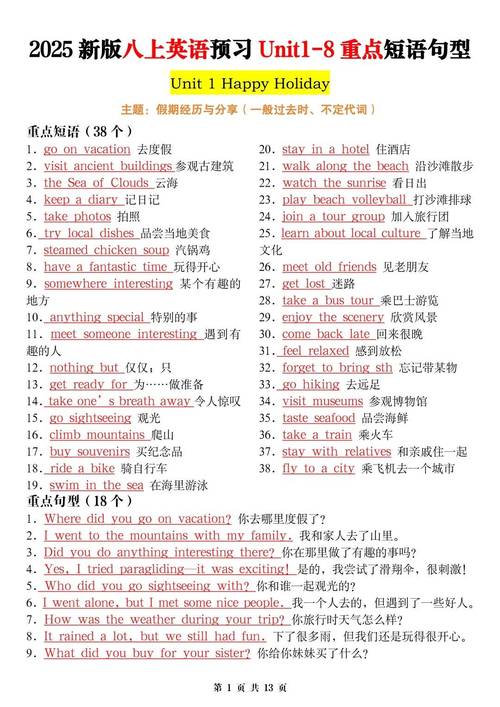
(图片来源网络,侵删)
How often 引导的特殊疑问句
- 句型:
How often + do/does + 主语 + 动词原形...? - 答语:
频率副词.或Every + 时间单位. - 例句:
- A:
How often do you exercise?(你多久锻炼一次?) - B:
I exercise every day.(我每天都锻炼。) - B:
I hardly ever exercise.(我几乎不锻炼。)
- A:
How / How long / How far 引导的特殊疑问句
- How long (多久 - 指时间):
- 句型:
How long + does it take + sb. + to do sth.? - 答语:
It takes + sb. + 时间 + to do sth. - 例句:
- A:
How long does it take you to get to school?(你到学校要花多长时间?) - B:
It takes me about 20 minutes.(大约要花我20分钟。)
- A:
- 句型:
- How far (多远 - 指距离):
- 句型:
How far + is it from...to...? - 答语:
It's + 距离 + away. - 例句:
- A:
How far is it from your home to school?(从你家到学校有多远?) - B:
It's about 3 kilometers away.(大约3公里远。)
- A:
- 句型:
现在进行时
- 结构:
am / is / are + 动词ing - 用法: 表示说话时正在进行的动作或现阶段的状态。
- 例句:
What are you doing?(你在做什么?)I'm watching TV.(我正在看电视。)He is reading a book in his room.(他正在他的房间里读书。)
比较级和最高级
- A + be + 比较级 + than + B (A比B更……)
- 例句:
My hair is longer than hers.(我的头发比她的长。)
- 例句:
- A + be + as + 原级 + as + B (A和B一样……)
- 例句:
Tom is as tall as his brother.(汤姆和他哥哥一样高。)
- 例句:
- A + be + the + 最高级 + (in/of...) (A是最……的)
- 例句:
He is the most hard-working student in our class.(他是我们班最勤奋的学生。)
- 例句:
过去式的一般疑问句和特殊疑问句
- 一般疑问句:
Did + 主语 + 动词原形...?- 例句:
Did you go to the park yesterday?(你昨天去公园了吗?)
- 例句:
- 特殊疑问句:
What/Where/When + did + 主语 + 动词原形...?- 例句:
What did you do last weekend?(你上周末做了什么?)Where did she go?(她去哪里了?)
- 例句:
发出邀请及回复
- 邀请:
Can you come to my...?(你能来我的……吗?)- 例句:
Can you come to my party on Saturday?(你周六能来我的派对吗?)
- 例句:
- 接受:
Sure, I'd love to./Yes, I'd love to.- 例句:
Sure, I'd love to. What time?(我很乐意,几点?)
- 例句:
- 拒绝:
Sorry, I can't. I have to.../I'm sorry, but I'm going to...- 例句:
Sorry, I can't. I have to visit my grandparents.(抱歉,我不能,我得去看望我的祖父母。)
- 例句:
祈使句
- 用法: 用于表达命令、请求、建议或指示。
- 结构:
动词原形 + 其他成分.或Let's + 动词原形. - 例句:
Peel the bananas.(剥香蕉。)Pour the milk into the blender.(把牛奶倒入搅拌机。)Let's make fruit salad.(我们来做水果沙拉吧。)
含情态动词 can 的被动语态
- 结构:
can be + 动词过去分词 - 用法: 表示某事可以被做,但不强调谁做的。
- 例句:
English can be spoken all over the world.(英语可以在全世界被说。)The door can be opened easily.(这门很容易被打开。)
希望这份详细的整理对你的学习有帮助!最好的学习方式是在句子和语境中理解和运用这些短语和句型,加油!
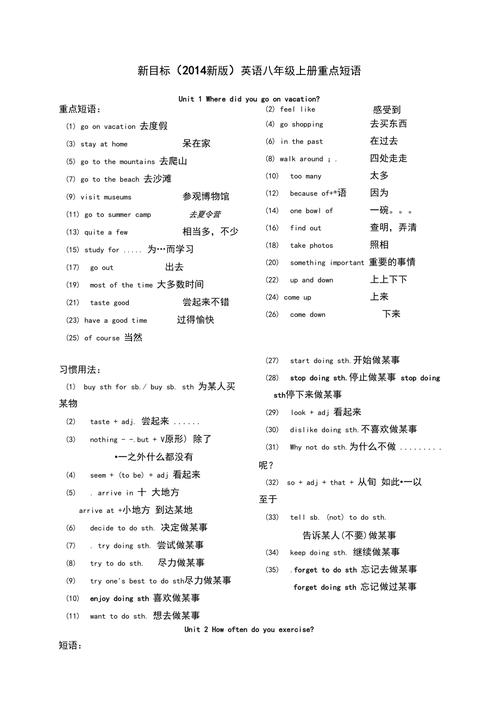
(图片来源网络,侵删)