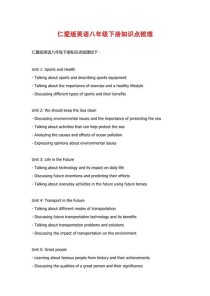
八年级上册英语单元重点
校园之窗 2025年12月24日 14:23:21 99ANYc3cd6
总览
八年级上册通常包含10个单元,重点围绕一般过去时、过去进行时、情态动词、比较级和最高级等核心语法展开,话题也更加贴近学生的日常生活和情感体验。
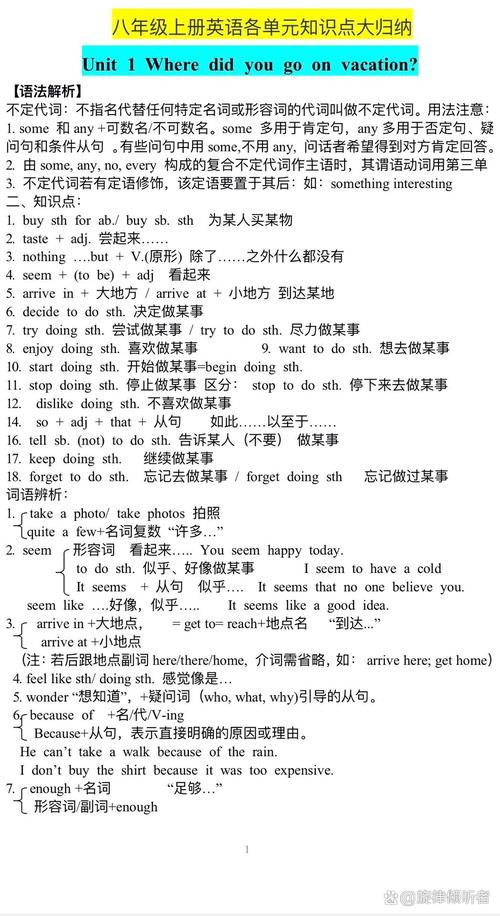
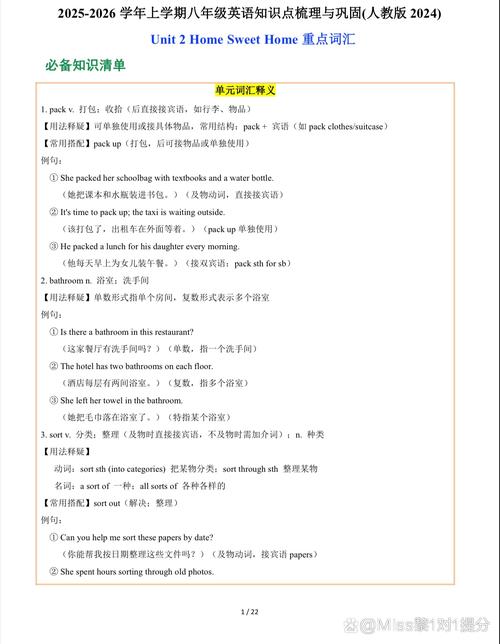
Unit 1: Where did you go on vacation? (你去哪里度假了?)
这是八年级上册的第一个单元,主要引入一般过去时。
(图片来源网络,侵删)
-
核心词汇:
- 名词:
vacation,beach,museum,movie,test,camp,hill,diary,bird - 动词:
decide,try,paraglide,feel,stay,fly,study,worry,miss - 形容词:
anyone,nothing,something,everyone,of course,bored,exciting,expensive,inexpensive,cheap - 疑问词:
anyone,anywhere
- 名词:
-
核心句型:
- 询问假期去向:
—Where did you go on vacation? —I went to New York City. - 询问假期活动:
—What did you do? —I went to the mountains. - 评价感受:
—Did you go with anyone? —Yes, I did. / No, I didn't. - 表达感受:
—How was the beach? —It was beautiful./—How were the people? —They were friendly. - 描述整体感受:
—How was your vacation? —It was great!
- 询问假期去向:
-
主要语法:
- 一般过去时: 本单元的重点。
- 构成:
主语 + 动词过去式 + 其他 - 动词过去式变化规则:
- 直接加 -ed:
work→worked - 以 e 结尾加 -d:
live→lived - 辅音+y 变 y 为 i 再加 -ed:
study→studied,cry→cried - 重读闭音节结尾,双写辅音字母再加 -ed:
stop→stopped
- 直接加 -ed:
- 常见不规则动词:
go→went,see→saw,buy→bought,eat→ate,do→did,have→had,get→got,feel→felt
- 构成:
- 一般过去时: 本单元的重点。
-
话题功能:
 (图片来源网络,侵删)
- 谈论过去的经历和假期活动。
- 描述过去发生的事情以及当时的感受。
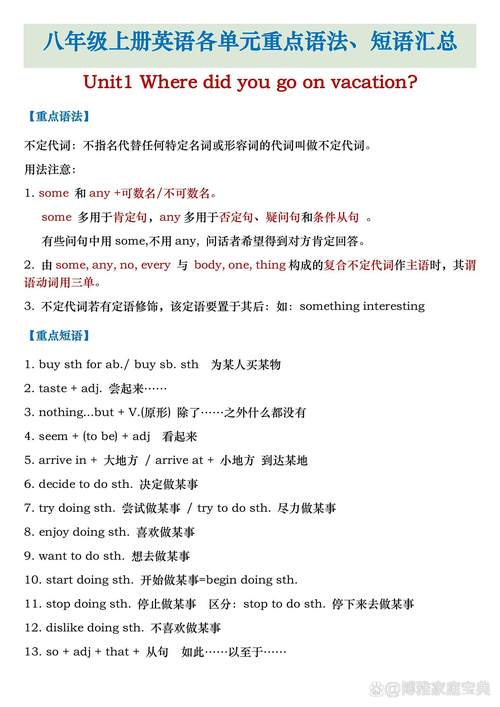
Unit 2: How often do you exercise? (你多久锻炼一次?)
本单元学习频率副词和一般现在时的用法。
-
核心词汇:
- 频率副词:
always(总是),usually(,often(经常),sometimes(有时),hardly ever(几乎不),never(从不) - 活动类:
exercise,go shopping,watch TV,use the Internet,get up,clean,read,etc. - 健康类:
health,healthy,unhealthy,habit,sleep,junk food
- 频率副词:
-
核心句型:
- 询问频率:
—How often do you exercise? —I exercise every day. - 询问活动:
—What do you usually do on weekends? —I sometimes watch TV. - 描述习惯:
My eating habits are pretty good./I try to eat a lot of vegetables.
- 询问频率:
-
主要语法:
 (图片来源网络,侵删)
- 频率副词: 用来表示动作发生的频率,通常放在实义动词之前,be 动词之后。
- 频率排序:
always(100%) >usually>often>sometimes>hardly ever>never(0%)
- 频率排序:
- How often 引导的特殊疑问句:
How often + do/does + 主语 + 动词原形...?
- 频率副词: 用来表示动作发生的频率,通常放在实义动词之前,be 动词之后。
-
话题功能:
- 谈论日常活动和健康的生活习惯。
- 使用频率副词描述自己和他人的生活方式。
Unit 3: I'm more outgoing than my sister. (我比我姐姐更外向。)
本单元学习形容词和副词的比较级。
-
核心词汇:
- 性格形容词:
outgoing,quiet,funny,serious,hard-working,smart,athletic - 比较级结构:
...than...,as...as... - 其他:
both,however,primary school,in common,be good at,make friends
- 性格形容词:
-
核心句型:
- 比较两者:
—Is Tom more outgoing than Sam? —Yes, he is./—Are you as friendly as your sister? —No, I'm not. I'm friendlier. - 描述共同点:
We both like sports./We are both tall./Both of us are students. - 表达观点:
I think a good friend makes me laugh.
- 比较两者:
-
主要语法:
- 形容词/副词的比较级:
- 规则变化:
- 一般直接加 -er:
tall→taller - 以 e 结尾加 -r:
nice→nicer - 辅音+y 变 y 为 i 再加 -er:
happy→happier - 重读闭音节结尾,双写辅音字母再加 -er:
big→bigger
- 一般直接加 -er:
- 不规则变化:
good/well→better,bad/badly→worse,many/much→more,far→farther/further
- 规则变化:
- 比较级的基本句型:
A + 动词 + 比较级 + than + B(A比B更...)A + be + as + 原级 + as + B(A和B一样...)A + be + not as/so + 原级 + as + B(A不如B...)
- 形容词/副词的比较级:
-
话题功能:
- 比较人与人之间的异同点。
- 描述朋友或家人的性格特点。
Unit 4: What's the best movie theater? (最好的电影院是哪家?)
本单元学习形容词和副词的最高级。
-
核心词汇:
- 评价类:
comfortable,seat,screen,close,ticket,worst,best,cheaply,quickly,service - 地点名词:
theater,cinema,mall,zoo,park - 动词:
choose,expect,creative,comfortable
- 评价类:
-
核心句型:
- 询问最佳选择:
—What's the best movie theater in town? —Sun Cinema. It's the closest to home. - 比较三者或以上:
—Which is the best clothes store? —Dream Clothes. It has the best quality. - 提出观点:
I think Town Cinema is the most popular. - 表达偏好:
I prefer movies that are scary and funny.
- 询问最佳选择:
-
主要语法:
- 形容词/副词的最高级: 用于三者或三者以上的比较,表示“最...”。
- 规则变化: 与比较级规则类似,将
-er变为-est。 - 不规则变化:
good/well→best,bad/badly→worst,many/much→most
- 规则变化: 与比较级规则类似,将
- 最高级的基本句型:
A + be + the + 最高级 + (in/of...)(A是最...)The + 最高级 + (in/of...)(在...中最...)
- 形容词/副词的最高级: 用于三者或三者以上的比较,表示“最...”。
-
话题功能:
- 对比不同的场所或事物,做出选择。
- 学会用最高级来表达个人偏好。
Unit 5: Do you want to watch a game show? (你想看游戏节目吗?)
本单元学习情态动词 want to 和 hope to,以及谈论喜好和计划。
-
核心词汇:
- 节目类型:
sitcom(情景喜剧),news,soap opera(肥皂剧),sports show,game show,talent show - 动词/短语:
want,hope,expect,plan,stand for,find out,meaning - 形容词:
meaningful,famous,educational,boring,terrible
- 节目类型:
-
核心句型:
- 表达意愿:
—Do you want to watch the news? —No, I don't. It's boring. - 表达希望:
I hope to find out what's going on around the world. - 询问意见:
What do you think of talk shows? - 表达观点:
I can't stand them./I love watching them./I don't mind them.
- 表达意愿:
-
主要语法:
- 情态动词
want to+ 动词原形: 表示“想要做某事”。 hope to+ 动词原形: 表示“希望做某事”。plan to+ 动词原形: 表示“计划做某事”。expect to+ 动词原形: 表示“期待做某事”。- 谈论喜好的句型:
What do you think of...?/How do you like...?I love/like/don't mind/can't stand/hate...
- 情态动词
-
话题功能:
- 谈论对不同电视节目、电影或书籍的看法。
- 表达自己的喜好和计划。
Unit 6: I'm watching TV. (我正在看电视。)
本单元学习现在进行时。
-
核心词汇:
- 家庭活动:
use,wash,dishes,make,soup,read,newspaper,exercise,go,shopping - 现在进行时标志词:
now,look,listen,at the moment - 其他:
juice,house,apartment,mall,pool
- 家庭活动:
-
核心句型:
- 描述正在进行的动作:
—What are you doing? —I'm watching TV. - 询问他人正在做什么:
—Is Jenny doing her homework? —Yes, she is. / No, she isn't. She's cleaning. - 描述场景:
This is Jenny. She's reading a book in the library.
- 描述正在进行的动作:
-
主要语法:
- 现在进行时:
- 构成:
am/is/are + 动词的-ing形式 - 用法: 表示说话时正在进行的动作,或现阶段正在进行的动作。
- 动词-ing形式构成规则:
- 一般直接加 -ing:
do→doing - 不发音的 e 去 e 加 -ing:
write→writing - 重读闭音节结尾,双写辅音字母再加 -ing:
sit→sitting - 以 ie 变 ie 为 y 再加 -ing:
lie→lying
- 一般直接加 -ing:
- 构成:
- 现在进行时:
-
话题功能:
- 描述当前正在发生的事情。
- 询问他人此刻的活动。
Unit 7: It's raining! (天在下雨!)
本单元学习现在进行时的另一种用法——描述天气,并引入How 引导的感叹句。
-
核心词汇:
- 天气状况:
sunny,cloudy,rainy,windy,snowy,weather,hot,cool,warm,cold - 描述感受的词:
bad,terrible,great,pretty good,not bad - 活动:
cook,study,bath,visit,walk,shop,watch,learn
- 天气状况:
-
核心句型:
- 描述天气:
—How's the weather? —It's raining./It's sunny and warm. - 表达感受:
How's it going? / How's everything going? - 回应感受:
Great! / Not bad. / Terrible! - 感叹句:
What a beautiful day!/How interesting!
- 描述天气:
-
主要语法:
- 用现在进行时描述天气:
It's + 动词-ing...(e.g.,It's raining.) - How's the weather? / What's the weather like? (询问天气的两种方式)
- How's it going? (询问近况的常用口语)
- 感叹句:
What + a/an + 形容词 + 名词 (+ 主语 + 谓语)!(e.g.,What a nice day it is!)How + 形容词/副词 (+ 主语 + 谓语)!(e.g.,How beautiful it is!)
- 用现在进行时描述天气:
-
话题功能:
- 谈论不同地方的天气情况。
- 根据天气情况谈论相应的活动。
Unit 8: How do you make a banana milk shake? (你如何做香蕉奶昔?)
本单元学习祈使句和可数名词与不可数名词,以及描述过程。
-
核心词汇:
- 食物:
banana,milk,shake,yogurt,honey,watermelon,spoon,pot,add,finally,mix,turn on,cut up - 过程词:
first,next,then,finally - 其他:
recipe,popcorn,corn,machine,salt,sugar
- 食物:
-
核心句型:
- 询问制作方法:
—How do you make a banana milk shake? —First, peel the bananas. - 下达指令/描述步骤:
Cut up the bananas./Put the bananas and yogurt into the blender./Turn on the blender. - 描述最终成品:
Finally, drink the milk shake.
- 询问制作方法:
-
主要语法:
- 祈使句: 用于表达命令、请求或指示。
- 肯定:
动词原形 + 其他...(e.g.,Open the door.) - 否定:
Don't + 动词原形 + 其他...(e.g.,Don't be late.)
- 肯定:
- 可数名词与不可数名词:
- 可数名词: 有单复数之分,可以用
a/an,many,few修饰。 (e.g.,banana→bananas,apple) - 不可数名词: 没有复数形式,不能用
a/an修饰,通常用much,little修饰。 (e.g.,milk,yogurt,honey,water)
- 可数名词: 有单复数之分,可以用
- 名词量的表达:
a cup of / a glass of / a bottle of + 不可数名词some / any + 不可数名词/可数名词复数
- 祈使句: 用于表达命令、请求或指示。
-
话题功能:
- 描述制作食物或饮料的步骤。
- 理解和遵循指令。
Unit 9: Can you come to my party? (你能来我的派对吗?)
本单元学习邀请、请求和回复,以及情态动词 can 的用法。
-
核心词汇:
- 活动邀请:
party,invitation,event,concert,exam,theater,trip,accept,refuse - 时间表达:
the day after tomorrow,tomorrow,tonight,this afternoon,this weekend,on Saturday - 回复理由:
prepare for,too much,have to,another time,look after
- 活动邀请:
-
核心句型:
- 发出邀请:
—Can you come to my party on Saturday afternoon? —Sure, I'd love to. / Sorry, I can't. I have to prepare for an exam. - 请求许可:
—Can I ask you some questions? —Yes, you can. / No, you can't. - 询问时间:
—When is the party? —It's at seven o'clock on Friday evening. - 提出建议:
Let's meet at the bus stop.
- 发出邀请:
-
主要语法:
- 情态动词
can的用法:- 构成:
can + 动词原形 - 用法: 表示能力、许可或请求。
- 否定:
can't / cannot + 动词原形 - 疑问句:
Can + 主语 + 动词原形...?
- 构成:
- 邀请与回复:
- 接受邀请:
Sure, I'd love to./Yes, I'd love to. - 拒绝邀请:
Sorry, I can't. I have to...(给出理由)
- 接受邀请:
- 情态动词
-
话题功能:
- 发出、接受和拒绝社交邀请。
- 学习如何礼貌地请求许可。
Unit 10: If you go to the party, you'll have a great time. (如果你去派对,你会玩得很开心。)
本单元学习if 引导的条件状语从句,即“主将从现”规则。
-
核心词汇:
- 情境词:
travel,famous,rich,around the world,get an education,make a lot of money,problem,give,wear,jeans,organize - 后果:
have a great time,be late,be happy,be famous,become a professional soccer player - 连词:
if,unless
- 情境词:
-
核心句型:
- 条件句:
If you do, you'll have a great time.(如果你这样做,你会玩得很开心。) - 预测结果:
If you wear jeans to the party, the teachers won't let you in. - 提出建议:
Should I wear my new jeans?
- 条件句:
-
主要语法:
- if 引导的条件状语从句 (第一类):
- 结构:
If + 主语 + 一般现在时, 主语 + will + 动词原形... - 规则: 在 if 引导的条件状语从句中,用一般现在时表示将来;主句用
will + 动词原形表示将来的结果,即“主将从现”。
- 结构:
unless的用法: 意思是“除非;如果不”,相当于if... not...。If you don't hurry, you'll be late.=Unless you hurry, you'll be late.
- if 引导的条件状语从句 (第一类):
-
话题功能:
- 讨论并预测某事可能带来的结果。
- 运用 if 条件句为他人提供建议。
学习建议
- 词汇是基础: 坚持每天背单词,利用词根词缀、联想记忆等方法,并放到句子中去理解和记忆。
- 语法是骨架: 不要死记硬背规则,多造句,多练习,理解每个语法的使用场景和核心概念(如“主将从现”)。
- 听力是关键: 多听课本录音、英文歌曲、简单的英文动画片,培养语感。
- 口语是应用: 大胆开口,可以和同学用英语对话,或者自言自语,描述身边的事物。
- 阅读是拓展: 适当阅读一些简单的英文读物,巩固所学词汇和语法,扩大知识面。
- 错题本是法宝: 准备一个错题本,记录做错的题目,分析错误原因,定期复习,避免再犯。
希望这份详细的重点总结对你的学习有帮助!加油!