仁爱英语七上句型有哪些重点?
校园之窗 2025年12月19日 21:54:25 99ANYc3cd6
核心基础句型
这些是构成英语句子的“骨架”,必须牢固掌握。
be 动词句型
be 动词是七年级上册绝对的重点,包括 am, is, are, was, were,主要用来表示“是”或状态。
① 肯定句
- 结构: 主语 + be动词 + 其他.
- 例句:
- I am a student. (我是一名学生。)
- You are my friend. (你是我的朋友。)
- He/She is a teacher. (他/她是一名老师。)
- It is a cat. (它是一只猫。)
- We/They are in the classroom. (我们在教室里。)
② 否定句
- 结构: 主语 + be动词 + not + 其他.
- 例句:
- I am not a teacher. (我不是老师。)
- She is not from China. (她不是来自中国。)
- They are not at home. (他们不在家。)
③ 一般疑问句
- 结构: Be动词 + 主语 + 其他?
- 答语: Yes, 主语 + be动词. / No, 主语 + be动词 + not.
- 例句:
- Are you a student? — Yes, I am. / No, I'm not. (你是学生吗? — 是的,我是。/ 不,我不是。)
- Is he your brother? — Yes, he is. / No, he isn't. (他是你哥哥吗? — 是的,他是。/ 不,他不是。)
- Are they from Japan? — Yes, they are. / No, they aren't. (他们来自日本吗? — 是的,他们是。/ 不,他们不是。)
④ 特殊疑问句
- 结构: 疑问词 + be动词 + 主语 + 其他?
- 常用疑问词: What (什么), Where (哪里), Who (谁), How (怎么样), How old (多大), What class (哪个班级)
- 例句:
- What's your name? — My name is Kangkang. (你叫什么名字? — 我的名字是康康。)
- Where is the book? — It's on the desk. (书在哪里? — 在桌子上。)
- Who is that girl? — She is my sister. (那个女孩是谁? — 她是我妹妹。)
- How old are you? — I am twelve. (你多大了? — 我十二岁。)
- What class are you in? — I am in Class 4, Grade 7. (你在哪个班? — 我在七年级四班。)
功能话题句型
这些句型围绕课本中的各个单元话题展开,实用性非常强。
问候与介绍
- Hello! / Hi! (你好!)
- Good morning/afternoon/evening. (早上/下午/晚上好。)
- How are you? — I'm fine, thank you. And you? — I'm OK, thanks. (你好吗? — 我很好,谢谢,你呢? — 我很好,谢谢。)
- Nice to meet you. — Nice to meet you, too. (很高兴认识你。 — 我也很高兴认识你。)
- This is... (这是...)
- This is my friend, Li Ming. (这是我的朋友,李明。)
- This is our teacher, Mr. Wang. (这是我们的老师,王老师。)
个人信息
- My name is... / I'm... (我的名字是... / 我是...)
My name is Jane. / I'm Jane.
- I'm from... (我来自...)
I'm from Beijing. (我来自北京。)
- I'm in Class..., Grade... (我在...年级...班)
I'm in Class Two, Grade Seven. (我在七年级二班。)
 (图片来源网络,侵删)
 - I'm... years old. (我...岁了。)
I'm 13 years old. (我13岁了。)
询问物品所属
- Is this/that your...? — Yes, it is. / No, it isn't.
(这是/那是你的...吗? — 是的,它是。/ 不,它不是。)
Is this your pencil? — Yes, it is. (这是你的铅笔吗? — 是的。)
- Are these/those your...? — Yes, they are. / No, they aren't.
(这些/那些是你们的...吗? — 是的,它们是。/ 不,它们不是。)
Are those your books? — No, they aren't. (那些是你们的书吗? — 不,不是。)
- What's this/that in English? — It's a/an...
(这个/那个用英语怎么说? — 它是一个...)
What's this in English? — It's a pen. (这个用英语怎么说? — 它是一支钢笔。)
谈论喜好
- Do you like...? — Yes, I do. / No, I don't.
(你喜欢...吗? — 是的,我喜欢。/ 不,我不喜欢。)
Do you like apples? — Yes, I do. (你喜欢苹果吗? — 是的,我喜欢。)
- Does he/she like...? — Yes, he/she does. / No, he/she doesn't.
(他/她喜欢...吗? — 是的,他/她喜欢。/ 不,他/她不喜欢。)
Does she like milk? — No, she doesn't. (她喜欢牛奶吗? — 不,她不喜欢。)
- I like... / I don't like... (我喜欢... / 我不喜欢...)
- I like playing basketball. (我喜欢打篮球。)
- I don't like math. (我不喜欢数学。)
谈论食物和点餐
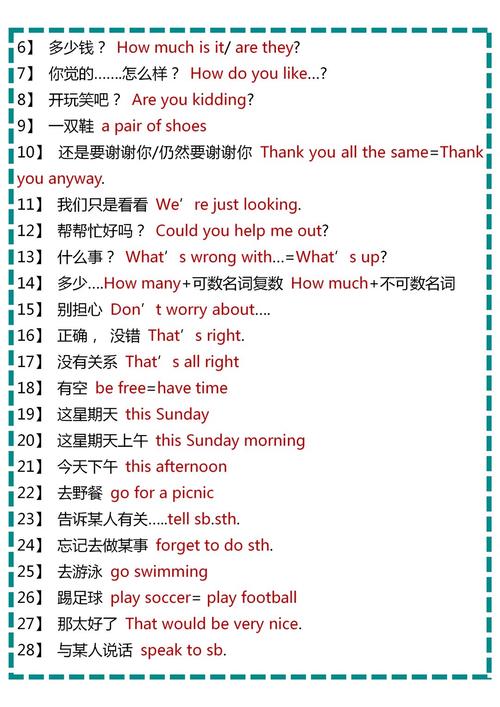
- What would you like? — I'd like some..., please.
(你想要点什么? — 我想要一些...,谢谢。)
What would you like? — I'd like some rice and fish. (你想要点什么? — 我想要一些米饭和鱼。)
- Would you like something to eat/drink? — Yes, please. / No, thanks. (你想要些吃的/喝的吗? — 好的,谢谢。/ 不用了,谢谢。)
- Can I have...? (我能要...吗?)
Can I have a cup of tea? (我能要一杯茶吗?)
谈论时间和日期
- What time is it? — It's... o'clock.
(现在几点了? — ...点。)
What time is it? — It's seven o'clock. (现在几点了? — 七点。)
- What day is it today? — It's Monday/Tuesday...
(今天星期几? — 星期一/星期二...)
What day is it today? — It's Friday. (今天星期几? — 星期五。)
- When is your birthday? — It's on...
(你的生日是什么时候? — 在...)
When is your birthday? — It's on May 1st. (你的生日是什么时候? — 在5月1日。)
提出建议和邀请
- Let's... (让我们...)
Let's go to the park. (我们去公园吧。)
- How about...? / What about...? (怎么样?)
How about playing soccer? (去踢足球怎么样?)
- Would you like to...? (你愿意...吗?)
Would you like to see a movie with me? (你愿意和我一起去看电影吗?)
- Shall we...? (我们...好吗?)
Shall we go home now? (我们现在回家好吗?)
谈论能力
- Can you...? — Yes, I can. / No, I can't.
(你会...吗? — 是的,我会。/ 不,我不会。)
Can you swim? — Yes, I can. (你会游泳吗? — 是的,我会。)
- I can... / I can't... (我会... / 我不会...)
- I can sing English songs. (我会唱英文歌。)
- I can't dance. (我不会跳舞。)
语法重点句型
这些句型包含了一些核心的语法知识点。
名词复数
- 结构: 主语 + be动词 + (these/those) + 复数名词 + 其他.
- 规则变化: 一般在词尾加
-s(book-books), 以 s, x, ch, sh 结尾加-es(box-boxes, watch-watches), 以“辅音字母+y”结尾变 y 为 i 再加-es(family-families)。 - 例句:
- These are apples. (这些是苹果。)
- Those are buses. (那些是公共汽车。)
- They are my classmates. (他们是我的同学。)
人称代词和物主代词
- 用法: 主格代词作主语,物主代词表示“某人的”。
- 例句:
- (I) am a boy. (My) name is Tom. (我是个男孩,我的名字是汤姆。)
- (He) is my friend. (His) bike is new. (他是我的朋友,他的自行车是新的。)
- (She) is a girl. (Her) hair is long. (她是个女孩,她的头发很长。)
- (It) is a cat. (Its) name is Mimi. (它是一只猫,它的名字是咪咪。)
- (We) are students. (Our) teacher is nice. (我们是学生,我们的老师很好。)
- (They) are in the park. (Their) balls are under the tree. (他们在公园里,他们的球在树下。)
祈使句
- 结构: 动词原形 + 其他. (表示命令、请求、建议)
- 例句:
- Open your book, please. (请打开你的书。)
- Look at the blackboard. (看黑板。)
- Don't be late. (不要迟到。)
- Don't talk in class. (上课不要说话。)
There be 句型 (表示“存在”)
- 结构: There be + (a/an/the/...) + 名词 + (地点状语).
- 例句:
- There is a bird in the tree. (树上有一只鸟。)
- There are some flowers on the desk. (桌子上有一些花。)
- — Is there a pen in your box? — Yes, there is. / No, there isn't. (你的盒子里有钢笔吗? — 有。/ 没有。)
- — Are there any students in the classroom? — Yes, there are. / No, there aren't. (教室里有学生吗? — 有。/ 没有。)
学习建议
- 大声朗读: 对着课本或笔记,把每个句型大声读出来,培养语感。
- 情景造句: 不要死记硬背,想象一个情景,用学过的句型自己造句子,看到桌上的苹果,就练习 "These are apples. They are red."
- 归纳总结: 定期把同类型的句型(比如所有关于“喜欢”的句型)整理在一起,对比记忆。
- 学以致用: 和同学、家人用简单的英语打招呼、介绍自己,把学到的句型用起来。
希望这份详细的句型总结对你的学习有帮助!加油!