九年级上册英语核心考点有哪些?
校园之窗 2025年12月13日 18:44:54 99ANYc3cd6
九年级英语上册核心知识点总结
九年级上册是整个初中阶段承上启下的关键时期,知识点难度和广度都有显著提升,复习时,不仅要掌握单个知识点,更要注重它们之间的联系和应用。
第一部分:核心语法点
宾语从句
这是本册的重点和难点,必须牢固掌握。
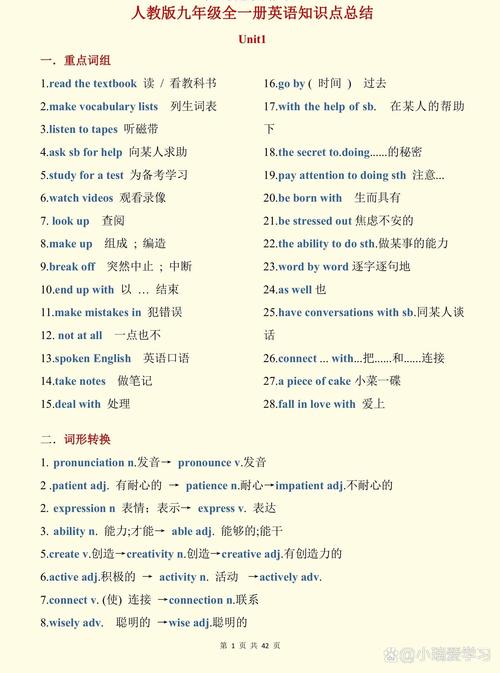
- 定义:在句子中作宾语的从句,它由一个引导词引导,跟在动词、介词或形容词后面。
- 引导词:
- that:无实际意义,只起连接作用,在口语和非正式文体中常被省略。
例:I think (that) he is right.
- if / whether:意为“是否”,不充当句子成分,不能省略。
- 例:I wonder if/whether it will rain tomorrow.
- 注意:介词后面只能用
whether,不能用if。 - 例:It depends on whether we have enough time.
- 特殊疑问词:who, what, which, when, where, why, how 等,它们在从句中充当相应的句子成分(主语、宾语、状语等)。
- 例:Can you tell me what time it is? (what 作 time 的定语)
- 例:I don't know why he is late. (why 作状语)
- that:无实际意义,只起连接作用,在口语和非正式文体中常被省略。
- 语序:无论主句的时态如何,宾语从句都必须使用陈述句语序(主语 + 谓语 + ...)。
- 错误:Do you know where is he?
- 正确:Do you know where he is?
- 时态:
- 主句是现在时或将来时,从句可以根据需要使用任何时态。
- 例:I know he was busy yesterday. (一般过去时)
- 例:I know he is busy now. (一般现在时)
- 例:I know he will be busy tomorrow. (一般将来时)
- 主句是过去时,从句通常需要使用过去的某种时态(“主过从过”原则)。
- 例:He said he was a student. (was 对应 is)
- 例:He told me that he had finished his homework. (过去完成时)
- 客观真理或事实,无论主句是什么时态,从句都用一般现在时。
- 例:The teacher told us that the earth moves around the sun.
- 主句是现在时或将来时,从句可以根据需要使用任何时态。
定语从句
这是本册的另一个语法重点,用来修饰名词或代词。
- 定义:在句子中作定语,修饰某一名词或代词的从句。
- 结构:被修饰的名词/代词 + 关系词 + 从句
- 关系词:
- that: 指代人或物,在从句中作主语或宾语,作宾语时可省略。
- 例:The book (that) I bought yesterday is very interesting. (that 指物,作 bought 的宾语,可省略)
- 例:The person that is standing over there is my teacher. (that 指人,作主语,不可省略)
- which: 指代物,在从句中作主语或宾语,作宾语时可省略。
例:The story (which) you told me is funny. (which 指物,作 told 的宾语,可省略)
- who: 指代人,在从句中作主语或宾语(作宾语时可省略,但较少见)。
例:The boy who is playing basketball is my brother. (who 指人,作主语)
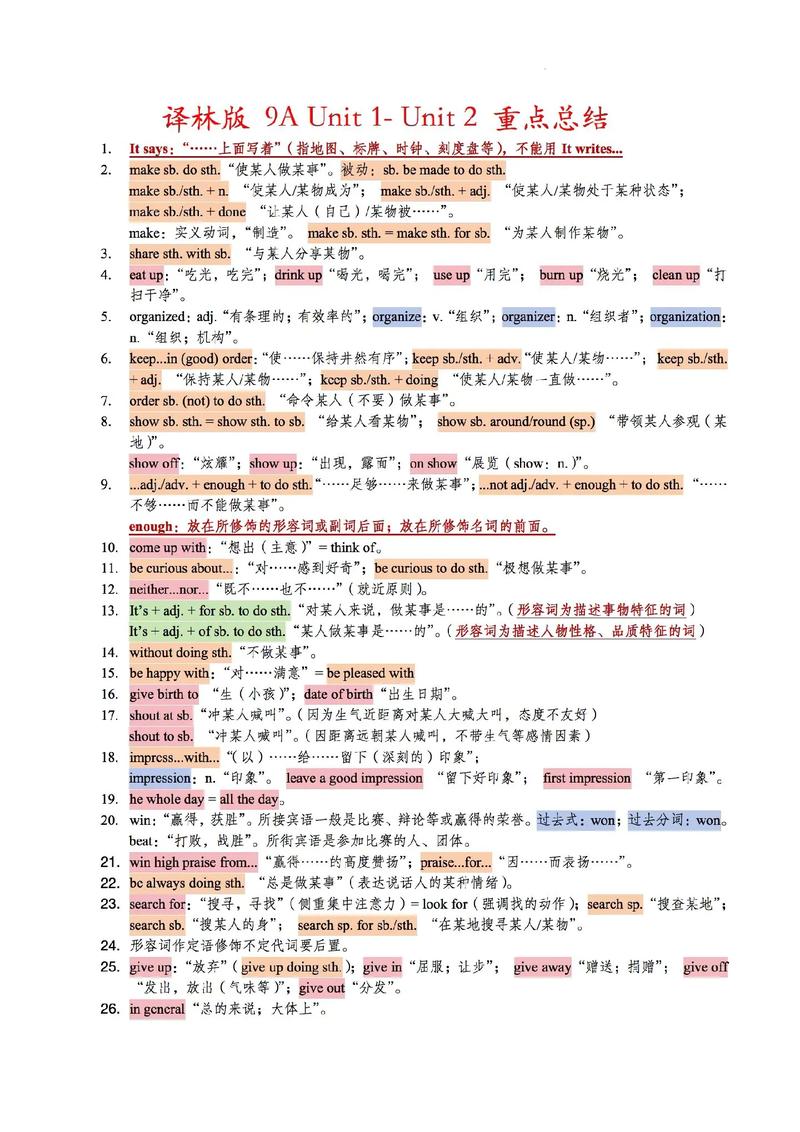 (图片来源网络,侵删)
 - whom: 指代人,在从句中作宾语,在现代英语中常被
who或that替代,或省略。例:The man (whom/who/that) I spoke to is our new boss.
- whose: 指代人或物,表示“……的”,在从句中作定语。
- 例:This is the boy whose father is a doctor. (whose 指男孩的)
- 例:I live in the house whose window faces south. (whose 指房子的)
- that: 指代人或物,在从句中作主语或宾语,作宾语时可省略。
- 关系副词:
- when: 指时间,在从句中作时间状语。
例:I still remember the day when I first came to this school.
- where: 指地点,在从句中作地点状语。
例:This is the town where I was born.
- why: 指原因,在从句中作原因状语,常与
reason搭配。例:Do you know the reason why he was late?
 (图片来源网络,侵删)
- when: 指时间,在从句中作时间状语。
被动语态
- 定义:主语是动作的承受者,而不是执行者。
- 结构:
be + 动词的过去分词 - 时变化:
- 一般现在时:am/is/are + done
例:Homework is finished every day.
- 一般过去时:was/were + done
例:The book was written by Lu Xun.
- 一般将来时:will be + done / am/is/are going to be + done
例:A new school will be built next year.
- 现在完成时:have/has been + done
例:This work has been finished already.
- 含有情态动词的被动语态:can/may/should + be + done
例:The room must be cleaned right now.
- 一般现在时:am/is/are + done
- 用法:
- 不知道或没必要指出动作的执行者。
- 强调动作的承受者。
- 在科技、新闻、正式文体中使用广泛,显得客观。
情态动词
- can / could:
can: 能力,许可 (can't = can not)could:can的过去式,表示过去的能力;更委婉的请求或许可。
- may / might:
may: 许可,可能性 (may not)might:may的过去式,可能性比may更小。
- must / have to:
must: 必须,一定 (mustn't = must not,表示“禁止”)have to: 不得不,强调客观需要。have to有多种时态形式,must只有现在时。
- should / ought to:
- 应该,表示责任或建议。
shouldn't表示“不应该”。
- 应该,表示责任或建议。
- will / would:
will: 意愿,将来时助动词would:will的过去式;表示委婉的请求或意愿。
非谓语动词
主要包括不定式、动名词和分词。
- 不定式:
- 作主语: To learn English well is important. (常用
It is + adj. + to do sth.结构) - 作宾语: want to do, decide to do, hope to do, agree to do 等。
- 作宾语补足语: ask sb. to do, tell sb. to do, find it + adj. + to do。
- 作定语: I have a lot of work to do. (to do 修饰 work)
- 作状语: He came to see me yesterday. (表目的)
- 作主语: To learn English well is important. (常用
- 动名词:
- 作主语: Swimming is my favorite sport.
- 作宾语: enjoy doing, finish doing, practice doing, be busy doing 等。
- 作定语: a swimming pool (a pool for swimming)
- 分词:
- 现在分词: 主动或进行,a sleeping baby (正在睡觉的婴儿), an interesting book (一本有趣的书)。
- 过去分词: 被动或完成,a broken window (一扇破窗户), a written report (一份写好的报告)。
第二部分:核心词汇与短语
以下是本册核心话题下的重点词汇和短语。
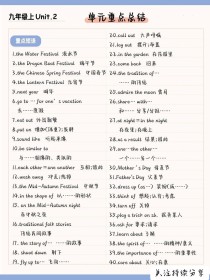
Unit 1 How can we become good learners?
- 重点词汇:
aloud, pronunciation, discover, repeat, note, physics, partner, increase, speed, create, knowledge, review, wisely, born, attention, concentrate, born with, pay attention to, connect...with..., depend on, take notes, look up - 重点句型:
- How do you study for a test?
- I learn by working with a group.
- It's too hard to understand the voice.
- Watching films is helpful to learn English.
Unit 2 I think that mooncakes are delicious!
- 重点词汇:
mooncake, lantern, relative, pound, celebrate, holiday, spider, treat, Christmas, present, warm, spread, put on, lay out, admire, get together, Christmas Eve, lay the table, share joy - 重点句型:
- What do you like about...?
- I love the smell... and the sweet taste...
- I think that... / I wonder if...
- They give gifts to each other.
Unit 3 Could you please tell me where the restrooms are?
- 重点词汇:
restroom, stamp, postcard, pardon, rush, suggest, bookstore, direct, passage, polite, request, direction, correct, impolite, go along, pass by, on one's way to, look forward to - 重点句型:
- Could you please tell me where I can buy some stamps?
- Excuse me, could you tell me...?
- Pardon me? / I beg your pardon?
- I'm looking for a bookstore.
Unit 4 I used to be afraid of the dark.
- 重点词汇:
humorous, silent, helpful, from time to time, score, background, interview, dare, private, guard, require, European, African, take pride in, in public, be proud of, no longer / not...any longer - 重点句型:
- I used to be afraid of the dark.
- I didn't use to like tests.
- Did you use to play the piano?
- He's not afraid of speaking in public anymore.
Unit 5 What are the shirts made of?
- 重点词汇:
chopstick, fork, blouse, silver, steel, glass, cotton, environment, product, widely, process, be made of/from, be known for, even though, as far as I know, take place, by hand - 重点句型:
- What is this shirt made of?
- It's made of cotton.
- Where are these products made?
- They are made in China.
Unit 6 When was it invented?
- 重点词汇:
invent, list, mention,pleasant,pleasant,divide,remain,pleasant,accidental,crispy,salty,sour,by mistake,according to,without doubt,fall into,at that time,by accident - 重点句型:
- When was the telephone invented?
- It was invented in 1876.
- What is it used for?
- It's used for connecting people.
Unit 7 Teenagers should be allowed to choose their own clothes.
- 重点词汇:
license, safety, smoke, pier, hug, lift, terrible, afford, choose, instead, pressure, society, manage, society, part-time job, be allowed to, look after, spend...on..., at least, get a driver's license, worry about - 重点句型:
- Teenagers should be allowed to choose their own clothes.
- I agree. / I disagree.
- Sixteen-year-olds should not be allowed to drive.
- I don't think sixteen-year-olds should be allowed to work at night.
Unit 8 It must belong to Carla.
- 重点词汇:
belong, picnic, rabbit, attend, valuable, pink, anybody, sleepy, neighbor, station, noise, invent, present, mystery, whose, must be, might be, could be, can't be, belong to - 重点句型:
- Whose book is this? It must be Carla's.
- It could be Mei's.
- It might be Tom's.
- It can't be Mary's.
Unit 9 I like music that I can dance to.
- 重点词汇: prefer, lyric, gentle, electronic, suppose, spare, director, painful, sadness, pain, reflect, performance, stick, to one's surprise, in fact, sing along with, take it easy, count on, cheer up
- 重点句型:
- I prefer music that has great lyrics.
- I like music that I can sing along with.
- The music that was popular in the 1990s reminds me of those days.
Unit 10 You're supposed to shake hands.
- 重点词汇: be supposed to, shake, bow, kiss, greet, value, capital, noon, mad, get mad, make plans, point at, drop by, after all, for example, exchange gifts, pick up, table manners
- 重点句型:
- What are you supposed to do when you meet someone for the first time in Japan?
- You're supposed to bow.
- You should also kiss them on the cheek.
第三部分:功能意念项目
- 提出建议: Why don't you...? You should... / You could... Let's... / Shall we...?
- 表达同意与不同意: I agree. / I think so. / That's a good idea. / I don't agree. / I'm afraid not.
- 表达喜好: I love / like / prefer / enjoy... (doing) sth. I don't mind... / I can't stand...
- 表达推测: It must be... / It might/could be... / It can't be... / I guess...
- 表达义务与责任: You must... / You have to... / You should... / You are supposed to...
- 请求许可: Could I...? / May I...? / Is it OK if I...?
- 谈论过去的习惯: I used to... / I didn't use to... / Did you use to...?
第四部分:学习建议
- 建立语法体系: 不要孤立地记语法规则,把宾语从句、定语从句等核心语法点串联起来,理解它们在句子中的作用和相互关系。
- 在语境中记单词: 不要死记硬背单词表,把单词放到课文、对话和例句中去理解和记忆,并尝试用它们造句。
- 重视阅读和听力: 通过阅读不同题材的文章(如课本、新闻、简易读物)来巩固词汇和语法,培养语感,多听英语材料,提高听力理解能力。
- 勤于练笔和开口: 尝试用英语写日记、小作文或回答问题,大胆开口说英语,可以自言自语,也可以和同学练习对话。
- 整理错题本: 把做错的题,特别是语法题,记录下来,分析错误原因,定期复习,避免再犯。
希望这份总结能帮助你高效地复习九年级英语上册的知识!祝你学习进步!