九年级英语知识点如何高效归纳总结?
校园之窗 2025年12月11日 08:36:55 99ANYc3cd6
九年级英语核心知识点归纳总结
九年级英语是整个初中阶段的收尾和升华,知识点不仅数量增多,难度和综合性也显著提升,它要求学生不仅要掌握新的语言知识,更要熟练运用已有的知识进行综合输出(写作和口语)。
第一部分:核心语法
语法是英语的骨架,九年级的语法重点是复杂从句和动词的高级用法。
宾语从句
在八年级基础上深化,掌握不同引导词的用法和语序。
-
引导词:
- that: 无实际意义,只起连接作用,在从句中不充当任何成分,可省略。
I know (that) he is right.
- if/whether: “是否”,在从句中不充当成分,不可省略,常与
or not连用。- Please ask if/whether he will come.
- I don't know whether it will rain or not.
- 特殊疑问词 (what, where, when, why, how, who 等): 在从句中充当主语、宾语、表语或状语。
- Can you tell me where the bus station is? (作表语)
- I wonder what he is doing. (作宾语)
- that: 无实际意义,只起连接作用,在从句中不充当任何成分,可省略。
-
语序: 宾语从句必须使用陈述句语序 (主语 + 谓语)。
 (图片来源网络,侵删)
- 错误:Do you know where is he?
- 正确:Do you know where he is?
-
时态一致性: 如果主句是现在时或将来时,从句可根据实际情况使用任何时态,如果主句是过去时,从句通常需要使用相应的过去时态 (一般过去时、过去进行时、过去完成时等)。
- He said (that) he was busy.
- She told me that she would come.
状语从句
这是九年级语法的重点和难点,主要掌握时间、条件、原因、让步、结果、目的等状语从句。
-
时间状语从句: 由
when, while, as, before, after, since, till/until, as soon as等引导。- when, while, as 的区别:
when: 可指“在...时”(点或段),主从句动作可同时发生,也可一前一后。while: 强调“在...期间”(段),主从句动作通常同时进行,从句常用进行时。as: 强调“一边...一边...”,或“随着...”。
- 时态:
when, as soon as, not...until等引导的从句,若用 一般现在时,主句用 一般将来时。- I will call you as soon as I arrive.
- when, while, as 的区别:
-
条件状语从句: 由
if, unless(除非,如果不) 引导。 (图片来源网络,侵删)
- 时态: 同样遵循“主将从现”原则。
- If it rains tomorrow, we will cancel the picnic.
- 时态: 同样遵循“主将从现”原则。
-
原因状语从句: 由
because, since, as引导。because: 语气最强,回答why提出的问题。since/as: 语气较弱,意为“由于,既然”,常表示对方已知的事实或理由。
-
让步状语从句: 由
though, although, even though/if引导。- 注意:
though/although不能与but连用,但可与yet, still连用。- 错误:Although he is poor, but he is happy.
- 正确:Although he is poor, he is happy. / He is poor, but he is happy.
- 注意:
-
结果状语从句: 由
so...that...(..以至于...) 和such...that...(..以至于...) 引导。so + adj./adv. + that...- He was so tired that he fell asleep.
such + (a/an) + adj. + n. + that...- It was such a nice day that we went out for a walk.
-
目的状语从句: 由
so that, in order that引导,从句中常含有can, could, may, might, will, would等情态动词。- He got up early so that he could catch the first bus.
情态动词
掌握 can, may, must, should, need, used to 等情态动词的过去式和用法。
- can/could:
could是can的过去式,也可表示更委婉的请求。Could you help me? (比 Can you? 更礼貌)
- may/might:
might是may的过去式,可能性比may更小。 - must/have to:
must表示主观“必须”,否定式mustn't表示“禁止”。have to表示客观“不得不”,有人称和数的变化,否定式don't/doesn't have to表示“不必”。
- should: 应该,建议。
- need: 需要,用作情态动词时多用于否定句和疑问句。
- used to: 过去常常做某事,现在不做了。
- He used to smoke, but he doesn't now.
被动语态
九年级重点学习各种时态的被动语态。
- 基本结构:
be + 动词的过去分词 - 常见时态:
- 一般现在时: am/is/are + p.p.
- 一般过去时: was/were + p.p.
- 一般将来时: will be + p.p. / am/is/are going to be + p.p.
- 现在完成时: have/has been + p.p.
- 含有情态动词: can/may/must/should + be + p.p.
- 主动变被动:
- 宾语变主语。
- 谓语动词变
be + p.p.。 - 主语变
by + 宾格,可省略。
- 主动:We clean the classroom every day.
- 被动:The classroom is cleaned by us every day.
非谓语动词
重点是动词不定式 to do 的用法。
- 作宾语:
want, hope, decide, agree, learn, plan, try等动词后常接to do。- I want to learn French.
- 作宾语补足语:
ask, tell, want, would like, invite等动词后。- The teacher told us to keep quiet.
- 作目的状语:
to do或in order to do。- He studies hard to pass the exam.
- 作定语: 放在名词后面,表示“做...的”。
- I have a lot of work to do.
- “疑问词 + to do” 结构: 作主语、宾语等。
- How to solve the problem is a big question. (作主语)
- I don't know what to do. (作宾语)
第二部分:核心词汇与短语
九年级词汇量要求更高,且更注重短语搭配和一词多义。
-
重点话题词汇:
- Unit 1-2 (How do you study for a test?):
flashcard, vocabulary, aloud, pronunciation, specific, memorize, grammar, frustrating, discover, look up, take notes, make mistakes, be afraid to, join, practice speaking - Unit 3-4 (What are you doing for vacation?):
plan, camp, lake, beach, hiking, away, get back, take photos, rent, forget to, decide on, invite, fish, wonder, plan to, leave for - Unit 5-6 (I'm watching TV. / It's raining.):
shower, cook, study, rain, hard, windy, cold, vacation, lie, beach, lake, host family, surprise, look for, postcard - Unit 7-8 (I'd like some noodles. / You're supposed to shake hands.):
noodle, beef, mutton, cabbage, potato, special, juice, tea, porridge, menu, would like, size, bowl, large, medium, small, tea, tradition, custom, bow, kiss, shake hands, be supposed to, should, important, capital - Unit 9-10 (Have you ever been to a museum? / By the time I got outside, the bus had already left.):
amusement park, water park, aquarium, zoo, space museum, have been to, have gone to, boat, outdoor, hang out, mall, especially, dislike, finish, yet, ever, never, already, just, past, present perfect tense, by the time, oversleep, rush, block, lock, get married - Unit 11-12 (Could you please tell me where the restrooms are? / You're supposed to write quickly.): 问路指路:
restroom, shampoo, drugstore, bookstore, department store, escalator, elevator, corner, straight, turn left/right, go along, block, on one's right/left, excuse me, could you please...被动语态 & 情态动词:be supposed to, introduce, point, correct, drop, break, open, park
- Unit 1-2 (How do you study for a test?):
-
重点短语与句型:
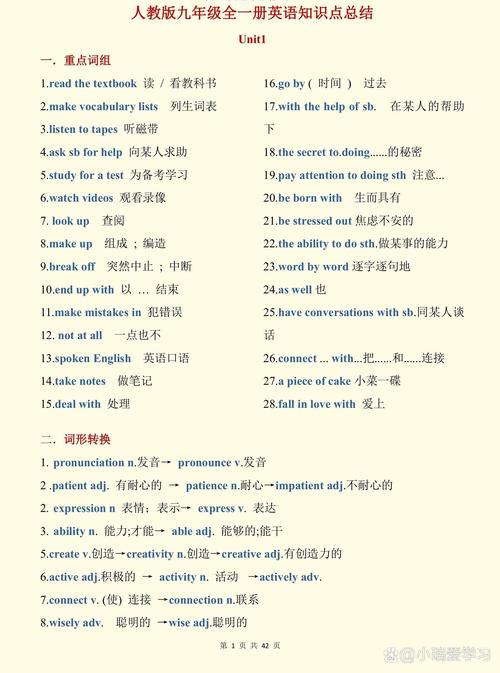
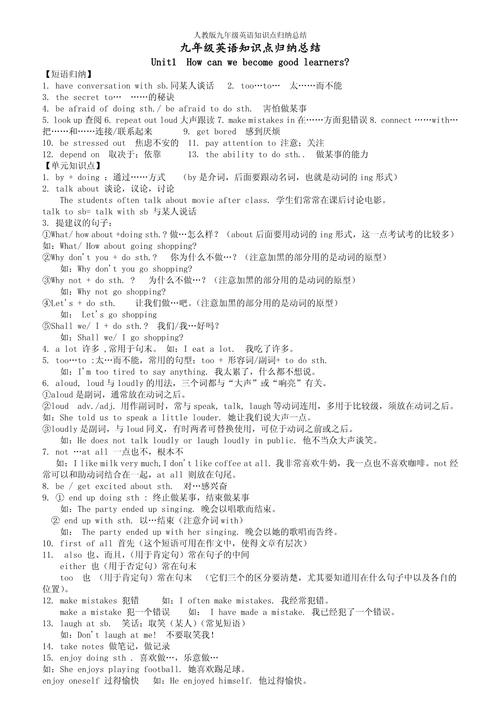
find out(查明,发现)end up(以...告终)laugh at(嘲笑)take notes(做笔记)give up(放弃)deal with(处理,应对)look up to(钦佩,仰慕)pay attention to(注意)instead of(代替,而不是)be interested in(对...感兴趣)help out(帮助...摆脱困境)so...that.../such...that...(..以至于...)too...to...(太...而不能...)not...until...(直到...才...)spend time/money (in) doing sth. / on sth.(花时间/金钱做某事)It's + adj. + for sb. to do sth.(对某人来说做某事是...)There's no need to do sth.(没必要做某事)
第三部分:功能意念项目与话题
九年级更强调语言的交际功能。
-
主要功能意念项目:
- 表达观点: I think/believe/suppose... / In my opinion... / From my point of view...
- 同意与不同意: I agree. / I don't agree. / That's a good point. / I'm afraid I can't agree with you.
- 做出决定: Let's... / I've decided to... / I think we should...
- 表达喜好与厌恶: I love/enjoy... / I hate/dislike... / I'm not fond of...
- 提出建议: Why don't you...? / You should... / What about...? / How about...?
- 寻求帮助: Could you help me...? / I wonder if you could...?
- 感谢与道歉: Thank you so much. / I'm sorry for... / I apologize for...
- 邀请与应答: Would you like to...? / I'd love to. / I'd like to, but...
-
核心话题:
- 学习方法与态度: 如何学习英语,学习中的困难与解决方法。
- 假期计划与活动: 假期打算去哪里,做什么。
- 日常生活与习惯: 描述正在发生的事情和日常活动。
- 饮食与健康: 点餐,谈论不同国家的饮食文化和餐桌礼仪。
- 旅行与经历: 谈论去过的有趣地方,分享旅行经历。
- 文化习俗与礼仪: 了解和讨论不同国家的文化差异,如问候、送礼、餐桌礼仪等。
- 问路与指路: 在公共场所如何礼貌地询问和指路。
- 科技与现代生活: 科技对生活的影响,如网络、手机等。
第四部分:应试技巧
-
听力:
- 提前审题: 利用读题时间,快速浏览题目和选项,预测可能听到的内容。
- 抓关键词: 注意听数字、人名、地名、时间、转折词 (
but, however) 等。 - 记笔记: 简单记录关键信息,特别是数字和比较级、最高级。
-
完形填空:
- 通读全文: 第一遍快速阅读,了解大意,不要急于选择。
- 瞻前顾后: 空格的答案往往取决于上下文,注意前后句的逻辑关系。
- 固定搭配: 注意动词短语、介词短语等的固定搭配。
- 词义辨析: 仔细分析四个选项在词义、词性、用法上的区别。
- 复读检查: 填完后将全文再读一遍,看是否通顺、逻辑是否连贯。
-
阅读理解:
- 先看题干,带着问题读文章: 这样可以有针对性地寻找信息,提高效率。
- 定位信息: 找到问题在原文中的出处,仔细比对。
- 理解主旨: 注意文章的开头、结尾和段落首尾句,它们通常是文章的中心思想。
- 推理判断: 对于推断题,答案通常不会直接出现在原文中,需要根据文中的线索进行合理推断。
- 猜测词义: 遇到生词,不要慌张,可以通过上下文、同位语、对比关系等猜测其意思。
-
书面表达:
- 认真审题: 明确写作要求(文体、要点、人称、时态)。
- 列提纲: 简单规划文章结构,确保要点齐全,逻辑清晰。
- 用好句型: 适当运用九年级学的宾语从句、状语从句、被动语态等复杂句型,提升文章档次。
- 连词成篇: 使用
and, but, so, because, however, first, then, finally等连接词,使文章过渡自然。 - 检查修改: 写完后,检查语法错误(时态、主谓一致、单复数)、拼写错误和标点符号。
总结建议:
- 构建知识体系: 不要孤立地记单词和语法,要将它们放到话题和句子中去理解和记忆。
- 多做真题: 通过练习历年中考题,熟悉题型,查漏补缺,总结规律。
- 整理错题本: 把做错的题(尤其是语法和完形)整理下来,分析错误原因,定期回顾。
- 坚持阅读和听力: 每天坚持进行一定量的英文阅读(如简易读物、新闻)和听力训练(如英文歌曲、动画片、新闻),培养语感。
希望这份总结能对你的九年级英语学习有所帮助!祝你取得优异的成绩!