春节英语作文怎么写?精选范文与写作技巧助你拿高分
作文示例 2026年2月1日 01:25:28 99ANYc3cd6
- 春节的核心主题与关键词
- 英语作文结构建议(三段式)
- 不同难度水平的范文参考
- 实用词汇与句型
- 写作小贴士
春节的核心主题与关键词
在动笔之前,先确定你想表达的核心内容,春节不仅仅是吃喝玩乐,它背后有深厚的文化内涵。
核心主题:
- Family Reunion (家庭团聚): 这是最重要的主题,无论身在何处,人们都会想方设法回家与家人团聚。
- New Beginnings (新的开始): 春节是新年的开始,象征着告别过去一年的不顺,迎接新一年的希望和好运。
- Tradition & Culture (传统与文化): 春节承载了上千年的习俗,如贴春联、放鞭炮、包饺子、发红包等,是中国文化的集中体现。
- Hope & Good Fortune (希望与好运): 人们通过各种仪式和活动,祈求新的一年健康、幸福、成功和财富。
- Nian (年兽): 传说中吓跑“年兽”的爆竹声,是春节放鞭炮习俗的由来。
- Red (红色): 春节的代表色,象征喜庆、幸运和驱邪。
- Dumplings (饺子): 北方传统食物,因其形状像元宝,寓意“招财进宝”。
- Lucky Money / Red Envelopes (红包): 长辈给晚辈的装有压岁钱的红色信封,寓意祝福和辟邪。
- Spring Festival Couplets (春联): 贴在门框两侧的对联,写有吉祥的话语。
- Family Reunion Dinner (年夜饭): 除夕夜全家人一起吃的大餐,是一年中最重要的一顿饭。
- Fireworks / Firecrackers (烟花/鞭炮): 用于庆祝和驱赶“年兽”。
- Cleaning the House (扫尘): 在年前大扫除,寓意“扫除”去年的晦气。
英语作文结构建议(三段式)
一篇好的作文需要有清晰的结构,这里推荐最经典的三段式结构。
第一段:引言
- 简要介绍春节是什么,可以说它是中国最重要的传统节日,类似于西方的圣诞节。
- 句式: 可以用一个概括性的句子开头,"The Spring Festival, also known as Chinese New Year, is the most important traditional festival in China."
- 目的: 引出主题,让读者对春节有一个初步的了解。
第二段:主体
- 这是文章的核心,需要详细描述,可以分几个方面来写:
- 准备工作: 描述节前的准备工作,如大扫除、贴春联、买年货等。
- 核心活动: 描述最重要的活动,如除夕夜的年夜饭、家人团聚、看春晚等。
- 特色习俗: 描述一些有代表性的习俗,如发红包、放烟花、拜年等。
- 目的: 通过具体的细节,让读者身临其境地感受春节的氛围。
第三段:结论
- 总结春节的意义和价值,可以再次强调家庭团聚的重要性,以及它带给人们的希望和喜悦。
- 句式: 可以用 "In conclusion," "All in all," 或 "To sum up" 等词语开头。
- 目的: 升华主题,给读者留下深刻印象。
不同难度水平的范文参考
这里提供三个不同水平的范文,你可以根据自己的需求选择和参考。
范文 1:基础版 (适合初中生或初学者)
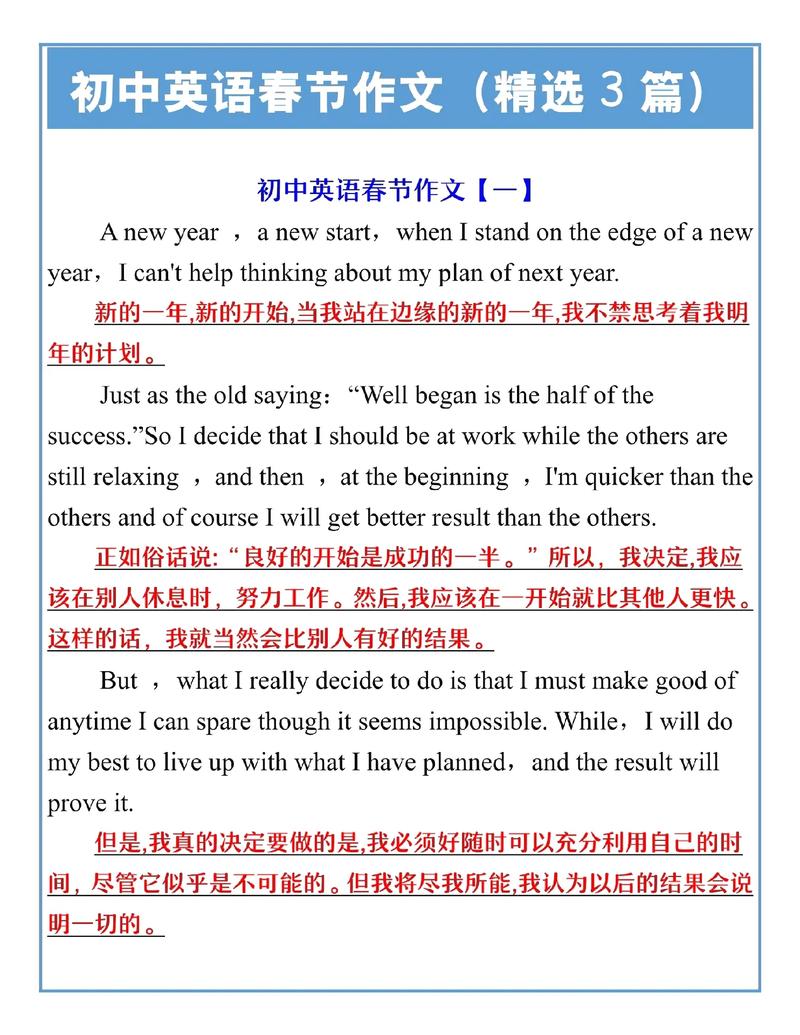
The Spring Festival
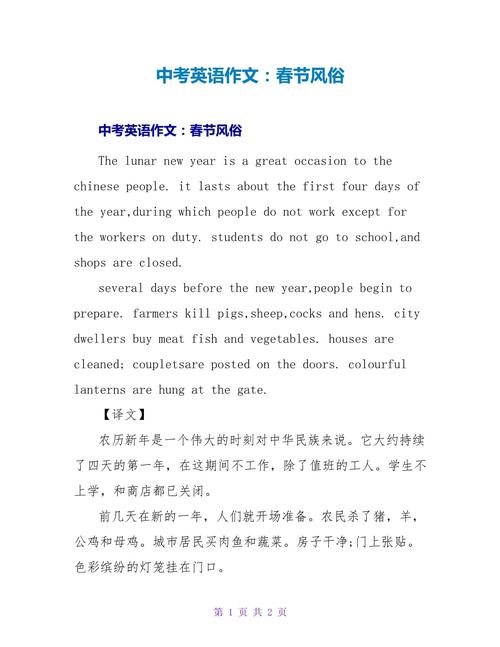
The Spring Festival is the most important festival in China. It is like Christmas in the West. It usually comes in January or February.
Before the festival, we clean our houses. We also buy new clothes and food. On New Year's Eve, my family gets together for a big dinner. We eat dumplings. After dinner, we watch TV. We are very happy. On New Year's Day, we say "Happy New Year" to our parents and get lucky money in red envelopes. I love the Spring Festival!
范文 2:标准版 (适合高中生或中级学习者)
My Favorite Festival: The Spring Festival
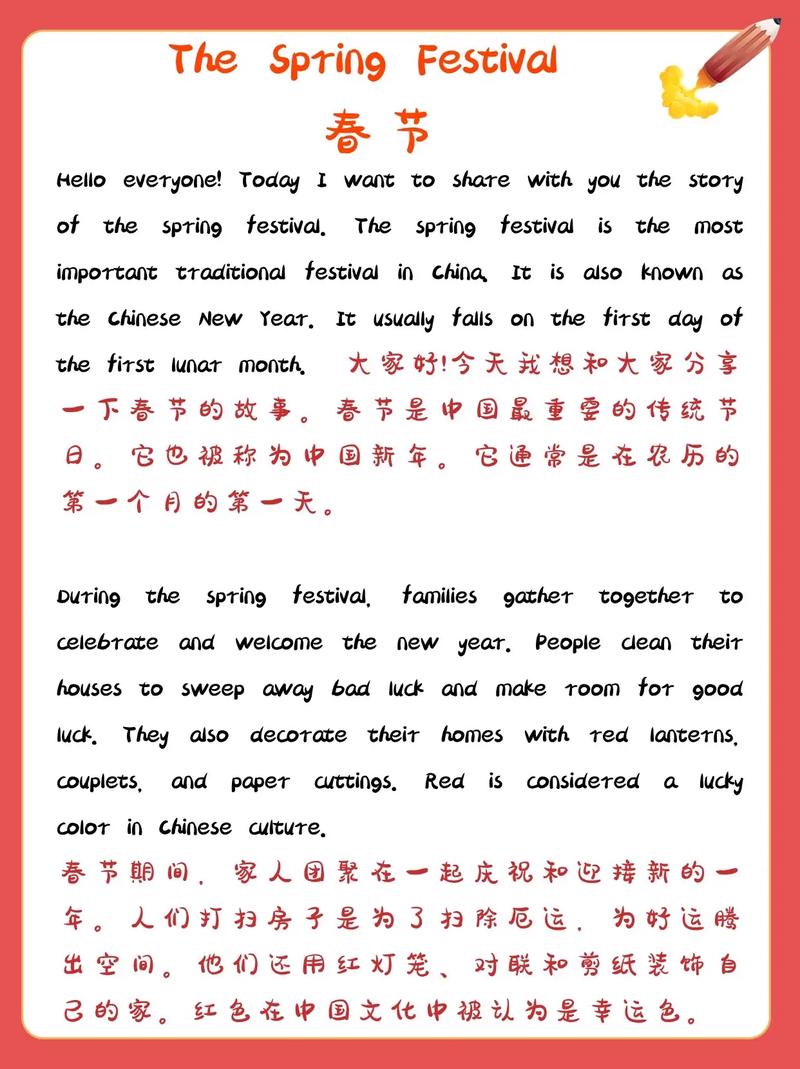
The Spring Festival, also known as Chinese New Year, is the most cherished and significant traditional holiday in China. Celebrated in late January or February, it is a time for family reunion, new beginnings, and hope.
The celebration starts long before the New Year's Eve. My family and I always give our home a thorough cleaning, a practice we call "sweeping the dust," which symbolizes sweeping away bad luck from the past year. We then decorate our doors with bright red Spring Festival Couplets, which are filled with wishes for happiness and prosperity. On New Year's Eve, the highlight is the Family Reunion Dinner. My grandparents, parents, aunts, and uncles all come to my home. We enjoy a delicious feast of traditional dishes, with dumplings being a must-have, as they are believed to bring wealth. After dinner, we stay up late to watch the Spring Festival Gala on TV and set off fireworks, filling the sky with brilliant colors and loud noises that, according to legend, scare away the monster "Nian".
On the first day of the New Year, we visit our relatives and friends to exchange greetings of "Happy New Year." The most exciting part for children is receiving red envelopes, or "hongbao," which contain lucky money. The Spring Festival is more than just a holiday; it's a deep-rooted cultural experience that strengthens family bonds and fills everyone's heart with joy and anticipation for the future.
范文 3:进阶版 (适合大学生或高级学习者)
The Spring Festival: A Tapestry of Tradition and Togetherness
As the chill of winter begins to wane, a vibrant and joyous energy fills the air across China. This marks the arrival of the Spring Festival, or Chinese New Year, a festival that transcends mere celebration to become a profound cultural cornerstone. It is a time-honored tradition that weaves together the threads of family, renewal, and cultural identity into a rich tapestry of shared experience.
The festival's significance is deeply rooted in its rituals. The days leading up to the New Year are a flurry of meticulous preparation. Homes undergo a "grand cleaning," not merely as a chore but as a symbolic act of purging misfortune and making way for good fortune. The streets and houses are adorned with splashes of red—the color of joy and prosperity—from intricate paper-cuts to poetic Spring Festival Couplets affixed to doorways. The climax of this period is the New Year's Eve Reunion Dinner, an event of paramount importance. It is a sacred gathering where generations of family members, often traveling from great distances, converge around a table laden with symbolic dishes. Each food item carries a meaning: fish for abundance, dumplings for wealth, and rice cakes for a higher position or better fortune in the coming year. The evening is a symphony of laughter, storytelling, and the clinking of glasses, a powerful affirmation of kinship.
As the clock strikes midnight, the sky erupts in a dazzling display of fireworks and firecrackers, their thunderous crackle echoing the ancient tale of frightening away the mythical beast "Nian." The subsequent days are dedicated to paying "New Year calls," visiting relatives and friends to exchange auspicious greetings and, most delightfully for the younger generation, receive red envelopes ("hongbao") containing money. In essence, the Spring Festival is a vibrant celebration that encapsulates the core values of Chinese culture: reverence for family, optimism for the future, and a deep-seated connection to ancestral traditions. It is a time when the past is honored, the present is cherished, and the future is welcomed with open arms and hopeful hearts.
实用词汇与句型
高级词汇:
- Cherished / Significant / Profound (珍贵的/重要的/深刻的)
- Cornerstone (基石)
- Togetherness / Kinship (团结/亲情)
- Ritual / Ceremony (仪式)
- Meticulous preparation (细致的准备)
- Purge misfortune (驱除厄运)
- Adorn / Embellish (装饰)
- Paramount importance (至关重要)
- Converge (汇聚)
- Symbolic dishes (象征性的菜肴)
- Dazzling display (绚丽的展示)
- Encapsulate (概括)
- Auspicious (吉祥的)
实用句型:
- 比喻/类比: "The Spring Festival is to China what Christmas is to the West."
- 强调句: "It is the Family Reunion Dinner that truly marks the spirit of the festival."
- 非限制性定语从句: "The Spring Festival, which falls in late January or February, is a time for celebration."
- 分词作状语: "Feeling excited, children run around to greet their relatives."
- 倒装句 (用于强调): "Not only is it a time for celebration, but it is also a time for family reunion."
- 表达观点: "From my perspective, the most meaningful part of the Spring Festival is..."
- 连接词: "Furthermore," "Moreover," "In addition," "However," "On the other hand"
写作小贴士
- 明确读者和目的: 是给老师看,还是给外国朋友看?这决定了你语言的正式程度和需要解释的文化背景。
- 融入个人体验: 在描述普遍习俗的同时,加入一两个你自己的真实经历或感受,会让文章更生动、更真诚,可以写“我最喜欢的环节是和爷爷一起包饺子”。
- 注意文化差异: 对于一些中国特色的词汇,如“年兽”、“压岁钱”,最好能用简单的英语解释一下。 "Nian, a mythical beast that was afraid of the color red and loud noises."
- 检查语法和拼写: 写完后务必仔细检查,避免低级错误。
- 保持积极基调: 春节是一个充满欢乐和希望的节日,文章的整体基调应该是积极向上的。
希望这份详细的指南能帮助你写出一篇优秀的关于春节的英语作文!祝你写作顺利,新年快乐!