写去敬老院作文,英语怎么表达?
作文示例 2026年1月28日 12:21:27 99ANYc3cd6
Of course! Here are several versions of an English essay about visiting a nursing home, ranging from a simple version for younger students to a more detailed one for older students. You can choose the one that best fits your level and needs.
Version 1: Simple Version (For Younger Students / Elementary Level)
A Happy Day at the Nursing Home**
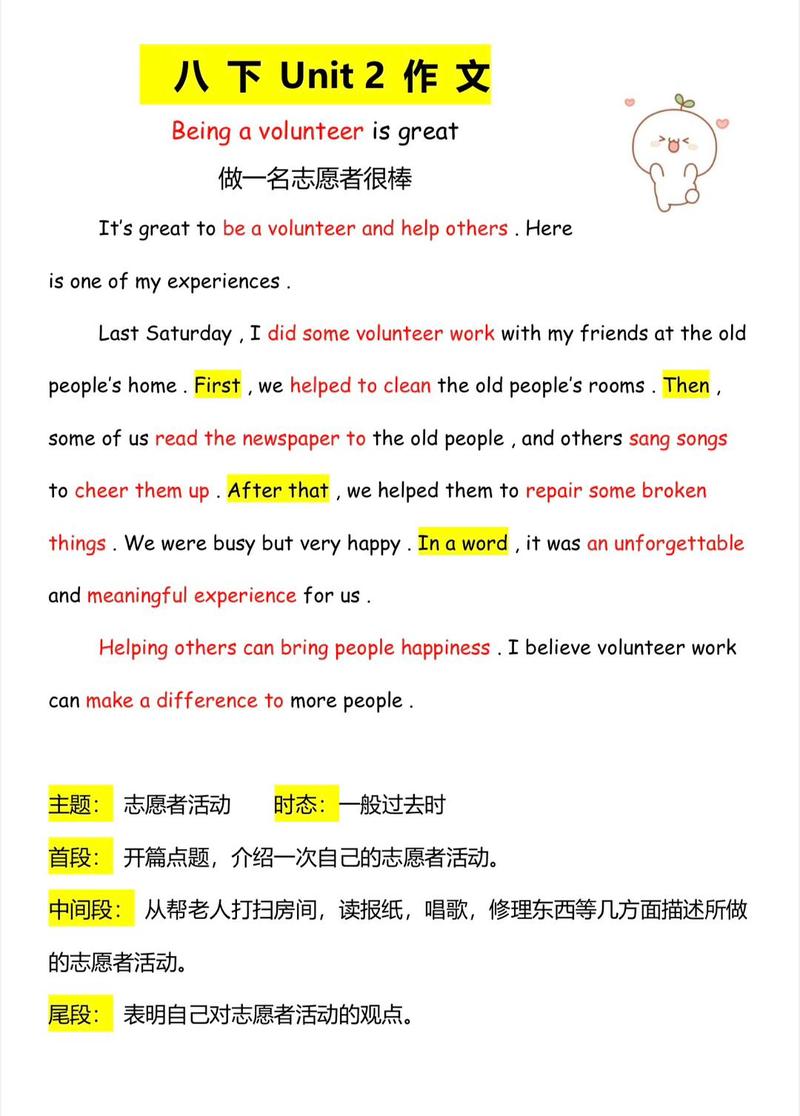
Last Sunday, my class went to a nursing home. We wanted to make the elderly people happy.
When we arrived, we saw many grandpas and grandmas. They were very happy to see us. First, we sang some old songs for them. They clapped their hands and smiled. Then, we gave them some beautiful flowers. The flowers smelled so good.
Next, I sat next to a kind grandma. She told me a story about when she was a little girl. Her story was very interesting. I held her hand and listened carefully. She felt warm and happy.
Before we left, we took a group photo with everyone. The grandpas and grandmas waved goodbye to us. I felt very happy that day. I learned that spending time with old people is a very good thing. We should always respect and love them.
Version 2: Intermediate Version (For Middle School Students)
A Visit to the Sunnyville Nursing Home**
Last Saturday, our school organized a volunteer trip to the Sunnyville Nursing Home. Our goal was to bring some warmth and companionship to the elderly residents, many of whom rarely have visitors.
As we walked into the common room, a wave of mixed emotions washed over me. Some residents were watching TV, while others were simply looking out of the window, lost in their thoughts. At first, I felt a little shy, but their warm smiles quickly put me at ease.
We had prepared a small performance. My friends played the piano and guitar, and I recited a poem. The applause we received was heartfelt and genuine. It was clear that they appreciated our effort. After the show, we spent time talking with them. I sat with Mr. Chen, a retired teacher. He shared fascinating stories about his life as a principal and his travels around the world. Listening to him, I realized that each of them has a rich history and a lifetime of wisdom.
The most touching moment for me was when I helped a grandmother named Ms. Li fold her laundry. As our hands worked together, she told me about her late husband and her children who lived far away. In her eyes, I saw not just loneliness, but also a deep appreciation for our simple company. Holding her hand, I felt a powerful sense of connection.
Leaving the nursing home, I felt a profound sense of fulfillment. This visit was more than just a school activity; it was a lesson in empathy and humanity. It taught me that happiness isn't found in material things, but in the joy of giving and the connections we make with others. I left with a promise to myself to visit my own grandparents more often and to cherish the time I have with my family.
Version 3: Advanced Version (For High School Students)
The Unspoken Wisdom: An Afternoon at Golden Years Home**
The sterile scent of antiseptic and the quiet hum of a television were the first things I noticed upon entering Golden Years Home. This was not the boisterous environment of youth I was accustomed to; it was a world suspended in time, a place where the echoes of the past mingled with the quiet realities of the present. Our school's community service project was to spend an afternoon here, but I soon realized this visit would be far more about receiving than giving.
Our initial plan was to perform a short concert. As the notes of our amateur violin and piano filled the room, I observed the audience. Some faces lit up with recognition, their lips silently mouthing the lyrics to familiar tunes. Others sat with a distant gaze, perhaps lost in a memory triggered by the melody. The performance was met with polite applause, but the true connection began afterward, in the unscripted moments of conversation.
I was drawn to a gentleman named Mr. Abernathy, a man whose hands, gnarled with age but steady, were folded neatly in his lap. He spoke with the eloquence of a bygone era, recounting his service in the war and his career as an engineer. He didn't just tell me facts; he painted vivid pictures of a world I had only read about. In his stories, I found a depth of experience and a resilience that no textbook could ever impart. He listened with equal attentiveness as I spoke of my anxieties about exams and my aspirations for the future. In that exchange of narratives, a bridge was built across a generational chasm.
This experience fundamentally challenged my perception of aging and the elderly. I had entered the nursing home with a sense of charity, a desire to "cheer them up." However, I left with a profound sense of humility and gratitude. I was the one who had been enriched. These individuals are not merely recipients of care; they are living libraries, repositories of a history that is in danger of being forgotten. Their quiet resilience in the face of loss and isolation is a testament to the strength of the human spirit.
In a society that often glorifies youth and speed, a visit to a nursing home is a necessary pilgrimage. It forces you to slow down, to listen, and to recognize the inherent dignity and worth of every individual, regardless of their age or physical ability. I learned that the most valuable gift we can offer is not our entertainment, but our presence—our willingness to sit, to listen, and to affirm that their stories matter. The afternoon at Golden Years Home was a poignant reminder that wisdom often resides not in the answers, but in the questions we ask and the silence we are willing to share.