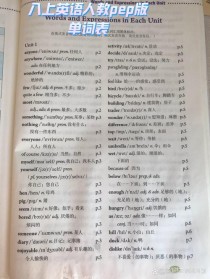
八年级下册人教版翻译
校园之窗 2026年1月18日 15:45:01 99ANYc3cd6
八年级下册人教版英语(Go for it!)核心内容概览
Unit 1 What's the matter?
单元主题: 健康与健康问题 核心功能: 描述身体不适并给出建议
重点词汇

| 单词 | 词性 | 中文意思 |
|---|---|---|
| matter | n. | 问题;事情 |
| have a cold | 感冒 | |
| have a fever | 发烧 | |
| have a cough | 咳嗽 | |
| have a stomachache | 胃痛;腹痛 | |
| have a toothache | 牙痛 | |
| have a headache | 头痛 | |
| have a sore back | 背痛 | |
| have a sore throat | 喉咙痛 | |
| rest | v. & n. | 休息;放松 |
| honey | n. | 蜂蜜 |
| dentist | n. | 牙医 |
| should | modal v. | 应该 |
| shouldn't | 不应该 | |
| dentist | n. | 牙医 |
| medicine | n. | 药 |
| brand | n. | 品牌 |
| illness | n. | 疾病;生病 |
| advice | n. | 建议 |
| thirsty | adj. | 口渴的 |
| stress | n. & v. | 压力;使紧张 |
| balance | n. & v. | 平衡;使平衡 |
| angry | adj. | 生气的;愤怒的 |
| strict | adj. | 严格的 |
| get tired | 变得疲惫 | |
| stay healthy | 保持健康 |
重点句型
-
询问病情:
- — What's the matter (with you)? / What's wrong (with you)? — 我怎么了?
- — I have a sore throat. / I have a fever. — 我喉咙痛。/ 我发烧了。
-
给出建议:
- — You should lie down and rest. / You should drink some hot tea with honey. — 你应该躺下休息。/ 你应该喝点加蜂蜜的热茶。
- — You shouldn't go to school today. / You shouldn't eat so much candy. — 你今天不应该去上学。/ 你不应该吃太多糖果。
- — It's a good idea to see a dentist. — 看牙医是个好主意。
-
描述感受:
- — I'm stressed out. / I'm tired. — 我压力很大。/ 我很累。
- — I'm thirsty. I need to drink water. — 我口渴了,我需要喝水。
核心语法
情态动词 should 的用法
- 用法: 用于提出建议或劝告。
- 结构:
主语 + should + 动词原形 - 否定式:
主语 + shouldn't (should not) + 动词原形 - 例句:
- You should see a doctor. (你应该去看医生。)
- He shouldn't play computer games all day. (他不应该整天玩电脑游戏。)
Why don't you...? 句型
- 用法: 用于提出建议,意为“你为什么不……呢?”,相当于
Why not...?。 - 结构:
Why don't you + 动词原形...? - 例句:
- Why don't you lie down for a while? (你为什么不躺一会儿呢?)
- Why don't you talk to your parents? (你为什么不和你的父母谈谈呢?)
Unit 2 I'll help to clean up the city parks.
单元主题: 志愿活动与帮助他人 核心功能: 表达提供帮助的意愿
重点词汇
| 单词 | 词性 | 中文意思 |
|---|---|---|
| clean-up | n. | 打扫;清理 |
| volunteer | n. & v. | 志愿者;自愿做 |
| sign | v. & n. | 标志;签名 |
| notice | n. & v. | 布告;注意到 |
| hand out | 分发 | |
| cheer up | 使……振奋起来 | |
| give out | 分发;发放 | |
| come up with | 想出;提出 | |
| put off | 推迟 | |
| make a plan | 制定计划 | |
| make a difference | 有影响;起作用 | |
| blind | adj. | 瞎的;失明的 |
| deaf | adj. | 聋的 |
| imagine | v. | 想象;设想 |
| difficulty | n. | 困难;难题 |
| open | adj. | 开着的;公开的 |
| carry | v. | 携带;搬运 |
| train | v. & n. | 训练;火车 |
| excited | adj. | 兴奋的;激动的 |
| kind | adj. | 友好的;善良的 |
| strong | adj. | 强壮的;强烈的 |
| care for | 照顾;非常喜欢 |
重点句型
-
表达提供帮助的意愿:
- I'd like to volunteer at an animal hospital. 我想在动物医院做志愿者。
- You could help to clean up the city parks. 你可以帮助清理城市公园。
-
提出建议:
- What about joining the volunteer project? 加入这个志愿者项目怎么样?
- How about making some notices? 制作一些布告怎么样?
-
描述帮助他人的感受:
- It makes me feel good to help others. 帮助别人让我感觉很好。
- Volunteering is fun and rewarding. 做志愿者很有趣,也很有回报。
核心语法
动词不定式作宾语
- 用法: 动词不定式
to do sth.可以跟在某些动词(如want,hope,like,decide,plan,learn,agree,offer等)后面作宾语。 - 结构:
主语 + 动词 + to do sth. - 例句:
- I want to help (help) kids with their schoolwork. 我想帮助孩子们做功课。
- She decided to join (join) the team. 她决定加入这个团队。
动词不定式作目的状语
- 用法: 用来说明做某事的目的,常放在句末。
- 结构:
主语 + 谓语动词 + ... + to do sth. - 例句:
- He came to help (help) us. 他来是为了帮助我们。
- I study hard to get (get) good grades. 我努力学习是为了取得好成绩。
Unit 3 Could you please clean your room?
单元主题: 家庭责任与请求许可 核心功能: 礼貌地提出请求和许可
重点词汇
| 单词 | 词性 | 中文意思 |
|---|---|---|
| do the dishes | 洗碗 | |
| sweep the floor | 扫地 | |
| take out the trash | 倒垃圾 | |
| make your bed | 整理床铺 | |
| fold the clothes | 叠衣服 | |
| living room | n. | 客厅 |
| bathroom | n. | 浴室;洗手间 |
| mess | n. | 混乱;脏乱 |
| throw | v. | 扔;抛 |
| all the time | 一直;总是 | |
| neighbor | n. | 邻居 |
| stress | n. | 压力;紧张 |
| waste | v. & n. | 浪费;废弃物 |
| in order to | 为了 | |
| provide | v. | 提供;供给 |
| anyway | adv. | 尽管如此 |
| depend on | 依赖;取决于 | |
| fair | adj. | 公平的;合理的 |
| take care of | 照顾;处理 | |
| since | conj. | 既然;由于 |
| communicate | v. | 沟通;交流 |
重点句型
-
礼貌地提出请求:
- — Could you please clean your room? — 你能打扫一下你的房间吗?
- — Could you please do the dishes? — 你能洗碗吗?
- — Would you mind taking out the trash? — 你介意倒垃圾吗?
-
礼貌地回应请求:
- Sure, I'd love to. / No problem. (好的,我很乐意。/ 没问题。)
- Sorry, I can't. I have to... (抱歉,我不能,我必须……)
- I'm sorry, but I'm busy right now. (很抱歉,但我现在很忙。)
-
请求许可:
- — Can I borrow your car? — 我能借用你的车吗?
- — Could I invite my friends to the party? — 我能邀请我的朋友们来参加派对吗?
核心语法
Could you please...? 句型
- 用法: 用于礼貌地提出请求,比
Can you...?更委婉、更客气。 - 结构:
Could you please + 动词原形...? - 注意: 在
Could you please...?句型中,动词必须用原形,即使主语是第三人称单数。 - 例句:
- Could you please help me with my homework? (你能帮我做作业吗?)
- Could you please not play the music so loud? (你能不要把音乐放得那么大声吗?)
Would you mind...? 句型
- 用法: 用于礼貌地请求对方做某事或请求对方不要做某事。
- 结构:
- 请求做某事:
Would you mind + doing sth.?(你介意做某事吗?) - 请求不做某事:
Would you mind not + doing sth.?(你介意不做某事吗?)
- 请求做某事:
- 例句:
- Would you mind opening the window? (你介意打开窗户吗?)
- Would you mind not smoking here? (你介意不要在这里吸烟吗?)
Unit 4 Why don't you talk to your parents?
单元主题: 与家人朋友的沟通与解决问题 核心功能: 提出建议,谈论问题和感受
重点词汇
| 单词 | 词性 | 中文意思 |
|---|---|---|
| instead of | 代替;而不是 | |
| argue | v. | 争论;争吵 |
| proper | adj. | 正确的;恰当的 |
| communicate | v. | 沟通;交流 |
| explain | v. | 解释;说明 |
| clear | adj. | 清晰的;清楚的 |
| get on with | 与……和睦相处 | |
| communicate with | 与……交流 | |
| relation | n. | 关系;联系 |
| cloud | n. | 云;阴云 |
| elder | adj. | 年长的;资格老的 |
| pressure | n. | 压力 |
| compete | v. | 竞争;对抗 |
| opinion | n. | 想法;看法 |
| skill | n. | 技能;技巧 |
| typical | adj. | 典型的;寻常的 |
| football | n. | 橄榄球 (美式) |
| cut out | 删去;戒掉 | |
| continue | v. | 继续;连续 |
| compare...to... | 把……比作…… | |
| compare...with... | 把……和……比较 | |
| send | v. | 发送;寄出 |
| huge | adj. | 巨大的;庞大的 |
重点句型
-
提出建议:
- — Why don't you talk to him about it? — 你为什么不和他谈谈这件事呢?
- — You should communicate with your friends. — 你应该和你的朋友们沟通。
- — You could write him a letter. — 你可以给他写封信。
-
描述问题和感受:
- — I'm really stressed out. — 我真的压力很大。
- — There are too many rules. — 规则太多了。
- — I don't know what to do. — 我不知道该怎么办。
-
谈论关系:
- — I'm not getting on well with my classmates. — 我和我的同学相处得不好。
- — We had a big fight. — 我们大吵了一架。
核心语法
Why don't you...? / Why not...? 句型
- 用法: 用于提出建议,意为“你为什么不……呢?”,是提出建议的一种非常口语化的方式。
- 结构:
Why don't you + 动词原形...?或Why not + 动词原形...? - 例句:
- Why don't you ask your teacher for help? (你为什么不向老师求助呢?)
- Why not go for a walk? (为什么不去散步呢?)
should / could / why don't you 提建议的比较
- Should: 比较直接的建议,表示“应该做某事”。
- You should see a doctor. (你应该去看医生。)
- Could: 更委婉、更客气的建议,表示“可以做某事”。
- You could try some herbal tea. (你可以试试花草茶。)
- Why don't you...?: 语气更轻松,带有商量的口吻。
- Why don't you get some rest? (你为什么不休息一下呢?)
Unit 5 What were you doing when the rainstorm came?
单元主题: 过去进行时 核心功能: 谈论过去某个时间点正在发生的事情
重点词汇
| 单词 | 词性 | 中文意思 |
|---|---|---|
| rainstorm | n. | 暴风雨 |
| alarm | n. | 闹钟;警报 |
| begin | v. | 开始 |
| heavily | adv. | 大量地;猛烈地 |
| suddenly | adv. | 突然地 |
| report | v. & n. | 报道;报告 |
| area | n. | 区域;地区 |
| wood | n. | 木头;木材 |
| window | n. | 窗户 |
| flashlight | n. | 手电筒 |
| beat | v. & n. | 敲打;心跳 |
| against | prep. | 倚;靠;反对 |
| die down | 逐渐变弱;平息 | |
| fallen | adj. | 倒下的;落下的 |
| icy | adj. | 结冰的;冰冷的 |
| kid | n. | 小孩;年轻人 |
| realize | v. | 意识到;明白 |
| make one's way | 前往;行进 | |
| by the time | 到……时候 | |
| final | adj. | 最后的;最终的 |
| proud | adj. | 自豪的;骄傲的 |
| graduation | n. | 毕业;毕业典礼 |
| ceremony | n. | 典礼;仪式 |
| miss | v. | 错过;想念 |
| interview | n. & v. | 采访;面试 |
| bother | v. | 打扰;使烦恼 |
| lock | v. & n. | 锁 |
| empty | adj. | 空的 |
| vanish | v. | 消失;突然不见 |
重点句型
-
谈论过去某个时间点正在发生的事情:
- — What were you doing at 8:00 last night? — 你昨晚8点在做什么?
- — I was doing my homework. — 我在做作业。
- — What was he doing when the rainstorm came? — 暴风雨来的时候他在做什么?
- — He was reading in the library. — 他在图书馆看书。
-
描述事件发生的过程:
- When the alarm went off, I was taking a shower. 当闹钟响的时候,我正在洗澡。
- While you were sleeping, I called you. 当你睡觉的时候,我给你打了电话。
核心语法
过去进行时
- 用法: 表示在过去某个特定时间点或某段时间内正在进行的动作。
- 结构:
- 肯定句:
was/were + 动词ing - 否定句:
was/were + not + 动词ing(wasn't/weren't + 动词ing) - 一般疑问句:
Was/Were + 主语 + 动词ing...? - 特殊疑问句:
What/Where/Who + was/were + 主语 + 动词ing...?
- 肯定句:
- 例句:
- I was watching TV at 9 o'clock yesterday evening. (昨晚9点我正在看电视。)
- They were having a class meeting this time yesterday. (昨天这个时候他们正在开班会。)
过去进行时与一般过去时的区别
- 过去进行时: 强调动作在过去某个时间点正在进行,是动作的过程。
- I was reading a book when he came in. (他进来的时候,我正在读书。)
- 一般过去时: 表示在过去发生的完整的、已结束的动作,是动作的结果。
- I read a book yesterday evening. (我昨晚读了一本书。)
when 和 while 引导的时间状语从句
when: 可以和一般过去时或过去进行时连用,指一个动作发生时,另一个动作正在进行或发生。- I was walking home when it started to rain. (我正在走回家,这时开始下雨了。)
while: 必须和过去进行时连用,强调在“一段时间内”,两个动作同时进行。- While I was cooking, he was listening to music. (当我做饭的时候,他正在听音乐。)
Unit 6 An old man tried to move the mountains.
单元主题: 中国传统故事与神话 核心功能: 讲述故事,表达观点和信念
重点词汇
| 单词 | 词性 | 中文意思 |
|---|---|---|
| remind | v. | 提醒;使想起 |
| instead of | 代替;而不是 | |
| bit | n. | 一点;小块 |
| once upon a time | 从前 | |
| shoot | v. | 射击;发射 |
| stone | n. | 石头 |
| weak | adj. | 虚弱的;不强的 |
| god | n. | 神;上帝 |
| remind sb. of sth. | 提醒某人某事;使某人想起某事 | |
| turn...into... | 把……变成…… | |
| as soon as | 一……就…… | |
| hide | v. | 隐藏;躲藏 |
| tail | n. | 尾巴 |
| stick | n. | 棍;棒 |
| excited | adj. | 兴奋的 |
| jump | v. | 跳 |
| voice | n. | 声音;嗓音 |
| brave | adj. | 勇敢的 |
| lead | v. | 领导;带领 |
| stupid | adj. | 愚蠢的;傻的 |
| point | v. & n. | 指向;点 |
| at the same time | 同时 | |
| in the end | 终于 | |
| become | v. | 变成;成为 |
| strong | adj. | 强壮的;强大的 |
重点句型
-
讲述故事的常用开头:
- Once upon a time, there was an old man... 从前,有一位老人……
-
表达坚持不懈:
- Even though it seemed impossible, the old man kept on trying. 尽管看起来不可能,那位老人还是坚持尝试。
- So what if it's a little hard? Nothing is impossible if you work hard. 如果有点难又怎么样呢?只要你努力,就没有什么是不可能的。
-
引用谚语:
- Many hands make light work. (人多力量大。)
- A friend in need is a friend indeed. (患难见真情。)
核心语法
连词 so...that... 和 such...that...
- 用法: 表示“…以至于……”,引导结果状语从句。
- 区别:
so + 形容词/副词 + that...- He was so tired that he fell asleep soon. (他太累了,以至于很快就睡着了。)
such + (a/an) + 形容词 + 名词 + that...- It was such a beautiful day that we decided to go for a picnic. (那是如此美好的一天,以至于我们决定去野餐。)
unless 引导的条件状语从句
- 用法: 意为“除非;如果不”,相当于
if...not...。 - 结构:
主句 + unless + 从句 - 例句:
- You'll fail the exam unless you study hard. = You'll fail the exam if you don't study hard. (除非你努力学习,否则你会考试不及格。)
- Don't go out unless it stops raining. = Don't go out if it doesn't stop raining. (除非雨停了,否则不要出去。)
Unit 7 What's the highest mountain in the world?
单元主题: 世界地理与自然奇观 核心功能: 比较事物,谈论数据
重点词汇
| 单词 | 词性 | 中文意思 |
|---|---|---|
| square | n. & adj. | 平方;广场;平方的 |
| kilometer | n. | 千米;公里 |
| deep | adj. | 深的 |
| desert | n. | 沙漠 |
| population | n. | 人口;数量 |
| tour | n. & v. | 旅行;观光 |
| wall | n. | 墙 |
| achievement | n. | 成就;成绩 |
| ancient | adj. | 古代的;古老的 |
| protect | v. | 保护 |
| wide | adj. | 宽的 |
| thick | adj. | 厚的 |
| condition | n. | 条件;状况 |
| take in | 吸入;欺骗 | |
| succeed | v. | 成功 |
| achieve one's dream | 实现某人的梦想 | |
| force | n. & v. | 力量;强迫 |
| nature | n. | 自然;大自然 |
| even though | 尽管;虽然 | |
| risk | n. & v. | 风险;冒险 |
| challenge | n. & v. | 挑战;质疑 |
| in the face of | 面对;不顾 | |
| spirit | n. | 精神;心灵 |
| finally | adv. | 终于 |
重点句型
-
询问和回答最高级:
- — What's the highest mountain in the world? — 世界上最高的山是什么?
- — It's Qomolangma. — 是珠穆朗玛峰。
- — How high is it? — 它有多高?
- — It's 8,844.43 meters high. — 它有8844.43米高。
-
比较事物:
- The Amazon River is longer than the Nile River. 亚马逊河比尼罗河更长。
- China has the largest population in the world. 中国拥有世界上最多的人口。
-
谈论数据:
- It covers an area of about 1,060 square kilometers. 它覆盖了大约1060平方千米的面积。
- It's famous for its beautiful scenery. 它以其美丽的风景而闻名。
核心语法
形容词和副词的最高级
- 用法: 三者或三者以上进行比较,表示“最……”。
- 规则:
- 单音节词和部分双音节词:
the + 形容词/副词最高级 + in/of...- the tallest (最高的), the biggest (最大的), the most carefully (最仔细地)
- 多音节词:
the + most + 形容词/副词原级 + in/of...- the most beautiful (最美丽的), the most interesting (最有趣的)
- 不规则变化:
- good/well → best
- bad/badly → worst
- many/much → most
- little → least
- far → farthest / furthest
- 单音节词和部分双音节词:
- 例句:
- Mount Qomolangma is the highest mountain in the world. (珠穆朗玛峰是世界上最高的山。)
- He runs the fastest in our class. (他在我们班跑得最快。)
one of the + 形容词最高级 + 复数名词
- 用法: 表示“最……的之一”。
- 注意: 名词必须用复数形式。
- 例句:
- The Yangtze River is one of the longest rivers in the world. (长江是世界上最长的河流之一。)
- She is one of the best students in our grade. (她是年级里最优秀的学生之一。)
Unit 8 Have you read Treasure Island yet?
单元主题: 经典文学与个人经历 核心功能: 谈论最近的经历和完成情况
重点词汇
| 单词 | 词性 | 中文意思 |
|---|---|---|
| treasure | n. | 财宝;财富 |
| island | n. | 岛;岛屿 |
| classic | adj. & n. | 经典的;名著 |
| page | n. | 页;页码 |
| already | adv. | 已经 |
| yet | adv. | 已经;还(用于否定和疑问句) |
| finish | v. | 完成;结束 |
| full | adj. | 满的;充满的 |
| hurry | v. & n. | 匆忙;赶快 |
| due | adj. | 到期的;预期的 |
| ship | n. & v. | 船;用船运输 |
| tool | n. | 工具;器械 |
| sand | n. | 沙子;沙滩 |
| mark | v. & n. | 做记号;标志 |
| parrot | n. | 鹦鹉 |
| gun | n. | 枪;炮 |
| else | adv. | 其他;别的 |
| treasure | n. | 财宝;财富 |
| towards | prep. | 朝;向 |
| cave | n. | 洞穴;山洞 |
| wave | n. & v. | 波浪;挥手 |
| pop | adj. | 流行的;通俗的 |
| rock | n. & v. | 岩石;摇滚乐;摇晃 |
| band | n. | 乐队;带 |
| fantastic | adj. | 极好的;了不起的 |
| record | n. & v. | 唱片;记录 |
| ever | adv. | 曾经;在任何时候 |
| hear of | 听说 | |
| introduce | v. | 介绍;引见 |
| simple | adj. | 简单的;朴素的 |
重点句型
-
谈论完成情况:
- — Have you read Treasure Island yet? — 你读过《金银岛》吗?
- — Yes, I have. / No, I haven't. — 是的,我读过。/ 不,我没读过。
- — Has he/she seen the movie yet? — 他/她看过这部电影了吗?
- — No, he/she hasn't. He/She has just started reading the book. — 不,他/她没看过,他/她刚开始读这本书。
-
描述感受:
- — How do you like the book? — 你觉得这本书怎么样?
- — It's fantastic. / It's boring. — 它太棒了。/ 它很无聊。
核心语法
现在完成时
- 用法: 表示过去发生或已经完成的动作对现在造成的影响或结果,或表示从过去开始持续到现在的动作或状态。
- 结构:
- 肯定句:
have/has + 动词过去分词 - 否定句:
have/has + not + 动词过去分词(haven't/hasn't + 动词过去分词) - 一般疑问句:
Have/Has + 主语 + 动词过去分词...? - 特殊疑问句:
What/Where/Who + have/has + 主语 + 动词过去分词...?
- 肯定句:
- 例句:
- I have finished my homework. (我已经完成了我的作业。)
- She has been to Beijing twice. (她去过北京两次。)
already 和 yet 的区别
already: 意为“已经”,用于肯定句或疑问句(表示惊讶)。- I have already seen that movie. (我已经看过那部电影了。)
- Have you finished already? (你已经完成了吗?)
yet: 意为“还(没)”,用于否定句和疑问句,放在句末。- He hasn't eaten breakfast yet. (他还没吃早饭。)
- Has she arrived yet? (她到了吗?)
动词过去分词的构成
- 规则变化: 动词原形 +
ed(e.g.,work→worked,clean→cleaned) - 不规则变化: 需要单独记忆 (e.g.,
do→done,see→seen,go→gone,read→read)
Unit 9 Have you ever been to a museum?
单元主题: 旅行经历与去过的地方 核心功能: 谈论过去的旅行经历
重点词汇
| 单词 | 词性 | 中文意思 |
|---|---|---|
| museum | n. | 博物馆 |
| space | n. | 太空;空间 |
| cinema | n. | 电影院 |
| art | n. | 艺术;美术 |
| gallery | n. | 美术馆;画廊 |
| stamp | n. | 邮票 |
| collect | v. | 收集;收藏 |
| clear | adj. | 清晰的;清楚的 |
| model | n. | 模型;榜样 |
| interactive | adj. | 互动的 |
| invention | n. | 发明;创造 |
| unusual | adj. | 不寻常的 |