嫦娥的英语作文该怎么写?
作文示例 2026年1月15日 02:43:38 99ANYc3cd6
- 入门级: 简单、直接,适合初学者或小学生。
- 进阶级: 内容更丰富,细节更多,适合中学生。
- 高级版: 语言优美,富有文学色彩,适合高中生或英语学习者作为范文参考。
入门级
Chang'e, the Lady on the Moon**
Chang'e is a famous character from a Chinese story. She lives on the moon.

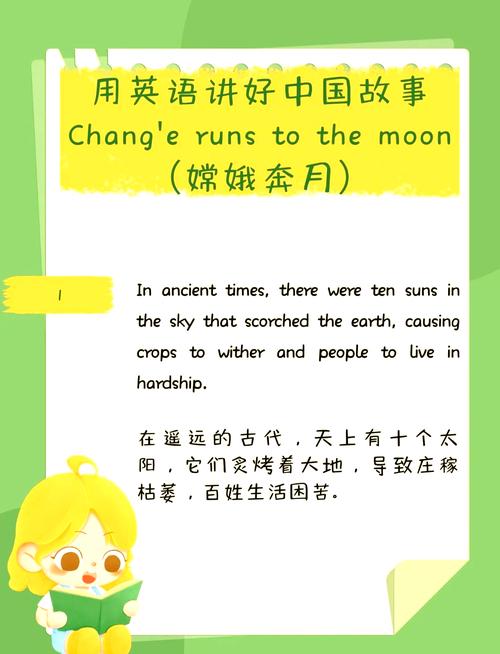
A long time ago, there were ten suns in the sky. The world was very hot. A hero named Hou Yi shot down nine of the suns and saved the world. As a reward, the Queen Mother of the West gave him a magic pill. If Hou Yi took the pill, he could become a god and live in heaven.
Hou Yi did not want to leave his wife, Chang'e. So he told her to hide the pill. But Chang'e was worried that a bad man named Peng Meng would steal the pill. One day, when Hou Yi was out, Peng Meng tried to take the pill. To protect it, Chang'e swallowed the pill herself.
Suddenly, she felt very light and flew up to the moon. Hou Yi was very sad. He would look at the full moon every night and think of his wife. People say that on the night of the Mid-Autumn Festival, you can see Chang'e and her little rabbit, Yutu, on the moon.
Chang'e's story is a beautiful tale of love and sacrifice.

进阶级
The Myth of Chang'e: A Tale of Love and Immortality**
The legend of Chang'e is one of the most beloved and enduring myths in Chinese culture. It is a timeless story of love, jealousy, and a lonely eternity spent on the moon.
The story begins with a time of great disaster for the Earth. Ten suns had risen into the sky, scorching the land and causing crops to fail. A brave archer named Hou Yi stepped forward. With his exceptional skill, he shot down nine of the suns, leaving just one to bring light and warmth to the world. For this heroic deed, Hou Yi was rewarded with an elixir of immortality by the Queen Mother of the West. This magical pill would grant him eternal life in the heavens.
Hou Yi, however, was deeply in love with his beautiful wife, Chang'e, and did not wish to leave her. He entrusted the precious elixir to her for safekeeping, warning her never to take it. Unfortunately, their peace was disturbed by a greedy apprentice named Feng Meng. While Hou Yi was away, Feng Meng tried to force Chang'e to hand over the elixir.
Faced with this threat, Chang'e made a difficult decision. To prevent the evil man from gaining immortality and using it for harm, she bravely swallowed the pill herself. Immediately, she felt her body grow light, and she began to float uncontrollably into the sky. She landed on the cold, lonely surface of the moon, separated from her beloved husband forever.
Heartbroken, Hou Yi would offer fruits and cakes to the moon every night, hoping to catch a glimpse of his wife. This tradition is said to be the origin of the Mid-Autumn Festival, a time for family reunions and moon gazing. It is also said that Chang'e was not alone on the moon; she is accompanied by a jade rabbit, Yutu, who endlessly pounds medicine, perhaps in a quest to find a way to return to Earth.
The myth of Chang'e has been passed down for thousands of years. It represents not only a tragic love story but also the Chinese cultural values of courage, sacrifice, and the enduring power of love that transcends distance and time.
高级版
Chang'e: A Celestial Ode to Love and Longing**
In the pantheon of Chinese mythology, few figures are as poignantly etched into the cultural consciousness as Chang'e. Her story is a lyrical tapestry woven from threads of heroism, betrayal, and an eternal, bittersweet love that culminates in a solitary vigil upon the moon. It is more than a mere folktale; it is a profound reflection on the human condition, exploring the costs of immortality and the enduring nature of memory.
The narrative unfolds in an age of celestial chaos, when ten suns scorched the earth, plunging the world into despair. It was then that the archer Hou Yi, a paragon of mortal strength, emerged. With arrows that flew like shooting stars, he pierced the sky, felling nine of the suns and restoring balance to the world. His reward was no less than the elixir of immortality, a gift from the Queen Mother of the West, a potent promise of eternal life among the gods.
Yet, Hou Yi's heart was anchored to the mortal realm by his devotion to Chang'e, his wife of ethereal beauty. He placed the elixir in her care, a trust that became a vulnerability. Their idyllic life was shattered by the arrival of Feng Meng, a covetous and treacherous apprentice. Driven by a lust for power, he sought to steal the elixir by force.
In that moment of crisis, Chang'e was faced with an impossible choice. To yield to Feng Meng was to unleash an unspeakable evil upon the world. To consume the elixir herself was to embrace a lonely, immortal fate. Choosing the greater good, she drank the potion. Her body, no longer bound by gravity, ascended gracefully, yet tragically, towards the cold, silver orb of the moon.
There, in the Palace of the Moon, Chang'e resides to this day, a celestial exile. Her story is inextricably linked to the Mid-Autumn Festival, a night when the moon is at its fullest and brightest. Families gather, sharing mooncakes and sweet fruits, not just in celebration, but as an act of quiet homage to Chang'e's enduring love. They gaze up at the luminous disc, imagining her silhouette and her constant companion, the industrious Jade Rabbit, Yutu, who ceaselessly grinds herbs in a mortar, perhaps in a futile quest for a cure to her solitude.
Thus, Chang'e transcends her role as a mythological character. She has become a symbol, a muse for poets and artists, and a poignant reminder that true love is not diminished by distance, but is instead immortalized by longing. Her story continues to illuminate the night sky, a timeless and beautiful testament to a love that reached for the heavens and found its home on the moon.