仁爱英语七下句型有哪些重点?
校园之窗 2025年12月20日 22:13:07 99ANYc3cd6
核心句型分类总结
第一部分:Be 动词句型
这是最基础也是最重要的句型,用于描述主语的状态、身份或特征。
肯定句
- 结构: 主语 + am / is / are + 其他.
- 用法:
I am...用于第一人称单数I。He / She / It is...用于第三人称单数。You / We / They are...用于第二人称和复数。
- 例句:
- I am a student. (我是一名学生。)
- He is my friend. (他是我的朋友。)
- They are from China. (他们来自中国。)
否定句
- 结构: 主语 + am / is / are + not + 其他.
- 用法: 在
am,is,are后面直接加not。 - 例句:
- I am not (I'm not) a teacher. (我不是老师。)
- She is not (isn't) busy. (她不忙。)
- We are not (aren't) at home. (我们不在家。)
一般疑问句
- 结构: Am / Is / Are + 主语 + 其他?
- 用法: 把
am,is,are提到句首,首字母大写,句尾用问号。 - 答语:
- 肯定回答:Yes, 主语 + am / is / are. (e.g., Yes, I am.)
- 否定回答:No, 主语 + am / is / are + not. (e.g., No, I'm not.)
- 例句:
- Are you a student? — Yes, I am. / No, I'm not. (你是学生吗?)
- Is he your brother? — Yes, he is. / No, he isn't. (他是你哥哥吗?)
- Are they from Japan? — Yes, they are. / No, they aren't. (他们来自日本吗?)
特殊疑问句
- 结构: 疑问词 + am / is / are + 主语 + 其他?
- 常用疑问词:
Where(哪里),What(什么),How(如何),Who(谁),How old(多大) - 例句:
- Where is the library? — It's next to the post office. (图书馆在哪里?)
- What color is your pen? — It's red. (你的钢笔是什么颜色?)
- How old are you? — I'm thirteen. (你多大了?)
- Who is that girl? — She is Lucy. (那个女孩是谁?)
第二部分:实义动词(行为动词)句型
这类句型用于描述主语所做的动作。
一般现在时 用于描述经常性、习惯性的动作或客观事实。
- 结构: 主语 + 动词原形 + 其他.
- 注意: 当主语是第三人称单数(he, she, it, 单个名字等)时,动词要加
-s或-es。 - 例句:
- I get up at 6:30 every day. (我每天6:30起床。)
- He goes to school by bus. (他坐公交车去上学。)
- They play basketball on weekends. (他们周末打篮球。)
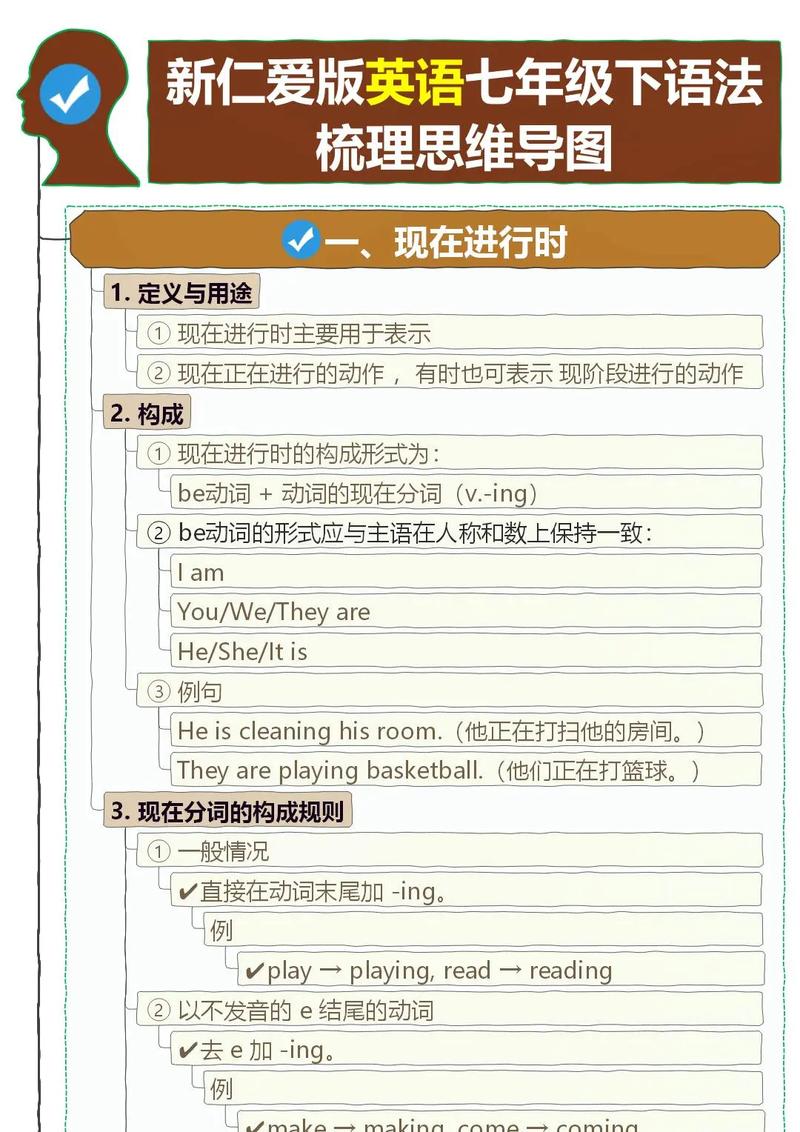
现在进行时 用于描述说话时正在发生的动作或现阶段正在进行的动作。
- 结构: 主语 + am / is / are + 动词的-ing形式 + 其他.
- 用法:
am + doing用于I。is + doing用于he, she, it。are + doing用于you, we, they。
- 例句:
- I am reading a book now. (我现在正在看书。)
- Look! The cat is running after a mouse. (看!那只猫正在追一只老鼠。)
- They are having an English class. (他们正在上英语课。)
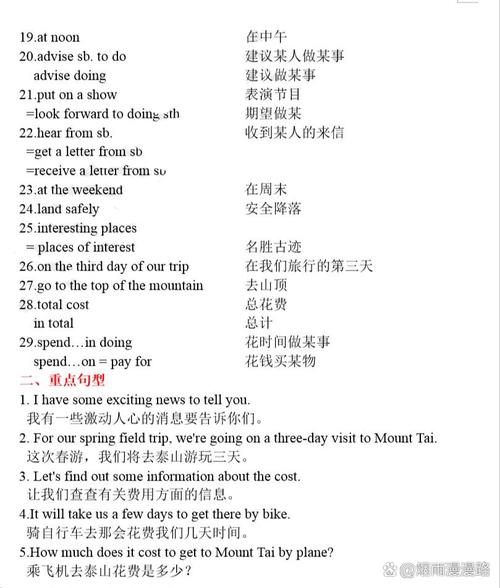
一般过去时 用于描述过去某个时间点发生的动作或存在的状态。
- 结构: 主语 + 动词的过去式 + 其他.
- 用法: 动词需要变成过去式,规则动词加
-ed,不规则动词需要单独记忆(如go-went,see-saw,have-had)。 - 例句:
- I went to the park yesterday. (我昨天去了公园。)
- He did his homework last night. (他昨晚做了作业。)
- Were you at home this morning? — Yes, I was. / No, I wasn't. (你今天早上在家吗?)
第三部分:情态动词句型
情态动词 can (能,会), must (必须), should (应该) 等后跟动词原形。
Can (能力,请求,许可)
- 肯定句: 主语 + can + 动词原形 + 其他.
I can speak a little English. (我会说一点英语。)
- 否定句: 主语 + can't (can not) + 动词原形 + 其他.
He can't swim. (他不会游泳。)
- 一般疑问句: Can + 主语 + 动词原形 + 其他?
Can you help me? — Yes, I can. / No, I can't. (你能帮我吗?)
- 特殊疑问句: 疑问词 + can + 主语 + 动词原形 + 其他?
What can you see in the picture? (你在图片里能看到什么?)
Must (必须,肯定推测)
- 肯定句: 主语 + must + 动词原形 + 其他.
You must finish your homework. (你必须完成作业。)
- 否定句: 主语 + mustn't (must not) + 动词原形 + 其他. (表示“禁止”,千万不要)
You mustn't play on the road. (你千万不能在马路上玩。)
- 一般疑问句: Must + 主语 + 动词原形 + 其他?
Must I clean the room now? — Yes, you must. / No, you needn't / don't have to. (我现在必须打扫房间吗?)
Should (应该)
- 肯定句: 主语 + should + 动词原形 + 其他.
You should eat more vegetables. (你应该多吃蔬菜。)
- 否定句: 主语 + shouldn't (should not) + 动词原形 + 其他.
He shouldn't stay up late. (他不应该熬夜。)
- 一般疑问句: Should + 主语 + 动词原形 + 其他?
Should we ask the teacher for help? — Yes, we should. / No, we shouldn't. (我们应该向老师求助吗?)
第四部分:There be 句型
表示“存在”,意为“某地有某物”。
肯定句
- 结构: There is / are + 某物/某人 + 地点.
- 用法:
There is...用于单数名词或不可数名词。There are...用于复数名词。
- 例句:
- There is a book on the desk. (桌子上有一本书。)
- There is some milk in the bottle. (瓶子里有一些牛奶。)
- There are many students in the classroom. (教室里有很多学生。)
否定句
- 结构: There isn't (is not) / There aren't (are not) + 某物/某人 + 地点.
- 例句:
- There isn't a cat in the box. (盒子里没有一只猫。)
- There aren't any apples on the tree. (树上没有苹果。)
一般疑问句
- 结构: Is / Are + there + 某物/某人 + 地点?
- 答语:
- 肯定回答:Yes, there is. / Yes, there are.
- 否定回答:No, there isn't. / No, there aren't.
- 例句:
- Is there a bank near here? — Yes, there is. / No, there isn't. (这附近有银行吗?)
- Are there any birds in the sky? — Yes, there are. / No, there aren't. (天上有鸟吗?)
特殊疑问句
- 结构: How many + 复数名词 + are there + 地点? (询问数量)
- 例句:
- How many people are there in your family? — There are three. (你家有几口人?)
- What's in the classroom? — There are some desks and chairs. (教室里有什么?)
第五部分:其他重要句型
祈使句 用于表达命令、请求、建议或警告。
- 肯定结构: 动词原形 + 其他.
- Open your book, please. (请打开你的书。)
- Be quiet! (安静!)
- 否定结构: Don't + 动词原形 + 其他.
- Don't be late. (不要迟到。)
- Don't talk in the library. (不要在图书馆里说话。)
Let's 句型 提出建议,意为“让我们……”。
- 结构: Let's + 动词原形 + 其他.
- 例句:
- Let's go shopping. (我们去购物吧。)
- Let's play soccer. (我们去踢足球吧。)
感叹句 用于表达强烈的情感,如喜、怒、哀、乐等。
- 结构1 (What): What + a/an + 形容词 + 可数名词单数 (+ 主语 + 谓语)!
What a beautiful girl! (多么漂亮的女孩啊!)
- 结构2 (What): What + 形容词 + 可数名词复数/不可数名词 (+ 主语 + 谓语)!
- What delicious food! (多么美味的食物啊!)
- What interesting stories! (多么有趣的故事啊!)
- 结构3 (How): How + 形容词/副词 (+ 主语 + 谓语)!
- How tall the tree is! (那棵树真高啊!)
- How fast he runs! (他跑得真快啊!)
喜欢与不喜欢的表达
- like / love / enjoy + doing sth. (喜欢做某事)
- I like listening to music. (我喜欢听音乐。)
- She enjoys reading books. (她喜欢读书。)
- don't like / hate + doing sth. (不喜欢/讨厌做某事)
- I don't like playing computer games. (我不喜欢玩电脑游戏。)
- He hates getting up early. (他讨厌早起。)
学习建议
- 理解记忆,而非死记硬背: 每个句型都有其特定的结构和用法,先理解为什么这么用,再进行记忆。
- 多造句,多练习: 看到一个句型,就用自己身边的人、事、物来造句,这样才能真正掌握。
- 结合课文: 课本中的对话和短文是最好的例句来源,反复朗读和分析,有助于培养语感。
- 整理错题本: 把自己做错的句子记录下来,分析错误原因,定期复习,避免再犯。
希望这份总结对你的学习有帮助!加油!