七年级英语下册句型转换有哪些常见考点?
校园之窗 2025年12月18日 15:54:12 99ANYc3cd6
七年级英语下册句型转换核心要点
句型转换通常围绕以下五种基本句型展开:
- 肯定句 ↔ 否定句
- 陈述句 ↔ 一般疑问句
- 陈述句 ↔ 特殊疑问句
- 肯定句 ↔ 否定疑问句
- 同义句转换
我们逐一来看。

(图片来源网络,侵删)
肯定句 ↔ 否定句
这是最基础的转换,核心是加否定词。
规则与步骤
- be 动词 (am, is, are, was, were):直接在 be 动词后加
not。- 例:He is a student. → He is not a student. (缩写:He isn't a student.)
- 情态动词 (can, should, would, must 等):直接在情态动词后加
not。- 例:I can swim. → I cannot swim. (缩写:I can't swim.)
- 例:You should finish your homework. → You should not finish your homework. (缩写:You shouldn't finish your homework.)
- 实义动词 (没有 be 动词和情态动词的句子):
- 主语是第三人称单数 (he, she, it, Tom, my mother 等):在动词前加
doesn't,动词恢复原形。- 例:She goes to school by bike. → She doesn't go to school by bike.
- 主语是其他人称 (I, you, we, they 等):在动词前加
don't,动词恢复原形。- 例:They play basketball every day. → They don't play basketball every day.
- 主语是第三人称单数 (he, she, it, Tom, my mother 等):在动词前加
- 含有
let's的句子:let's=let us,其否定形式是Let's not...。- 例:Let's go home. → Let's not go home.
- 含有
some的句子:在否定句中,some通常要改为any。- 例:There is some milk in the bottle. → There isn't any milk in the bottle.
陈述句 ↔ 一般疑问句
一般疑问句通常需要用 Yes 或 No 来回答。
规则与步骤
- be 动词 (am, is, are, was, were):
- 将 be 动词提到句首。
- 例:They are in the library. → Are they in the library?
- 注意:
I am的疑问句是Am I...?,回答用Yes, you are./No, you aren't.。
- 情态动词 (can, should, would, must 等):
- 将情态动词提到句首。
- 例:He can speak English well. → Can he speak English well?
- 实义动词 (没有 be 动词和情态动词的句子):
- 主语是第三人称单数:在句首加
Does,动词恢复原形。- 例:She likes apples. → Does she like apples?
- 主语是其他人称:在句首加
Do,动词恢复原形。- 例:You have a book. → Do you have a book?
- 主语是第三人称单数:在句首加
- 含有
some的句子:在疑问句中,some通常要改为any。- 例:There are some birds in the tree. → Are there any birds in the tree?
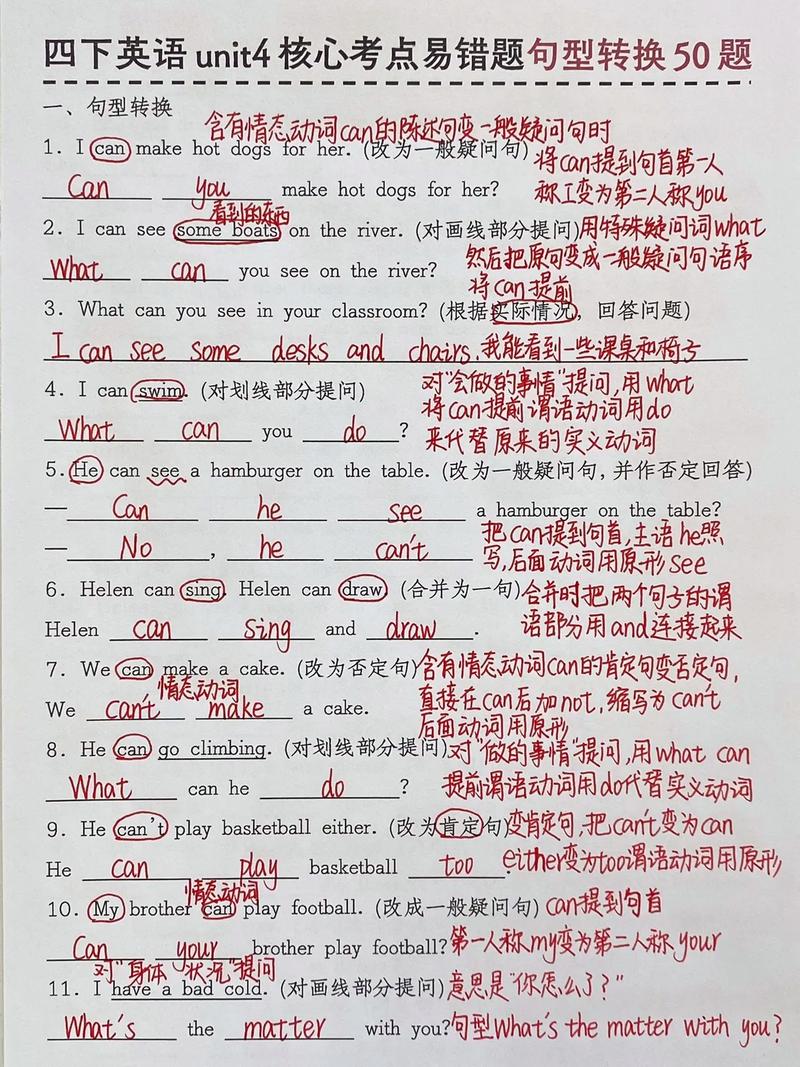
陈述句 ↔ 特殊疑问句
特殊疑问句用来询问具体信息(如时间、地点、人物、原因等),不能用 Yes 或 No 回答。
规则与步骤
核心公式:特殊疑问词 + 一般疑问句?
(图片来源网络,侵删)
-
第一步:确定特殊疑问词,根据问题选择合适的疑问词。
- Who (谁) - 问人
- What (什么) - 问事物/职业
- Where (哪里) - 问地点
- When (什么时候) - 问时间
- Why (为什么) - 问原因,回答通常用
Because... - How (怎样) - 问方式
- How old (多大年龄) - 问年龄
- How many (多少) - 问可数名词数量
- How much (多少钱/多少) - 问价格或不可数名词数量
- What time (几点) - 问具体时刻
-
第二步:把剩下的部分变成一般疑问句。
- 如果原句有 be 动词或情态动词,直接提前。
- 如果原句只有实义动词,则借助
do/does并把动词恢复原形。
-
第三步:组合起来。
经典例句
| 原句 | 特殊疑问词 | 剩余部分(变一般疑问句) | 特殊疑问句 |
|---|---|---|---|
| He is a teacher. | What | is he? | What is he? |
| They go to school by bus. | How | do they go to school? | How do they go to school? |
| Tom likes playing the piano. | What | does Tom like? | What does Tom like? |
| My birthday is in May. | When | is your birthday? | When is your birthday? |
| There are some books on the desk. | How many | books are there on the desk? | How many books are there on the desk? |
肯定句 ↔ 否定疑问句
否定疑问句通常表示惊讶、建议或责备,期待得到肯定回答。
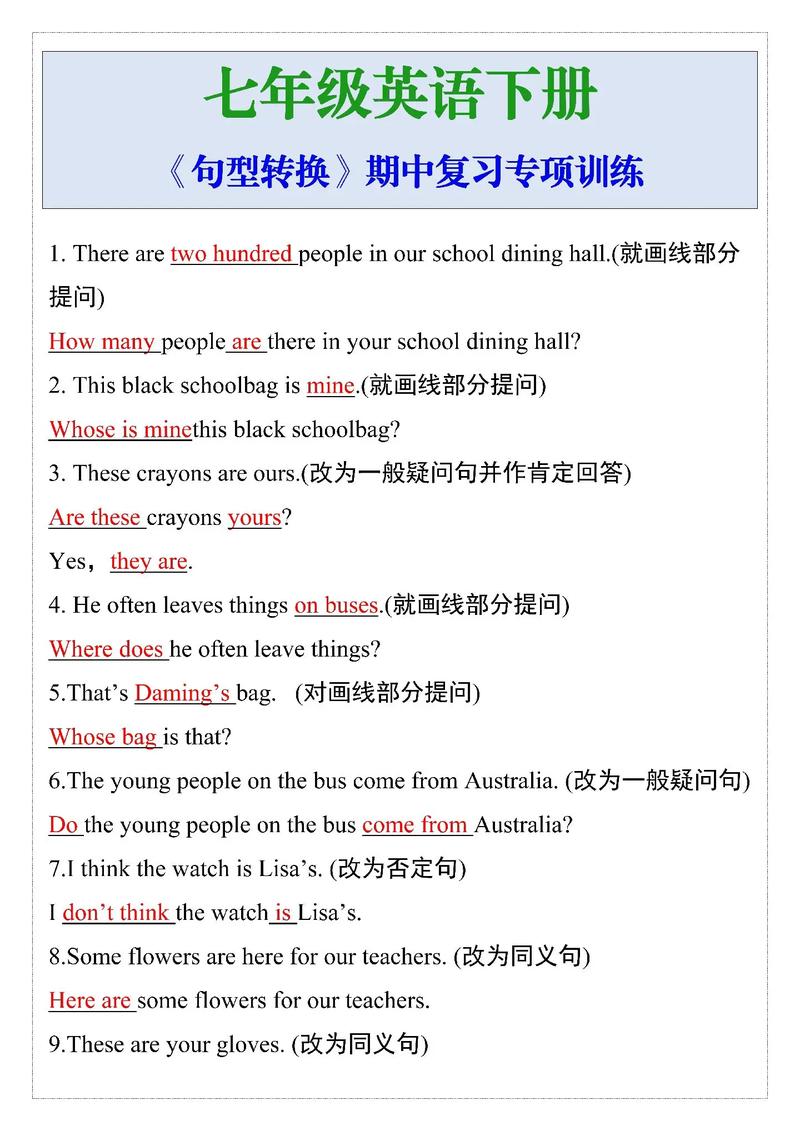
(图片来源网络,侵删)
规则与步骤
核心公式:Be动词/情态动词/助动词 + not + 主语 + ...?
- be 动词:
Be动词 + not + 主语...?- 例:It is a nice day. → Isn't it a nice day?
- 情态动词:
情态动词 + not + 主语...?- 例:You can help me. → Can't you help me?
- 实义动词:
Do/Does + not + 主语 + 动词原形...?- 例:He knows the answer. → Doesn't he know the answer?
同义句转换
这种题型更灵活,考察词汇和句式的综合运用能力。
常见转换方法
-
用
too或also改写- I like apples. Lily likes apples, too.
- Lily also likes apples.
-
用
both...and...改写- Lucy and Lily are both students. (Both Lucy and Lily are students.)
-
用
either...or...改写- You can go there by bus or by bike.
- You can go there either by bus or by bike.
-
用
neither...nor...改写- Tom doesn't like apples, and Jerry doesn't like apples, either.
- Neither Tom nor Jerry likes apples. (注意:
neither...nor...连接两个主语时,动词与离它最近的主语保持一致。)
-
用
There be句型改写- A cat is under the table.
- There is a cat under the table.
-
用
let's改写建议- Why don't we go to the movies?
- Let's go to the movies.
-
用
spend / take / cost / pay改写花费句型- I spent 20 yuan on this book.
- This book cost me 20 yuan.
- It took me 20 yuan to buy this book.
- I paid 20 yuan for this book.
实战演练:综合练习
请将下列句子按要求进行转换。
肯定句 → 否定句
- 例:They are playing soccer. → They aren't playing soccer.
- 练习:He can swim very well. → He can't swim very well.
- 练习:She does her homework every evening. → She doesn't do her homework every evening.
陈述句 → 一般疑问句
- 例:The library is near the post office. → Is the library near the post office?
- 练习:They want to join the music club. → Do they want to join the music club?
- 练习:Tom's father goes to work by car. → Does Tom's father go to work by car?
陈述句 → 特殊疑问句
- 例:She gets up at 6:30. → What time does she get up?
- 练习:My favorite subject is P.E. → What is your favorite subject?
- 练习:They are talking about the movie. → What are they talking about?
- 练习:There is a little milk in the glass. → How much milk is there in the glass?
肯定句 → 否定疑问句
- 例:You need some help. → Don't you need some help?
- 练习:It's a good idea. → Isn't it a good idea?
同义句转换
- 例:Lucy likes dancing, and Lily likes dancing, too. → Both Lucy and Lily like dancing.
- 练习:He doesn't like math, and he doesn't like English, either. → Neither math nor English does he like. (或:He likes neither math nor English.)
- 练习:Why don't we have a picnic this weekend? → Let's have a picnic this weekend.
总结与建议
- 熟记规则:把上面的规则和步骤记牢,特别是实义动词的否定和疑问句,是易错点。
- 多做练习:找一些练习册或试卷上的句型转换题,反复练习,形成条件反射。
- 检查细节:做完后一定要检查!特别是动词的形式、
some/any的使用、标点符号(问句用 )等。 - 理解语境:同义句转换不仅要语法正确,还要符合英语的表达习惯。
希望这份详细的总结能对你有所帮助!祝你学习进步,英语考试取得好成绩!加油!